


Performance or humanity: why choose?
with Anne Chabert and Anick Ritchie
In this recent webinar, our Head of Partnerships, Gregory Pepper, brought together Anne Chabert, organisational transformation consultant at idehō, and Anick Ritchie, General Manager of PCN Physiothérapie, around a tension that many leaders know well:
Do you have to choose between a human culture and operational performance?
Anne Chabert has spent more than ten years guiding organisations toward alternative management. Anick Ritchie leads PCN Physiothérapie, a network of fifteen clinics in Quebec, which she is steering toward a more collective model where leadership is shared and people's wellbeing comes first. Together, they spent nearly a year transforming how PCN is organised. Their conclusion is clear: the real question is not whether to choose between the two, but how to structure the organisation so that performance and humanity reinforce each other.
A collaborative culture that had reached its limits
PCN didn't start from scratch. As early as 2017, the desire to share power and work more as a team was already there. The pandemic accelerated that shift: to get through the crisis, teams mobilised and pooled their talents. PCN came out of it as a deeply organic organisation, where initiative, distributed leadership, and collective intelligence had real space.
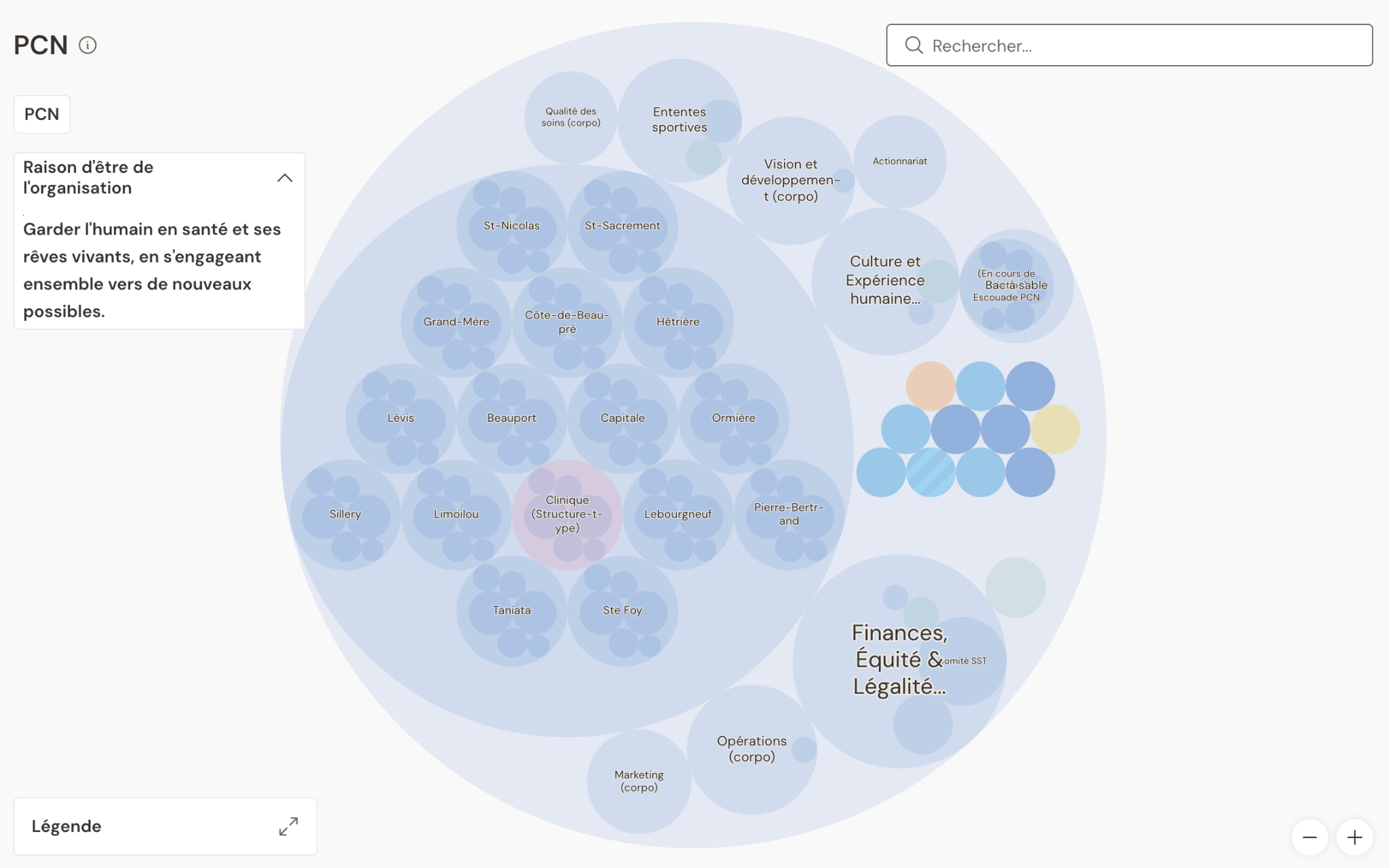
Several practices were already in place: decision-making by consent, circles, the unbundling of the manager role, a culture guide bringing together the organisation's ways of working.
But toward the end of 2024, a realisation set in. The culture was there, the autonomy was there, and yet something was missing.
"We were missing structure. We needed a management system that brought more clarity on who does what, and who to turn to when a decision needed to be made."
With a network of fifteen clinics and a head office supporting them, PCN was struggling to operate smoothly. The arrival of a new HR Director and her organisational diagnosis confirmed the need. After meeting several firms, often very process-engineering focused, PCN found a rare fit at idehō: the human and collaborative side, without giving up on results or performance.
First foundation: individual responsibility, carried by roles
The work with idehō was built in large blocks. The first: making each person's responsibility visible and explicit.
The starting idea is simple. Rather than distributing the work by job titles or positions, you identify all the roles the organisation needs to function. For each role, you define three things:
- A purpose, which states why this role exists and why it matters to the organisation.
- Accountabilities, that is, the minimum expectations of this role, which create clear accountability.
- Competencies, the skills and qualities needed for the right person to play the right role.
Anne illustrates with a concrete example: the spokesperson role at PCN, whose purpose is to be the voice that amplifies the organisation. The same role can be assigned to one person or to several, and when it is shared, each person's scope is specified: one spokesperson for radio, another for a specific event. A role may take up only a small percentage of someone's time, while they energise other roles elsewhere in the organisation.
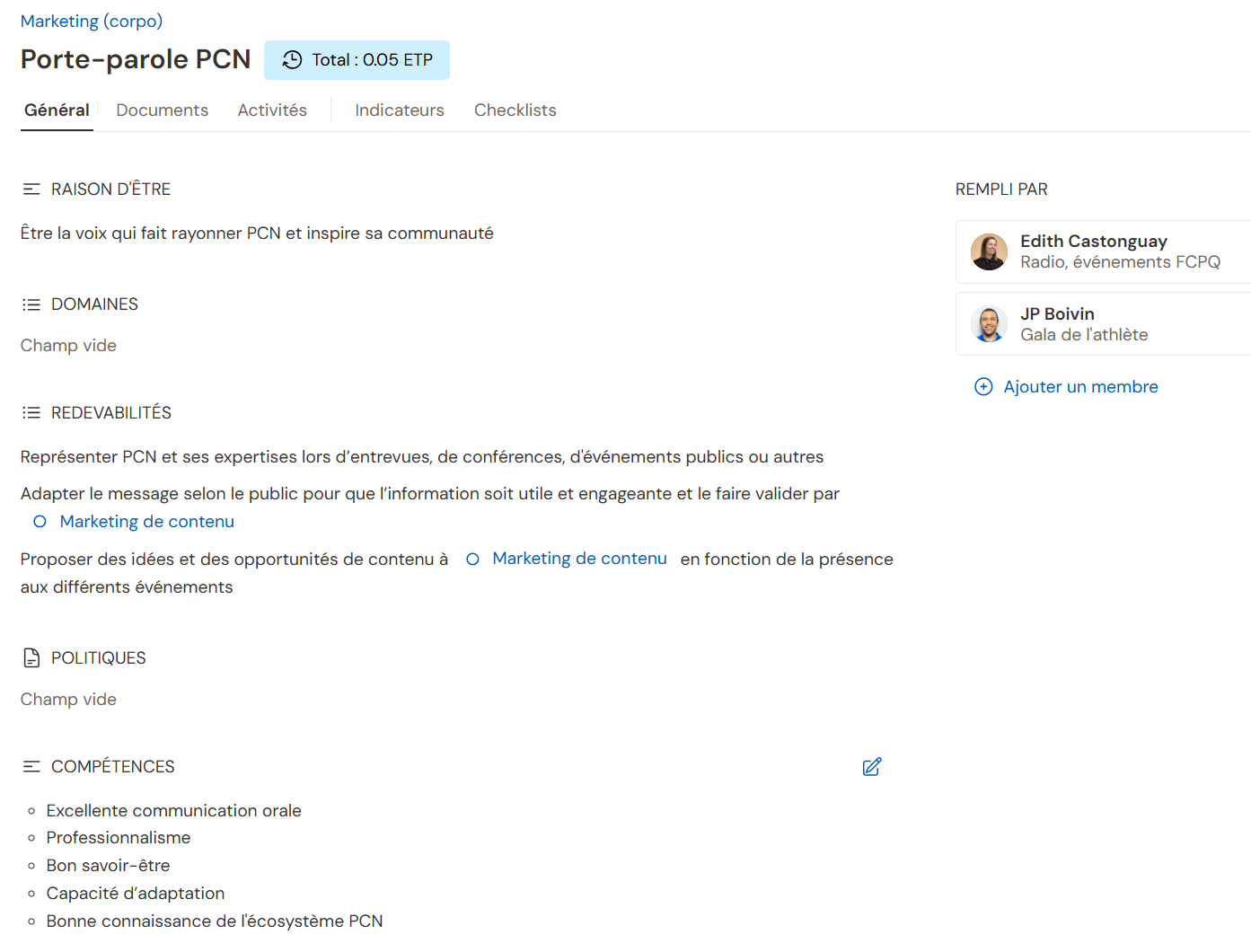
This work brings out a multitude of small, clear pockets of responsibility. Each person gains in legitimacy and autonomy to fully play their roles, because expectations, in both directions, are finally explicit.
Second foundation: collective responsibility, carried by circles
Once individual responsibility is in place, another question arises: how do you create collective responsibility and alignment around these roles?
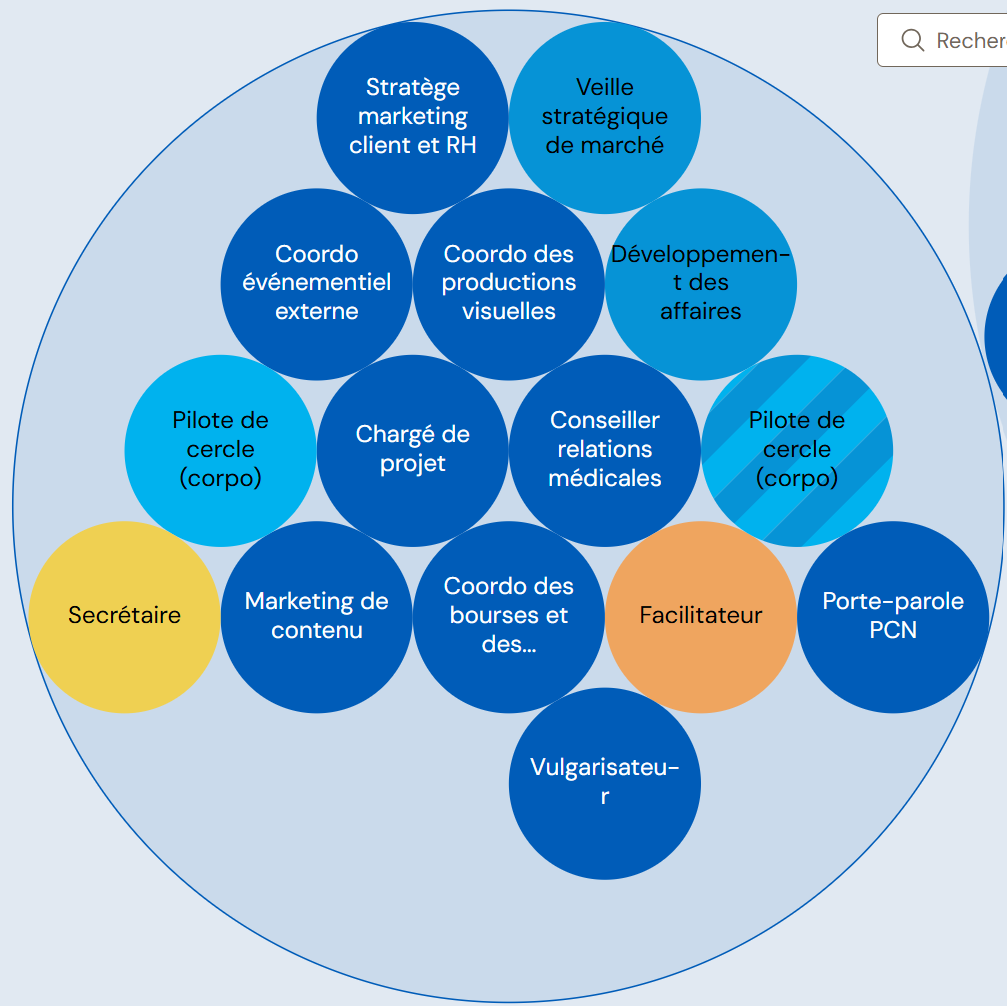
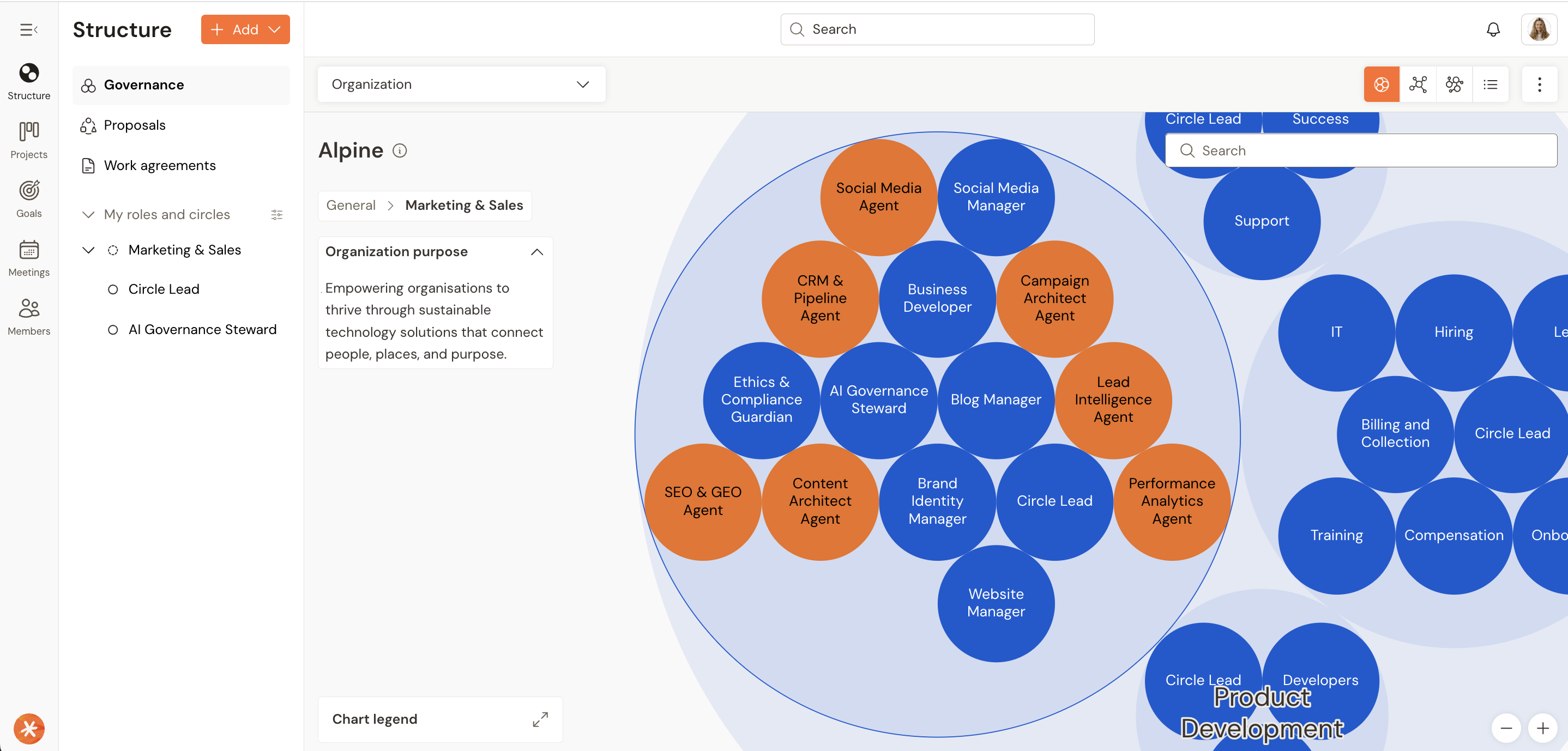
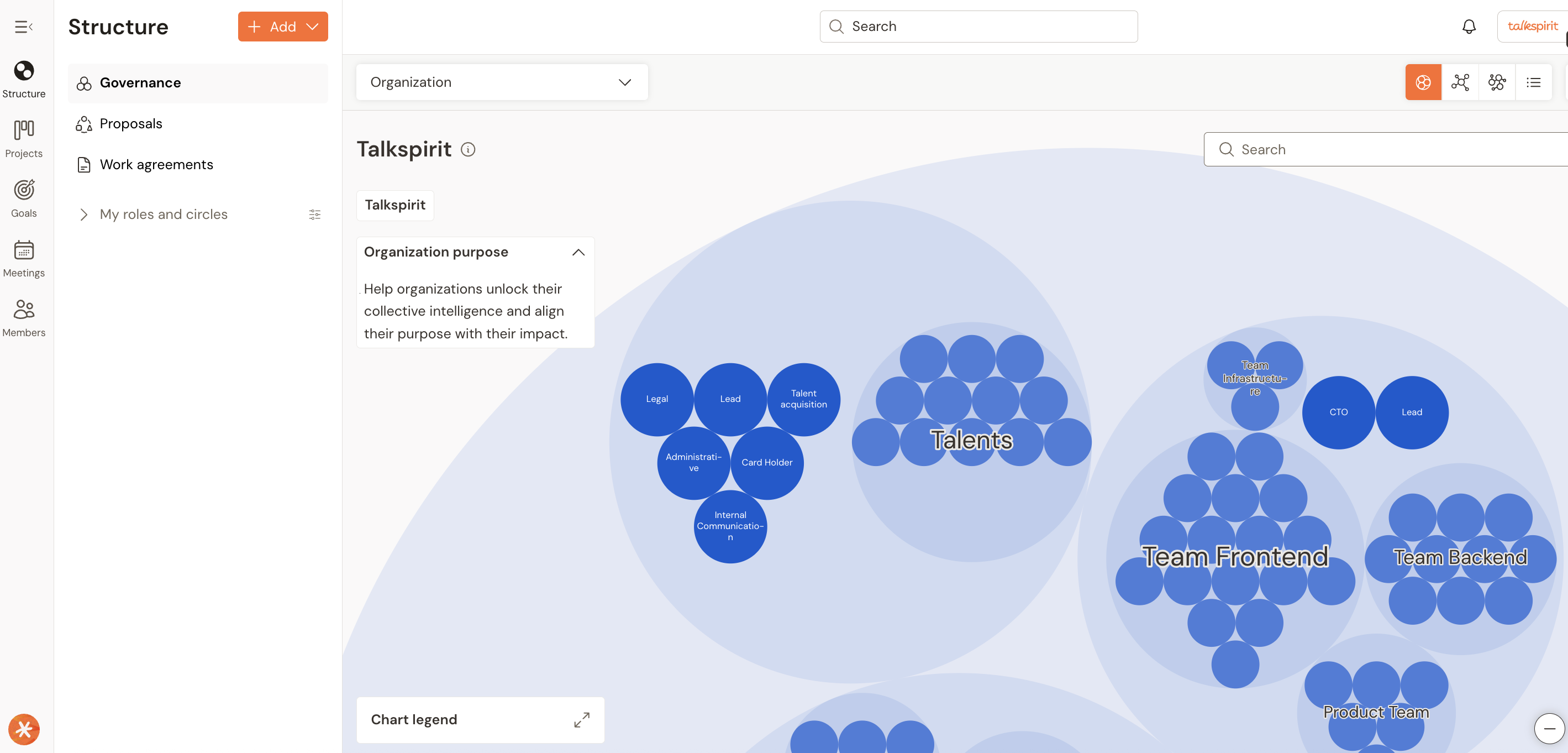
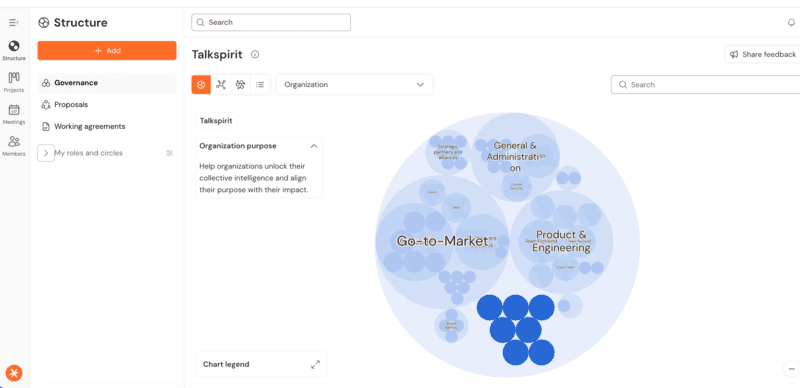
That's where the circle comes in. A circle answers a simple question: which roles need to work closely together to create value? Like roles, each circle has its own purpose and its own accountabilities, which allows for a clear distinction between what belongs to each collaborative space.
But a circle doesn't just group roles together. To set a shared direction, the team defines circle strategies together: based on the organisation's high-level objectives, the circle articulates the goals it has a role to play in. At PCN, these goals aren't framed in SMART format, but as broad orientations that guide the team. To these orientations, prioritised initiatives are added for the year, reviewed each quarter. Nothing is set in stone: the circle meets to validate that the direction is still the right one.
Anick highlights what, for her, changes everything in this construction: at every level, everything starts from meaning.
"Today, we say we need to create meaning. The starting point, in every role and every circle, comes precisely from meaning: why we are together, and why each morning I do this work."
This, Anne notes, is a deep difference from a more traditional organisation, where you mostly come in to do a job for your supervisor. When work is organised around purposes, people contribute to a goal that goes beyond them, and that also resonates at a more personal level.
Third foundation: rhythm and rituals
A clear structure isn't enough. For it to truly produce performance, you still have to bring it to life. PCN therefore worked on its organisational rhythm.
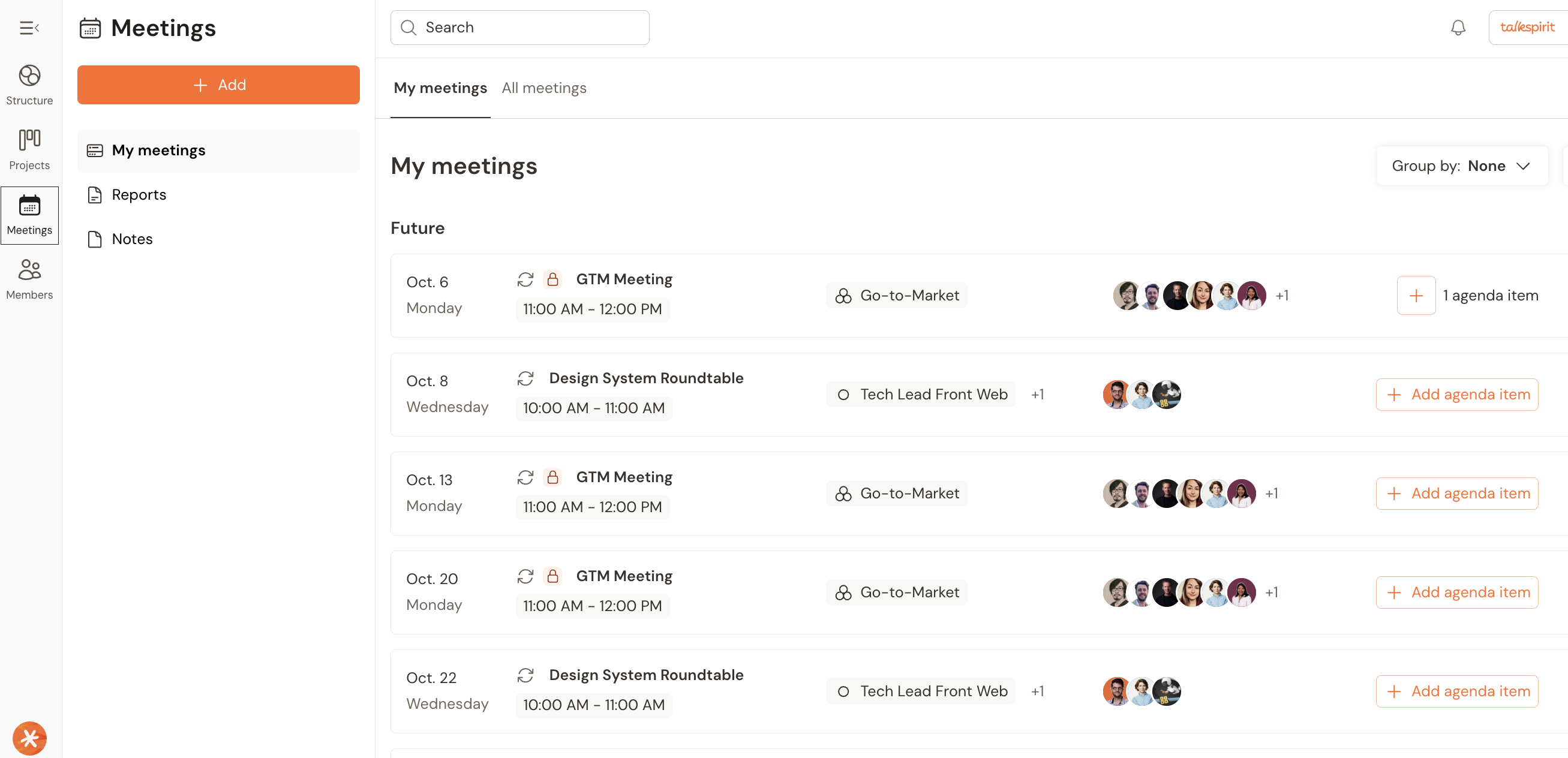
Each circle now distinguishes between two types of meetings: tactical meetings, dedicated to operational follow-up, and strategic meetings, generally quarterly, where the circle's strategies are revisited. Clearly separating these two spaces has made things more effective on both the operational and the strategic side.
Each circle also sets its own cadence and the list of roles needed around the table, sometimes inviting roles from other circles. This is one of the most interesting contributions of this structure: it makes visible, and therefore manageable, the collaboration links between teams that exist in most organisations but usually remain invisible.
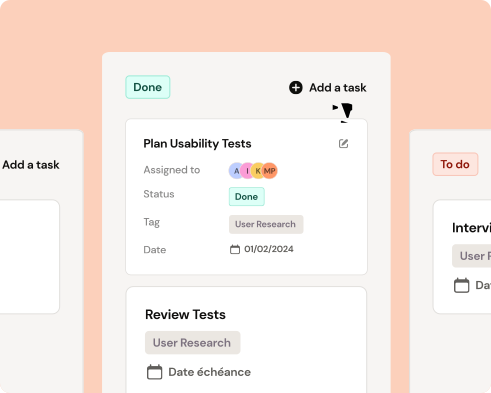
To anchor all of this, tactical meetings rely on collectively defined indicators and checklists: each role knows what information to share, and how often, for the circle to move forward. Some indicators are quantitative, such as a conversion rate; others are more qualitative, such as a quarterly round-table on rewarding moments, failures, and learnings, which gives a valuable read on the circle's health.
The result can be measured in the meetings themselves. Anick is clear on the gain.
"The meeting no longer depends on the manager or the leader. It's a responsibility shared between the roles of the circle."
Six months after adopting this format, PCN handles sometimes complex topics in five to ten minutes, and leaves each meeting with a clear deliverable, owned by an identified role. For Anne, this is where the full strength of the structure plays out: stopping at the roles without going on to the collaboration dynamics would be missing the essential.
What the structure reveals: leadership, not seniority
The benefit most often cited by Anick comes down to one word: clarity.
"The biggest change is clarity. It's now easy to know who plays which role."
With this clarity, behaviours change. Far fewer things "fall through the cracks": each person positions themselves in relation to their role and their accountabilities, and takes ownership of what belongs to them. Engagement, already strong at PCN, is better served by a readable framework.
The structure also reveals something else. In the clinics, the notion of a manager gives way to a circle lead role. People at the start of their careers can contribute to a mandate, energise a leadership role, without waiting for seniority or a title. Anne sums up this shift:
This kind of structure reveals people's natural leadership, where traditional organisations rely on leadership through seniority or title.
This transition is anything but automatic. It calls for a lot of humility, particularly from people who held a directive role for years and who now have to trust rather than control. Anick acknowledges this for herself: she had to accept letting go of roles she was attached to, sometimes to let someone better placed play them. The role of head office, she says, is not to force the pace.
"You don't pull on a flower to make it grow faster. Our role is to water it and give it the most favourable environment."
A change managed clinic by clinic
PCN doesn't hide that the transition required time and energy. It took six or seven meetings for teams to feel comfortable with the format. At head office, since the structure had been co-built with colleagues, buy-in was simpler. In the clinics, the rollout required real change management.
Anick and a colleague physiotherapist from the field, credible with the teams, toured all fifteen clinics to make sure everyone understood their ecosystem properly. Each clinic now has a "guardian of collaborative practices", a touchpoint for evolutions and communication. Listening played a central role: feedback from the field led to adjustments, and even to the evolution of certain roles.
Because roles are not set in stone. Ten months after adopting the structure, PCN has already modified them to better reflect its reality. A departure, a return from leave, a new context: the structure moves with the organisation, and that is precisely what makes it alive.
The role of technology: a brain connected to a heart
Before idehō, PCN was trying to hold all of this together in files that people had to search for, send to fifteen clinics, and that were never quite up to date. Technology changed the game.
"Talkspirit really represents the brain of our company. All of our knowledge is there. And I find that it also touches the heart, because our purposes are there."
With Talkspirit, PCN's business intelligence — who does what, what the goals are, where each circle is going — is accessible to the whole organisation and continuously updated. A person in a clinic can read the latest report from a circle simply because the topic interests them. The role-based structure becomes the reference point that all the other tools hook into: processes, document management, access. Everything connects to the same language.
The importance of language: from management to support
One detail reveals the spirit of the whole approach. PCN renamed its "corpo" team: from management team to support team. The shift isn't cosmetic. It says that head office's purpose is to support the clinics that see patients, not to manage them. PCN's purpose, Anick reminds us, is not to deliver excellent management — it's to enable the clinics to care for their patients.
Where to begin
Anne's closing message comes down to an image. The role-based structure is the small bubbles you define one by one, and it is above all a foundation.
"The role-based structure is like the foundation. And on this foundation, lots of other things then come and graft on."
That is where you have to start: make responsibility visible, role by role, then build collaboration and rhythm on top. The rest — processes, tools, all the way to compensation — connects to that initial clarity.
Conclusion: you don't choose, you structure
The webinar's theme framed performance and humanity as an either/or. PCN's experience suggests the opposite.
When each role starts from a purpose, when circles set a shared direction, and when rituals bring collaboration to life, the organisation gains in effectiveness while giving more meaning to work. The result never arrives on its own: it is carried by something that is meaningful to people.
This is probably the most useful lesson of this conversation. Performance and humanity do not oppose each other. They hold together, on condition of giving them a clear structure to lean on.
PCN regularly opens its meetings to outside observers. If you'd be interested in seeing an organisation like this work in real conditions, let us know.


Révélez le potentiel de votre organisation.
Nous sommes là pour répondre à toutes vos questions et vous accompagner dans vos projets.








.jpg)












.jpg)



.jpg)
.jpg)




.jpg)
.jpg)


.jpg)

.jpg)

.jpg)


.jpg)


.jpg)


.jpg)
