
How Role Clarity Drives 30% Higher Organisational Performance — and How Talkspirit Makes It Possible


Ask any team member in an evolving organisation what slows them down, and you’ll likely hear the same answers: unclear responsibilities, duplicated efforts, and decisions that stall because nobody knows who should make them. These aren’t just frustrations, they’re measurable drags on organisational performance.
A growing body of research now puts hard numbers behind what many leaders sense intuitively: when roles are clearly defined, organisations perform significantly better. According to a 2024 meta-analysis, organisations that adopt role-based governance structures see performance improvements of up to 30%. Meanwhile, HR analytics show that employees with high role clarity are 53% more efficient and 27% more effective than those working in ambiguity.
So how do you move from fuzzy job descriptions to a living, breathing system of clear roles and accountabilities? That’s exactly what Talkspirit is designed to do.
What the Research Says
Role-based organisations outperform traditional structures
The concept of a role-based organisation isn’t new. Frameworks like holacracy and sociocracy have been refining it for over a decade. But until recently, hard evidence was scarce. That’s changing.
The 2024 meta-analysis examined 15 companies that adopted role-based governance and found that 70% of them showed measurable performance improvements, with gains averaging 30%. The improvements were driven by faster decision-making, reduced duplication of work, and greater employee engagement.
A separate study found that employees in role-based organisations report significantly fewer “illegitimate tasks”, that is, work they perceive as outside their actual responsibilities, and significantly higher feelings of appreciation compared to employees in traditional work settings.
Role clarity is a direct lever for efficiency
Research published in 2025 confirmed that role clarity, combined with resource availability and intrinsic motivation, is a significant predictor of organisational effectiveness. When people know exactly what they’re accountable for, they spend less time navigating politics and more time creating value.
Further research demonstrated that role clarity moderates the relationship between role efficacy and actual performance. People with clearer roles also develop stronger confidence in their ability to perform them.
Deloitte’s case for skills-based organisations
Deloitte’s extensive research on Skills-Based Organisations (SBOs) brings a complementary perspective. Where role-based governance defines who is accountable for what, a skills-based approach ensures that the right people fill those roles based on capabilities, not just job titles. The two approaches are natural complements, and the data backs this up.
According to Deloitte’s research, organisations that adopt a skills-based approach are 107% more likely to place talent effectively and 98% more likely to retain high performers. They are also 57% more likely to be agile, 52% more likely to be innovative, and 79% more likely to deliver a positive workforce experience. Perhaps most tellingly, they are 63% more likely to achieve results compared to organisations that stick to traditional job-based models.
Despite these compelling numbers, Deloitte found that fewer than one in five organisations have adopted a skills-based approach extensively across the entire company in a clear and reproducible manner. The opportunity gap is enormous. As nearly nine in ten executives now say that skills are becoming more important for defining work, deploying talent, and managing careers, the question is no longer whether to move towards role and skills clarity, but how fast.
Deloitte’s framework centres on deconstructing jobs into tasks, then reconstructing work based on skills and abilities, enabling greater agility and autonomy for both workers and organisations. This aligns perfectly with the role-based approach: when you define roles by purpose and accountabilities (rather than static job descriptions), you create the structure within which skills can be flexibly deployed to the work that matters most.
Key Research Findings at a Glance
Role-Based Governance
+30% average performance improvement (meta-analysis, 2024)
53% more efficient — employees with clear roles vs. ambiguous ones
70% of companies adopting role-based models saw measurable gains
Skills-Based Organisations (Deloitte)
107% more likely to place talent effectively
98% more likely to retain high performers
63% more likely to achieve results
57% more likely to be agile
Why Traditional Org Charts Fall Short
Most organisations still rely on static org charts, a PDF or image that maps reporting lines but tells you almost nothing about who actually does what. These charts become outdated the moment they’re published, and they fail to capture the cross-functional reality of modern work.
The result is a familiar set of symptoms:
- Overlapping responsibilities that create turf wars or, worse, gaps where nobody feels accountable.
- Decision bottlenecks because it’s unclear who has the authority to act on what.
- Onboarding confusion for new hires who can’t find a reliable source of truth about who owns which topics.
- Invisible workloads where some team members carry far more roles than others, with no visibility into the imbalance.
A 2025 study found that even in flat, team-based structures, only 30% of respondents confirmed role clarity, despite 70% reporting high task flexibility. Flexibility without structure doesn’t produce clarity; it produces chaos.
Deloitte’s research reinforces this point from a different angle: 63% of business executives report that workers are already focused on team and project work that falls outside their current job descriptions. The gap between what the org chart says and what people actually do is widening, and traditional tools can’t keep up. Moving to a role- and skills-based model isn’t a nice-to-have; it’s becoming an imperative to make the real organisation visible.
From Theory to Practice: How Talkspirit’s Structure Module Makes Roles Explicit
Talkspirit is built to close the gap between how organisations want to work and how they actually operate. Rather than imposing a single governance model, it gives you a flexible toolkit to map your organisation’s real structure, whether you follow holacracy, sociocracy, a traditional hierarchy, or a hybrid approach.
Here’s how each feature directly addresses the role-clarity challenge that research links to performance gains.
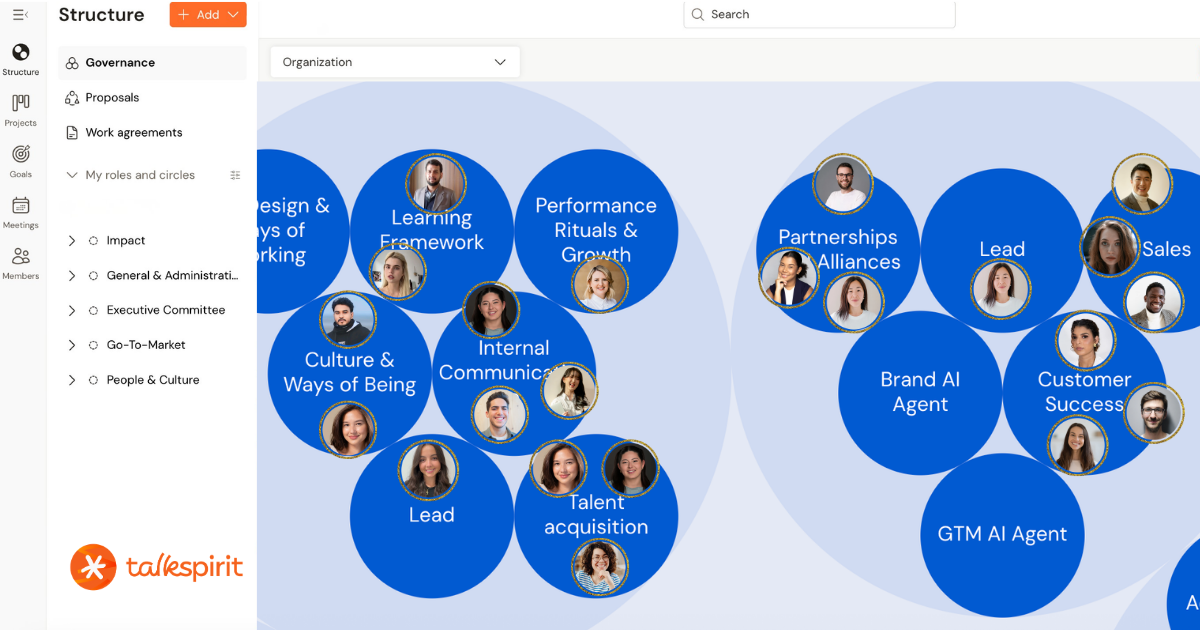
1. Dynamic organisational chart
The problem it solves: Static org charts are outdated by the time they’re shared.
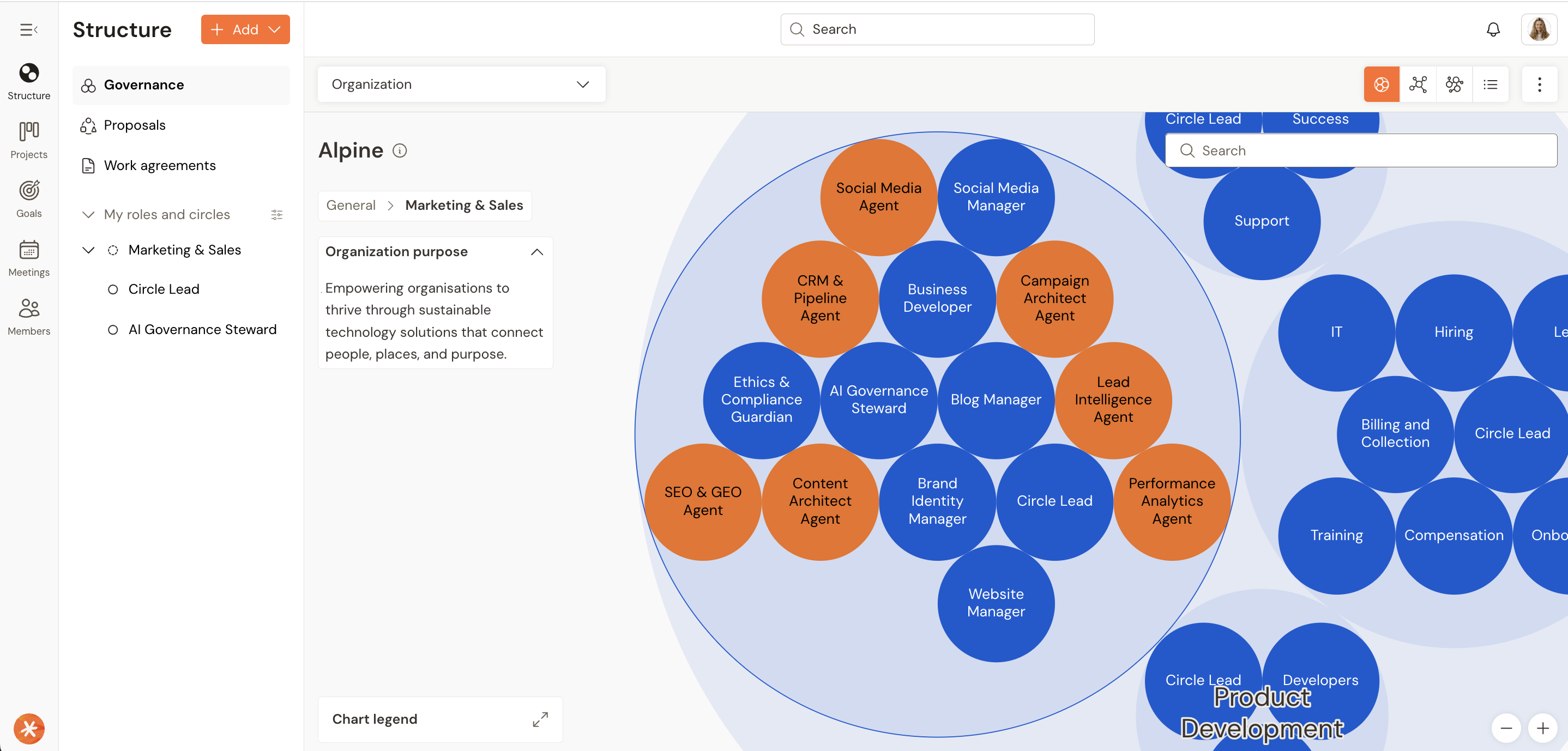
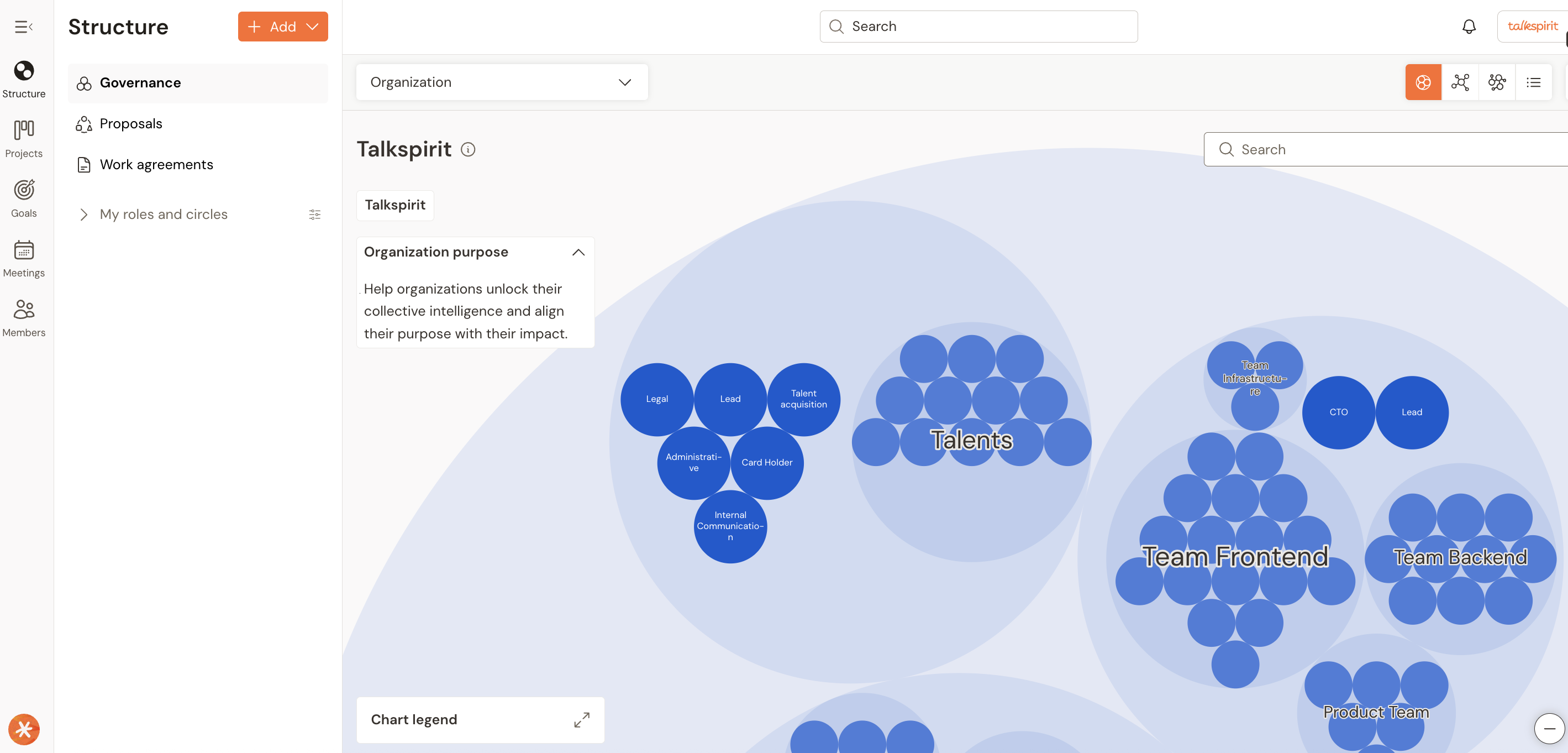
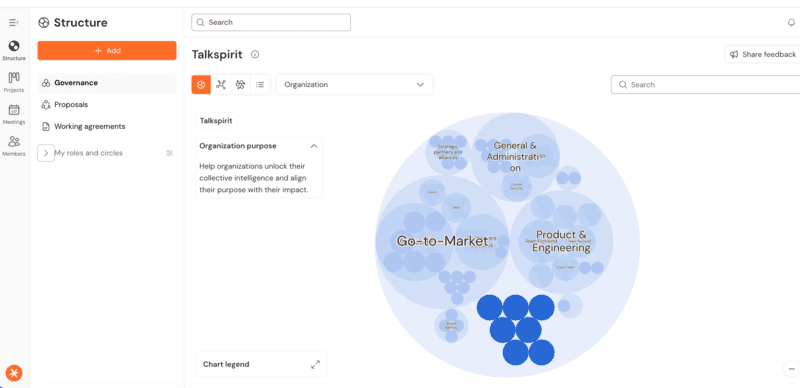
Talkspirit’s dynamic org chart updates in real time. Every role, team, and reporting line reflects the current state of the organisation, not a snapshot from six months ago. From any employee’s profile panel, you can see their position, their team, and the hierarchical links connecting them to the broader structure.
How to use it: In the Structure module in Talkspirit, set up roles, teams, projects (circles) and links between them. As people move, join, or take on new responsibilities, the organisational structure is instantly updated.
2. Roles with purpose, domains, and accountabilities
The problem it solves: Job titles don’t tell you what someone actually does or decides.
A “Brand Manager” could mean entirely different things in two organisations, or even in two teams within the same company.
In Talkspirit, each role follows a structured format built on three pillars: a clear purpose (why the role exists), defined domains (what it controls and has authority over), and explicit accountabilities (what it’s expected to deliver on an ongoing basis). One person can hold multiple roles, and each role is distinct from the person filling it, so when someone new joins, the role and its institutional knowledge persist.
How to structure a role, in a concrete example: Let’s say you need to define a “Brand Identity Development” role. In the Structure module, you would fill it in as follows.
Purpose: Define one sentence that captures why this role exists. For example: “Develop and safeguard a distinctive and engaging brand identity that reinforces our core essence and resonates with our audiences.” This is your north star, everything the role does should serve this purpose.
Domains: List the areas this role has authority over, the things no other role should touch without consulting this one. For Brand Identity Development, these might include: brand assets and guidelines management, brand strategy and positioning, brand messaging and voice, brand visual and design consistency, brand partnerships and collaborations, and brand experience and engagement. Domains are critical because they answer the question “who decides?” before a conflict arises.
Accountabilities: Describe the ongoing activities the role is expected to perform. These are not one-off tasks but recurring responsibilities. For our example: cultivating relationships with key stakeholders to ensure alignment and support for brand initiatives; developing and implementing brand training programmes for internal teams to ensure consistent application of brand identity across all touchpoints; and monitoring brand performance metrics to assess the effectiveness of brand initiatives. Well-written accountabilities start with a verb and describe a continuous obligation.
.png)
Tips for Writing Effective Roles
- Keep the purpose to one sentence. If you need two sentences, you probably have two roles.
- Domains answer “who decides?” not “who does the work?” A domain gives exclusive authority over a topic.
- Start every accountability with a verb. Cultivating, developing, monitoring, reporting, these signal ongoing work, not a one-time project.
- Separate the role from the person. Talkspirit tracks who fills a role and their FTE allocation (e.g. 0.10 FTE), making workload distribution visible across the organisation.
- Use Role Templates to get started fast. Talkspirit’s AI provides predefined blueprints with best-practice purposes and accountabilities, ideal for scaling new teams or circles.
3. Circles for self-organising teams
The problem it solves: Departments are rigid. Cross-functional work doesn’t fit neatly into boxes.
Circles in Talkspirit are groups of roles working towards the same purpose. They function as semi-autonomous teams: each circle has its own purpose and accountabilities, and can self-organise internally while remaining connected to the broader structure. Circles can even nest inside other circles, mirroring how real work happens at different scales.
How to use it: Create circles (by team or project) in the Structure module and assign roles to them. Define each circle’s purpose clearly. This is the anchor that keeps the team aligned even as roles within it evolve. Use the colour-coding feature to make navigating your structure intuitive at a glance.
4. Governance meetings and tension processing
The problem it solves: Roles drift over time. What was clear at launch becomes fuzzy within months.
Talkspirit supports structured tactical and governance meetings where team members can raise tensions (gaps between how things are and how they could be) and propose changes to roles, accountabilities, or circle structures. This creates a continuous feedback loop that keeps the organisation’s structure aligned with its actual needs, not a theoretical model.
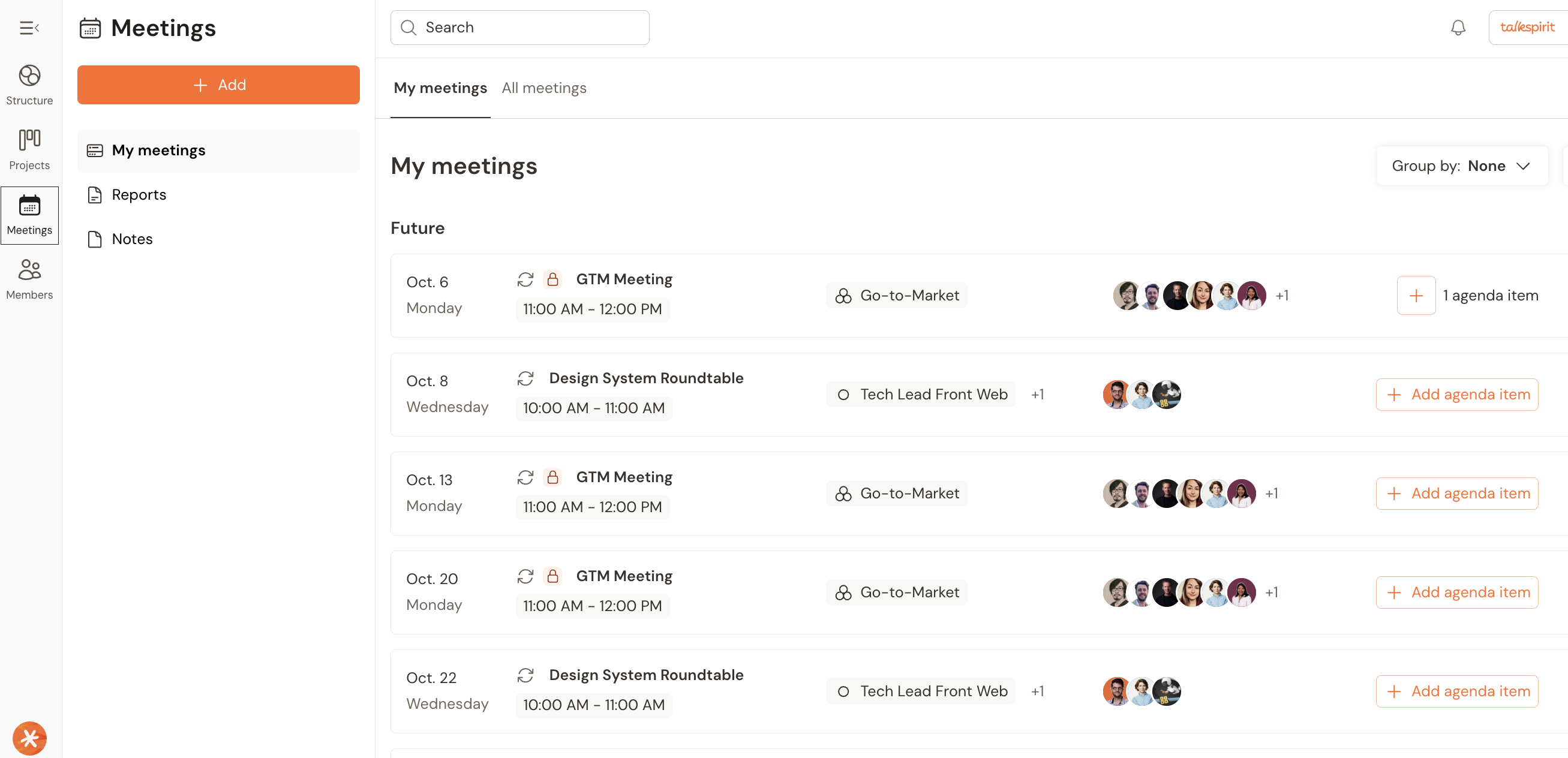
How to use it: Schedule regular tactical and governance meetings within your circles. Encourage team members to log tensions as they encounter them in their daily work. During governance sessions, process tensions one by one to update roles, add accountabilities, or restructure circles. Talkspirit’s built-in meeting facilitation tools guide you through the process.
5. Goals, projects, and metrics linked to roles
The problem it solves: Roles exist in a vacuum if they’re not connected to measurable outcomes.
People know their accountabilities on paper, but they can’t see how their work moves the needle, and leaders can’t track progress without chasing individuals for updates.
Talkspirit bridges this gap by letting you attach goals, projects, and metrics directly to each role or circle. This is where role clarity transforms from an organisational design exercise into a live performance system.
How to link roles to goals: In Talkspirit, every role page features dedicated tabs for Goals and Projects (alongside Overview, Documents, Activities, Metrics, and Checklists). From the Goals tab, you can attach strategic objectives directly to the role and define key results with measurable targets. This creates a visible thread from the organisation’s top-level goals down to the individual role accountable for delivering them.

For example, the Brand Identity Development role might carry an objective like “Strengthen brand recognition across European markets” with key results such as “Increase aided brand awareness from 35% to 50%” or “Launch updated brand guidelines across 100% of internal teams by Q3.” Each key result has a progress indicator, so anyone in the organisation can see at a glance how the role is tracking against its goals.
How to link roles to projects: From the Projects tab, you can connect active projects to the role. This answers a question that traditional org charts never could: not just “what is this role responsible for?” but “what is this role working on right now?” Projects linked to a role show their current status, deadlines, and progress, giving leaders and collaborators real-time visibility without requiring status meetings.

How to track metrics: The Metrics tab allows each role to define and monitor key performance indicators tied to its accountabilities. These can be quantitative (NPS scores, conversion rates, brand mentions) or qualitative checklists. Metrics attached to roles ensure that progress is measured at the point of accountability, not aggregated into a dashboard that obscures who is actually driving results.
The combined effect is powerful: purpose tells people why their role exists and matters, domains and accountabilities tell them what they said they will do in a role, and linked goals, projects, and metrics show them how well they’re doing it, all in one place, updated in real time. This is the difference between an organisation that describes its structure and one that operates through it.
Getting Started: A Practical Roadmap
You don’t need to overhaul your entire organisation overnight. Research consistently shows that the organisations that succeed with role-based models are those that prepare thoughtfully and roll out incrementally.
Here’s a step-by-step approach:
Step 1: Start with one or two teams or projects (circles). Choose a team that’s experiencing the symptoms of role ambiguity, such as duplicated work, slow decisions, or unclear ownership. Map their current responsibilities using Talkspirit’s role format (purpose, domains, accountabilities).
Step 2: Make it visible. Publish the circle and its roles in Talkspirit’s Structure view. The act of making roles visible and searchable by the entire organisation is itself a powerful driver of clarity.
Step 3: Run your first governance meeting. Gather the team. Walk through each person’s roles. Invite tensions. Make adjustments. This single meeting often surfaces misalignments that have persisted for months.
Step 4: Connect roles to goals. Attach measurable objectives to each role or circle. This transforms role clarity from an HR exercise into a performance lever.
Step 5: Scale progressively. Once the first circle is running smoothly, expand to adjacent teams. Use role templates to accelerate setup and maintain consistency.
The Flexibility–Clarity Balance
One concern leaders often raise: “Won’t too much structure stifle agility?” The research suggests the opposite. A systematic review found that brief role-clarification interventions in healthcare teams improved team functioning without reducing adaptability. The key insight is that clarity and flexibility are not opposites. When people know exactly what they own, they can flex more confidently into new challenges because they know what’s covered and what isn’t.
Deloitte’s skills-based organisation framework points in the same direction. Their research advocates for deconstructing rigid jobs into tasks and skills, then reconstructing work around capabilities. Organisations that do this successfully are 57% more likely to be agile and 52% more likely to innovate, precisely because clarity about what needs to be done (roles) and who is best placed to do it (skills) creates a foundation for flexible, responsive teams.
Talkspirit is built around this principle. Its Structure module doesn’t lock you into one organisational model. You can run holacracy in one department, a traditional hierarchy in another, and a hybrid in a third. The platform supports dynamic governance, a system of roles, circles, and authorities that is continuously updated as your organisation evolves, rather than fixed in a chart that gathers dust. By making roles, accountabilities, and decision-making rules explicit and searchable, Talkspirit gives organisations the structural foundation that Deloitte identifies as essential to becoming truly skills-based.
The Bottom Line
The evidence is clear: organisations that invest in explicit role definition see measurable gains in efficiency, alignment, and employee satisfaction. The challenge has always been making role clarity operational, not a one-off exercise, but a living system that evolves with the organisation.
That’s what Talkspirit as an Organisational Clarity Platform delivers. By combining a dynamic org chart, structured roles with purpose and accountabilities, self-organising circles, governance meetings, and integrated goals, it gives leaders and teams the tools to turn role clarity into a sustained competitive advantage.
Ready to bring clarity to your organisation?
Discover how Talkspirit’s Structure module can help your teams work with more alignment, autonomy, and performance.
Request a clarity diagnostic →

Sources cited in this article:
Role Clarity, Resource Availability and Employee Motivation in Organisational Effectiveness
HR Analytics: Role Clarity Impacts Performance
Role Efficacy, Role Clarity, and Role Performance Effectiveness
Systematic Review of Brief Team Interventions to Clarify Roles in Healthcare Teams
The Skills-Based Organization: A New Operating Model for Work and the Workforce
About Talkspirit — Talkspirit is the European organisational clarity platform. It brings together organisational structure, governance, collaboration, and communication in one place, so every team knows who does what, and how their work connects to the organisation's mission and goals. From dynamic org charts and role-based governance to goals and real-time project tracking, Talkspirit helps organisations move effectively from purpose to measurable impact.


Révélez le potentiel de votre organisation.
Nous sommes là pour répondre à toutes vos questions et vous accompagner dans vos projets.












.jpg)













.jpg)




.jpg)
.jpg)




.jpg)
.jpg)


.jpg)

.jpg)


.jpg)


.jpg)


.jpg)


.jpg)
