
A Guide for Leaders and Executive Committees: How to Gain Performance and Organisational Clarity


How Might Leaders and Executive Committees Support the Organisation Gain in Alignment and Performance?
Organisational clarity refers to an organisation's ability to make its strategic direction, roles, decision-making processes, and workflows visible and understandable. When it is in place, every employee knows where the organisation is headed and what is expected of their role.
What Is Organisational Clarity, and Why Is It Decisive?
Organisational clarity rests on three pillars. The first is clarity of strategic direction: every employee should be able to answer the question "Where are we going, and why?", not by reciting a mission statement, but by understanding how their daily work contributes to the collective trajectory. The second is role clarity: who decides what, who is responsible for what. Role ambiguity is one of the leading causes of friction, duplication, and interpersonal conflict in organisations. The third is workflow clarity: how information flows, how decisions are made, communicated, and followed up on.
When these three dimensions are aligned, the organisation is high-performing. When one of them is missing, it compensates through excessive meetings, over-communication, and bureaucracy.
Clarity as a Measurable Performance Driver
The link between organisational clarity and financial performance is no longer a hypothesis. It is a measured and widely replicated fact established by leading consulting firms and research institutes.
McKinsey — Organisational Health Index
For over fifteen years, McKinsey has measured organisational health through its Organisational Health Index (OHI), a database covering more than 2,600 companies and 8 million employee responses. The finding is unequivocal: organisations in good organisational health outperform their peers by a factor of three in terms of shareholder returns. Among the markers of this health, clarity of strategic direction and role alignment rank at the forefront. Companies that invest in organizational performance show, on average, 30% higher revenue growth and a turnover rate five points lower than their competitors.
Gallup — Q12 Engagement Model
Gallup data confirm this dynamic at the individual level. Clarity of expectations forms the foundation of the Q12 engagement model, and for good reason: employees who benefit from role clarity are 53% more effective and 27% more productive than those operating in ambiguity. Gallup goes further: targeted training on role clarity and communication alone can cut active disengagement within teams by half.
Academic Research
Organisations where employees perceive both a shared sense of purpose and a clear direction show a risk-adjusted stock return that is 7.6% higher over time. Companies that cultivate a shared purpose are 2.4 times more likely to set a clear strategic direction and 4.1 times more likely to be in good overall organisational health.
In summary: investing in organisational clarity is a measurable value-creation driver, validated by robust data in management research.
Simplifying to Navigate Complexity
French companies are going through a period of profound transformation: hybrid work, successive reorganisations, accelerated digitalisation, cost pressures. In the face of this growing complexity, the most common response is to stack: one more tool, one more process, one more meeting.
The result? Organisations suffering from three simultaneous ailments, identified by research on corporate performance. First, siloed tools and fragmented workflows that prevent coordination and alignment. Second, abstract purpose statements that do not translate into operational behaviours. Third, governance models that are neither dynamic nor adaptive.
Without an operating system that connects people, purpose, and collaboration practices, stagnation sets in. Decisions made at the executive committee level take weeks to translate into concrete actions. Managers spend more time searching for the right information than leading their teams. Strategy remains a document consulted once a year.
This is not a skills problem. It is an organisational clarity deficit.
In the Age of AI, Organisational Clarity Becomes the New Productivity
Artificial intelligence amplifies. It amplifies the effectiveness of clear organisations, targeted automation, relevant decision support, significant time savings. And it amplifies the chaos of incoherent organisations.
For leaders, the conclusion is simple: before talking about digital transformation, you must talk about organisational transformation. Before investing in AI, you must invest in building a clear and coherent operating system. An organisation that does not know who does what, and why, will not reap lasting benefits from automation. Conversely, a structured, readable, aligned organisation will make AI a performance multiplier.

Clarifying the Organisational Structure in 90 Days: A Concrete Roadmap for Leaders and Executive Committees
Gaining clarity and organisational performance is a key project that can start producing results in 90 days, provided a structured methodology is followed.
Phase 1 — Map
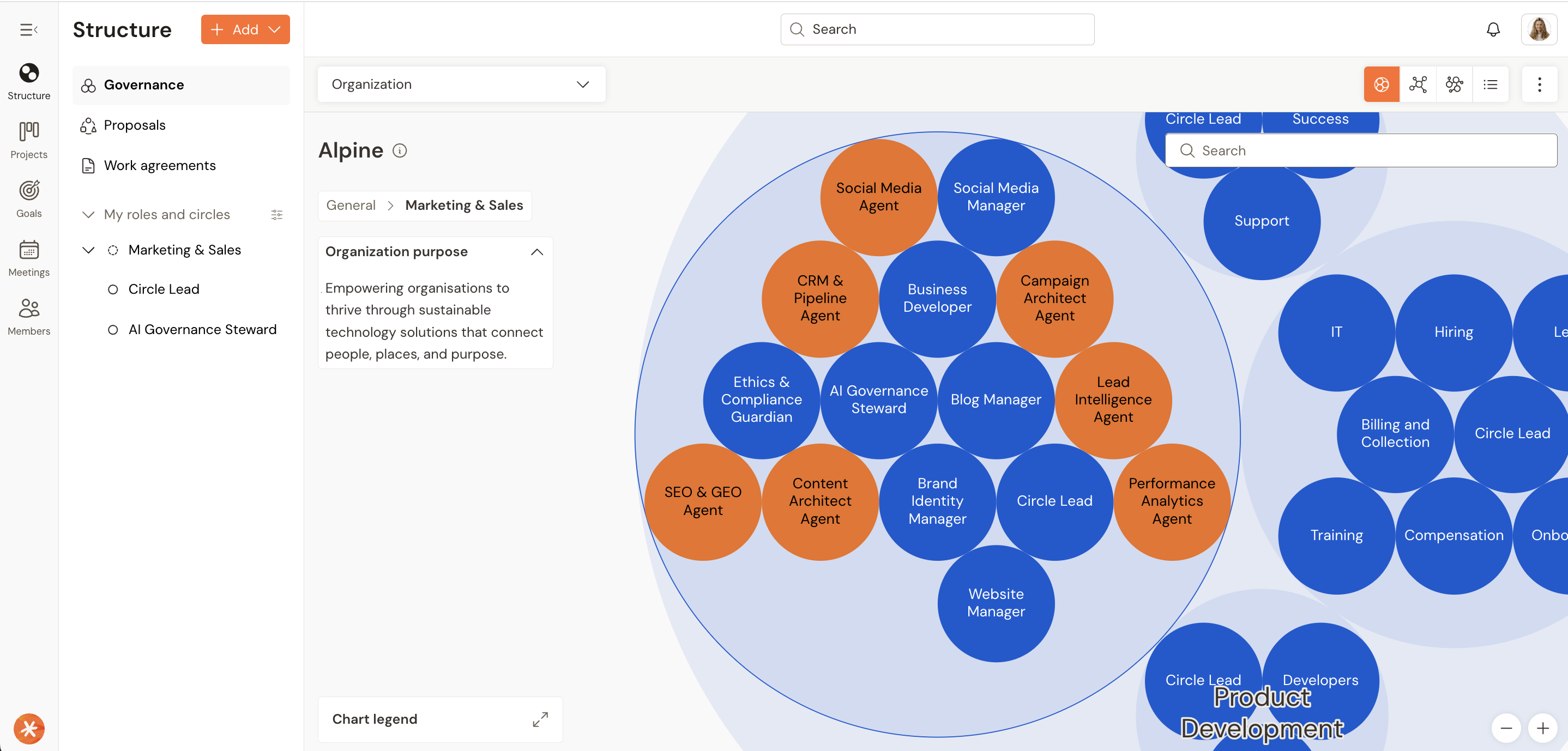
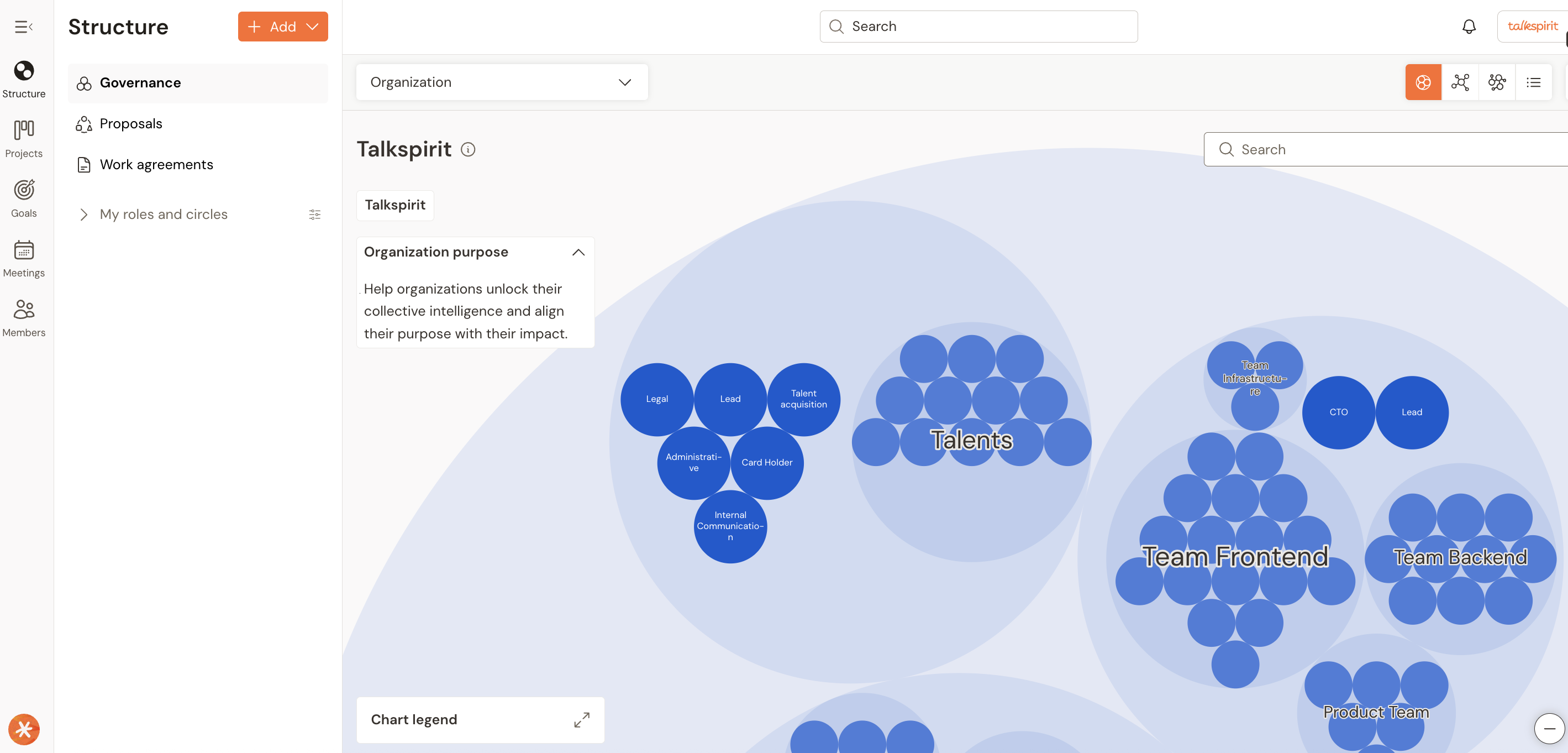
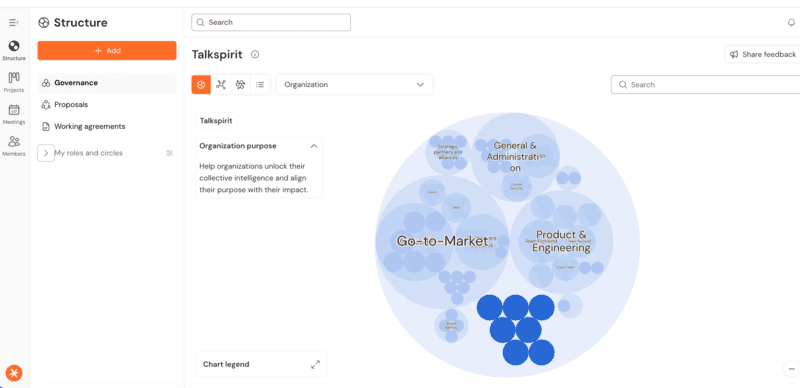
The goal of this first phase is to shed light on the current state of the organisation and define organisational clarity objectives in relation to strategy. Concretely, this means mapping the organisation's existing operating system using a diagnostic tool. It involves identifying organisational tensions (grey areas in roles, stalled decisions, information that does not flow) and the strengths to build on. This phase includes formalising the organisation's purpose and operating principles, not as a communications exercise, but as a decision-making framework. Finally, the existing structure (roles, teams, objectives) is configured in an integrated environment to make it visible and effective.
Phase 2 — Organise
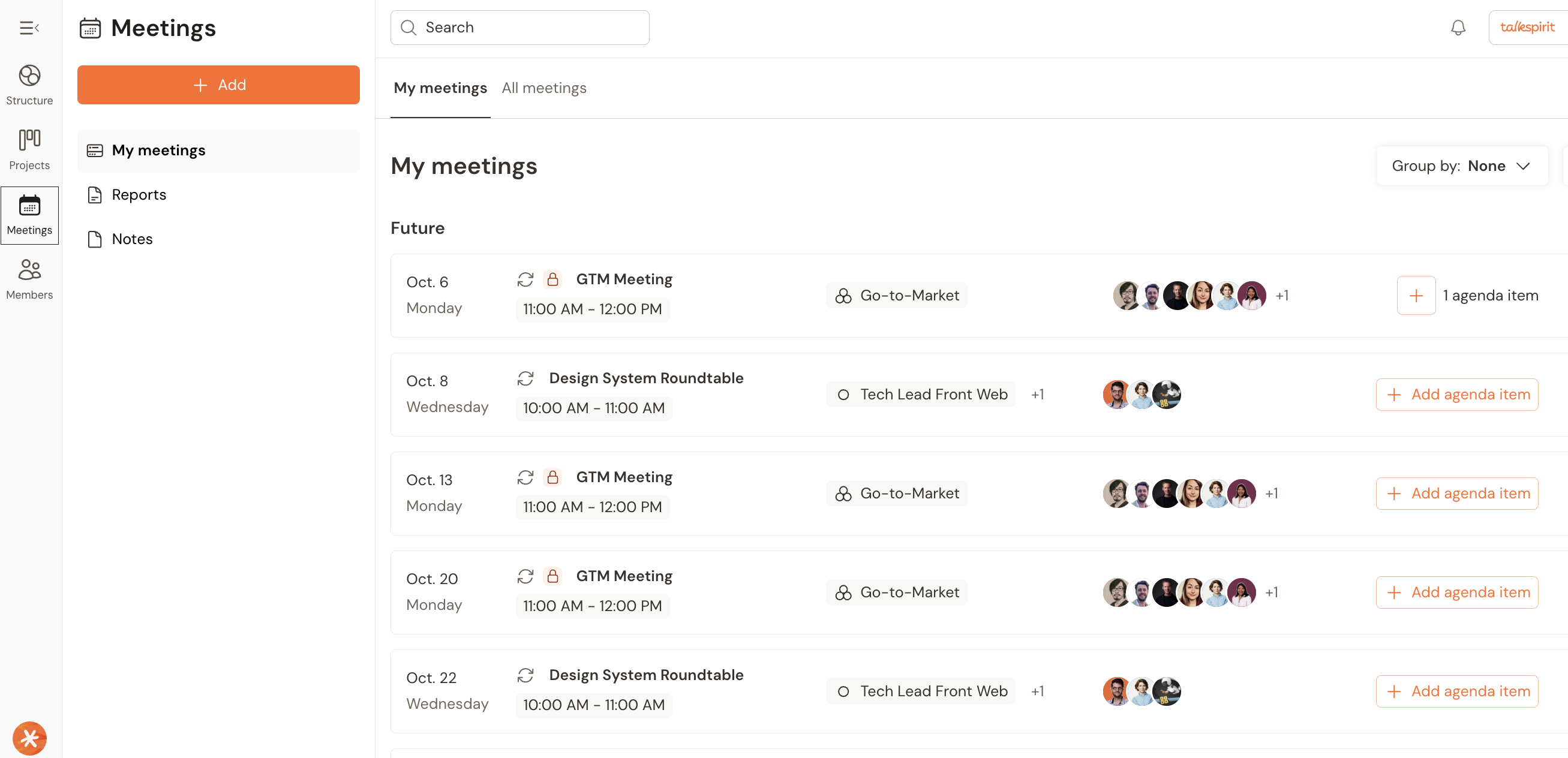
The goal of the second phase is to activate daily coherence, team by team. This involves deploying communication and collaboration modules within a unified environment, replacing the four to five siloed tools that fragment information. Project spaces and role circles are structured to simplify collaboration. Governance workflows are activated: decision logs, formalised proposals, role reviews. Finally, rituals are established: weekly check-ins, asynchronous stand-ups, objective tracking.
During this phase, a measurable reduction in tool-switching time is already observed (up to 30% based on experience feedback), along with visible progress in team alignment and fewer coordination meetings.
Phase 3 — Anchor
The third phase aims to evolve the operational rhythm and embed new practices for the long term. The work environment is extended to all teams and functions. Governance circles become autonomous, capable of self-management and adaptation to a dynamic context. Adoption, engagement, and perceived clarity are measured via dedicated dashboards. New habits are codified using reusable templates and playbooks.
In this phase, a team alignment score improvement of more than 40% is observed, along with visible and shared governance and established rituals.
Results Observed in the Field
Organisations that have already embarked on this approach observe four types of converging results. They see a significant reduction in fragmentation, with four to five tools replaced by a coherent suite. Governance becomes visible, shared, and adaptive, decisions no longer get lost in email threads. Purpose translates into daily practices, not just displays. Finally, reproducible rituals are established for meetings, planning, and collective learning.
Technology as Infrastructure for Clarity and Organisational Performance: The Talkspirit Approach
Organisational clarity cannot be decreed. It is built on an infrastructure that makes the organisation readable on a daily basis. This is the role of an organisational operating system.
Talkspirit is the European platform that integrates governance, collaboration, and communication in a single environment. Unlike existing collaborative suites, Talkspirit does not just connect projects and people: it structures roles and workflows so that alignment becomes the default operating mode.
What sets Talkspirit apart in the European market is, first, its modular and unified nature: organisations can adopt governance, collaboration, or communication modules separately, or deploy them as an integrated strategic suite. Second, its ability to operationalise any governance model, including shared governance models and self-management models. Third, its approach to sovereignty: 100% EU hosting, ISO 27001 certification, GDPR compliance, EU AI Act compliance, and SecNumCloud certification in progress. Finally, the integration of purpose into the platform, where every space, every role, and every decision can be linked to the organisation's strategic intent.
Frequently Asked Questions About Organisational Clarity
Is organisational clarity relevant for SMEs and mid-sized companies, or only for large corporations? SMEs and mid-sized companies with 50 to 1,000 employees are precisely the organisations where a clarity deficit has the most immediate impact. In a structure of this size, role ambiguity or an unclear decision-making process ripples through the entire organisation within days. Large corporations can temporarily absorb this type of friction thanks to their inertia. SMEs and mid-sized companies cannot.
How long does it take to measure the first results? Customers feedback indicates that the first improvements (reduction in the number of tools, clarification of key roles, establishment of governance rituals) are visible within the first 30 days. Structural gains (team alignment, governance autonomy, objective progression) are measured over 90 days.
How do I know if my organisation suffers from a clarity deficit? Three warning signs: the same decisions are discussed multiple times without being resolved; team members do not know whom to turn to for a given topic; the company's strategy is known to the executive committee but not implemented by managers and their teams. If any of these signals is present, a clarity diagnostic is recommended.
What is the link between organisational clarity and employee engagement? The link is direct and documented. Gallup identifies clarity of expectations as the primary engagement factor in its Q12 model. Employees who know what is expected of them are 53% more effective. Conversely, role ambiguity is one of the main predictors of active disengagement.
Is Your Organisation Clear? Take the Diagnostic.
Most leaders overestimate the clarity of their organisation. Data show that the gap between the executive committee's perception and the reality experienced by teams is often considerable.
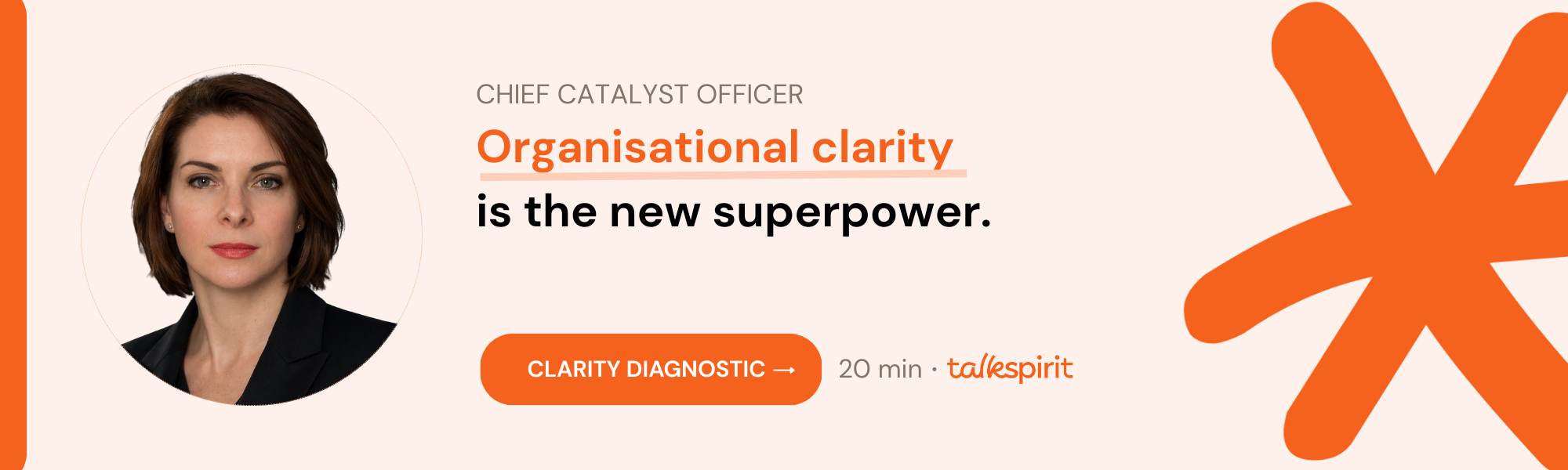
Talkspirit offers a free and confidential organisational clarity diagnostic, designed for CEOs and executive committee members. In 20 minutes, you receive a map of your clarity zones and blind spots, along with priority recommendations.
Performance is not decreed. It is built, decision by decision, role by role, workflow by workflow. And it all starts with one word: clarity.
About Talkspirit — Talkspirit is the European organisational clarity platform that unifies governance, collaboration, and communication for organisations seeking to increase their performance and accelerate their impact. Modular and sovereign (100% EU hosting, ISO 27001, GDPR), it helps SMEs and mid-sized companies transform their organisational clarity into collective performance and shared purpose.
→ Request your organisational clarity diagnostic


Révélez le potentiel de votre organisation.
Nous sommes là pour répondre à toutes vos questions et vous accompagner dans vos projets.












.jpg)













.jpg)




.jpg)
.jpg)




.jpg)
.jpg)


.jpg)

.jpg)


.jpg)


.jpg)


.jpg)


.jpg)
