

Many organisations today are trying to solve very practical problems.
Decisions take too long or depend on too few people. Roles are unclear, leading to overlaps or gaps in responsibility. Meetings multiply without always improving outcomes. Teams are asked to be more autonomous, but without the clarity to do so.
To address this, leaders introduce new tools, processes, or ways of working. Often, things improve at first.
But over time, something frustrating happens. Despite real effort, organisations slip back into old patterns. Why is it so difficult to make these changes last?
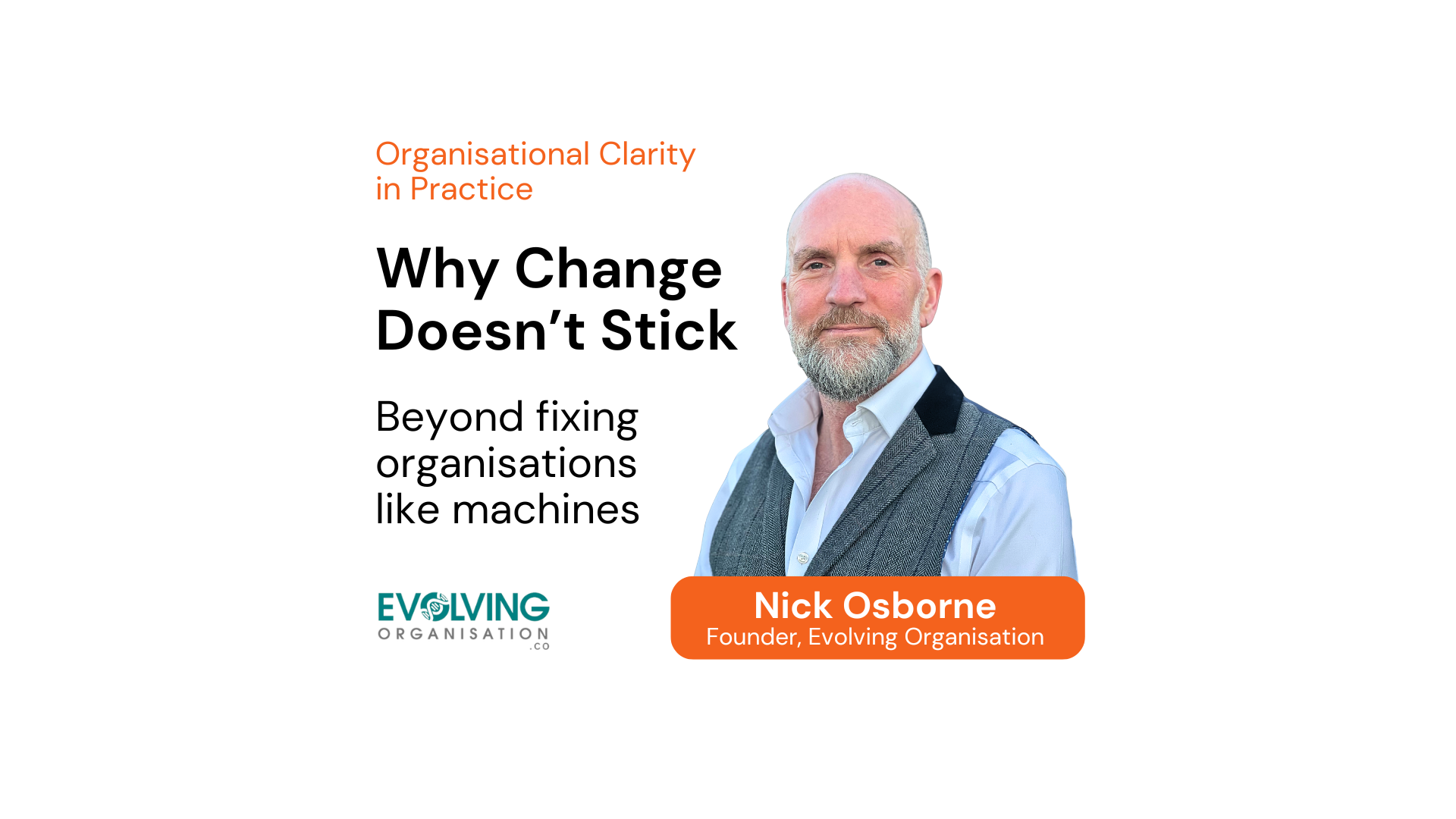
In this conversation, Gregory Pepper speaks with Nick Osborne, founder of Evolving Organisation and Beyond the Machine. Drawing on 30 years of experience working with teams and leaders, Nick shares a perspective shaped by observing what actually holds, and what quietly falls apart.
Together, they explore what might be happening beneath the surface, and why making change stick requires looking beyond tools, processes, and even mindset.
Hi Nick! For those who don’t know you yet, could you introduce yourself and your work?
Nick Osborne: I’ve been on a bit of a 30-year journey trying to understand how people work together.
When I started out, I was working in a fairly conventional management hierarchy, and I didn’t like it very much. Partly because I don’t enjoy being told what to do, but also because it didn’t seem like a very effective way of getting work done. The people who were telling me what to do weren’t on the front line, didn’t really know what needed to happen, and yet they were deciding what should be done and how.
I’ve always had a fascination with people, teams and group dynamics, especially power dynamics. How power works between people when they are trying to get things done together.
That led me to explore alternative ways of working. I went quite deep into collaborative and consensus-based approaches, including formal consensus, which comes from Quaker traditions. I developed facilitation skills in that space, but I also found the limitations. It can take a long time to hear everyone’s voice, integrate all perspectives, and still you might not end up with a satisfying outcome.
From there, I continued exploring and eventually came across Holacracy about 15 years ago. I became very involved in it, trained extensively, and became one of the few Master Coaches globally. It is a powerful system, but again, I found limitations. It can be quite technical, quite demanding to learn, and requires a significant investment from organisations.
So over time, my work has evolved. What I do now with Evolving Organisation is about introducing new ways of working in a more practical, accessible way, breaking things down into smaller practices that teams can adopt step by step.
And alongside that, Beyond the Machine explores a different idea: what changes when we stop thinking of organisations as machines and start thinking of them as living systems.
What challenges do you see most organisations facing today?
At a surface level, there are many familiar challenges that people will recognise.
There is often a lack of clarity around who is doing what, or who is responsible for decisions. People are not always sure what they can decide themselves and what needs to be checked with others. Decision-making can go round in circles or get bottlenecked. Meetings can feel long, unproductive or frustrating. People can feel overwhelmed, pulled in different directions, or disengaged from the work.
But these are symptoms.
If you step back and look at these challenges together, there is a broader pattern.
For me, the underlying issue is that something is not working in how people are working together.
And what I often see is that organisations try to address this by introducing something new. A new process, a new framework, a new way of running meetings, a new approach to roles or decision-making.
It can make sense at first. It can even work for a while. But then, quite often, things drift back.
The change does not really stick.
Why do these approaches not hold over time?
A big part of it is that they are introduced from the top or from the outside.
A leader decides that something needs to change and introduces a new approach. Or a consultant comes in and says “this is what you should do”.
Even if it is done thoughtfully, it often does not fully change how the organisation actually operates.
They address the visible layer, but not the system underneath.
What do you mean by the underlying system?
Most organisations operate on a set of assumptions that are so familiar that we do not really question them.
For example, the idea that there needs to be a leader at the top, that work flows down through a hierarchy, that problems can be fixed by introducing a new process. Even the language we use reflects this.
“The language we use, designing, building, fixing, is founded on a paradigm as if organisations are machines.”
This is the dominant mental model.
We treat organisations as if they are machines that can be engineered and fixed.
But organisations are not machines. They behave much more like living systems.
What does it mean to see an organisation as a living system?
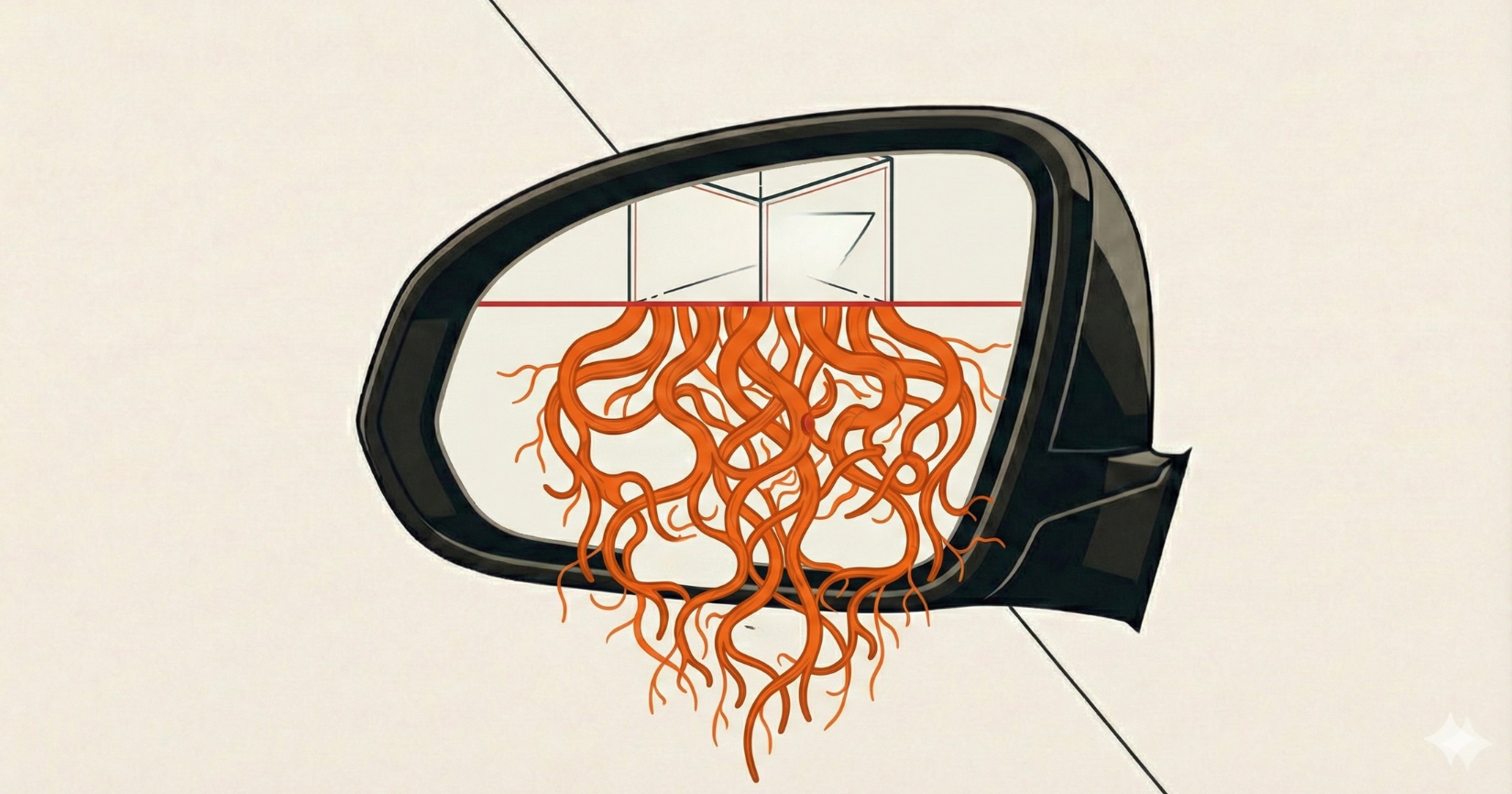
If you want an image, you could think of something like a forest ecosystem.
There are many different elements, all interconnected, but also distinct. There are relationships, feedback loops, and constant interactions. The elements in the system have agency, they make choices, and those choices affect the system itself.
That is very different from a machine, where everything is predictable and controlled.
When you see an organisation as a living system, you stop trying to fix parts and start understanding interactions.
How does this change the way you work with organisations?
One of the biggest shifts for me is that I no longer come in as the expert with answers.
I do not assume that I know what is going on.
Instead, I work with the people in the system to explore what is actually happening. That starts with a process of sensing and listening.
We look at different dimensions of the organisation at the same time. Not just the structure, but also the quality of trust and psychological safety in the relationships, the developmental capacity of the people involved, the ways impact is measured, the diversity of cognitive and behavioural preferences, the customer journey, the stage an organisation is in its lifecycle and the broader context.
The goal is not diagnosis from the outside, but understanding from within.
“Help the system see itself in a new way.”
From there, we explore together what experiments might be worth trying.
Can you share an example where this became tangible?
One example that stands out was with a leadership team I was working with on role clarity.
They had expressed a desire to work more cooperatively and to have more clarity, but those ideas were still quite abstract.
As we worked through defining roles and responsibilities together, something shifted. One person said:
“If we have this written down… then we don’t need to check with each other all the time.”
It was a simple realisation, but it had a big impact.
This team had been spending a lot of time checking who should do what or asking for permission. That was slowing them down.
They realised that clarity was not control. It was liberation.
And once they saw it, it created real commitment.
What role does technology play in supporting this?
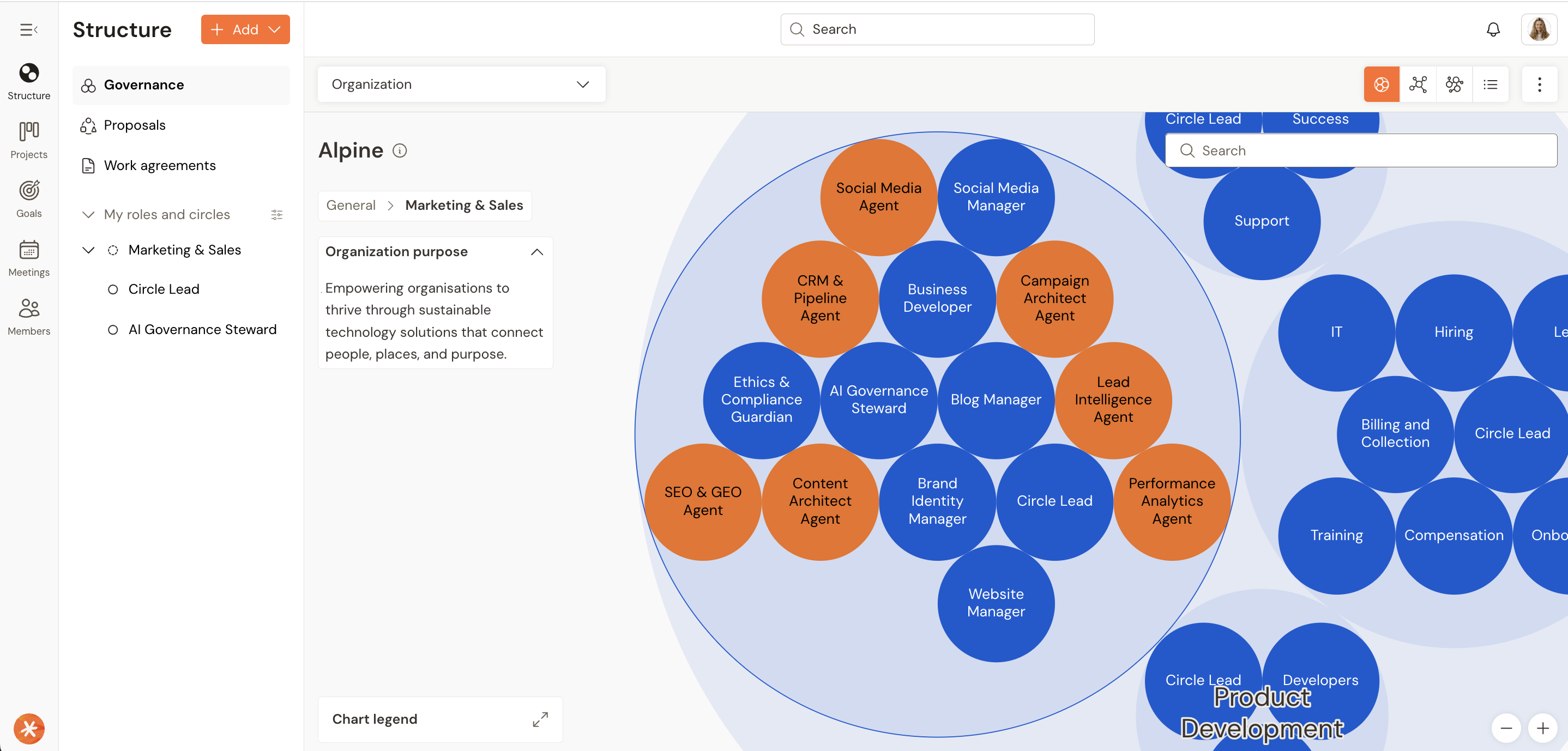
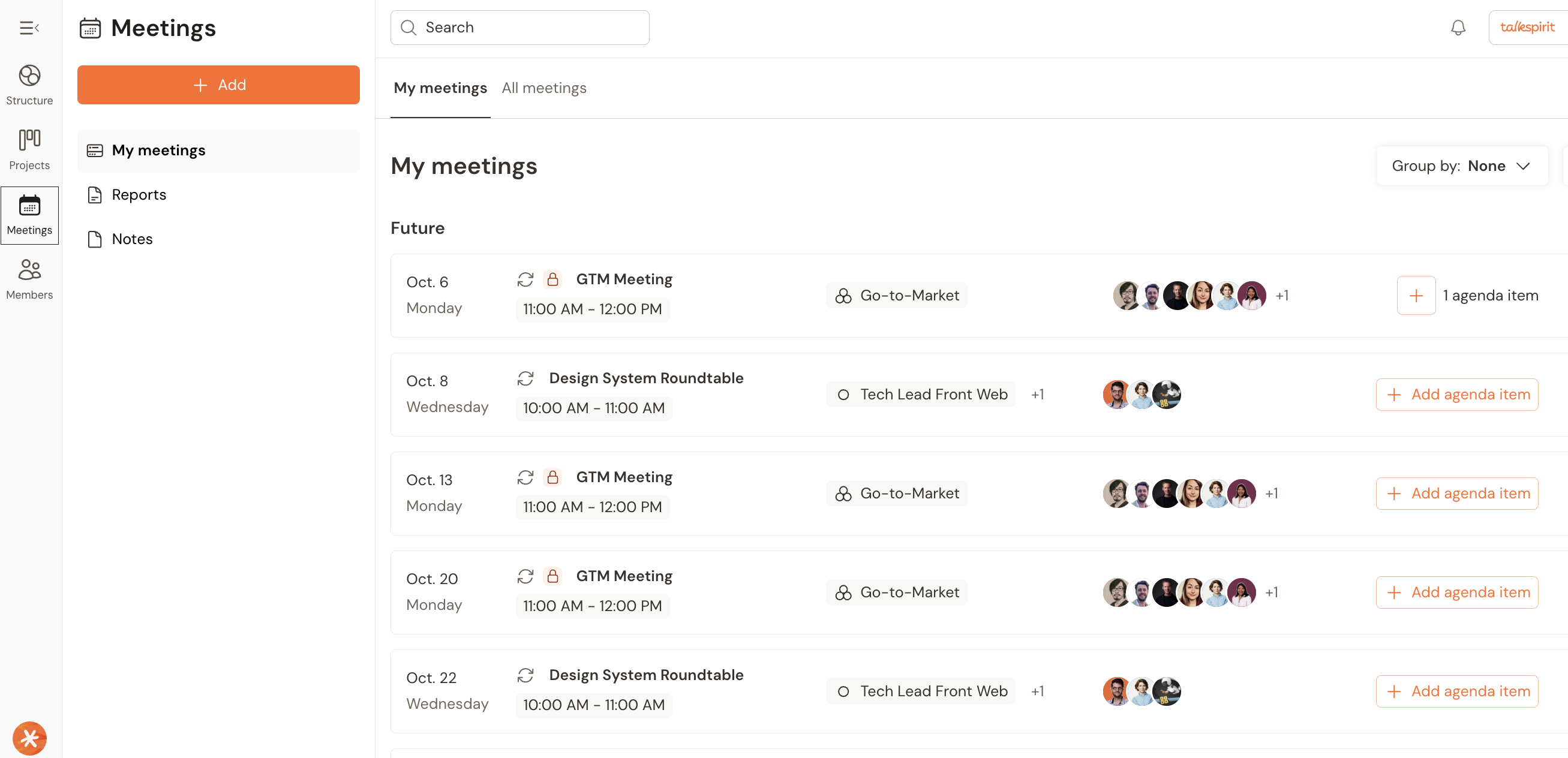
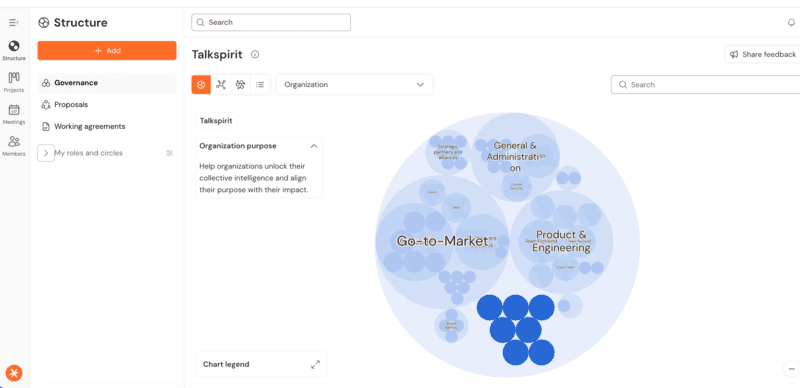
Technology, and platforms like Talkspirit, play an important role.
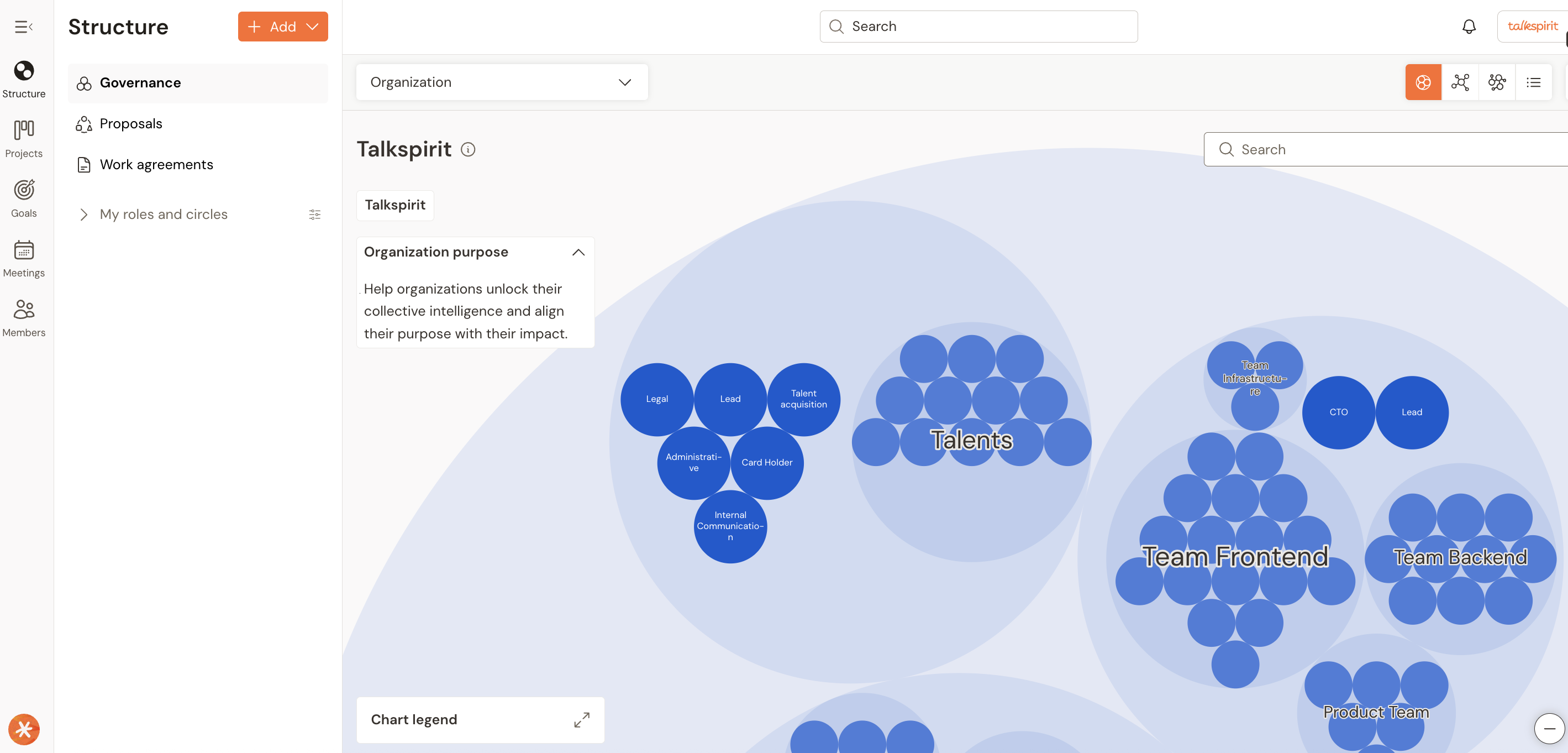
They make the structural layer of the organisation visible and persistent. Roles, accountabilities and governance become clear and accessible.
This is necessary. But it is not sufficient.
I have seen organisations where everything is correctly set up, but people are not really engaging with it.
They go through the motions, but real conversations still happen elsewhere.
That is because structure alone does not change relationships, trust, or psychological safety. Without those, the system does not fully come to life.
What about mindset shifts? Are they part of the answer?
It is often said that leaders need to change their mindset.
There is some truth in that, but it is often oversimplified.
“You can’t just wake up and decide to change your mindset.”
Even when leaders genuinely change, the organisation may continue operating as before.
Because the patterns live in the system itself. In habits, relationships and informal dynamics.
It is not just about how people think. It is about how the system behaves.
So what should leaders do instead?
I would suggest not assuming that the problem you see is the whole problem.
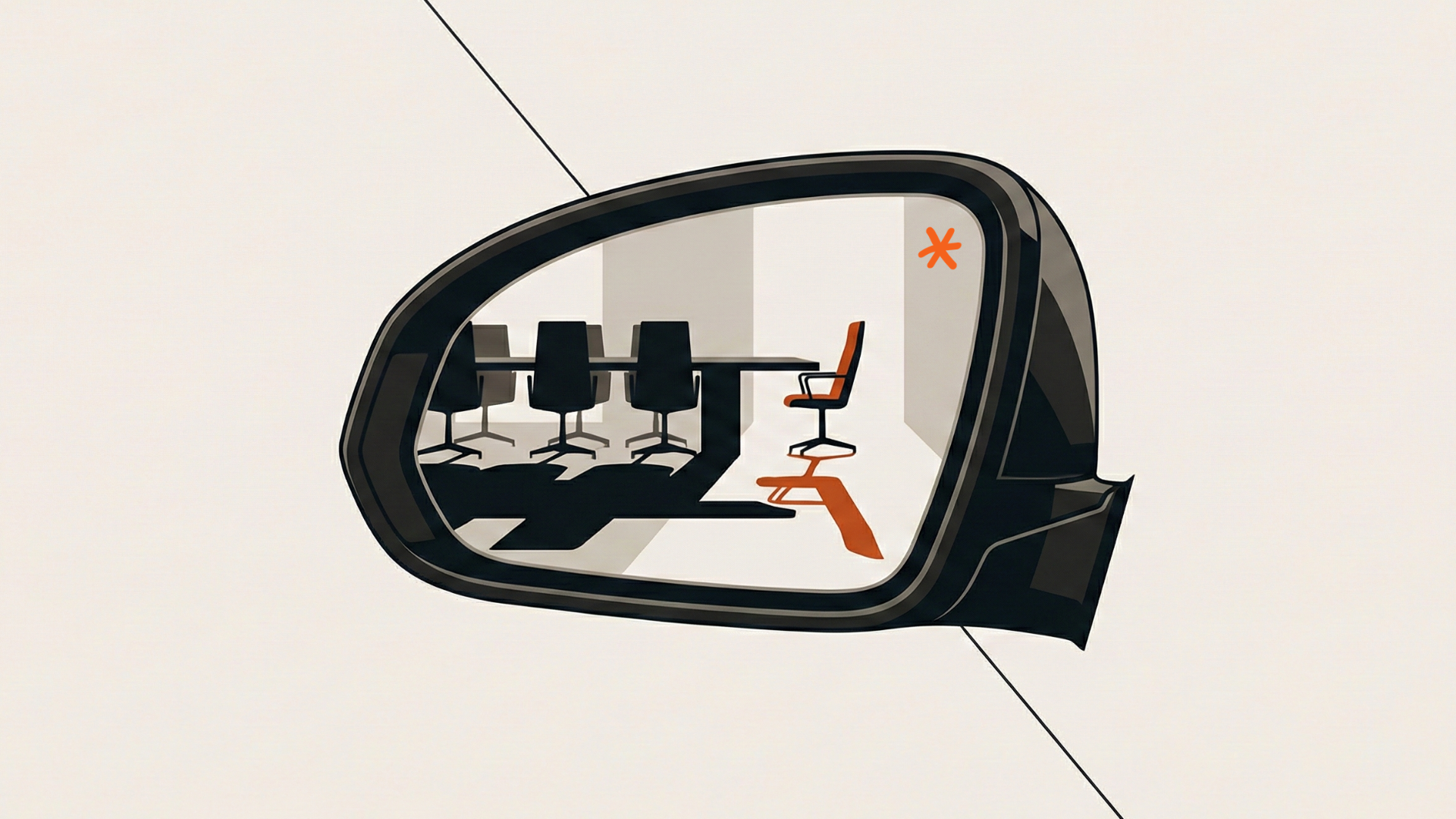
Often, what derails transformation is something that is not visible at the start.
So before implementing another change, it is worth asking:
What assumptions am I making about this system?
And have I actually checked them?
That creates space to see more of what is really going on.
What questions are you still exploring today?
One question I am actively exploring is why some changes stick and others do not.
I have been going back to organisations I worked with in the past and looking at what has held over time and what has not.
Another question is about the role of the practitioner.
Do more durable transformations happen when the practitioner is inside the system, rather than outside it?
I do not have a final answer yet, but I am exploring it.
A final thought?
If I bring it back to something practical, it would be this:
Can you create a bit of space to pause?
To reflect on what is happening, question your assumptions, and notice what you might not be seeing.
And from that place, allow something new to emerge.
If Nick's closing thought landed - the invitation to pause, question assumptions, and notice what you might be missing - there are a few ways to take that further.
Something feels off, but you can't quite name it yet
If this conversation resonated, there's a growing body of writing that explores what becomes possible when you stop trying to fix organisations and start working with them differently.
Explore the Beyond the Machine: Articles →
Something specific is happening in your team right now
Once a month, Nick runs a small online group — no agenda, no pitch — where people bring real questions about what they're noticing in their teams. It's a place to think alongside others who are working through similar territory.
Maximum six people. First Wednesday of every month, 4–5pm CET
Join Beyond the Machine: Live →
Is this right for us?
Before committing time, energy, and your team's goodwill to something new, it's worth understanding your specific situation more clearly. Cross the Threshold is:
- a 90-day inquiry
- a structured conversation
- three months of group access
To help you work out whether this kind of change fits where you actually are, or whether something else is needed first.


Révélez le potentiel de votre organisation.
Nous sommes là pour répondre à toutes vos questions et vous accompagner dans vos projets.









.jpg)













.jpg)




.jpg)
.jpg)




.jpg)
.jpg)


.jpg)

.jpg)


.jpg)


.jpg)


.jpg)


.jpg)
