
6 Barriers to Overcome for Successful Internal Communication

.svg)
- A poorly defined strategy scatters your messages: with no vision, objectives or editorial calendar, internal communication goes in every direction at once.
- 28% of companies have no internal resource dedicated to internal communication (Observatory of Communication Professions, Cohda, 2022).
- Communication that is too top-down creates silos; internal ambassadors and cross-team spaces for dialogue rebalance it.
- Too much information saturates, too little frustrates: the issue is the dosage and the channel, not the volume.
- A lack of transparency leaves room for rumours, and drags down both engagement and retention.
- Piling up tools is a barrier in itself; one channel, chosen after assessing your needs, works better.
Building strong bonds and fostering smooth communication in the workplace is something you can learn! Indeed, along your journey or your rollout process, many barriers can get in the way of your internal communication. But how do you avoid the common pitfalls? Simply by knowing them!
When internal communication isn't managed effectively, it can lead to friction, misunderstandings and a lack of alignment that affect the company's overall performance. Employees are then left with doubts, uncertainties, and a feeling of exclusion that can impact their motivation and their engagement.
In this article, we revisit the 6 most common barriers and how to overcome them for successful internal communication. By removing these barriers, you'll be able to create internal communication that's smooth, transparent, and inspiring, propelling your company toward new heights of success! 🚀

1) A poorly defined strategy
Not having a clear, defined strategy is one of the main barriers to effective internal communication! “Where do I start? How? Where? With whom?” Do these questions ring a bell? That's normal: getting internal communication right can be a real challenge.
But rest assured: by clearly defining your vision, your objectives and your editorial calendar, you'll be able to create a solid roadmap that guides your actions over time. You'll know where and how to communicate to reach your audience effectively. This will prevent your messages from scattering and make your internal communication more effective.
Read also: 6 key steps to build an internal communication strategy
Next, you need to communicate this strategy to all your teams, in order to engage them. Without a robust strategy, employees may feel disoriented and lack confidence in the relevance of internal communication.
This step is essential to successful internal communication! Take the time to define a solid internal communication strategy, and you'll see the benefits reflected in your employees' cohesion, motivation and productivity.
2) A lack of internal resources
According to the Observatory of Communication Professions conducted by the Cohda institute in 2022, 28% of companies don't have internal resources dedicated to managing internal communication. Yet this lack of resources is one of the major barriers to successful internal communication!
Indeed, when the internal communication team doesn't have enough qualified staff, this can lead to delays in distributing information, lower-quality content, and inconsistent communication. A lack of resources can also lead to a lack of follow-up on results and employee feedback, which makes it difficult to assess how effective communication efforts are. Ultimately, this undermines your efforts… and no one likes investing in a void!

To overcome this barrier, it's essential to recognize the importance of a team dedicated to internal communication. Investing in qualified professionals with skills in communication, project management and people relations will improve quality and effectiveness, and help you succeed in your internal communication. A skilled team will be better able to coordinate actions, meet the specific needs of each department, and adapt messages to different internal audiences.
3) Internal communication that's too top-down
When information flows mainly from the top of the hierarchy down to the teams without any real exchange, this can create silos and hinder collaboration. According to one study, 93% of employees want more social connection¹, underscoring the importance of cross-functional communication.
Yet only 22% of internal communicators feel they receive adequate support from directors or team leaders². The need is clear: all that's left is to put in place more cross-functional communication for successful internal communication!

To do this, you need to involve employees and managers, but also create cross-team spaces for dialogue that encourage cross-functional exchanges. To do this, you can, for example:
- Identify employees and managers who are enthusiastic and motivated to become internal ambassadors. These ambassadors can play an active role in spreading information within their team and serve as a relay between management and employees.
- Suggest that these ambassadors animate topic-based groups on cross-functional subjects that may interest different teams.
- Organize regular meetings with each department to discuss ongoing projects and share each team's news.
- Involve employees and managers in creating internal communication campaigns. Hold brainstorming sessions or polls to gather their ideas and feedback on the messages to share.
By removing this barrier, you give a new dimension to your internal communication and make it more dynamic. This helps strengthen team cohesion and instill a genuine sense of belonging within the company. In fact, 93% of employees in a Deloitte study believe that a strong sense of belonging boosts an organization's performance. So don't wait any longer! 😉
Read also: 7 initiatives to improve information sharing in the workplace
4) Too much or too little information
In internal communication, balance is essential. Too much information can lead to information overload for employees. However, too little information can create a sense of frustration and isolation. According to an OpinionWay study, nearly one-third of the employees surveyed feel they aren't sufficiently informed within their company, while 20% of them say they lack the information needed to carry out their tasks.

This overload or lack of information can both lead to a decline in productivity and a drop in employee engagement.
To avoid these barriers, it's important to find the right balance in the amount of information shared. A Panopto study shows that 60% of employees struggle to get the information they need. As a result, it's essential to prioritize sharing essential information and to communicate it clearly, concisely, and regularly. In addition, it's important to use appropriate communication channels for each type of information and to streamline your tools. This avoids overwhelming employees with multiple notifications and messages.
Read also: Productivity: 12 alternatives to email
By balancing and carefully calibrating your internal communication, you make it easier for employees to access essential information, thereby removing another barrier to successful internal communication! 🏆
5) A lack of transparency
A lack of transparency in the workplace can be an unsuspected barrier to successful internal communication. And yet!
When important information isn't communicated clearly and openly, this can create doubts and distrust among employees. They may then turn to rumors and misinformation to fill the information gap. As a result, employees' engagement and motivation can plummet, friction between employees can emerge, and employee retention can be jeopardized.
Read also: How can you improve your teams’ well-being at work?
To overcome this barrier to internal communication, it's essential to promote transparency at every level of the company. How? By making information easily accessible and creating a culture of trust.
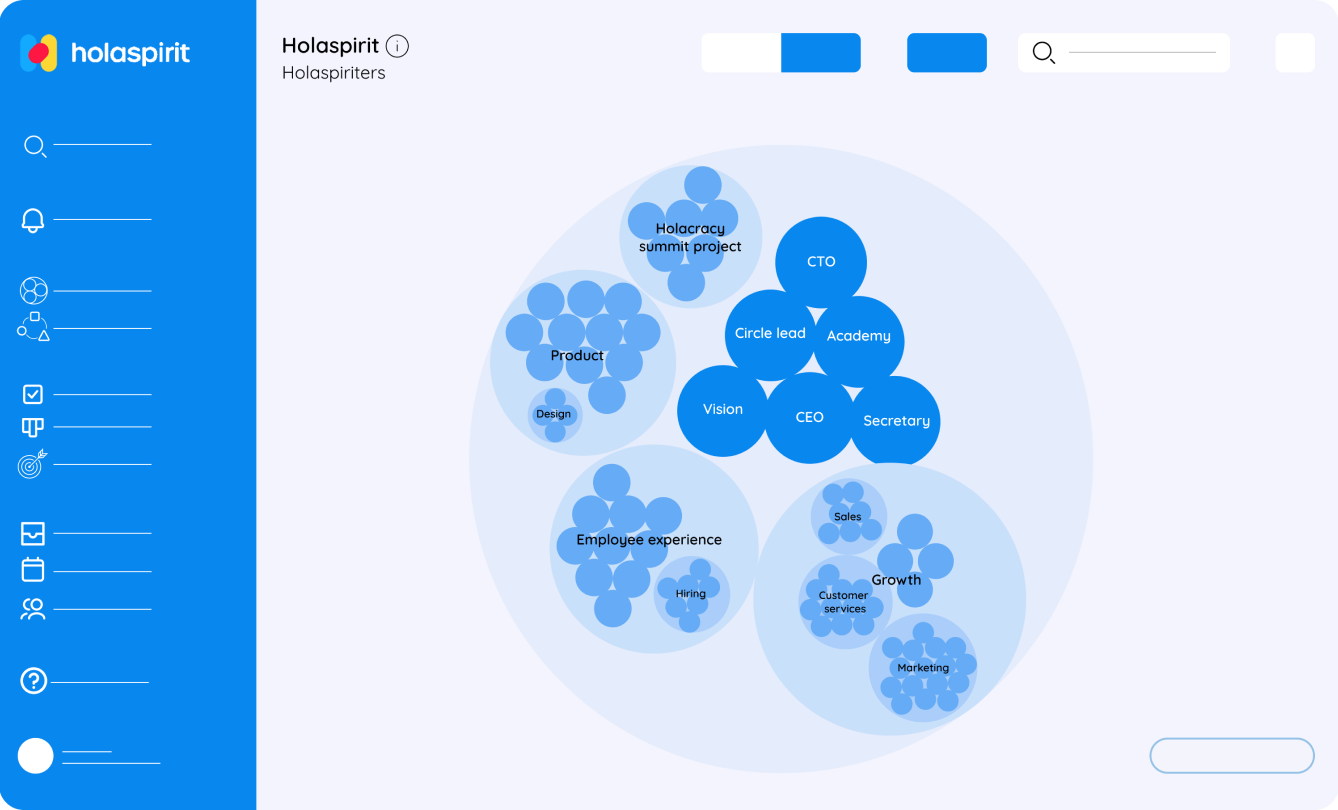
A self-management software such as Holaspirit can also help you bring more transparency to your organization, since it makes it possible to:
- clarify everyone's roles and responsibilities,
- formalize policies and processes,
- define and track shared objectives.
No more mysteries, no more barriers, everything is clear and accessible to foster open, collaborative internal communication!
Request a Holaspirit demo
6) Unsuitable or ineffective tools
With the proliferation of solutions available on the market, it can be tempting to be won over by a multitude of tools, each promising to solve a specific problem. But beware: this approach can quickly lead to excessive complexity for employees and become a barrier to successful internal communication!
With a multitude of tools, keeping track of information and updates becomes complex for everyone. This then negatively impacts team productivity and the effectiveness of internal communication. To succeed in your internal communication, it's therefore important to limit the number of tools used (ideally choosing just one!), but also to choose suitable tools. This requires a thorough assessment of your internal communication needs.
Whatever your needs, we invite you to check out our 3 tips for choosing the right internal communication tool. As well as our top 14 best software tools for internal communication. This way, you'll have all the keys to make an informed choice!
Read also: 4 steps to launch a new internal communication tool
The 4 families of communication barriers
The six barriers above are those of an organization. Seen from closer up, in a meeting or in a conversation thread, they take four different forms, and each one is removed with a different lever. Naming them helps you make the right diagnosis before changing anything: a message that fails because of jargon will not be fixed by switching tools.
- Individual barriers, psychological and relational: judgement, interpreting too quickly, selective listening, the fear of getting the wording wrong, the hierarchy that keeps people quiet.
- Semantic barriers, those of language: business jargon, in-house acronyms, registers of language, different languages from one country to the next.
- Technical barriers, those of the channel: a message sent where nobody reads it, a notification lost in the flow, frontline employees with no work email address.
- Organizational barriers, those of the structure: silos, a long chain of command, nobody genuinely owning internal communication, no routine that makes sure information circulates.
| Family of barriers | What it looks like | The lever that removes it |
|---|---|---|
| Family of barriersIndividual barriers | What it looks likeJudgement, hasty interpretation, selective listening, the fear of phrasing it badly in front of a manager. | The lever that removes itActive listening, a feedback culture, spaces where speaking up costs nothing. |
| Family of barriersSemantic barriers | What it looks likeBusiness jargon, in-house acronyms, registers of language, teams spread across several countries. | The lever that removes itA shared glossary, messages rephrased, translation when the team is multilingual. |
| Family of barriersTechnical barriers | What it looks likeA message posted where nobody reads it, a notification lost in the flow, frontline staff with no work email address. | The lever that removes itOne channel, reachable on mobile, where important information stands out. |
| Family of barriersOrganizational barriers | What it looks likeSilos, a long chain of command, nobody genuinely owning internal communication, no routine at all. | The lever that removes itCross-functional communication, explicit roles, regular meetings that keep information moving. |
A single message rarely runs into just one family. An announcement that lands badly usually combines an unsuitable channel, opaque vocabulary and a hierarchy that filters. That is why it is worth identifying the dominant family first, then removing the barriers one at a time rather than all at once. And when the barrier is organizational, an email will not remove it: it is deeper work, in which internal communication supports change management.
Talkspirit, the ideal platform to energize your internal communication
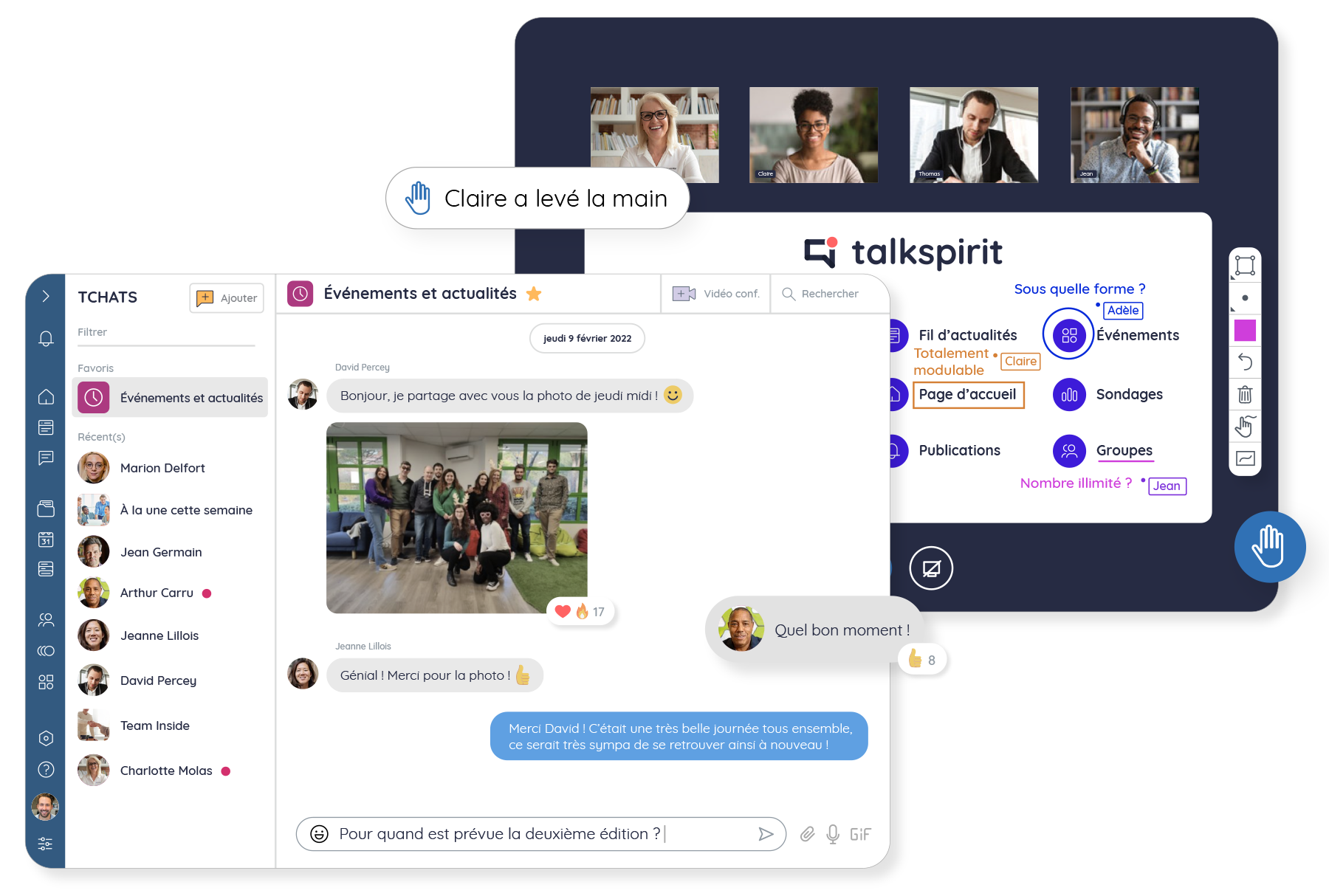
Among these software tools, you'll find Talkspirit. 100% made in France, our platform helps streamline internal communication and team collaboration thanks to:
- A newsfeed to stay informed continuously,
- A welcome portal to share everything that brings your team together,
- A chat and a video conferencing tool to communicate in real time with your teams,
- Groups and posts to facilitate exchanges.
- And much more!
Take advantage of a free trial to explore all the features of Talkspirit!
By opting for tools like Talkspirit, energize your internal communications and strengthen their impact on overall performance.
In conclusion
Well-designed internal communication is a powerful lever for achieving the company's strategic objectives and delivering remarkable performance! By overcoming the challenges related to a lack of strategy and resources, excessive top-down communication, the absence of feedback, or the choice of unsuitable tools, you'll be able to create an environment conducive to dynamic exchanges and proudly say that “your internal communication is a success!” 😃
Now that you know the barriers to overcome for successful internal communication, you may be wondering how to put these best practices into action. Surprise! We've gathered in a practical guide 10 examples of initiatives from our customers to improve internal communication.
In our practical guide “10 initiatives from our customers to improve internal communication,” you'll discover best practices to improve your internal communication, examples of initiatives implemented by our customers across all sectors, as well as concrete tips and tools to put in place to energize your internal communication.
¹The Observatory of Communication Professions, Cohda (2022)
²2022 X-ray of internal communication, Cap'Com and the Occurrence research institute (2022)
FAQ
According to the Observatory of Communication Professions run by the Cohda institute in 2022, 28% of companies have no internal resource dedicated to managing internal communication. That shortage leads to delays in distributing information, lower-quality content and inconsistent messages.
Because it creates silos and hinders collaboration: information flows from the top down to the teams with no real exchange. Yet 93% of employees want more social connection (Observatory of Communication Professions, Cohda, 2022), which is exactly what cross-functional communication provides.
Balance is the real question. Too much information causes overload; too little creates frustration and isolation. In an OpinionWay survey, nearly one-third of employees felt they were not sufficiently informed, while 20% said they lacked the information needed to do their job.
The gap fills itself. When important information is not shared clearly and openly, doubt and distrust set in, and employees turn to rumours and misinformation. Engagement and motivation drop, friction appears between colleagues, and retention is put at risk.
No, the opposite. Being won over by a multitude of tools, each promising to solve one specific problem, quickly creates excessive complexity: tracking information and updates becomes hard for everyone. Limiting the number of tools, ideally to one, and choosing them after assessing your needs works far better.
There are four families. Individual barriers come from people (judgement, hasty interpretation, selective listening, the fear of poor phrasing). Semantic barriers come from language (jargon, acronyms, different languages). Technical barriers come from the channel (a message posted where nobody reads it, frontline staff with no work email address). Organizational barriers come from the structure (silos, a long chain of command, no routine). Identifying the dominant family stops you from treating a vocabulary problem with a change of tool.