

Strategy remains just a presentation
Priorities are announced at the start of the year. Then, teams return to their projects with no visible link to the objectives.
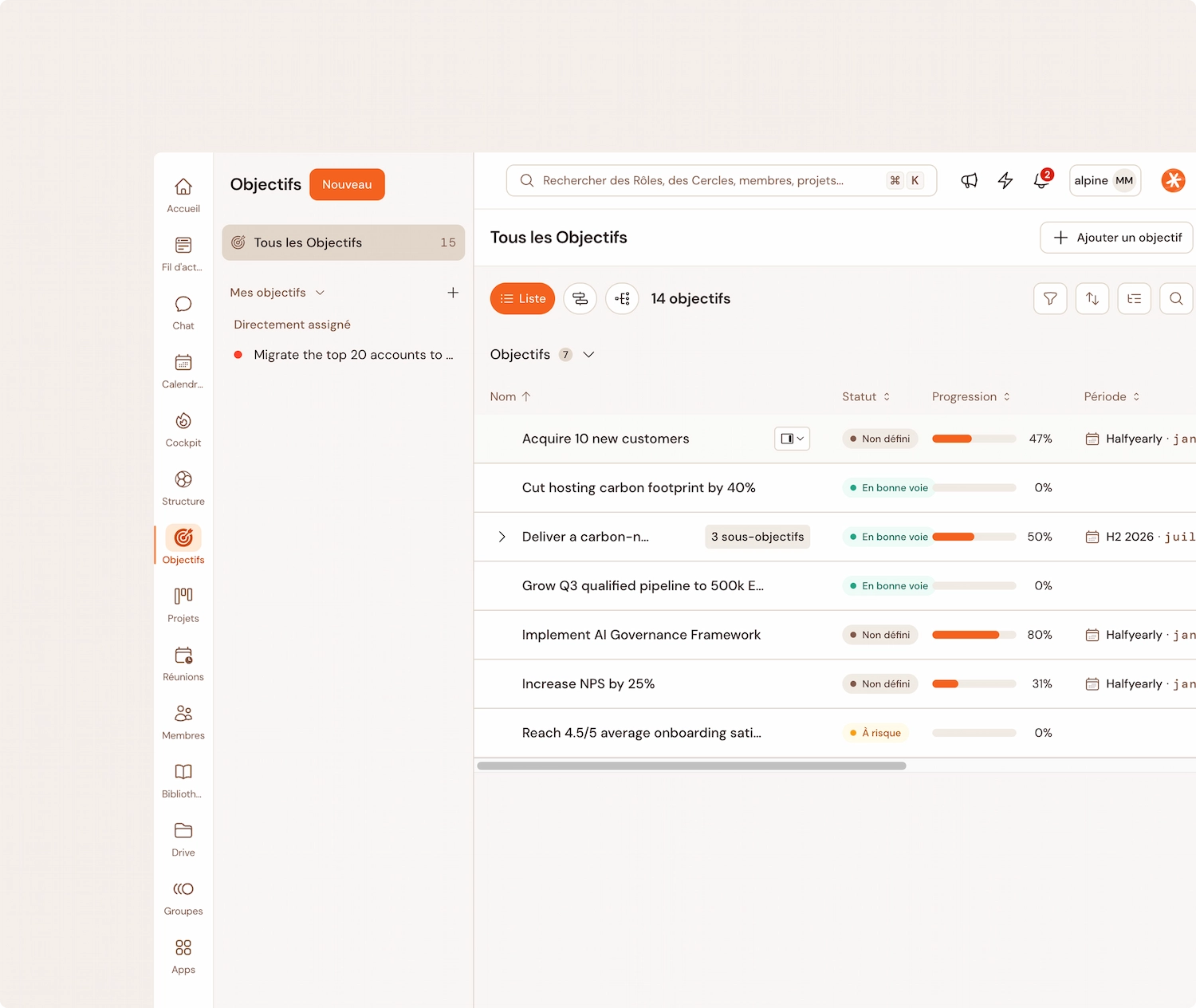
Every objective is linked to the teams responsible for it, the projects that bring it to life, and the results that measure it. Strategy is no longer an annual document: it becomes a shared system that guides priorities, decisions, and execution.
The situation
Objectives are defined, approved, and shared. Then, teams return to their own priorities. Without a link between objectives, projects, and teams, the strategy becomes a document that is only read again before the next committee meeting.
Priorities are announced at the start of the year. Then, teams return to their projects with no visible link to the objectives.

They are tracked in a spreadsheet or a dedicated tool, disconnected from the teams, projects, and daily work.

A few months later, it is impossible to know the real status of the strategy without checking in with every team.

Joint business development, shared leads, and co-hosted events: we grow together over the long term.
What is clear moves forward
Three impacts your teams will see from the very first goal cycle.
In practice
Strategic alignment is not a reporting exercise. It is the system that connects organizational priorities to teams, projects, and daily work.

Each goal is clear, measurable, and assigned to a team. A few key results are all it takes: everyone knows what matters this quarter.

Goals cascade naturally from one team to another. Everyone understands how their work contributes to the organization's priorities.

Projects and tasks automatically feed into goals. The committee tracks real-time progress without waiting for the next reporting cycle.
Same teams, same strategy. What has changed: a system that finally connects goals to daily work.
Steering meetings focus on decision-making.
Less time needed for alignment.
Less time needed for alignment.
Progress is visible without waiting for the quarterly review.
Freedom of action and accountability guaranteed.
Freedom of action and accountability guaranteed.
Every goal has an identified owner.
Transparency in project management.
Transparency in project management.
Priorities evolve with the organization.
Real-time updates.
Real-time updates.

"Talkspirit played a key role in clarifying roles, responsibilities, and cross-team collaboration within our hierarchical organisation. The tool also transformed our meetings: better structured, roles clearly defined, more effective decisions." — Markus Mantsch, Process and Compliance Manager, Big Blue Marble
What is clear moves forward



Everything in one system
Goals come to life when supported by clear governance, decisive meetings, and teams that execute. Strategic alignment connects vision, structure, and daily work within a single system.

Who decides what, and why.

Decisions that drive goals forward.

The entire organization follows the same priorities.
Strategic alignment connects every goal to the teams, roles, projects, and tasks that move it forward. Everyone can see how their work contributes to the organization's priorities.
Most tools track goals. Talkspirit connects them to actual work. Key results are linked to the teams, projects, meetings, and decisions that drive them forward.
No. Talkspirit adapts to your current method and allows you to gradually introduce OKRs or any other strategic management framework.
Each goal is supported by a team and a lead. Progress is updated as work happens, providing a continuous view rather than periodic reporting.
Yes. A goal can involve multiple teams while maintaining a clear owner. Everyone's responsibilities and contributions remain visible.
Permissions are fully configurable. You choose who sets the goals, who updates them, and who can simply track their progress.
Yes. Meetings allow you to make the decisions that drive your goals forward, while projects and tasks make their progress visible in your day-to-day work.
Yes. OKRs are just one practice among many. You can start by clarifying your organization or improving your management, then add strategic alignment when you are ready.

Clarity drives progress
In 30 minutes, we will connect one of your goals to its key results, the teams responsible for it, and the work driving it forward. You will see how strategy becomes visible in daily execution.