
7 Best Practices to Improve Internal Communication

.svg)
Improving internal communication is a key driver for engaging, motivating, and fostering a sense of belonging among employees. And engaged employees mean higher productivity, lower turnover, and improved overall company performance.
Indeed, according to a Gallup study, companies with the most engaged employees are 17 % more productive and 21 % more profitable than those with disengaged staff. All good news for the business!
So, what actions can you take to improve internal communication within your organization? And which tools should you prioritize to boost employee engagement?
Here are 7 best practices to energize your internal communication.
 end HubSpot Call-to-Action Code
 1. Take the pulse of your organization
The best way to improve your internal communication? Start by conducting an audit to get a clear picture of what’s already in place, and to analyze what’s working — and what isn’t — in your company.
Review the situation within your team, and take the time to survey employees across different departments (via a survey and/or interviews) to gather their feedback and improvement suggestions. For example, ask them:
- their level of satisfaction with your internal communication,
- how often they consult your messages,
- which communication initiatives and formats they liked most and least,
- any ideas they may have to improve internal communication.
This will allow you to step back and assess the initiatives you’ve put in place, and adjust your strategy based on the feedback you receive.
2. Set clear objectives
Once you’ve completed this audit, set yourself SMART goals (specific, measurable, achievable, realistic, and time-bound). For example, if you’ve just rolled out a new internal communication tool, one of your goals might be to increase the active user rate on that tool by 30 % over the next 6 months, and to increase engagement by 10 % over the same period (measurable via likes and comments).
Similarly, if you regularly organize internal events, you might set a goal of increasing event participation rate by 10 % by next year.
Adapt your objectives based on feedback from the various teams and the resources at your disposal!
3. Build an internal communication plan
Now it’s time to develop your internal communication plan. This plan will help you define:
- the topics you’ll communicate about,
- the target audiences you want to reach,
- the content formats you want to feature (videos, photos, events, newsletters, messages on your collaborative tool, etc.),
- how often you want to publish this content,
- the tools you’ll use (for example, an enterprise social network),
- the budget you have available to carry out your projects.
 end HubSpot Call-to-Action Code
 The goal isn’t to build a detailed editorial calendar, but rather to identify the key pillars of your internal communication strategy. This step will also help you assess whether the initiatives you’re planning are realistically achievable given your human and financial resources.
You can then use a project management tool to plan and track the various projects you need to implement.
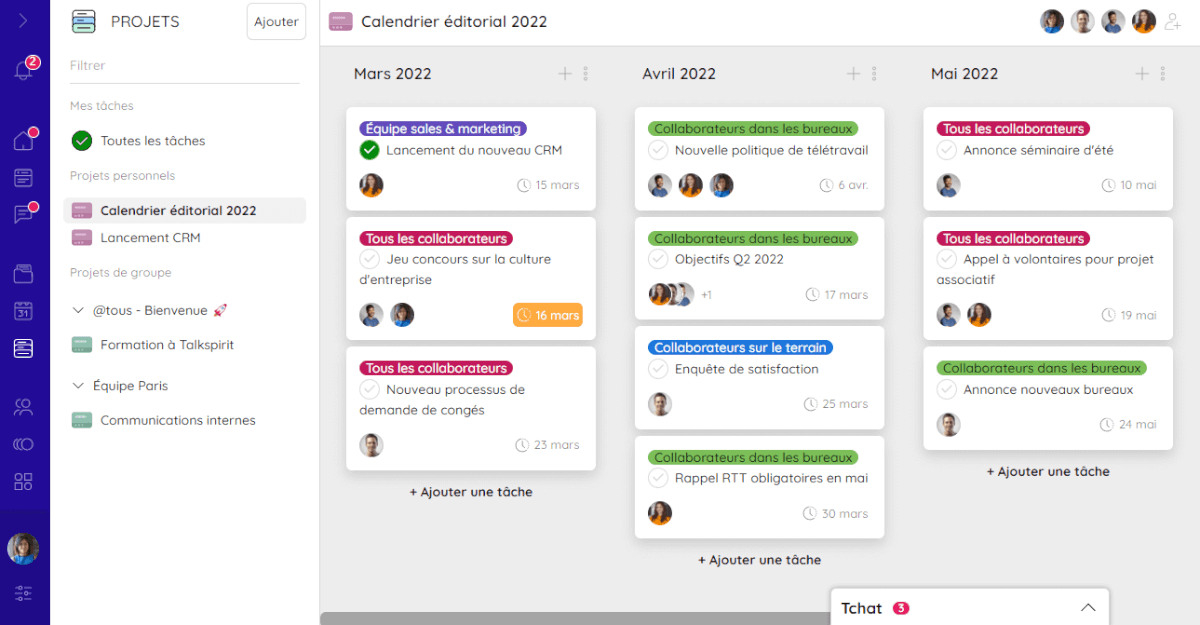
Discover Talkspirit’s Projects module
4. Involve management and employees
Employees and managers play a key role in your internal communication. By involving staff more closely in your initiatives, you can highlight their contribution, boost their engagement, and strengthen their sense of belonging to the company.
Likewise, managers will be better positioned to lead by example when they are active participants in internal communication themselves. However, this kind of exemplary behavior doesn’t come naturally to everyone. That’s why it’s important to support them in this process.
Several initiatives can help you more actively involve managers and employees in your internal communication, for example:
- Building a culture of trust where every manager or employee feels comfortable speaking up
- Offering managers internal communication training
- Involving employees in decisions that affect them
- Identifying ambassadors who can relay your messages to teams, or even launch their own initiatives
- Launching an “ideas box” group on your enterprise social network where anyone can submit ideas to improve internal communication and strengthen company cohesion
Read also: Enterprise Social Network: THE Solution to Improve Your Internal Communication!
5. Create rituals
Improving internal communication also means creating rituals — rituals that carry your company’s values, and bring employees together around shared traditions.
These rituals can take many forms, for example:
- an internal event held once or several times a year,
- a weekly coffee break (in-person or virtual) designed to encourage informal conversations,
- a post on your internal social network (or an internal newsletter) summarizing the week’s or month’s news,
- a quarterly survey to collect employee feedback on various topics (company culture, management, job satisfaction, etc.),
- an annual video highlighting the biggest wins across different teams,
- etc.
Most importantly, create rituals that reflect your company’s identity, and will inspire engagement and participation from your employees.
Read also: How to Succeed at Internal Communication While Working Remotely?
6. Measure your performance
Measuring your performance is essential to evaluate the effectiveness of your internal communication efforts. It also helps you justify your investments (in new tools or processes, for example) to leadership, and showcase the value of your work within the organization.
 end HubSpot Call-to-Action Code
 There are several ways to measure the impact of your internal communication. For example, you can:
- Track quantitative KPIs (such as employee engagement rate, tool usage rate, message reach, etc.)
- Ask employees for feedback via a survey, individual interviews, or focus group discussions (also called focus groups)
- Conduct an internal communication audit (yourself or by bringing in an external partner)
Whatever method(s) you choose, make sure to carry out this analysis regularly, so you can identify areas for improvement and continuously refine your strategy.
7. Put the right tools in place
It’s easy to overlook, but having the right tools is essential to successfully executing your internal communication initiatives.
To streamline your tech stack as much as possible, we recommend choosing an internal communication tool: Talkspirit. 100% made in France, the platform brings together features such as messaging, video conferencing, webinars, polls, a news feed, a home page, a directory, and much more. Thus, no more juggling between a multitude of tools !
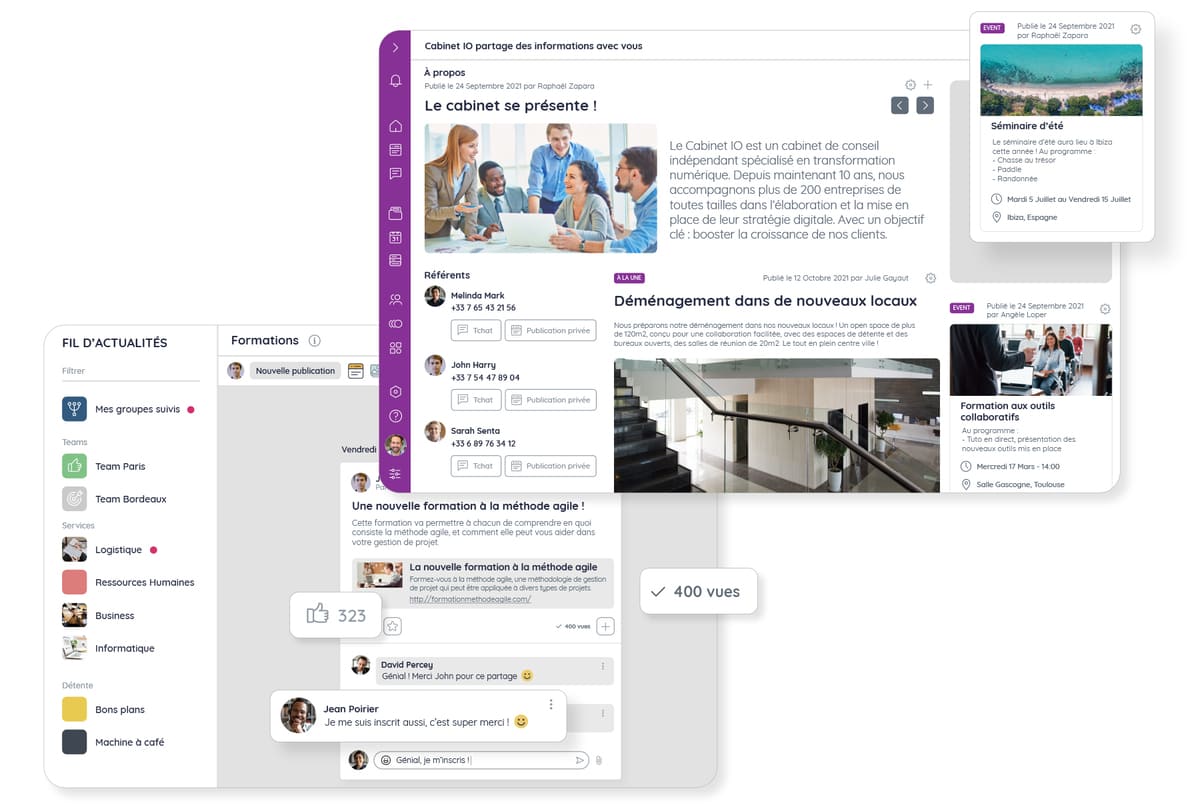
If you prefer best-of-breed tools, you can also opt for:
- Intranet: a private computer network that allows employees to access company resources and communicate with each other
- Enterprise Social Network (ESN): more comprehensive than an intranet, an ESN is designed to facilitate information sharing and collaboration among employees
- Internal newsletter: usually sent by email, it keeps employees informed of company news
- Video conferencing solution: for hosting remote meetings and webinars
- Survey tool: for regularly gathering employee feedback
*
* *
As you can see, improving internal communication requires building an action plan, consulting your employees to refine it over time, and investing in the right communication tools.
🤔 But what does this look like in practice? Discover in this practical guide how 10 of our clients use Talkspirit to energize their internal communication:
Access the Practical Guide
In our practical guide “10 Client Initiatives to Improve Internal Communication”, you’ll find: 10 examples of companies using Talkspirit to improve their internal communication, along with tips and tricks for better information sharing and building stronger cohesion within your organization.
–
Author: Emmanuelle Abensur