Email, Intranet, or Collaborative Platform: What’s the Difference?

.svg)
At first glance, one might think that intranet, email and the collaborative platform all do the same thing. Each allows information to be shared and distributed, and enables communication to some degree. But only at first glance.
Looking more closely, one might try to compare intranet, email, and the collaborative platform by identifying what each does that the others don’t.
In fact, comparing intranet, email, and a collaborative platform is the same as comparing postal mail, a landline phone, and the internet. Three different technologies that unlock very different potential and support very different uses. The comparison stops there — and even these few lines make it clear that we are talking about tools that really have nothing in common.

What Kind of Future Are We Talking About?

The organization of the future looks like an ecosystem, an interconnected set of resources (human and machine) that continuously exchange information, learn from these interactions, and conduct transactions at a vastly larger scale than today — both within the ecosystem and across all the ecosystems to which it is connected.
The organization of tomorrow is a platform for collective intelligence that addresses increasingly complex challenges ever more quickly. This is what networked intelligence delivers: a collective intelligence infinitely more creative than the same minds working in isolation.
In this organization of the future, information is the fuel that powers this intelligence — able to better understand its environment, sense things more clearly, and make faster, better decisions. Taking a broad view of intelligence, there are said to be around twenty distinct types.
Envisioning this future means looking honestly at today’s organizations and acknowledging a reality: they are often confused, broadly static, and poor at circulating information. In these conventional organizations, there are typically those who know, those who hold the information, and everyone else. There are those who can put their intelligence to work for a collective project — and those who cannot.
The transition from a conventional organization to this organization of the future is a fascinating undertaking for those already on the journey. It requires, among other things, the adoption of new technologies that unlock previously unimaginable capabilities. These new technologies go by names like governance, collaborative platform, blockchain, and so on. They cannot simply be bought off the shelf. They must be explored and discovered. And when the environment is right, they reveal their potential, their promise, and allow you to accelerate your transformation at a speed unimaginable to most organizations today.
This piece focuses solely on collaborative platforms as mature technologies capable of supporting the ecosystem described above. Mature in the sense that they are complete enough — and ergonomic enough — to serve the use cases discussed here, while continuing to evolve.
More Information, More Leadership
Behind the collaborative platform tool, there is more than just a functional challenge. Above all, it is a change in behavior, a new mindset, a new breath of freedom. Moving from email or from intranet to a collaborative platform is like stepping into “adulthood” in the way we produce, share, and exchange information. This is arguably the hardest part of making a collaborative project.

For ten years, the vast majority of employees have worked in environments where the information they need is hard to access. For a decade, everyone puts up with their inbox because, unfortunately, it is open to anyone who knows the address. Everyone puts up with the intranet, the quintessential top-down tool of a few, imposed on everyone else.
For ten years, everyone has been struggling with these two tools to push projects forward, develop ideas, and find help. For a decade, this has not worked — or has worked poorly — because something essential has been missing: the freedom for each person to more easily access the information that are useful to them, to share them, and to collaborate around them.
What Does a Collaborative Platform Look Like Today?
A New Way to Choose
On a collaborative platform, I take back control — the lead — over what I want to receive and what is useful for doing my work simply by choosing the groups I join and deciding which activities to surface in my news feed. It is that simple — and this new freedom of choice alone represents one of the key shifts in moving from intranet or email to a collaborative platform.
A New Way to Access Information
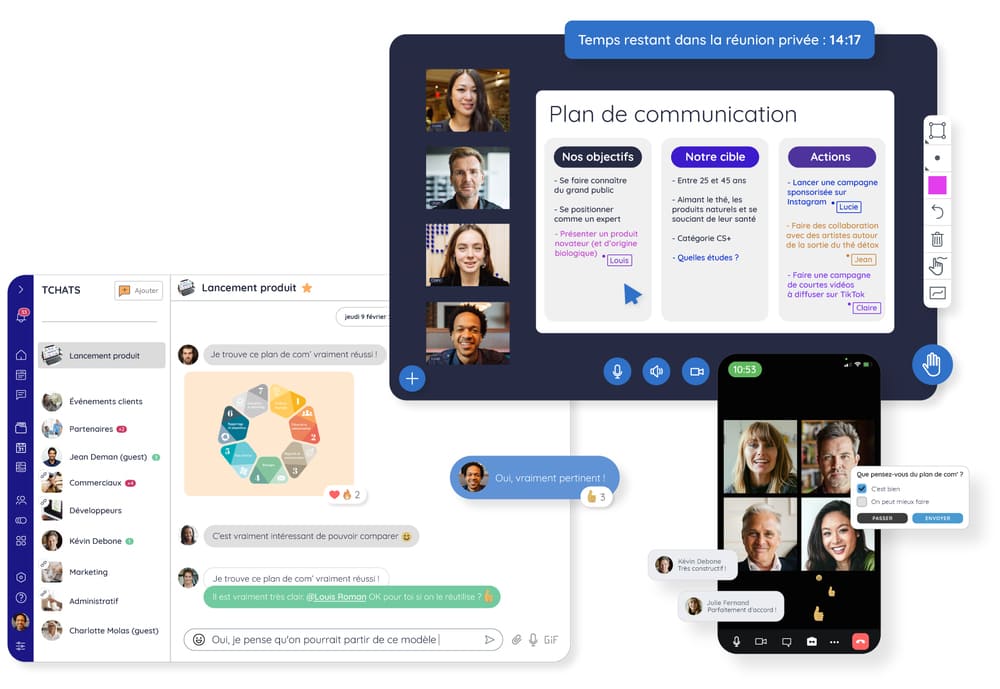
On these platforms, I no longer have to go searching for information — information comes to me. The platform is connected to all business applications and all external information sources I need day-to-day. Services pull this information into a single space so I can share it, discuss it with colleagues, and ask for feedback…
Where information was previously inaccessible — locked in application silos — it now becomes visible and flows freely. Where it was relayed with delay, often informally or through meetings, it is now transmitted in real time at the very moment an event occurs. And where information was once incomplete, partial, or distorted, it is now delivered accurately, factually, and in its raw state — free from the emotional filters we unconsciously apply. This way, I retain full freedom to receive and process it.
Read also: Collaboration: How to Stop Working in Silos (For Good)?
A New Way to Share and Work with Information
“Informing is not communicating,” explains Dominique Wolton in his essay of the same title. Information is the fuel, the raw material needed to better understand and sense things in the environment where I work. Enriched and supplemented by exchanges with others, their views and feedback, information-turned-into-conversation is an essential element of my decision-making, and of my ability to take new initiatives while reducing the risk of error. In a healthy environment, feedback on information is natural and continuous.
A New Way to Capitalize on Information
In this new world, the collaborative platform is a tool that serves the accomplishment of individual missions and, more broadly, the organization’s purpose. The information that flows through it serves this goal. Information is no longer the property of individual users, imprisoned in their inboxes. When someone leaves the organization, they no longer take with them all the knowledge exchanged in the course of their work. Information remains available, accessible, ready to be reused, enriched, and useful to others.
Read also: Collaborative Tools: A New Way of Working.
Toward a Paradigm Shift
At this point, you may share the conviction that a collaborative platform is something far more than simple features features for participation or commenting.
You certainly sense that this represents a new capacity for the organization to breathe “oxygen” of good quality — neither scarce nor polluted. You also certainly sense that deeper changes are needed are needed to produce and consume that oxygen. And that a technology like a collaborative platform produces nothing — it remains an inert body — in an environment that is not ready for it.
At this point, you also sense that this is a paradigm shift — not merely an evolution of email or an intranet with a few sharing and collaboration features bolted on. You may even perceive that housing a collaborative platform inside an intranet kills all hope of developing a collective intelligence platform worthy of your ambitions. Because between these two apparently similar solutions lies that mindset and posture shift that makes any “liberation” impossible. Because the DNA of an intranet cannot encode the behaviors required to genuinely build collective intelligence.
Will the Collaborative Platform Kill or Replace Intranet and Email?
The immediate answer to this question is: “no, not right away at least.”
The deployment of a collaborative platform in your organization is like introducing any new technology alongside those already in place. At first, no one really knows how it works; people try it, and can’t quite understand why this “thing” is being added on top of tools that already exist and “work.” Or even if they don’t work perfectly, familiarity has made the frustration fade. Why change, then? Sound familiar? And then new possibilities and capabilities emerge — for example, the ability to be informed of everything you need to do the job through platform connectors and services, and soon — very soon — through commands that increasingly assist users in their daily tasks. New capabilities, in short.
If your organization allows you to seize these opportunities (how sad to see so many companies buy a Ferrari only to keep it permanently in second gear…), and if you have the capacity to deploy these opportunities across your team or project, you progressively discover new ways of working that gradually render both email and the intranet obsolete for a growing range of use cases.
Just as the internet did not kill postal mail, your inbox and your intranet will still be around for a few more years — to the relief of some — but their lifespan and the number of use cases you rely on them for should drop considerably as you shift to this new technology of “working better together.”
Do You Need a Collaborative Platform?
A few words to close on this essential question: what is your company’s project? What is your purpose? What do you need to get there?
Do you need “hands” to scale something that works well today (will it still work as well tomorrow)? Do you need “heads” to imagine new solutions in an increasingly complex environment where change is accelerating?
Your urgency in deploying a collaborative platform is likely directly linked to your urgency to mobilize collective intelligence within your organization — a resource that, for the vast majority of companies, remains largely untapped. A resource whose value far exceeds the few euros in licensing fees per user that we are so often asked to justify.
This is an invitation to start right now, to stop waiting — on a small scale, with your team, a department, a unit — to let yourself be surprised, to iterate, and to keep going…
We want to contribute to your success and help you accelerate the achievement of your projects. It is with this goal and this understanding that we build Talkspirit. That is our reason for being.
– Author: Philippe Pinault, Co-founder of Talkspirit