
Does Employee Wellbeing Really Impact Productivity?

.svg)
- The link between workplace wellbeing and productivity has been documented for years: a Harvard and MIT study relayed by Harvard Business Review in 2011 describes happy employees as 31% more productive, 55% more creative and 6 times less absent.
- The evidence has since become causal: published in Management Science in 2023, a study of nearly 1,800 British Telecom employees links a one point rise in self reported happiness to around 12% more productivity.
- Disengagement is expensive: in France, the IBET 2024 index puts it at 14,840 euros per employee per year, and the INRS estimates the cost of work related stress for the country between 1.9 and 3 billion euros.
- Worldwide, Gallup measures only 20% of employees engaged in 2025, with 40% reporting a lot of stress the previous day and 34% describing themselves as thriving.
- A wellbeing policy comes down to four steps: clarify objectives with your teams, prioritize actions, communicate internally, adjust continuously.
- Six indicators are enough to measure the effect: absence rate, turnover, eNPS, participation in team rituals, repeated short sick leaves, deadlines and quality delivered at stable scope.
According to a study by Harvard and MIT published in 2011, happy employees are on average 31% more productive!¹ If that figure holds, workplace wellbeing does have a real impact on how much teams get done. More recent research has since confirmed the link, and even measured it causally. But what does it look like in practice? Is investing in quality of life and working conditions genuinely worth it for your organization? And if so, how can you tell?
Let's explore together why implementing a wellbeing policy matters, and how this initiative can have an impact on your company's performance.
Workplace Wellbeing: Why Does It Matter?
Investing in workplace wellbeing brings plenty of benefits, both for the company and for its people. Putting a wellbeing policy in place is a good way to:
- attract and retain talent,
- reduce employee turnover,
- improve your teams' physical and mental health (and prevent burnout in particular),
- strengthen their sense of belonging to the company,
- boost engagement and motivation,
- and more.
Even so, many companies still park wellbeing behind every other priority. The global picture suggests they should not. In its State of the Global Workplace 2026 report, which covers the year 2025, Gallup measures 20% of employees engaged at work worldwide, 40% saying they felt a lot of stress the previous day, and 34% describing themselves as thriving. We went through the same indicators for the 2024 edition in our article on the key figures of the Gallup study. And new ways of working keep shifting what quality of life at work actually covers.
Doing nothing has a cost too, and that cost can be measured. In France, Mozart Consulting computes its IBET index every year: according to the 2024 edition, built on 19.5 million private sector employees, the average cost of disengagement reaches 14,840 euros per employee per year.² The French occupational health institute INRS puts the cost of work related stress for the country between 1.9 and 3 billion euros.
In short, we strongly recommend implementing a workplace wellbeing policy within your organization.
What Impact on Productivity?
Can workplace wellbeing also impact performance? According to the Harvard and MIT study mentioned above, whose figures date back to 2011, the answer is yes. Happy employees are on average:
- 6 times less absent,
- 2 times less likely to be sick,
- 9 times more loyal,
- 55% more creative,
- and 31% more productive.
Why? Because these different wellbeing levers (absenteeism, health, creativity and loyalty) all feed into productivity.
And the link is more than a correlation. A study of nearly 1,800 employees in British Telecom call centres, published in Management Science in 2023 by researchers from Oxford, MIT and Erasmus Rotterdam, found that a one point rise in self reported happiness goes with around 12% more productivity. On the most complex tasks (negotiating, selling bundles of products, re-contracting), the gap gets closer to 20%. Happier employees do not work longer: they convert the time they spend at work better.
Company leaders see the same thing. In the Malakoff Humanis Fragilities Barometer 2025, a French survey of 450 executives and 2,060 private sector employees, personal fragilities among staff are named as weighing on engagement (52%), on company performance (43%), on the social climate (41%) and on absenteeism (38%).
 end HubSpot Call-to-Action Code
 Motivation and engagement play a key role in productivity. And to lift engagement, you usually end up acting on wellbeing (yes, it is all connected). Initiatives can aim to improve:
- working conditions,
- the balance between work and personal life,
- recognition at work,
- team cohesion,
- and more.
Read also: The Workplace as a Driver of Productivity and Employee Engagement
So it is settled: improving your teams' wellbeing at work helps boost their productivity. Now let's look at how to improve quality of life and working conditions in your organization.
4 Steps to Implement a Workplace Wellbeing Policy
As with any project, implementing a workplace wellbeing policy means taking it step by step. Here are 4 key steps to ensure the success of your program:
1. Clarify your objectives upfront, taking your teams' feedback into account
Start with a survey, for instance, to collect everyone's view. You can then adjust your objectives to the answers you get.
And do not forget to think SMART: specific, measurable, achievable, realistic and time bound objectives.
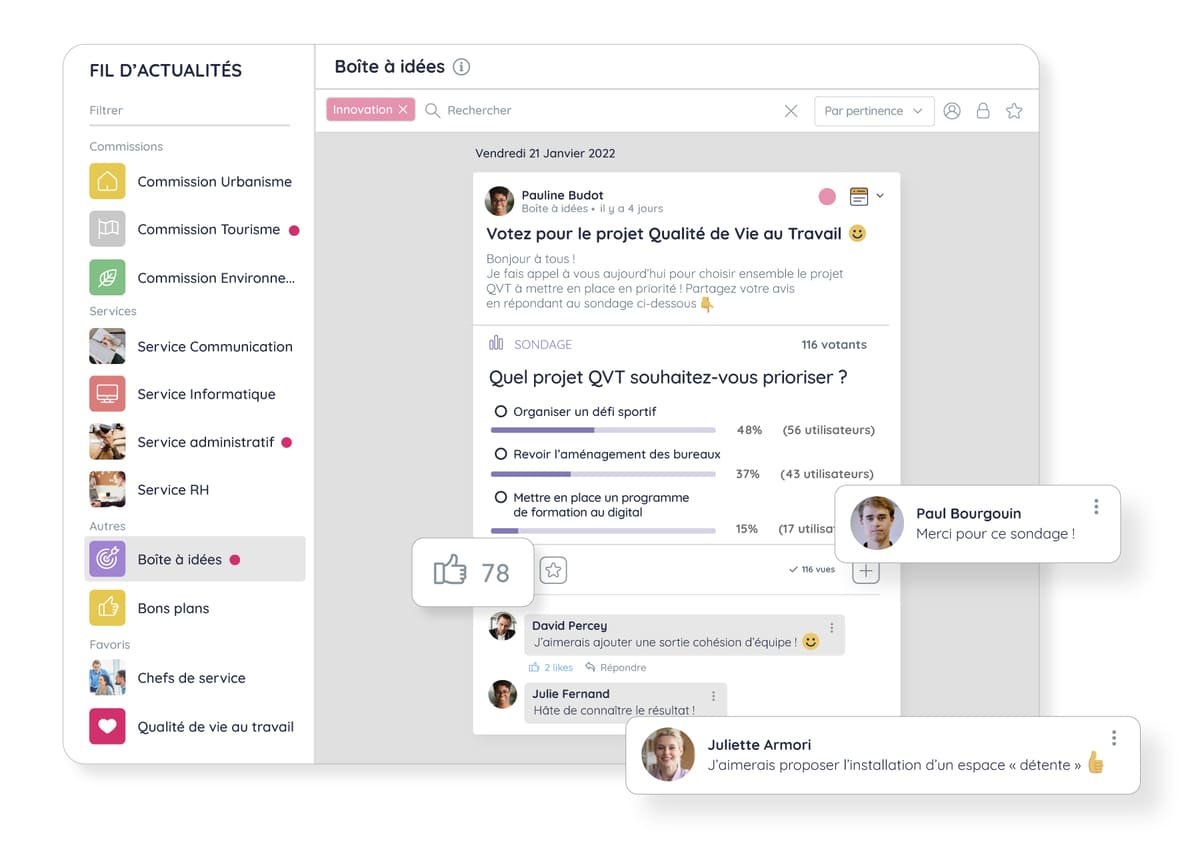
Did you know? The Talkspirit platform includes a poll module that lets you ask your teams for their opinion straight from your newsfeed. You can pick the answer format (multiple choice, free text or images), and make the poll anonymous. Everyone then votes for the answer of their choice and can add suggestions in the comments.
2. Prioritize actions based on the needs raised by your employees
For example, will you focus on actions aimed at:
- improving the layout of your workspaces,
- giving employees more flexibility,
- making the day to day more sociable,
- preventing psychosocial risks,
- and so on.
PS: run a second poll with your teams to help you prioritize the actions to launch. And if you are short on ideas, have a look at our guide gathering 10 examples of initiatives to improve wellbeing at work 👇
 end HubSpot Call-to-Action Code
 3. Communicate this policy internally
Your internal communication strategy plays a key role in the success of your wellbeing policy. It should explain:
- which initiatives are being launched,
- why they are being launched,
- and what they will bring to employees.
Need a hand building your action plan? Download our internal communication plan template 👇
 end HubSpot Call-to-Action Code
 4. Continuously adjust your policy
Your policy will keep evolving to match the needs of your organization and your teams. Keep an open mind and test new things regularly, and be ready to stop initiatives that do not work.
Above all: measure the impact of your actions, and keep listening to your teams.
How Do You Measure the Impact of Wellbeing on Productivity?
This is the question that decides next year's budget. Wellbeing does not come down to a single number: it shows up in a small set of indicators, measured before the actions start and then at a regular pace, over two or three quarters at the very least. Here are the ones a management team will listen to.
| Indicator | What it reveals | Where to find it | How often |
|---|---|---|---|
| IndicatorAbsence rate | What it revealsThe direct cost of poor wellbeing, and its trend | Where to find itHRIS, payroll | How oftenMonthly |
| IndicatorTurnover and average tenure | What it revealsYour ability to keep skills in house | Where to find itHRIS | How oftenQuarterly |
| IndicatoreNPS (would you recommend your company?) | What it revealsHow attached your teams are, in one question | Where to find itInternal survey | How oftenQuarterly |
| IndicatorResponse rate to surveys and team rituals | What it revealsReal engagement, beyond what people declare | Where to find itCollaboration platform | How oftenOngoing |
| IndicatorRepeated short sick leaves | What it revealsEarly warning signs of overload | Where to find itHRIS, occupational health | How oftenQuarterly |
| IndicatorDeadlines met and quality delivered, at stable scope | What it revealsThe effect on output, at comparable workload | Where to find itProject tracking tools | How oftenMonthly |
Two precautions. First, compare like with like, meaning the same team scope and the same season: absence in January has nothing to do with absence in June. Second, do not expect one isolated indicator to prove cause and effect. It is several signals moving the same way, over several quarters, that makes a policy defensible in front of an executive committee. And if the numbers get worse despite the actions you have launched, look at workload: our article on workload management lays out five strategies for avoiding burnout, and the one on boreout at work is a reminder that prolonged boredom does as much damage as overload.
👀 No more suspense: workplace wellbeing does have an impact on your teams' productivity, because it acts on key performance levers such as engagement, motivation, health, creativity and the quality of day to day relationships.
If you have not put a wellbeing policy in place yet, now is the time. Be careful, though, not to stop at surface level initiatives (no, unlimited snacks will not improve your teams' quality of life at work).
To get started, have a look at this article gathering 8 best practices to improve wellbeing at work. And to go further, you can download our practical guide below, with 10 examples of initiatives run by companies from various sectors.
Access the Practical Guide
In our practical guide “10 examples of initiatives to improve wellbeing at work”, you will find 10 quality of life at work initiatives run by French and international companies, along with advice, best practices and tools to make your own approach work.
¹ Harvard and MIT study, relayed by Harvard Business Review in 2011
² IBET 2024, Indice de Bien-Être au Travail, Mozart Consulting
FAQ
Yes, and the link has been established causally. A study of nearly 1,800 employees in British Telecom call centres, published in Management Science in 2023, shows that a one point rise in self reported happiness goes with around 12% more productivity, and closer to 20% on complex tasks. Older figures, relayed by Harvard Business Review in 2011, already described happy employees as 31% more productive and 6 times less absent.
In France, 14,840 euros per employee per year, according to the 2024 edition of the IBET index computed by Mozart Consulting on 19.5 million private sector employees. The French occupational health institute INRS also puts the cost of work related stress for the country between 1.9 and 3 billion euros.
With a small set of indicators, measured before the actions start and then at a regular pace over two or three quarters: absence rate, turnover and average tenure, eNPS, participation in surveys and team rituals, repeated short sick leaves, deadlines met and quality delivered at stable scope. Two rules: compare the same team scope in the same season, and never conclude from one isolated indicator.
20% worldwide in 2025, according to Gallup's State of the Global Workplace 2026 report. The same report measures 40% of employees who felt a lot of stress the previous day, and 34% who describe themselves as thriving.
Attracting and retaining talent, reducing turnover, improving the physical and mental health of your teams and preventing burnout in particular, strengthening their sense of belonging, and boosting engagement and motivation.
In four steps: clarify your objectives upfront, taking employee feedback into account, for instance through a survey; prioritize actions based on the needs they raise; communicate the policy internally, explaining which initiatives are being launched and why; then adjust continuously, measuring the impact of each action.