
6 Key Steps to Build an Internal Communication Strategy

.svg)
Building an internal communication strategy is an essential step for any company, institution, or association looking to streamline information sharing and to strengthen the cohesion of its teams, especially when those teams work in hybrid mode.
Read also: The 6 benefits of internal communication in the workplace
So how do you define your internal communication plan? What elements should it include? And how do you measure its effectiveness over the long term?
To help you get off to a good start, we've gathered for you 6 key steps to build your internal communication strategy.

1) Ask your employees for feedback
Your employees are the primary targets of your internal communication. So before building your strategy, take the time to ask them for feedback on your internal communication through polls, group interviews and/or one-on-one interviews.
Read also: [Webinar] Why and how to build a feedback culture?
Here are a few questions that will help you assess what to prioritize in your internal communication strategy:
- Which processes and tools do your employees find most useful?
- Which ones seem outdated to them?
- Where, when, how often, and on what device do they read your messages?
- What would their suggestions be to improve your internal communication?
This feedback will also be essential to better understand your employees' preferences and needs, and thus tailor your internal communication to your different audiences.
2) Define OKRs
Now it's time to define your objectives. Our tip: use the OKR method (Objectives and Key Results) to set objectives tied to key results, and thus clarify the priorities you'll set for yourself over the coming months.
These OKRs should be:
- set together with your entire team,
- aligned with your organization's objectives,
- clearly time-bound,
- ambitious,
- and measurable with several key results.
The key results (KRs) you define will depend directly on your objectives. For example, if your objective is to boost employee engagement, one of your key results could be to increase the number of likes and comments on posts shared on your enterprise social network by 10% over the next three months.
And if your objective is to centralize exchanges in a single tool, you could set yourself a key result of reducing the number of internal emails sent to your employees by 60% over the next 6 months.
Read also: The 7 major challenges of internal communication
If your key results are 60–70% achieved, then your objectives are considered accomplished. Conversely, if you reach 100%, that means they weren't ambitious enough!

3) Detail the topics to cover
Next step to build your internal communication strategy: think about the subjects you're going to communicate on in the coming months. For example, are you planning to roll out a new tool? To organize an event? To launch a satisfaction survey? To recruit new employees?
List all the topics you want to cover in a spreadsheet, and specify for each one:
- The associated objectives and budget,
- The target audience(s) (only certain roles, or all employees),
- The types of content you'll create (article, email, video, photos, post on your intranet, etc.),
- The channels you'll communicate on (newsletter, enterprise social network, email, internal newspaper, etc.),
- The dates of each communication,
- The KPIs to measure.
Short on time? Download this template to quickly build your internal communication plan. You'll find all the information to fill in for each topic, along with pre-filled examples to give you inspiration.
4) Create an editorial calendar and plan your actions
Once your strategy is defined, note all your important communications in an editorial calendar to get an overview of the dates to remember.
You can include the dates of your events, the launch dates of new tools and/or processes, public holidays, mandatory days off and/or vacations (if your company closes in the summer, for example), and any key date requiring dedicated communication.
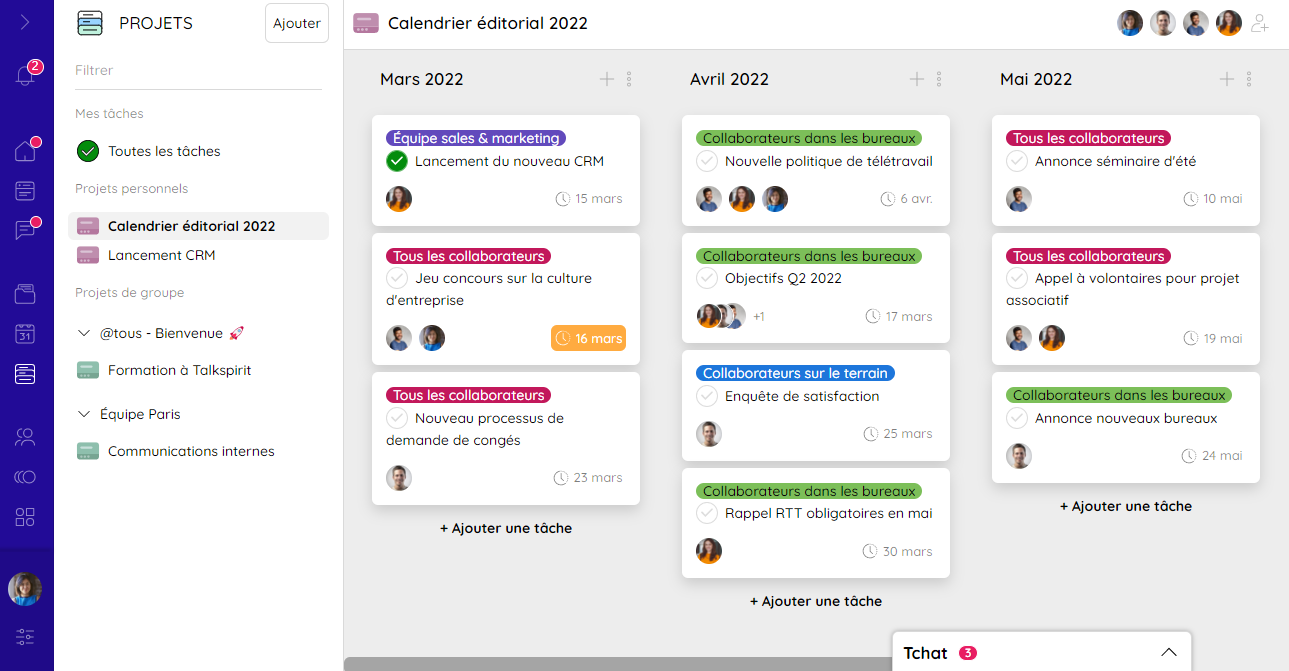
Then it's time to plan! For that, there's nothing better than a project management tool. Talkspirit, for example, has a Projects module that lets you organize your projects in Kanban-style boards. In particular, you can use it to:
- plan your communications month by month (or week by week),
- assign tasks and subtasks to your team members,
- specify the publication date of each piece of content,
- and track the progress of the different tasks.
Schedule a demo of the Projects module
Here's an example of what your project management board could look like in Talkspirit:
Read also: Talkspirit launches Projects, its new project management module
5) Identify the tools to put in place
To reach your objectives, you'll also need to identify the tools you need to:
- share your news with all your employees (including those without an email address),
- create discussion groups,
- schedule events,
- run polls,
- centralize your resources,
- plan the content to produce,
- and so on.
Whatever your needs, there are countless tools to help you implement your internal communication strategy. To help you make your choice, we invite you to check out our top 14 best software tools for internal communication.
However, be careful not to scatter information across too many tools at once. A good solution to avoid this problem is to opt for an all-in-one platform like Talkspirit, which will be able to meet all your needs.
Read also: How the Town of Venelles energizes its internal communication with Talkspirit
100% made in France, Talkspirit has, for example, a newsfeed, a customizable home page, a module for webinars and video conferencing, a chat, groups and a module for project management (as mentioned above).
6) Adjust your strategy continuously
Finally, remember to adjust your internal communication strategy continuously. Each quarter, take the time to assess whether or not you've reached your objectives. If some OKRs weren't met, try to identify the cause. Were your OKRs too ambitious? Did you allocate tasks poorly within your team? Or perhaps you had to deprioritize them to deal with more urgent issues?
This will put you in the best position to review your objectives and your internal communication strategy, and think about new initiatives to put in place.
Also remember to consult your employees regularly to gather their views on the actions implemented, and ask them whether they have new suggestions for improvement.

In conclusion
To sum up: building an internal communication strategy requires involving your employees, defining measurable objectives, identifying the topics you want to communicate on, integrating them into an editorial calendar, and putting the right tools in place.
To save you time, we've created an internal communication plan template that you simply need to fill in. Discover it now:
Access the template
In this template, you'll find: an example of an internal communication plan and editorial calendar, along with two ready-to-use spreadsheets to build your own internal communication strategy.
–
Author: Emmanuelle Abensur