
Our Step-by-Step Guide to Effective Governance Meetings

.svg)
A governance meeting is a structured meeting where team members gather to discuss and make decisions about the organisation's structure, roles, policies and processes — as opposed to tactical meetings, which handle day-to-day operations. The article sets out its objectives, explains the integrative decision-making process behind it, and gives a step-by-step template: check-in, agenda, presentation of proposals, clarification, reactions, objections.
Is your organization struggling to implement change? Do you employees often feel like they’re left out of important decisions that affect them? Whether you’re looking to change a role, a process or a policy, there’s an easy way to do it effectively, while involving your employees in the process. It’s called governance meetings!
In Holacracy and sociocracy, governance meetings help ensure that every team member’s voice is heard, and decisions are made collaboratively. Of course, practicing these methodologies isn't mandatory for organizing governance meetings. You can implement them regardless of your current structure or organizational model. It is, in fact, a key lever for fostering a sense of ownership and engagement among team members, leading to a more agile and responsive organization. So, why not give it a try?
In this article, we delve into what a governance meeting is, why it's essential, and provide a step-by-step guide on how to conduct one. By the end, you'll be able to run effective governance meetings, and thus accelerate change within your organization.
What is a Governance Meeting?
Definition
A governance meeting is a structured meeting where team members gather to discuss and make decisions about the organization’s structure, roles, policies, and processes.
Unlike tactical meetings, which focus on day-to-day operations and immediate task-related issues, governance meetings address the broader framework within which the team operates. This ensures that everyone’s roles are clear and that the organization's governance system evolves to meet current needs.
Objectives
The primary objectives of governance meetings are to:
- Clarify roles and responsibilities, to ensure every team member understands their roles and how they fit into the overall structure.
- Update or create new policies or processes, to improve workflow and address any emerging challenges.
- Resolve governance-related issues that may be hindering the team’s performance and well-being (such as overlapping roles or lack of clarity in decision-making authority).
Integrative Decision-Making Process
In Holacracy, governance meetings are structured using an integrative decision-making process (IDM). This process ensures that all voices are heard and considered, and promotes a collaborative approach to decision-making.
For a proposal to be implemented using this process, not everyone needs to agree with it, however no one must have an objection to it.
So, how does it work exactly? Read the next part to understand what are the key steps involved 😉.
What Does a Typical Governance Meeting Look Like?
Governance meetings typically follow a specific structure to ensure efficiency and effectiveness. Below is a detailed step-by-step template to guide you through it:
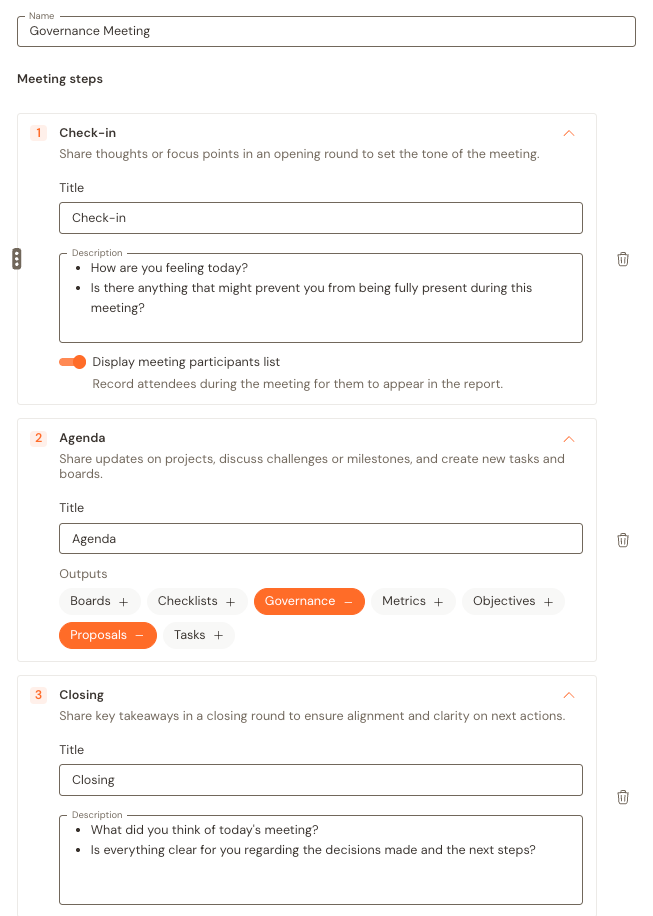
Check-in
Begin the meeting with a brief check-in, during which participants can share their current state or any pressing concerns. This is the time to ask questions like:
- "How are you feeling today?"
- "Is there anything on your mind that might distract you during this meeting?"
This will help everyone be present and focused during the meeting.
Agenda
Now is the time to examine and discuss the proposals that each participant wants to implement. Before starting the discussion, take time to add those proposals to the agenda (if it wasn’t done in advance already). Once everything is noted, you can follow the steps below 👇
.png)
1. Presentation of Proposals
Each team member starts by presenting their proposals one at a time. Proposals should address specific governance issues such as role definitions, policies, or processes.
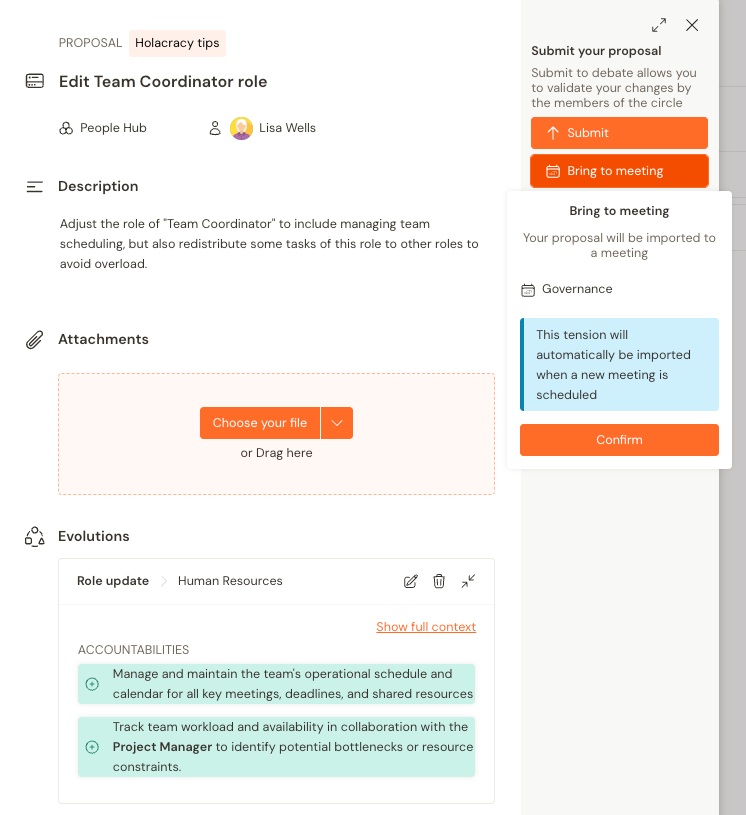
Here’s a proposal example: “Redefine the role of ‘Team Coordinator’ to include responsibility for managing team scheduling.”
To make sure each proposal is clear and valid, the meeting facilitator can ask questions like:
- "Can you summarize your proposal?"
- "What specific problem are you trying to solve with this proposal?"
2. Clarification of Proposals
Team members can then ask questions to clarify any aspects of the proposals, and get a good understanding of it.
For example:
- "Can you explain how the additional responsibility of managing team scheduling will fit into the Team Coordinator's current workload?"
- "What resources will be needed to support this new responsibility?"
3. Reactions to Proposals
Once the proposal is clarified, each team member can react to it. For example, they can voice support, concerns, or suggestions for improvement.
For example:
- "I support this change as it addresses our current scheduling issues."
- "I’m concerned that this might overload the Team Coordinator."
Based on everyone’s reactions, the person who initiated the proposal can clarify again the purpose of the proposal, and if necessary make some amendments to it (though it’s not mandatory to do it at this time).
4. Objections to Proposals
In the next round, the facilitator invites participants to raise objections one by one, by asking questions like:
- "Do you see any potential harm or issues with this proposal?"
- "Can you explain why you believe this proposal might cause a problem?"
Objections must be based on tangible issues that would cause harm or significant problems for the circle.
For example:
- "This proposal could increase the workload of the Team Coordinator."
- "There might be overlap with the responsibilities of the Operations Manager."
5. Integration and Amendment of Proposals
If objections are raised, the proposal is amended to make sure it takes those objections into account. The goal is to integrate feedback and create a proposal that works for everyone.
For example, the amended proposal could be: Adjust the role of "Team Coordinator" to include managing team scheduling, but also redistribute some tasks of this role to other roles to avoid overload.
If participants have no more objections, then the proposal gets accepted, and participants can discuss another proposal on the agenda.
💡 Pro tip: once a proposal is validated, create a follow-up action and assign a responsible role to ensure the proposal is acted upon after the meeting.
Closing
The facilitator ends the meeting with a brief closing round where participants can share their final thoughts or reflections on the meeting. This usually includes questions like:
- "What are your thoughts on today's meeting?"
- "Do you feel clear about the decisions made and the next steps?"
Best Practices for Conducting Effective Governance Meetings
To ensure your governance meetings are productive and effective, consider implementing the following best practices:
Clarify roles
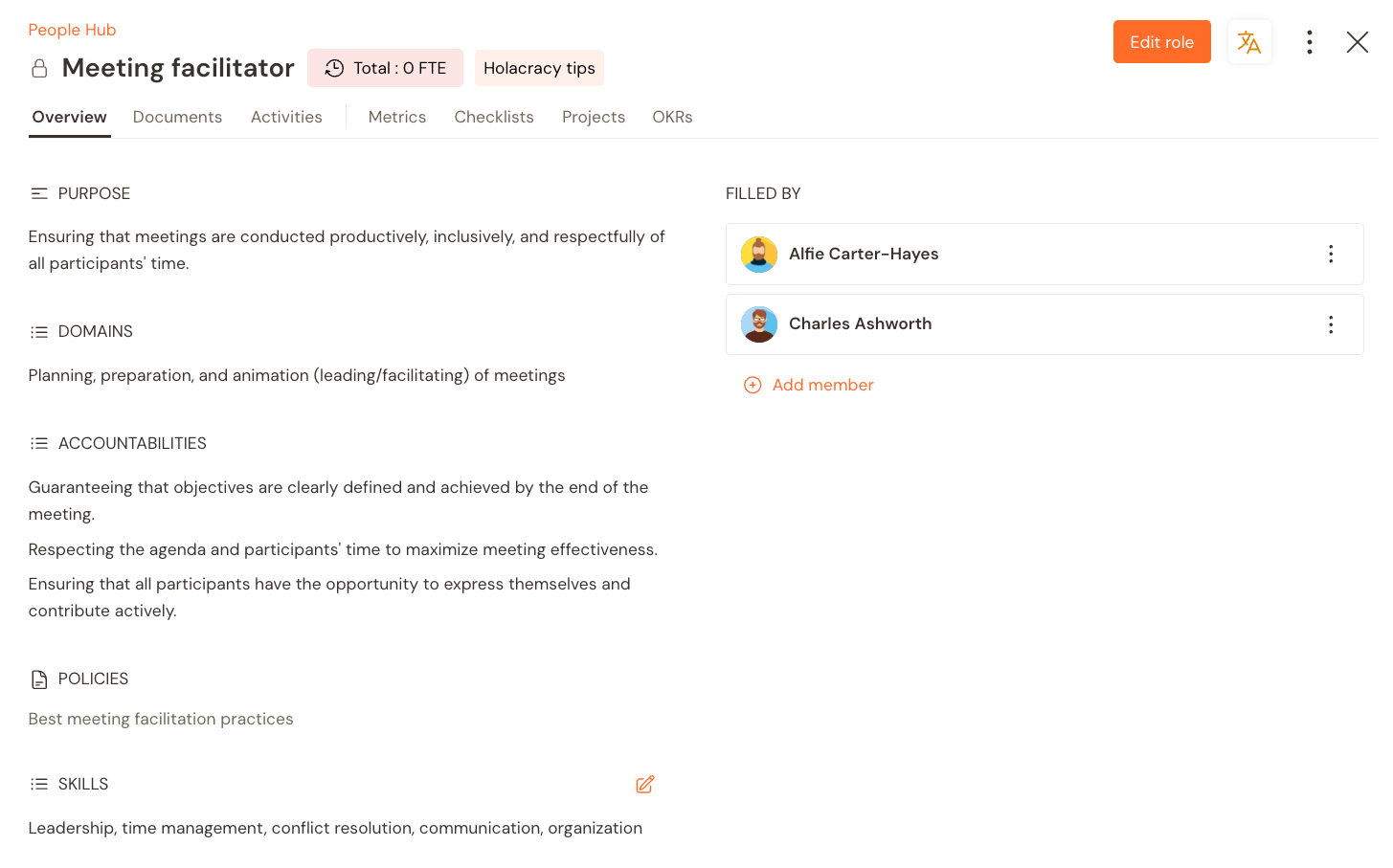
Clearly defined roles within the meeting help maintain structure and efficiency. Key roles include:
- Facilitator: Guides the meeting, ensures adherence to the agenda, and manages the discussion to keep it on track.
- Secretary: Takes notes, records decisions and actions, and ensures that all important information is documented.
- Timekeeper: Monitors the time to ensure the meeting stays within the allotted duration and each agenda item is covered.
Set a Frequency and Time
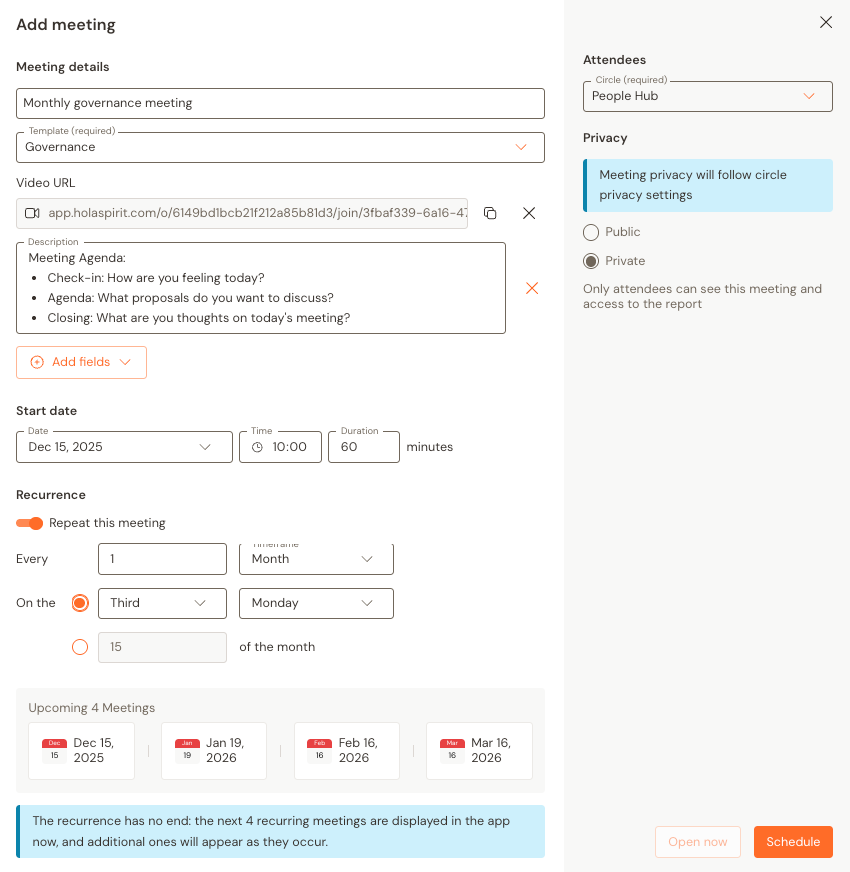
Establish a regular schedule for governance meetings to maintain consistency and ensure ongoing governance issues are addressed promptly. A good frequency might be once a month, but this can vary based on your organization's needs.
Moreover, make sure to allocate a specific amount of time for the meeting and respect this timeframe to avoid overrun. A typical governance meeting can last anywhere from 30 to 90 minutes, depending on the number of proposals on the agenda. So don’t forget to take that into account.
Foster Psychological Safety
Create an environment where team members feel psychologically safe to voice their reactions and objections without fear. This encourages open and honest communication, which is vital for effective decision-making.
Clarify the Next Steps
Ensure that the next steps are clearly defined at the end of the meeting. This includes:
- Documenting what was decided and why.
- Assigning follow-up actions to specific individuals or roles.
- Establishing deadlines for completing those actions.
Use a Dedicated Tool
Using a tool designed for governance meetings can help streamline the process. Talkspirit, for example, offers several features tailored for effective governance meetings:
- Meeting templates: Use predefined and customizable templates to structure your governance meetings and ensure they follow the process defined above.
- Proposal management: Give any member of the organization the possibility of making proposals to improve the organization's governance, and submitting these proposals for a vote during the meeting or asynchronously.
- Decision tracking: Record and follow up on decisions made during the meeting.
- Task management: Create and assign follow-up actions to specific roles or team members.
- Role definition: Clearly define and adjust roles as needed before, during or after the meeting.
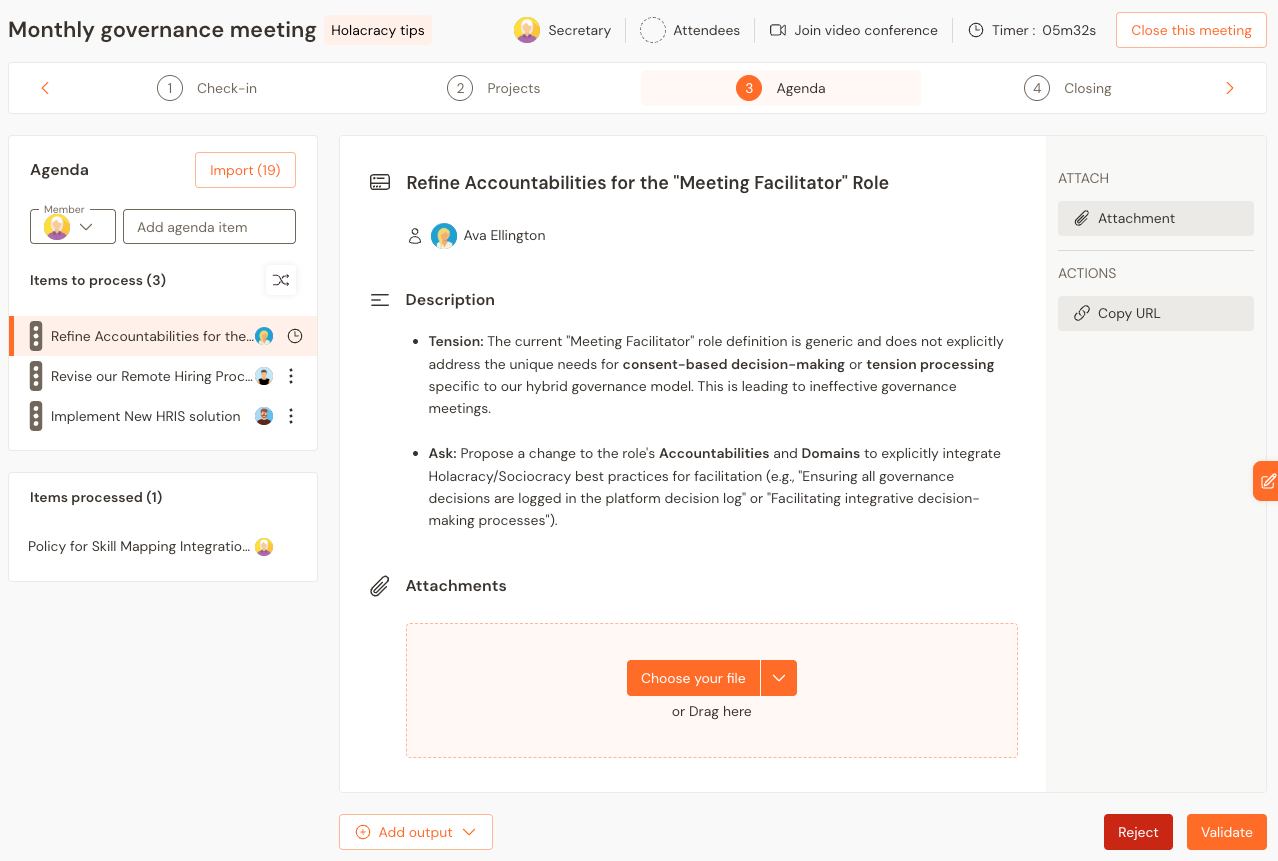
But Talkspirit is much more than a simple tool to facilitate meetings. It's a complete operational system that allows you to communicate, collaborate, and evolve the governance of your organization, keeping your teams aligned on a common purpose. All on a sovereign platform, 100% made in Europe, and which guarantees the security of your data. Schedule a demo now to discover how we can unlock the full potential of your organization 👇

To conclude
Clear roles and agenda, proper preparation, the use of tools like Talkspirit, and a focus on psychological safety and time management can help you conduct governance meetings that truly make a difference. By integrating these elements, you’ll be able to address governance issues efficiently, foster collaboration, and drive your organization towards its goals with agility and transparency.
Ready to see how Talkspirit can enhance your governance meetings? Contact our sales team to explore how our features can streamline your decision-making processes.
Eager to learn more about governance models such as Holacracy and Sociocracy, and the benefits they can bring to your meetings? Download our dedicated white paper on this topic 👇
Access the White Paper
In "The Ultimate Guide to Organizational Models," you will discover:
- Innovative organizational models (such as Agile, Teal, Holacracy, and Constitutional Management),
- Testimonials from organizations that have successfully adopted these models,
- Tips for choosing, implementing, and measuring the effectiveness of your model,
- The best tools for driving change smoothly.

FAQ
A governance meeting is a structured meeting where team members gather to discuss and make decisions about the organization's structure, roles, policies, and processes. Unlike tactical meetings, which focus on day-to-day operations, it addresses the broader framework within which the team operates.
Three objectives: clarify roles and responsibilities so every team member understands their roles and how they fit into the overall structure; update or create policies and processes; and resolve governance issues that hinder performance, such as overlapping roles or unclear decision-making authority.
No. Practising these methodologies isn't mandatory for organising governance meetings — you can implement them regardless of your current structure or organizational model. They are a lever for ownership and engagement whatever the model.
The process that structures governance meetings in holacracy. It ensures that all voices are heard and considered. The key rule: for a proposal to be implemented, not everyone needs to agree with it, however no one must have an objection to it.
It starts with a check-in, where participants share their current state or any pressing concern, then moves to the agenda. Each proposal is presented one at a time, clarified through questions, then opened to reactions — support, concerns, suggestions — before objections are processed.
Something specific and governance-related, about a role definition, a policy or a process. The article's example: redefine the role of Team Coordinator to include responsibility for managing team scheduling.


Explore similar articles
.webp)

Self-Management in Healthcare Teams: Using Feedback to Make it Work
Discover how self-managing healthcare teams thrive! This post reveals how effective feedback - from daily interactions to structured sessions - builds trust, aligns goals, and enhances patient care, drawing lessons from a Finnish initiative.