Remote Work: 6 Keys to the Right to Disconnect

.svg)
According to a Ugict-CGT survey from May 2020, nearly 80% of employees working remotely feel their right to disconnect is not guaranteed. An alarming figure when you consider that psychosocial risks (stress, isolation, burnout…) tend to be more prevalent in remote settings.
Yet few companies have introduced initiatives to encourage remote employees to disconnect regularly. The reasons? Often a lack of information on the topic, a lack of time to address it, and — less commonly, fortunately — a lack of interest.
Read also: Social isolation, overwork… : the risks of hybrid work
To take control of this issue and prevent the risks of hyperconnectivity among your remote workforce, here are 6 keys to help you uphold the right to disconnect in your organization:
1) Assess actual workload and working hours
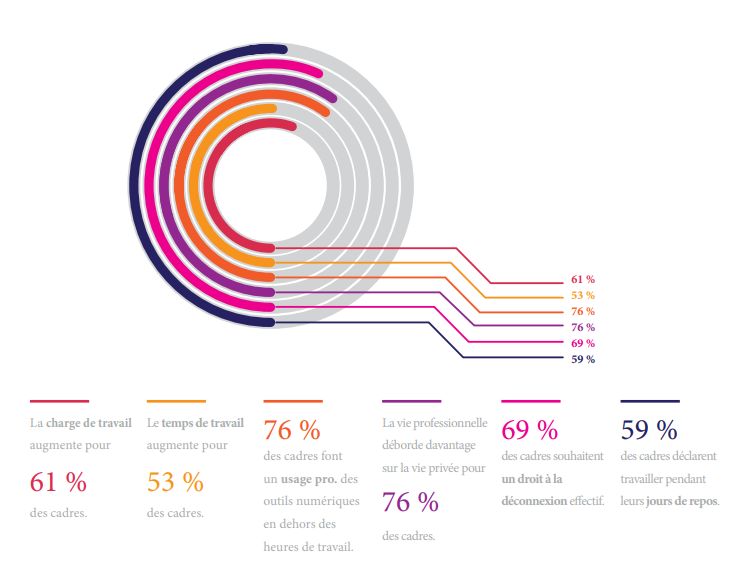
In recent years, employee workloads have grown continuously. In 2020, 61% of managers felt their workload had increased again compared to the previous year. As a result of this overload: 59% say they work on their days off, and 39% admit to working more than 45 hours a week.¹
Remote workers are no exception to this rule.
According to the same Ugict-CGT barometer from November 2020, 75% of managers feel that remote work does not protect them from excessive working hours. Quite the contrary.
Indeed, remote work often increases workload, or at least the "mental load" associated with work, which can prevent employees from "switching off" when they should.
To be in a position to guarantee the right to disconnect, the first step is to assess your employees' actual workload.
If this workload is too heavy, take action to reduce it; for example:
- adjust objectives and responsibilities;
- offer the employee training to improve their productivity, manage their time better, or delegate more effectively…;
- hire an additional team member.
Then monitor regularly how this workload evolves over time.
2) Set clear boundaries
Under the El Khomri Law (2016), companies with more than 50 employees are required to open negotiations on the right to disconnect with their employee representatives. If no collective agreement is reached, the company must draw up a charter. As for smaller companies: while not legally required, the law also encourages them to address this issue.
The key provisions of the charter or agreement can then be incorporated into your internal regulations, as well as into your employee handbook, or a summary document distributed to all employees.
3) Build a communication plan
Once the "disconnection" rules are in place, you can build your communication plan, aimed at promoting the right to disconnect across the company.
Several practical approaches are available to you. For example:
- Send a survey to all employees to gather more information about what prevents them from "switching off" when working remotely
- Leverage your internal social network to explain to employees the importance of the right to disconnect and highlight the risks of hyperconnectivity
- Send a dedicated newsletter on this topic, incorporating images, videos, key figures, and testimonials
- Schedule information sessions (via video conference) that give employees who wish to share their questions and experiences;
- Create a digital suggestion box (using a platform such as diBoks, Humanperf, or Beeshake) where employees can submit their ideas for initiatives to promote the right to disconnect
4) Raise awareness among managers and employees
Even if you have drawn up an agreement or a charter, that does not mean everyone will read it and follow the recommendations to the letter. That is why it is essential to raise awareness among all internal audiences (leadership, managers, and employees) about the right to disconnect.
Indeed, if managers keep sending messages late in the evening or at weekends, employees will sometimes feel obliged to respond — or worse, will start following their example "to make a good impression."
Leadership and managers are therefore the first people you need to engage.
This awareness effort should cover:
- the stakes of the right to disconnect (particularly hyperconnectivity);
- best practices for using digital tools (such as turning off notifications in the evenings and at weekends);
- and above all the behaviors to avoid (in particular sending emails or scheduling meetings outside working hours).
Do not hesitate to organize a dedicated training session on this topic, or a live Q&A session to address everyone's concerns. You can then summarize these exchanges in a document made available to all.
Read also: How to implement the right to disconnect?
Then encourage managers to lead by example and act as ambassadors for their teams. To change (bad) habits, middle managers will play a key role.
This direct communication will have far more impact on employees than overly "official" written communications. It will also help you reassure new hires working remotely who are unfamiliar with the company's "real" working hours.
5) Embed the right to disconnect in your company culture
What better way to encourage employees to switch off than to make the right to disconnect a core part of your company culture? It is the perfect opportunity to communicate regularly with employees — and to give your employer brand a real boost.
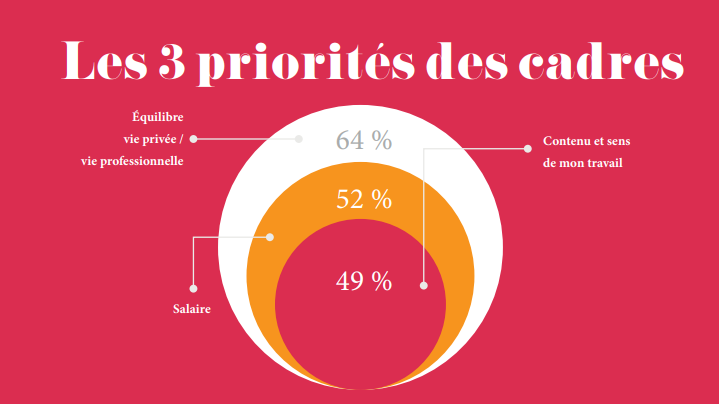
The UGICT-CGT Barometer 2020 further shows that the "right to disconnect" is also a key aspiration among managers: 69% of managers want it (an increase of 9 points compared to 2019). This growing concern reflects the top priority among managers today: maintaining a balance between their professional and personal lives (more important than salary or even sense of purpose at work).
By promoting this balance — and by extension the quality of work life (QWL) of your employees, you increase not only your attractiveness to potential candidates but also to your existing workforce!
6) Align your work tools
The tools you provide to your teams will also play a key role. But their sheer number can sometimes be a threat. Indeed, the more tools there are, the more notifications employees receive every day, which can increase their "mental load" and prevent (or discourage) them from "switching off."
If you struggle to rationalize your tools, it may be worth implementing a collaborative platform. By centralizing all features related to internal communication and collaborative work, it also makes it easy for employees to configure the time slots during which they no longer wish to be disturbed by notifications.
How the Talkspirit platform supports the right to disconnect
Talkspirit is a collaborative platform that brings together a wide range of communication and collaboration features (chat, video conferencing, drive, document co-editing, checklists, shared calendar, etc.). Its all-in-one nature means teams no longer need to juggle multiple tools to communicate or find information: everything is centralized in one place.
The platform also offers several features to promote the right to disconnect, whether in the office or working remotely: the ability to schedule connection and disconnection windows; a status setting that lets colleagues know you are on vacation, busy, or unavailable; scheduled posts, allowing you to publish announcements at a later time.
Our clients use these features to encourage their employees to disconnect from their digital tools. This is the case, for example, with the restaurant chain PUR etc., which lets employees freely configure their notifications on the platform. Alongside the rollout of Talkspirit, the chain also raised awareness among all teams about the importance of the right to disconnect.
Read also: Streamlining communication across a retail network: PUR etc.'s story
*
* *
In an age of remote work, the right to disconnect has become a must-have for companies that want to protect their employees' well-being and stand out to top talent. Scheduled emails, disconnection windows, remote connection monitoring… Examples of initiatives to support the right to disconnect are plentiful. All that remains is for you to get started!
Want to learn more about the right to disconnect? Download our white paper:
Access the white paper
Our white paper "Right to Disconnect: a survival guide for remote work" provides a comprehensive analysis of the challenges around the right to disconnect, best practices for implementing it, and concrete examples of initiatives introduced in companies.
¹ Ugict-CGT Barometer, November 2020
–
Author: Emmanuelle Abensur