
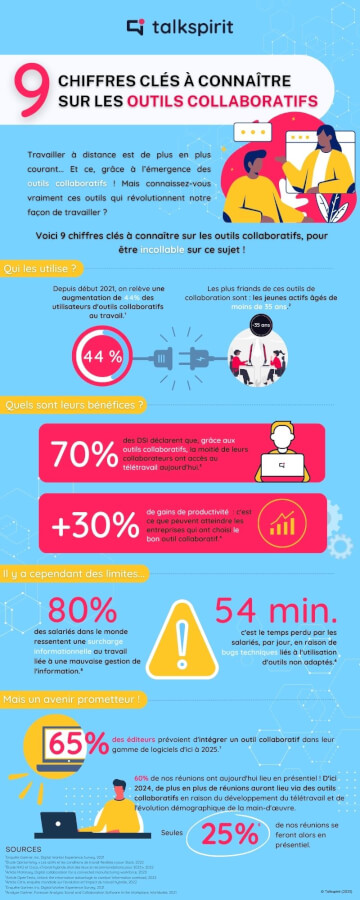
[Infographic] 9 Key Figures You Need to Know About Collaborative Tools

.svg)
- Nine figures, every one of them dated: the most recent go back to 2022, and the two forecasts quoted were made in 2021 for deadlines that have now passed.
- Adoption: close to 80% of workers were using a collaborative tool in 2021, against a little over half in 2019, a 44% rise (Gartner, 2021).
- In France, 40% of professionals used a digital HQ in October 2022, and 54% of those under 35 (OpinionWay for Slack).
- Benefits: 70% of IT leaders said in June 2022 that half of their teams had access to remote work, and McKinsey put the productivity gain from the right tool at up to 30% in 2020.
- Limits: 80% of employees reported information overload in 2022 (OpenText, against 60% in 2020) and 54 minutes a day are lost to technical glitches (Citrix, 2022).
- Since then, AI has entered these tools: in 2026, 36% of the respondents to the Blog du Modérateur and SocIAty survey of 807 digital professionals report AI use that is fully embedded in their company’s processes or mandatory.
Working remotely with partners or colleagues living on the other side of the world is increasingly common. And that is thanks to advances in technology and the rise of collaborative tools!
You are probably already familiar with some of the famous ones, but many others exist! For example, Talkspirit is an all-in-one French collaboration platform with many features that make it an essential tool for making group work more pleasant, and more productive.
Only a few years ago, collaborative tools were still little used in companies. It was the consequences of the health crisis (lockdowns, social distancing, etc.) and the rise of remote work that made these tools genuinely important to companies, and to a range of sectors: education, public bodies, healthcare, law, real estate, consulting, and so on.
Genuine levers and accelerators of new ways of working, collaborative tools can answer many use cases, from team cohesion in a shared space to improving employee productivity and more.
But how well do you really know these tools that are revolutionising the way we work?
Our infographic gives you 9 key figures you need to know about collaborative tools: everything you need to become an expert on the subject!
Every figure below is dated and sourced, so you know which year it describes and what each forecast is worth. If you are looking for a definition and an overview of the tool families first, start with Collaborative tools: a new way of working.
The New Collaboration: Teams United on a Single Tool
Technology is transforming the world, and the world of work has obviously not been spared. Year after year, collaborative tools adapt to the working environment of companies. The end of the Covid-19 pandemic proved it! In 2021, close to 80% of workers were using collaboration tools for work, compared with a little over half of workers in 2019, a rise of 44% in two years, according to the Gartner Digital Worker Experience Survey published in August 2021¹. It is the figure most often quoted on the subject, and it has not been refreshed since.
The keenest users of these tools are professionals under 35: 54% of them use a digital HQ, meaning a platform that brings together messaging, video conferencing and shared documents, according to the OpinionWay study for Slack run in October 2022 among 1,075 French professionals².
More broadly, at the same date, 40%² of all French professionals used a digital HQ, such as Talkspirit, to support their work.
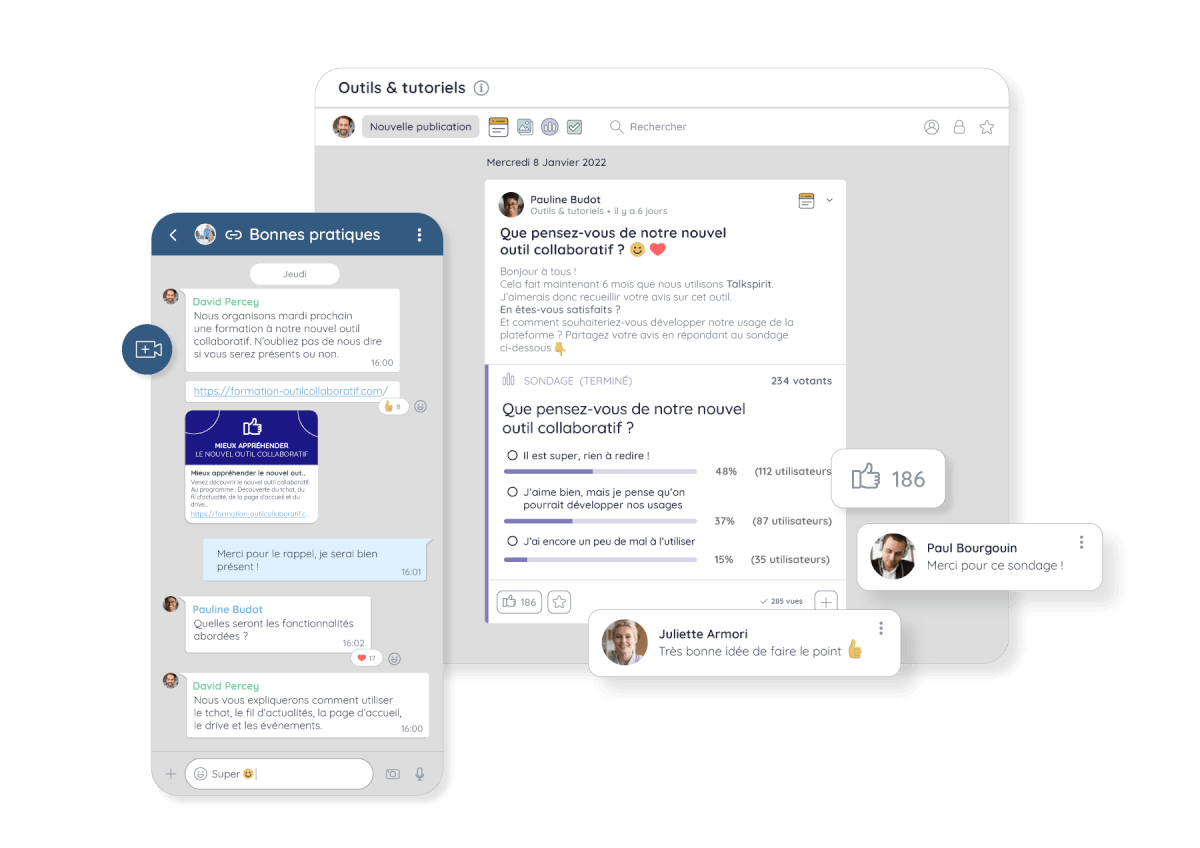
Talkspirit is an all-in-one French platform that lets you combine different modules to answer several use cases, from internal communication to collaborative project management. You are in charge, the choice is yours! Its features include:
- Chat and video conferencing so you never waste time again talking to your colleagues, even those on the other side of the world.
- A drive for sharing and centralising documents
- Groups for creating working circles by topic
- A news feed, so that everyone is continuously informed of the news that concerns them
We dive deeper into these figures in our infographic on collaborative tools. Click the banner below to download it!
What Are the Benefits of Collaborative Tools?
Collaboration is a lever for performance, and it proves even more powerful when collaborative tools are added to the mix. But that is not all! If companies are so keen on collaborative tools, it is also because they bring many benefits. They make it possible to:
- Develop new ways of working, such as hybrid work or remote work. 70% of the IT leaders surveyed in June 2022 by NXO and Cisco said that half of their employees had access to remote work, two days a week on average³.
- Make team collaboration easier through dedicated features: workgroups, chat and video conferencing, news feed, drive and more.
- Increase productivity. Companies that have chosen the right collaborative tool can achieve productivity gains of up to +30%, according to a 2020 McKinsey analysis of manufacturing teams⁴.
- Save time by bringing information together in one place
- Improve knowledge management and avoid the information overload that 80% of the employees surveyed worldwide by OpenText in 2022 said they suffered from, against 60% two years earlier⁵
 end HubSpot Call-to-Action Code
 Best Practices for Getting the Most Out of Your Collaborative Tools
Collaborative tools can be a real asset for companies and employees, but they have to be used strategically to be genuinely effective.
Before changing your work processes and adopting a new collaborative tool, you first need to know why and how you want to use it, so that you get the full benefit.
- Once that is clear, you will be able to choose collaboration software suited to your needs and ticking your various boxes in terms of price, usability, security and data confidentiality.
- We then advise you to create a charter for using the platform and to train your users continuously, to make sure everyone gets to grips with it.
To save time, you can also assess your needs with an expert! Employees lose around 54 minutes a day because of technical glitches linked to using unsuitable tools, according to the global Citrix survey on hybrid work published in 2022, which questioned 900 business leaders and 1,800 employees across eight countries.⁶ So make the right choice!
At Talkspirit, our experts are here to answer any question you may have! Contact us to get your personalized assessment:
What Does the Future Hold for Collaborative Tools?
Collaborative tools are also a thriving market, and one that is bound to change. But what lies ahead in the coming years?
Faced with growing demand, more and more vendors are developing collaborative features and making the market more competitive. Back in 2021, Gartner estimated that 65% of them would have added a collaborative tool to their software range by 2025⁷. That deadline has passed: we quote the figure as the forecast it was, not as a state of play.
Vendors will then have to innovate in order to better meet the needs of more companies and more users.
A range of technological developments are within their reach for creating innovative products and services: the metaverse, the rise of artificial intelligence, responsible technology, sovereign solutions and more. A boon for these providers, but also for the companies that will benefit from them!
The evolution of collaborative tools will affect organizations at several levels, starting with how meetings are run. In 2021, 60% of meetings took place in person, and Gartner expected that by 2024, with the growth of remote work and the changing demographics of the workforce, they would account for no more than 25% of the total⁸. Here too, this is a projection made in 2021, and we have no published measurement to confirm or contradict it. The underlying trend has held, though: a growing share of meetings takes place over video, through collaborative tools.
What 2026 Adds to These Forecasts
These projections were written before generative AI reached everyday work tools. The annual survey run in 2026 by the French tech outlet Blog du Modérateur with the consultancy SocIAty, among 807 digital professionals, gives an order of magnitude: 36% of respondents say AI use is either fully embedded in their company’s processes or mandatory, and 56.6% use it daily in their work⁹. The reading holds for that population, not for the workforce at large, but the direction is clear: AI features are no longer a demo argument, they are arriving in the tools people use every day.
For a collaboration platform vendor, the next question is where the data those features process actually sits, which is exactly what a sovereign solution answers. Before getting there, the most useful step is to look at what other organisations got out of their platform: we have gathered five examples, and compared elsewhere what email, an intranet and a collaborative platform each cover.
| Figure | What it measures | Source and year |
|---|---|---|
| Figure+44% | What it measuresRise in the number of workers using collaborative tools between 2019 and 2021 | Source and yearGartner, Digital Worker Experience Survey, 2021 |
| Figure54% | What it measuresShare of French professionals under 35 who use a digital HQ | Source and yearOpinionWay for Slack, October 2022 |
| Figure40% | What it measuresShare of all French professionals who use a digital HQ | Source and yearOpinionWay for Slack, October 2022 |
| Figure70% | What it measuresShare of IT leaders whose employees, half of them, have access to remote work | Source and yearNXO and Cisco, hybrid work survey, June 2022 |
| Figure+30% | What it measuresProductivity gain reachable with the right collaborative tool | Source and yearMcKinsey, 2020 |
| Figure80% | What it measuresShare of employees worldwide experiencing information overload, against 60% in 2020 | Source and yearOpenText, August 2022 |
| Figure54 min | What it measuresTime lost per day to technical glitches caused by unsuitable tools | Source and yearCitrix, global hybrid work survey, 2022 |
| Figure65% | What it measuresShare of vendors expected to add a collaborative tool to their range by 2025 (forecast) | Source and yearGartner, 2021 |
| Figure25% | What it measuresShare of meetings expected to still be held in person in 2024, against 60% in 2021 (forecast) | Source and yearGartner, Forecast Analysis, 2021 |
*
* *
With these 9 figures on collaborative tools, you are now a “tech ace”! You now know why and by whom collaborative tools are used, what their benefits are and what their impact on the future of work will be. And if you have a doubt, or a memory lapse, just refer back to our downloadable infographic at the top of the article!
Now that these figures are on the table, one question remains: how do you successfully roll out these collaborative tools? Find your answers in our webinar on the adoption of collaboration software!
Watch the Webinar Replay
In our webinar “6 key steps to boost the adoption of your collaboration software”, you will discover: the key steps to boost the adoption of your collaboration software, best practices for a successful onboarding, and the common mistakes to avoid.
–
¹Gartner, Inc. survey, Digital Worker Experience Survey, August 2021
²OpinionWay study for Slack, « Les actifs et les conditions de travail flexibles », October 2022, figures reported by France Num (OpinionWay no longer serves the study on its download page)
³NXO and Cisco survey, « Panorama du travail hybride 2023 », run in June 2022, figures reported by Le Monde Informatique
⁴McKinsey article, Digital collaboration for a connected manufacturing workforce, 2020
⁵OpenText article, Unlock the information advantage to combat ‘information overload’, August 2022
⁶Global Citrix survey on the evolution and impact of hybrid work, 2022, figures reported by Blog du Modérateur (the original Citrix page is no longer online)
⁷Gartner, Inc. forecast, 2021
⁸Gartner analysis, Forecast Analysis: Social and Collaboration Software in the Workplace, 2021
⁹Blog du Modérateur and SocIAty survey, « IA en entreprise en 2026 », June 2026, 807 digital professionals surveyed
FAQ
Close to 80% of workers were using collaboration tools in 2021, against a little over half in 2019, a 44% rise, according to the Gartner Digital Worker Experience Survey published in August 2021. It is the most quoted measurement on the subject and it has not been refreshed since. In France, the OpinionWay study for Slack run in October 2022 among 1,075 professionals found that 40% of them used a digital HQ.
Professionals under 35: 54% of them use a digital HQ, against 40% of all French professionals, according to the OpinionWay study for Slack run in October 2022. A digital HQ brings team messaging, video conferencing and shared documents together in one space.
They make hybrid and remote work possible: 70% of the IT leaders surveyed in June 2022 by NXO and Cisco said half of their employees had access to remote work, two days a week on average. They also make team collaboration easier, save time by centralising information and improve knowledge management. McKinsey put the productivity gain from the right tool at up to 30% in 2020.
80% of the employees surveyed worldwide by OpenText in 2022 reported information overload, against 60% in the same survey in 2020. The reasons given are round-the-clock information and the number of apps to check every day: it is a knowledge management problem as much as a tooling one.
Around 54 minutes per employee per day, because of technical glitches linked to poorly suited tools, according to the global Citrix survey on hybrid work published in 2022, which questioned 900 business leaders and 1,800 employees across eight countries. Hence the value of clarifying why and how you want to use a tool before changing your work processes.
The two forecasts quoted in this article were made in 2021 and their deadlines have passed: 65% of software vendors were expected to have added a collaborative tool to their range by 2025, and the share of meetings held in person was expected to fall from 60% to 25% by 2024. We have no published measurement to confirm or contradict them, so we quote them as projections, not as findings. What 2026 adds is measured, though: 36% of the respondents to the Blog du Modérateur and SocIAty survey of 807 digital professionals report AI use that is fully embedded in their company’s processes or mandatory.