Why Companies Should Keep Investing in Remote Work

.svg)
The remote work landscape: where do we stand? After the work-from-home mandate was lifted at the end of the Covid-19 pandemic, figures from February 2022 showed that "24% of employees continued to work remotely at least one day per week"¹. Remote work has become a reality for many organizations around the world, and for good reason!
Employees love the flexibility it brings, while employers see clear gains in productivity and cost savings. Yet remote work remains a contentious topic for some employers, who worry about social isolation, the challenge of maintaining a healthy work-life balance, and the difficulties around remote communication and collaboration. So why not double down on what works?
In this article, we’ll explore why it’s worth continuing to invest in remote work as part of your company strategy, and how such a policy benefits both employees and employers.

1. Benefits for employers
Employers have every reason to support remote work — particularly for two key reasons:
Access to a larger talent pool
Remote work has become a major differentiator in today’s job market. For younger generations, it’s a must-have that shapes employer brand perception. According to an ADP study, in 2022, 35% of remote workers were aged between 18 and 34 — up from just 27% in 2020. Candidates are increasingly demanding, and organizations are facing a workforce that expects roles they can perform remotely, or in a hybrid model that supports a good work-life balance.
By offering remote work options, you access a wider, more diverse talent pool without being limited by geography. You also signal to your employees that their well-being matters. This helps retain employees who feel more engaged at a company that listens and responds to their needs — a powerful asset for your employer brand strategy!
Lower energy costs
Companies don’t always have easy ways to cut spending, especially when costs accumulate across:
- electricity;
- lighting;
- water;
- food;
- office supplies, etc.
But remote work has demonstrated a measurable impact on corporate energy costs. ADEME estimates that widespread remote working could reduce corporate energy consumption by 19%, provided all employees work from home on the same day.
Read also: Reducing your energy consumption through hybrid work
2. Benefits for employees
Remote work — or hybrid work — is equally beneficial for employees. Here’s how!
Flexibility
Hybrid work offers employees a degree of flexibility by allowing them to work remotely on certain days. According to the Télétravail et Organisations hybrides barometer by Malakoff Humanis, this model is widely embraced by employees (82% of eligible workers want to adopt it) and leadership alike (63% believe it will continue to grow).
The advantage of hybrid work is that it helps maintain a healthy balance between professional and personal life, while keeping people connected with colleagues who work remotely and/or in the office.
Read also: Hybrid work: definition and key considerations for companies
Work environment
Working from anywhere brings greater flexibility and freedom — and that’s a top priority for many employees. The ADP Workforce View survey shows that “76% of remote workers are more optimistic about their professional future over the next five years, compared to 69% of their counterparts who commute to a physical workplace”.
This can be explained by several factors, most notably the work environment itself, which has a direct impact on how employees perform.
Remote work gives employees the ability to work in a personalized environment, free from the constraints of noise, workspace layout, lighting, and temperature. They can also personalize their home office freely, without encroaching on anyone else’s space. The perfect setup for the employee who always brings a photo of their cat or a favorite plant to work!
Productivity
According to a study by Labo Société Numérique, employees are more productive when working remotely, reporting a reduction in physical fatigue (85%), an improvement in well-being and health (82%), and greater efficiency at work (80%).
A healthy team is a growing company! By investing in remote work, you’re prioritizing the well-being of your teams — and there’s nothing better than a manager who genuinely cares. It will naturally encourage your teams to give their best in the motivating conditions you provide.
3. The bigger picture
A positive environmental impact
Working from home significantly reduces our carbon footprint, mainly by cutting down on commuting. According to ADEME, remote work reduces an individual’s carbon footprint by 69% compared to a day spent commuting to the office — a significant reduction given the overall impact of our working habits on the environment.
That said, remote work has its limits. As one expert from the French Senate’s prospective unit put it: “Remote work, by reducing commutes, contributes to the decarbonization of our economies. But it makes mastering our digital footprint even more critical”³. It can be hard to grasp the impact of our digital usage, but the growing production of IT equipment puts us face to face with another challenge: digital pollution. To address it, you can adopt eco-friendly habits or pursue a digital sobriety approach.
Read also: [BFM Business] How to reduce digital pollution in your organization?
Collaborative tools enabling remote work
More and more tools are emerging to meet the growing demand for remote work! Intranets, digital workplaces, all-in-one collaboration platforms… If you’re looking for a solution to organize remote work and boost productivity, you have plenty of options!
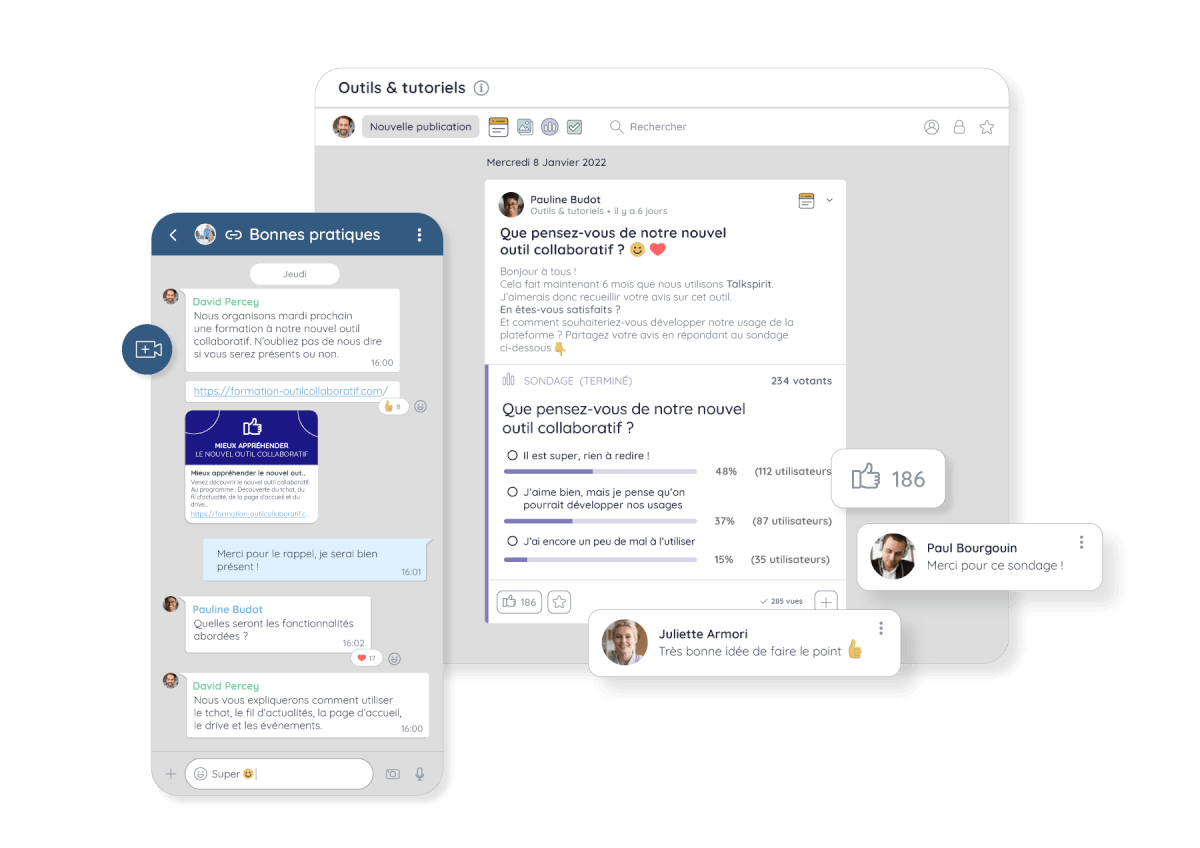
For example, Talkspirit is a secure 100% French-made digital workplace that simplifies information sharing, streamlines collaborative work, and drives internal communication. The solution includes a wide range of features designed to deliver the best possible employee experience.
Request a Talkspirit demo
Publishers have recognized that remote work is growing and that organizations need quality, data security, and feature sets that address multiple needs. That’s why the latest solutions are increasingly powerful and designed to make remote work seamless — so you can fully trust your teams, wherever they work. A great opportunity to support sovereign solutions and invest in home-grown technology.
*
* *
Remote work is a trend that continues to gain momentum — and for good reason. It can deliver real benefits for employers, employees, and the environment alike. It’s therefore worth continuing to invest in remote work to take advantage of these benefits and improve working conditions for everyone involved.
Integrating remote work into your company strategy means rethinking your organization’s ecosystem and ways of working. This transformation can be supported by the right tool: the digital workplace. But how? Our methodology guide can help!
Access the methodology guide
In our methodology guide 6 steps to setting up a Digital Workplace, you’ll discover: the criteria to consider when identifying your needs and choosing the right Digital Workplace, the key elements to include in your deployment plan, and best practices for driving engagement on your Digital Workplace.
¹ Labo Société Numérique report: Remote work: for whom, at what frequency, and what are the impacts on health, work and HR management? (2022)
² 8 figures on the evolution of remote work in 2022, Infoburomag (2022)
³« Senate: the future of remote work in eight questions » in the Labo Société Numérique report: Remote work: for whom, at what frequency, and what are the impacts on health, work and HR management? (2022)