
6 Best Practices to Improve Internal Communication in Local Government

.svg)
- Six best practices for internal communication in a local authority: tailor the message to the audience, craft quality content, involve elected officials, encourage upward feedback, break down silos between departments, and deploy an enterprise social network.
- Field staff are the blind spot: many have no work email address, so the tool has to be reachable from a mobile phone or they simply drop out of the loop.
- Elected officials are internal communication channels in their own right, and giving them a voice lends credibility to your messages with staff.
- Two obligations narrow the shortlist before any demo: the EU Web Accessibility Directive for public sector websites and apps, and the GDPR requirement to appoint a data protection officer.
- Hosting is the third question, and it has no single EU-wide label: where the data sits and which law the provider answers to belong in the procurement file, not in the renewal discussion.
- Formats matter as much as channels: varying length and media, and letting staff host or write the content, does more for reach than one more newsletter.
In the age of hybrid work, improving internal communication has become a top priority, for both companies and local authorities. According to a Parlons RH study, more than half of French employees are not satisfied with the way their organization communicates internally.
Beyond its role in sharing information, internal communication is essential for uniting and motivating teams, and fostering a sense of belonging. When used effectively, it can even boost engagement and the productivity of staff, and help retain them over the long term. That's why it should never be overlooked.
How do you succeed with internal communication in a local authority? Which channels and tools should you prioritize? And how do you involve all stakeholders? Here are 6 best practices to improve internal communication in local government organizations.
 end HubSpot Call-to-Action Code
 1. Tailor your internal communication to your audience
The most important first step is to learn about the audience you are addressing. For example, ask yourself:
- What is their role?
- Where do they work? (at the office, in the field, at home, etc.)
- What is their current work setup? (flex office, remote work, hybrid work, etc.)
- Which communication channels do they prefer?
- What IT equipment do they have access to?
Then think about how to adapt your internal communication to your audience. For example, if you are addressing staff working in offices, it may be worth going digital with your internal newsletter and favoring digital communication channels (such as instant messaging, webinars, intranet…).
Similarly, if your audience works mainly in the field, you will need to deploy tools they can access without an email address, using a mobile phone (for example, an enterprise social network).
Read also: [Digital transformation] Better connect your deskless workers (employees without email)
2. Craft quality content
Whatever your target audience, make sure to craft quality content and personalize it as much as possible. Be clear and communicate one key piece of information at a time to avoid information overload, and maximize the visibility of your messages.
Varying the format and length of content is also a great way to boost the reach of your messages. For instance, the city of Rouen created a weekly web-radio show called "Hebdo déclic" and a mini TV series called "Tête d'ampoule" to enhance its internal communication.
Don't hesitate to involve staff in the creation of this content, for example, by inviting them to write an article for the internal newsletter, host an episode of your internal podcast, or share their experience on video. Your content will be richer for it, and far more likely to resonate with your audience.
Whatever content formats you choose, it is essential to maintain a consistent communication rhythm (weekly or monthly, for example). With this approach, you can create your own internal communication rituals and embed them in a shared culture.
3. Involve elected officials
Of course, creating quality content is not enough to ensure it is seen and read by staff. For local authorities, optimizing internal communication also means engaging elected officials (mayors, and municipal, provincial or regional councillors, depending on the country).
By virtue of their executive roles, elected officials serve as representatives within local authorities. They are therefore powerful internal communication channels, essential for relaying key information and lending credibility to your messages.
There are several ways to involve elected officials in your internal communication strategy. For example, you can:
- give them a platform in your internal newsletter or at key events
- organize face-to-face meetings between elected officials and staff in the field
- ask them to share your organization's success stories in the press, to highlight the work of your teams
4. Encourage upward feedback
Beyond distributing information, internal communication should also be used to encourage upward feedback within local authorities. This information is invaluable, as it helps diagnose issues faced by staff and continuously improve your practices.
Several approaches can help you encourage feedback, for example:
- surveys and/or satisfaction questionnaires,
- suggestion boxes (physical or digital),
- individual and/or group interviews,
- employee engagement platforms,
- collaborative platforms,
- etc.
With these tools, you can create a space for open dialogue and encourage staff to put forward new ideas (ones you might never have thought of yourself!). Make sure to capture this feedback in a dedicated space so no insight is lost.
Read also: Webinar recap: "Why and how to build a feedback culture?"
5. Break down silos between departments
Improving internal communication in local authorities means building connections between staff, to eliminate the silos that can exist between departments. Like a marketing manager, your role will be to find the most engaging ways to capture staff attention.
For example, why not organize a contest or challenge that engages all staff, both office-based and field teams? It's hard to say no when there's a prize at stake! Alternatively, you can invite staff to take part in a sporting, cultural or community challenge (based on individual interests). Don't hesitate to look at internal communication initiatives run by other local authorities, such as the Essonne departmental council in France, for inspiration!
Another way to break down silos is to create groups dedicated to informal exchanges (on your internal social network, for example), where everyone can share anecdotes, interesting content, or even plans for outings. A great way to encourage conversations between staff!
Read also: [White Paper] The 7 challenges of internal communication in multi-site organizations
6. Deploy an enterprise social network
Despite what the name suggests, the enterprise social network is not just for companies. Local authorities can also use it to optimize their internal communication.
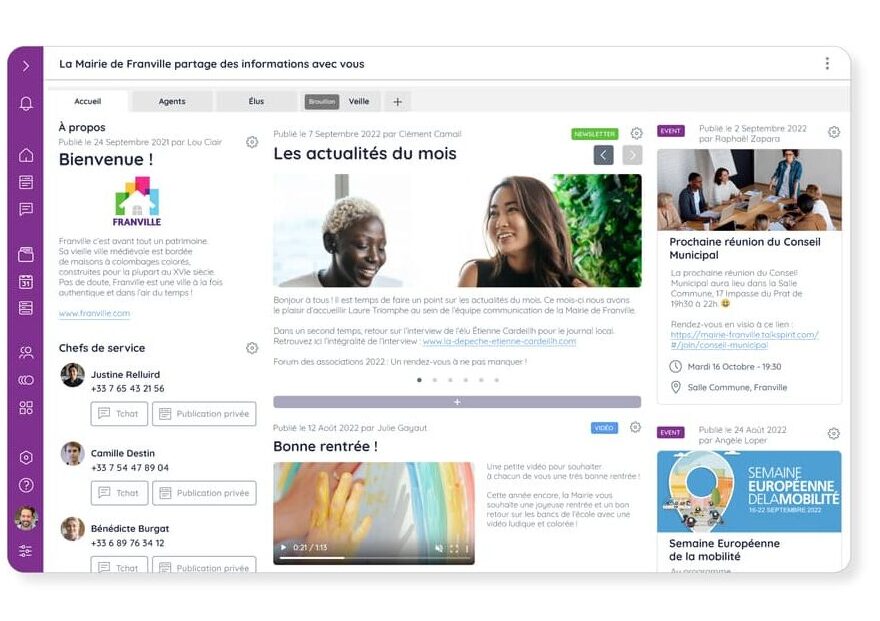
One of the biggest advantages of an enterprise social network? It streamlines the flow of information internally (through features like the news feed or homepage), ensuring everyone has access to the information they need, wherever they are. It also enables you to encourage cross-functional exchanges and facilitate peer-to-peer knowledge sharing (via groups, for example).
Read also: Improving knowledge management with Talkspirit: feedback from Pôle emploi
Some enterprise social networks, like Talkspirit, can even be used by staff who do not have an email address. This way, no one is excluded from internal communication.
The rules that apply to public sector organizations
A local authority does not choose its internal communication tools the way a private company does. Two obligations narrow the shortlist before any feature comparison, and a third question usually decides the procurement.
Digital accessibility. The Web Accessibility Directive obliges the websites and mobile apps of public sector bodies to be accessible, and it comes with three duties that are easy to forget during a tool rollout: an accessibility statement for each website and app, a feedback mechanism so users can flag problems, and regular monitoring by the member state. National rules go further in places. In France, for instance, the same obligation explicitly covers intranets and extranets, so it is worth checking what your own country requires before you sign.
Data protection. Under Article 37 of the GDPR, a data protection officer must be designated whenever the processing is carried out by a public authority or body, with courts acting in their judicial capacity as the only exception. Any tool that collects staff content, surveys, suggestion boxes, directories or discussion groups, goes through the DPO before rollout, not after.
Where the data sits. There is no single EU-wide label to point at here, so hosting stays a procurement question: which country stores the data, which law the provider answers to, and what happens to a transfer outside the EU. France answers it with a national qualification, the ANSSI’s SecNumCloud scheme, which gives a useful checklist of what a sovereignty requirement can look like even where it is not mandatory.
None of this is legal small print: each point removes tools from the shortlist before the first demo. Better to deal with them first.
| Requirement | What it covers | Who it applies to |
|---|---|---|
| RequirementWeb accessibility (Directive (EU) 2016/2102) | What it coversWebsites and mobile apps, with an accessibility statement, a feedback mechanism and regular monitoring | Who it applies toPublic sector bodies across the EU |
| RequirementData protection officer (GDPR, Article 37) | What it coversAny processing of personal data, including internal surveys and staff feedback | Who it applies toEvery public authority and body, except courts acting in their judicial capacity |
| RequirementHosting and data sovereignty | What it coversWhere the data is stored, and which law the provider answers to | Who it applies toA procurement criterion rather than a single EU-wide certification |
Read also: Optimizing internal communications in a public body: Anah’s experience
In conclusion
Internal communication is not always straightforward, especially in local authorities that are sometimes still catching up on digitalization. With these best practices, you now have some solid starting points to drive change and improve staff engagement. And above all, don't forget: digital tools, especially enterprise social networks, play a key role in your internal communication strategy. What is left is choosing the tool, then rolling it out: that is where adoption is won or lost, and we have set out the path in four steps. And if you are told the public sector lags behind on digital, the field says otherwise.
Still looking for the perfect solution? Check out our comparison of the 14 best internal communication tools for local authorities, and download our practical guide to discover real-world use cases.
FAQ
Because dissatisfaction runs deep: according to a Parlons RH study, more than half of French employees are not satisfied with the way their organization communicates internally. Used well, internal communication unites teams, builds a sense of belonging, and lifts both engagement and productivity among staff.
By deploying tools they can access from a mobile phone without a work email address, an enterprise social network for example. For office-based staff, the opposite applies: digitize the internal newsletter and lean on digital channels such as instant messaging, webinars or the intranet.
Two obligations and one open question. The EU Web Accessibility Directive requires public sector websites and mobile apps to be accessible, with an accessibility statement, a feedback mechanism and regular monitoring. The GDPR requires a public authority to designate a data protection officer. Hosting is the open question: no single EU-wide label settles it, so where the data sits and which law the provider answers to belong in the procurement file.
Because of their executive roles, elected officials act as representatives within a local authority. That makes them powerful internal communication channels, essential for relaying key information and lending credibility to your messages. Give them a platform in the internal newsletter, organize meetings with staff in the field, and ask them to carry your success stories in the press.
Through surveys and satisfaction questionnaires, suggestion boxes both physical and digital, individual or group interviews, employee engagement platforms and collaborative platforms. Whatever the channel, capture the feedback in a dedicated space so no insight is lost, and keep in mind that this data falls under the GDPR like any other.
Yes. It streamlines the flow of information internally through the news feed and the home portal, and encourages cross-functional exchanges through groups. Some enterprise social networks, Talkspirit among them, can even be used by staff who have no email address, so nobody is left out. Check the hosting arrangement and the accessibility level before you commit.