The Workplace as a Driver of Productivity and Employee Engagement

.svg)
It is easy to forget, but a pay rise is not the only way to keep employees productive, motivated and fulfilled. Other levers come into play, such as meaning at work, recognition, the relationship with the manager, and also the layout of the workspace.
For many companies, the workspace is a key driver of productivity and employee engagement. Yet it has to be said that it is not always laid out as well as it could be.
According to a JLL study, 64% of French employees are not convinced that their working environment makes them more productive. And 30% would like their company to improve the quality of its layout.
What real impact does the workspace have on productivity and employee engagement? How can you lay out your premises to make them as ergonomic as possible?
These are the two questions this article sets out to answer.

A driver of engagement
According to a global study by Steelcase, employee engagement is directly linked to how satisfied people are with their workspace. The result: the most engaged employees are also often the most satisfied with their working environment.
But they are only a minority. In France, more than half of employees are both disengaged and dissatisfied with their working environment.
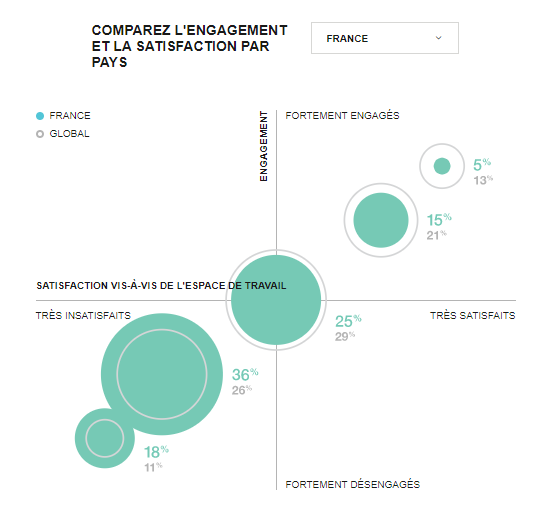
You will have gathered as much: improving employee engagement means paying particular attention to the layout of workspaces.
A Productivity Driver
According to JLL, 70% of French employees consider that the layout of their workplace supports their performance. It all depends, however, on how the workspace is organised. For example, employees say they are 50% more productive when they work in a closed office than when they are in an open space of more than 50 people.
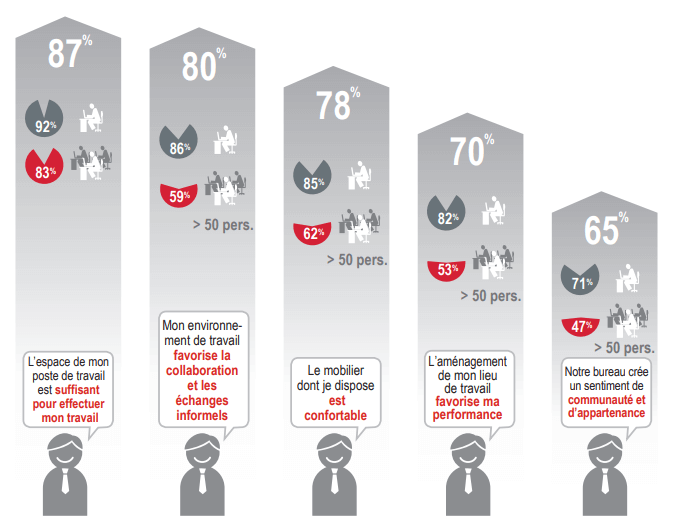
Of course, that does not mean you have to partition all your workspaces. The open space does keep several advantages. Beyond saving space, it makes communication between employees easier, and it also strengthens conviviality.
Other types of layout, such as the flex office or co-working, can also improve your employees’ productivity and wellbeing. That choice of layout will depend above all on your employees’ needs and expectations.
Best Practices for Designing Your Workspace
Here are 4 recommendations for creating the office your employees dream of:
1. Start by consulting them
Before completely redesigning your offices, survey your employees about their preferences. Ask them what kinds of spaces and furniture they need, who they work with regularly, and how often they work in project mode versus on tasks that demand deep concentration.
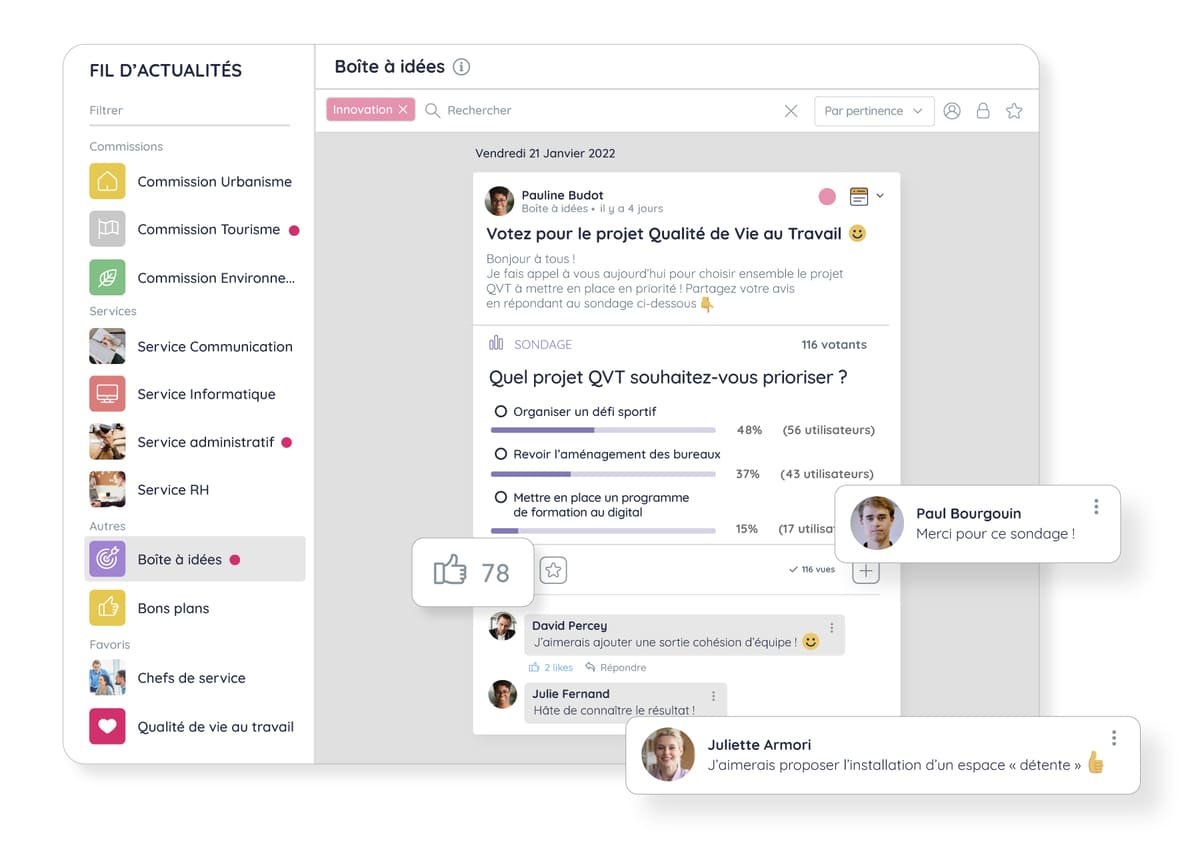
To conduct this survey effectively, you could, for example:
- post a poll on your internal social network;
- set up an idea box (physical or digital);
- run a brainstorming session;
- conduct individual or group interviews with a panel of employees;
- observe how different teams actually work.
Then inform them of the decisions made.
2. Offer a variety of work spaces
According to Steelcase, 88% of employees who are highly engaged and satisfied report that they can choose where to work within their company, depending on the tasks they have to carry out.
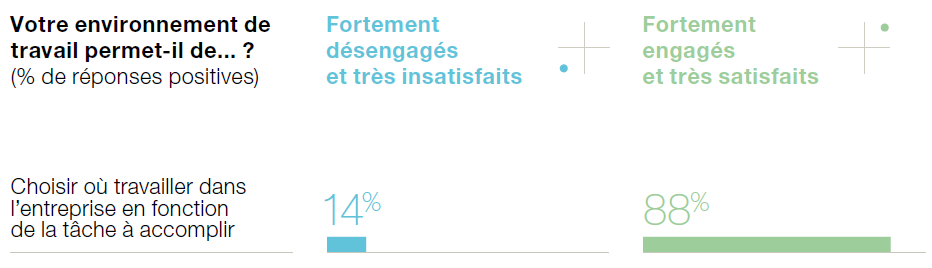
Having only partitioned offices or an open space is no longer enough to boost employee engagement and productivity.
To adapt to their new ways of working, the company has to create different spaces:
- some dedicated to collaboration and creativity;
- others for socialising and relaxing;
- others again for working quietly, with acoustic and visual privacy.
Read also: Remote Work: The Death of the Office?
Offering a variety of spaces will also help reduce noise disturbances at work, thereby limiting the associated loss of productivity (which affects more than half of French employees¹).
Diversifying spaces is the order of the day, and employees have understood this. According to a 2020 Wojo study, 56% of them believe that the “à la carte” office will replace the “traditional” office. In that setup, employees will be able to choose their workstation according to location, type of space, and the time at which they want to use it.
3. Design pleasant living spaces
In his article “The Happiness Dividend”, published in 2011 by the Harvard Business Review, the speaker Shawn Achor states that happy employees are 31% more productive than average. And to make them happy, you have to think of the working environment as a living space that should be pleasant.
For example, having plants in the office is highly recommended. Beyond their decorative role, plants can be used to absorb noise and purify the air. Their virtues are said to increase employee productivity by 15%², reduce fatigue by 38% and cut stress by 37%³. A real lever for quality of life at work.
And where there are plants, there is light, of course! Choosing a well-lit office is equally important for keeping employees healthy. According to a 2018 US study, employees who work in a naturally lit space are less likely to suffer from eye strain, visual impairment, and headaches.
Finally, do not hesitate to bring colour into your offices! As the interior designer Jean-Gabriel Causse explains in this video, colours can influence our intellectual abilities. For example, white and grey increase the risk of burn out and reduce productivity. Blue, on the other hand, encourages creativity, pink lowers stress and red stimulates team productivity.
4. Combine comfort and technology
Aesthetics are not everything, though. Because a good office is above all a comfortable, ergonomic one, which helps prevent musculoskeletal disorders.
So you will have to make sure the furniture lets employees change position when they need to, for example standing up for meetings, or sitting down to write a report.

Changing posture regularly can benefit employees’ health and productivity. According to a US study carried out in a call centre, employees using a sit-stand desk are 45% more productive than those who stay seated all day.
Fitting out offices with digital tools and infrastructure is also essential for working effectively. According to Parella’s 2020 barometer, it is the second key success factor for a good employee experience.
Several types of tool make employees’ work easier, in particular office software, collaborative tools and communication tools. To bring all these applications together, some companies deploy a digital workplace: an online office, accessible anywhere and any time, offering everything you need to work. That is what the French platform Talkspirit gives you. Available to all your employees, it centralises all your organisation’s important data and smooths the sharing of information internally.
Our digital workplace includes many features, in particular an office suite, a content library, a chat, a news feed, a welcome portal, video conferencing, and much more!
Discover how to create your digital workplace on Talkspirit
Finally, you can turn to one of the latest trends: connected furniture. Both attractive and functional, it improves the employee experience while optimising the use of workspaces. From the virtual whiteboard to the digital yurt, by way of the connected acoustic booth, there are many ways to move to the 3.0 office.
Conclusion
When it comes to workspace layout, there is no “one size fits all”. To turn the office into a source of productivity and engagement, the key is to diversify your workspaces and create a setting that supports wellbeing, having taken employees’ needs into account.
Beyond the workspace, there are of course other levers for keeping your employees productive and engaged. Read our practical guide for more tips on improving the employee experience:
Access the Practical Guide
In our practical guide “10 Best Practices to Improve the Employee Experience”, you will find: advice on creating a quality employee experience, examples of initiatives put in place by our customers, and tools to roll out within your organisation.
¹ 2019 Ifop study
² Study “The relative benefits of green versus lean office space” (2014)
³ Study “Greening the Great Indoors for Human Health and Wellbeing” (2010)