[2024 Study] Workplace Transparency: How Do French Employees Really Feel?

.svg)
Many companies today claim to be transparent — but are they really? To find out, we conducted a study with Ipsos at the start of the year, surveying 1,000 French employees. What we discovered is that only 12% of French employees find their company completely transparent!
So what does it actually mean to be a transparent company? For us, it means a company that makes information easily accessible internally and shares it with the right people.
This transparency of information is widely valued by employees. So what are the reasons behind the lack of transparency in companies? And how can we turn things around? Here are the key findings from our study with Ipsos, conducted between January and February 2024.
PS: Click here to access the infographic from the study, and watch the webinar replay below for a detailed presentation of the findings 👇
Transparency: a driver of performance and engagement
Adopting transparent internal communication delivers real benefits, both for the company and its employees. Consider:
- 48% of French employees feel it helps give meaning to their work
- 44% believe it boosts company performance
- 43% say it helps empower and give autonomy to employees
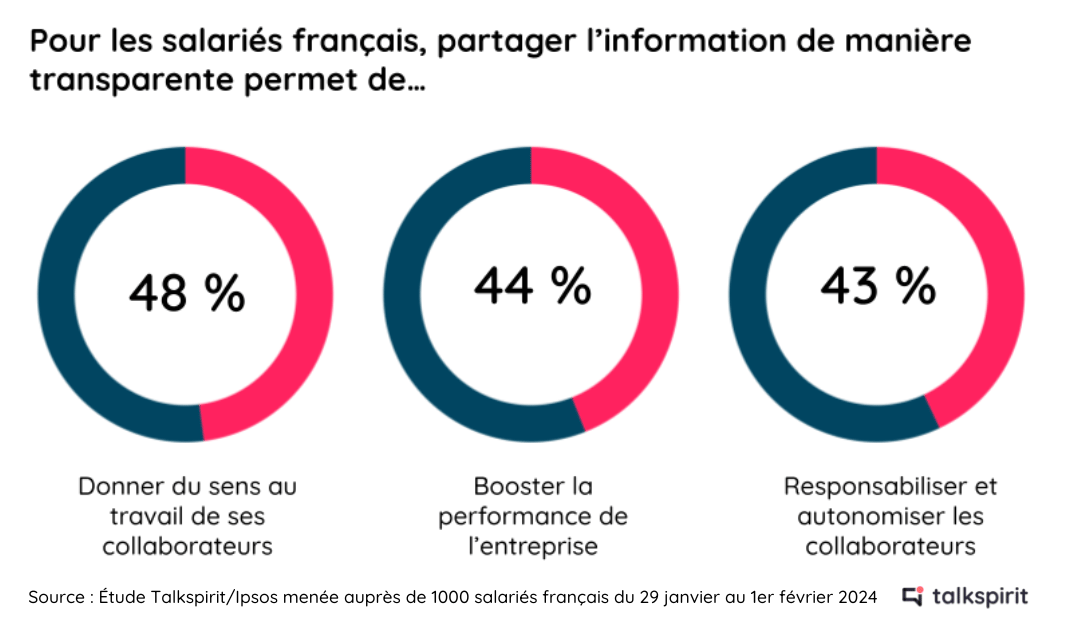
It is therefore a key lever for improving engagement and productivity at work!
Read also: What are the main drivers of company performance?
Employees skeptical about information transparency in their organization
On the surface, half of employees (53%) find their company fairly transparent. However, when you dig deeper, it becomes clear that most struggle to take a clear stance on the issue. Nearly a third (31%) find their company neither transparent nor opaque, and only 12% find it completely transparent!
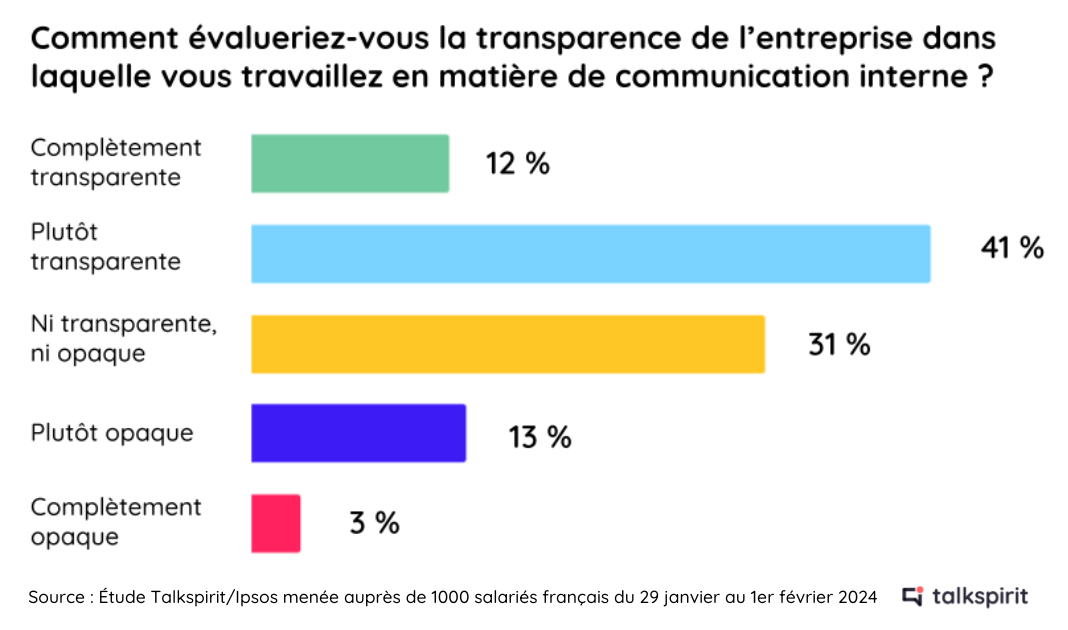
This lack of transparency is more pronounced in large enterprises, among Generation X and baby boomers, and among employees with more seniority. For example, only 43% of respondents from companies with more than 10,000 employees find their company transparent, compared to 60% in companies with fewer than 50 employees.
The reasons behind this lack of transparency
Several factors can explain the lack of transparency in companies. By analyzing the key figures from our study, we identified four. 👇
A lack of clarity
The first reason is a lack of clarity. When roles, processes, and company strategy are not clearly defined, the organization is perceived as more opaque by employees.
Indeed, 67% of employees who find their organization opaque also find their company's strategy for the next 12 months unclear.
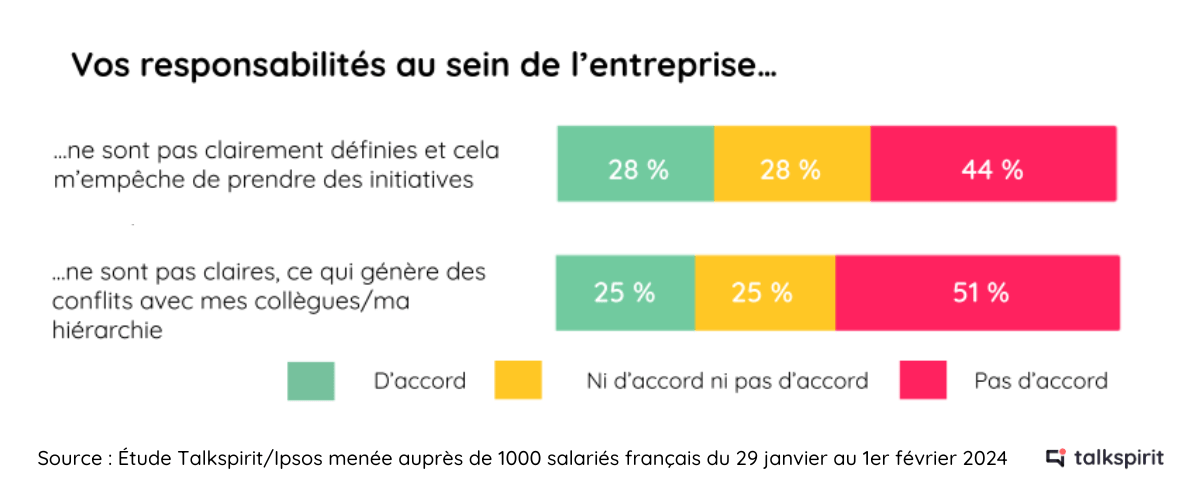
A lack of clarity around responsibilities can also hinder your employees' work. 28% say it prevents them from taking initiative, and a quarter say it generates conflicts with colleagues and/or management.
Infrequent communications
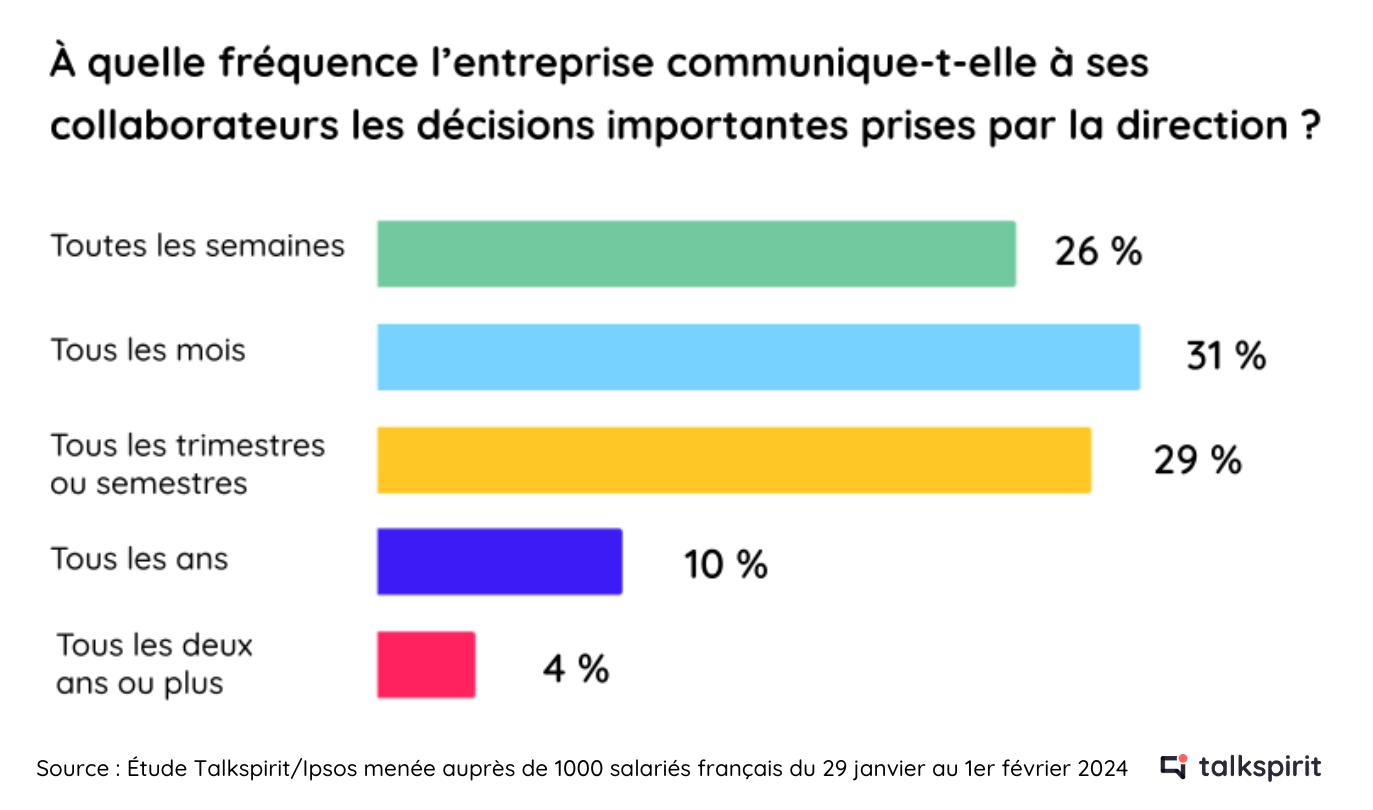
Irregular internal communication can also hurt your organization! 43% of respondents say their company communicates on important decisions at most once a quarter. That figure rises to 59% among those who find their organization opaque!
So to improve transparency in the workplace, there's no secret: communicate more frequently! The ideal is to communicate at least once a month, or more frequently depending on the nature of the information you need to share.
Poor information sharing
Be careful, however, to keep information relevant and clear! 45% of French employees believe that an organization that shares information poorly can create confusion and disengage its workforce.
Being transparent doesn't mean sharing everything with everyone. What matters is sharing the right information with the right person, in order to avoid information overload and its pitfalls.
Read also: [OICN Study] Information overload: what is the impact of our collaborative practices?
Also try to minimize the number of tools you use. 23% of employees believe that an organization sharing information across too many different channels can become anxiety-inducing. To avoid this, the best approach is probably to centralize your internal communications on a single tool! Good news: that's exactly what Talkspirit 😉 enables.
Inadequate tools
Keep in mind that not all communication tools are created equal, and the most widely used are not necessarily the best.
Email (56%) and team meetings (55%) remain the most common formats for communicating management decisions. However, they are not the ones that actually make a company more transparent — quite the opposite!
Business communication and collaboration apps (like Talkspirit), meanwhile, are less popular. Yet companies that use them are perceived as more transparent by their employees.
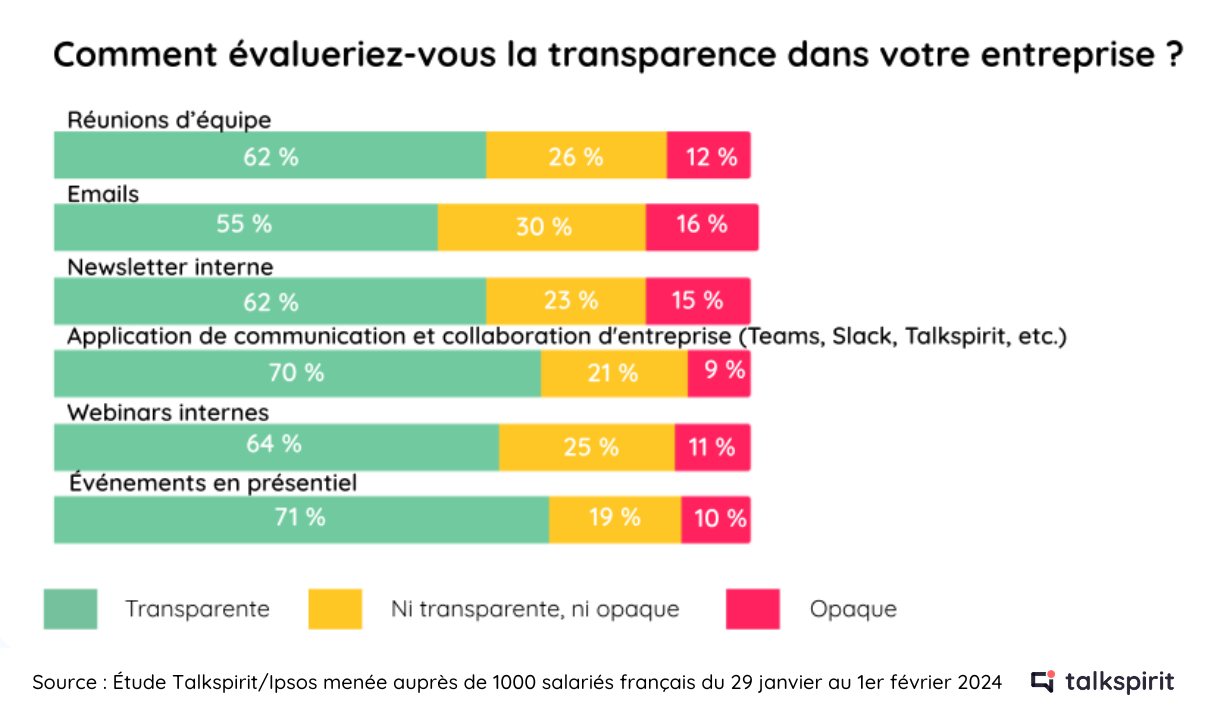
Indeed, 70% of respondents whose company communicates important decisions via communication apps find their organization transparent. By contrast, only 56% of respondents whose company communicates by email share the same view.
Topics to prioritize to improve workplace transparency
So, which areas need more transparency in the workplace? Everything that directly affects employees!
41% want more transparency around salary scales and bonuses. This is followed by career advancement conditions (35%), employee benefits (28%), and training entitlements (26%). In other words, everything related to their well-being and development at work.
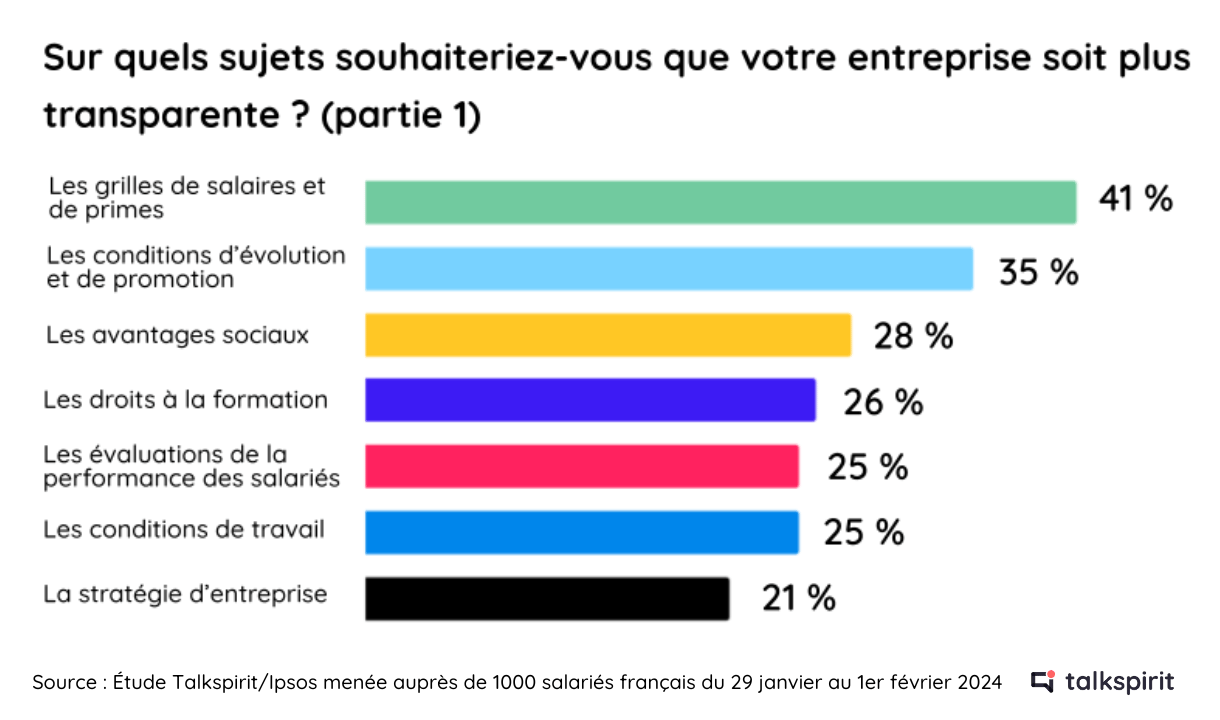
Company-wide topics, by contrast, are seen as secondary:
- 21% of employees want more transparency on company strategy,
- 20% on the company's financial performance,
- 18% on team objectives and expected performance.
Finally, company values (15%) and corporate social responsibility (11%) bring up the rear. This clearly shows that what matters most to the company isn't necessarily what matters most to employees.
Best practices for improving workplace transparency
Now that you know exactly where to focus your efforts, you may be wondering which initiatives to put in place to gain greater transparency.
Here are a few tips that could be useful:
- Map roles and responsibilities for every individual on a dedicated tool (Holaspirit, for example), to clarify who does what in the organization.
- Document your processes and policies, and make them accessible to everyone who needs them. In particular, highlight policies related to pay, advancement conditions, and training.
- Set clear objectives, and connect your teams' goals to company objectives so everyone understands how their work contributes to overall performance.
- Deploy a single internal communication tool (such as Talkspirit) that brings together all company news. That way, employees no longer need to check multiple tools to find the right information.
- Create topic-based groups on this tool, invite the right people, and share your communications there. This ensures employees only receive information that is relevant to them.
- Ban internal emails, and ask employees to use your internal communication tool instead.
- Rely on ambassadors (or communication relays) to get your messages across to frontline teams.
- Involve your employees in decision-making, and keep them informed about important projects you're working on (especially those likely to affect them).
- Create internal communication rituals, both on your digital tools and in person.
PS: watch this video for top tips from our CEO Philippe Pinault ▶️
In conclusion
What we take away from this study is that transparency has many benefits in the workplace. It not only gives meaning to work, but also boosts team productivity. Yet when only 12% of French employees consider their company completely transparent, it is clear there is still a long way to go.
To improve information transparency — and by extension company performance — it is important to share the right information with the right person in the right place. Ditch the lengthy email chains and opt instead for tools that allow you to centralize your communications.
Finally, make sure you provide greater clarity on roles and responsibilities, work processes, and all the topics your employees care about (salaries, advancement conditions, etc.).
Want to go further? View the infographic for a more visual overview of the figures, and download the full report from our study with Ipsos 👇
Access the Study Report
This report brings together all the key findings from our 2024 study on workplace transparency, conducted in partnership with Ipsos. You will discover how employees perceive internal communication in their company, how it affects their productivity at work, and which topics they want more transparency on.