
The best internal communication tools for a multi-site organisation

.svg)
A multi-site organisation does not lack internal communication tools. It lacks a way to get the right information to the right people on every site, including those who have neither a desk nor an e-mail address. In 2026, three families of tools answer that need. Publishing platforms (LumApps, Haiilo, Sociabble, Jamespot) broadcast information from headquarters. Frontline apps (Staffbase, Beekeeper, Flip, Speakap, Steeple) reach employees without a workstation. Communication connected to the structure (Talkspirit) addresses information to teams, sites and roles as they exist in the organisation, and follows their changes. This comparison reviews ten tools and proposes a selection grid for an organisation of 250 to 5,000 people spread across several sites.
When an organisation grows from one site to several, internal communication stops being a question of channels and becomes a question of targeting. Headquarters e-mails everyone. The production site does not read it, because half of its teams never open a mailbox. The subsidiary acquired last year receives it, but it does not concern them. And the site manager, who should relay it, hears the news from a colleague on another site.
What we see across the multi-site organisations that use Talkspirit is that the problem is rarely the number of channels. It is that the channels ignore the structure. They know distribution lists, not teams, sites, entities or roles. And when the organisation changes, the lists stay.
What changes when the organisation is multi-site
Three problems appear with the second site and get worse with each one after.
- Reaching those who have no desk. In industry, logistics, healthcare and retail, a large share of employees has neither a workstation nor a professional e-mail address. Internal communication that relies on e-mail does not reach them.
- Targeting by site, entity and function. A notice about a warehouse’s opening hours concerns that warehouse only. A decision on purchasing policy concerns every buyer, whatever their site. Without targeting, everyone receives everything, and nobody reads any more.
- Keeping a single source when the structure moves. Reorganisation, acquisition, opening of a site: every change makes the distribution lists wrong. Internal communication then depends on someone remembering to update them.
The third problem is the least visible and the most expensive. It explains why multi-site organisations pile up tools without information circulating any better.
Three families of internal communication tools
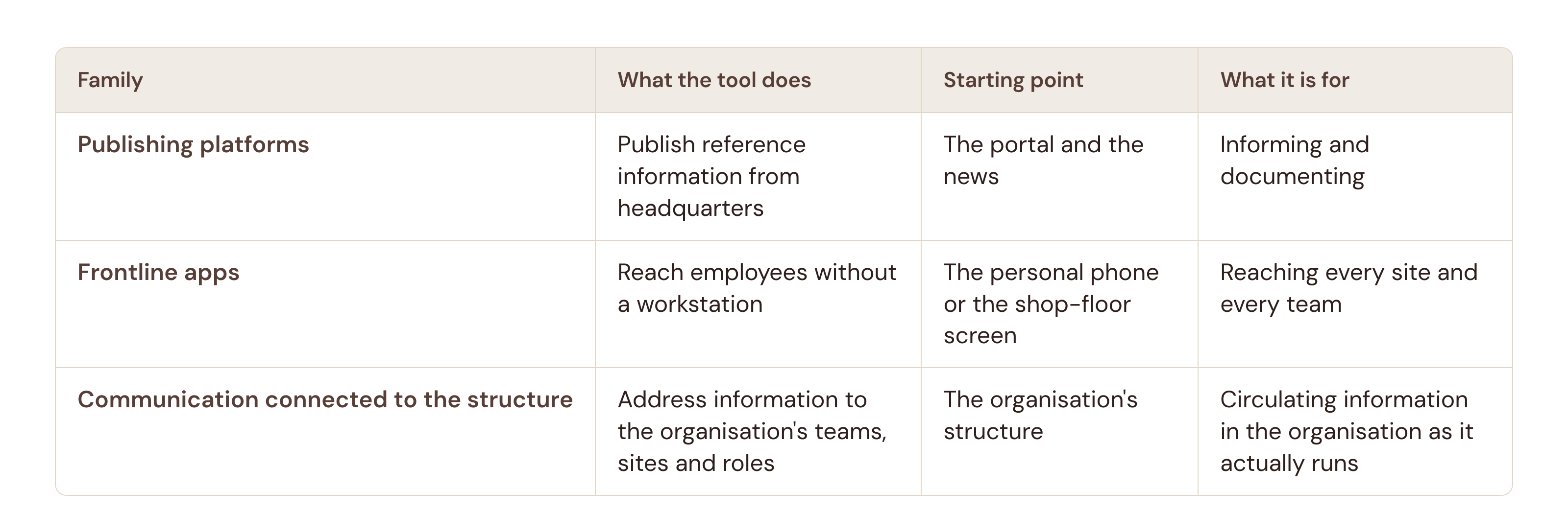
Before comparing tools, you need to know which family you are looking in. The three families answer different needs, and many multi-site organisations combine two of them.
Publishing platforms. Publish reference information from headquarters. Starting point: the portal and the news. Use: informing and documenting.
Frontline apps. Reach employees without a workstation. Starting point: the personal phone or the shop-floor screen. Use: reaching every site and every team.
Communication connected to the structure. Address information to the organisation’s teams, sites and roles. Starting point: the organisation’s structure. Use: circulating information in the organisation as it actually runs.
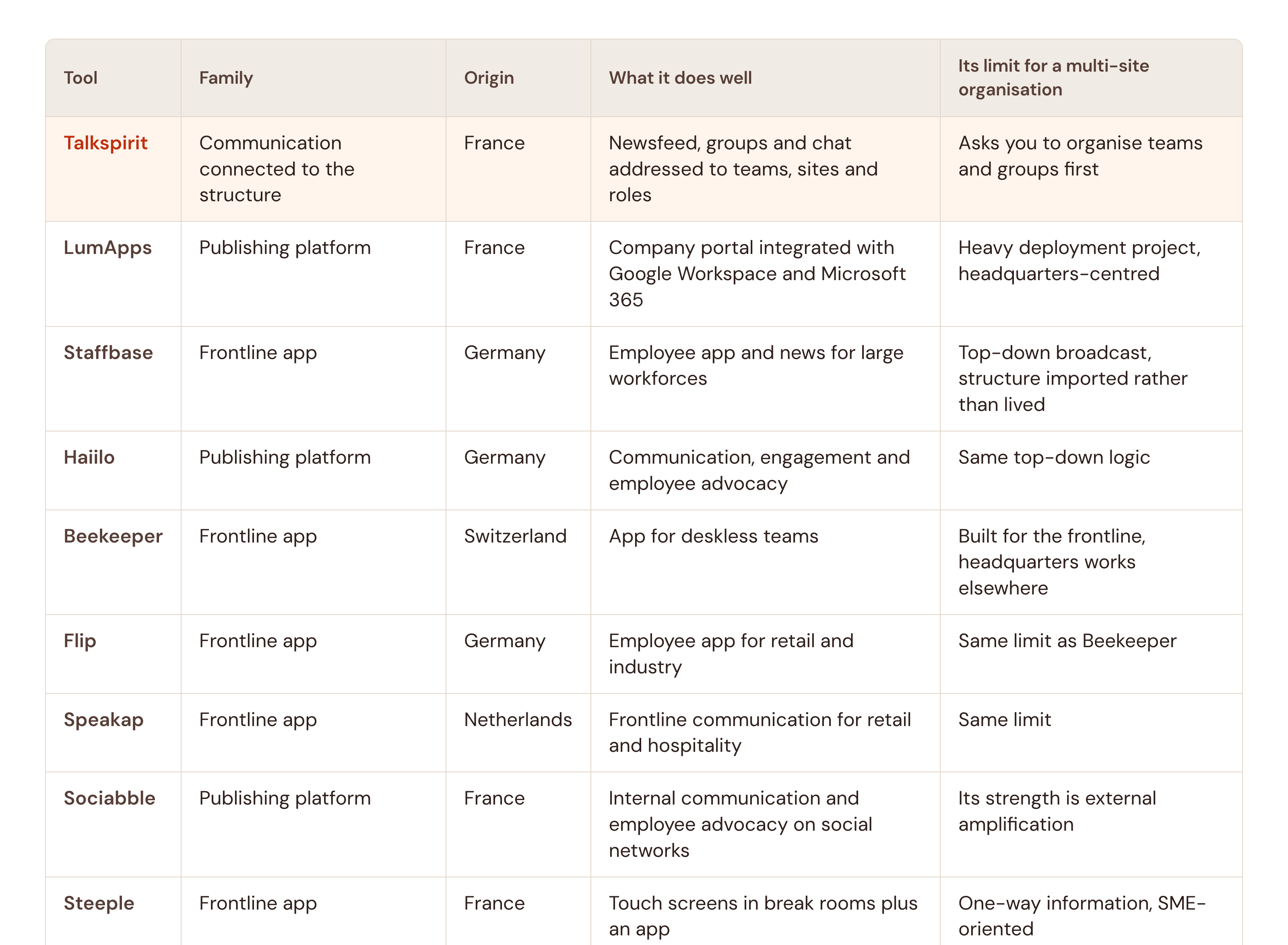
The comparison: ten internal communication tools reviewed
- Talkspirit (communication connected to the structure, France): newsfeed, groups and chat addressed to teams, sites and roles. Its limit: asks you to organise teams and groups first.
- LumApps (publishing platform, France): company portal integrated with Google Workspace and Microsoft 365. Its limit: heavy deployment project, headquarters-centred.
- Staffbase (frontline app, Germany): employee app and news for large workforces. Its limit: top-down broadcast, structure imported rather than lived.
- Haiilo (publishing platform, Germany): communication, engagement and employee advocacy. Its limit: same top-down logic.
- Beekeeper (frontline app, Switzerland): app for deskless teams. Its limit: built for the frontline, headquarters works elsewhere.
- Flip (frontline app, Germany): employee app for retail and industry. Its limit: same limit as Beekeeper.
- Speakap (frontline app, Netherlands): frontline communication for retail and hospitality. Its limit: same limit.
- Sociabble (publishing platform, France): internal communication and employee advocacy on social networks. Its limit: its strength is external amplification.
- Steeple (frontline app, France): touch screens in break rooms plus an app. Its limit: one-way information, SME-oriented.
- Jamespot (publishing platform, France): sovereign communication and collaboration spaces. Its limit: spaces, not a structure.
1. Talkspirit: communication that follows the structure
Talkspirit is the European operating system for organisational clarity. Its Communication modules rest on a simple idea: information circulates better when it is addressed to the organisation as it is actually structured, rather than to distribution lists kept on the side.
The newsfeed is organised by groups and by teams. A message meant for a site, an entity or a function reaches the people who belong to it, and that list evolves with the structure: an employee who changes site or role receives what concerns them without anyone editing a list. The home portal gathers reference information. Chat and video calls keep exchanges attached to a context. Events and the member directory connect the sites to each other, and the mobile app reaches those who have no workstation.
What sets Talkspirit apart from the other tools in this comparison is the link with the rest of the organisation. Communication is not an isolated module: it rests on the structure, which describes teams, roles and accountabilities, and it extends into collaboration, where decisions, projects and documents stay attached to the teams that carry them. An announcement from headquarters points to the decision that produced it, and to the project that implements it.
Who it is for: organisations of 250 to 5,000 people, multi-site or multi-entity, in transformation, that want internal communication that stays right when the organisation changes, with European hosting and ISO 27001 certification.
Its limit: Talkspirit asks you to organise first the teams and groups that structure communication. That is a clarification effort, and it is what organisations come for. Talkspirit does not provide shop-floor display screens either, which remain the ground of specialised tools.
2. LumApps: the company portal of large groups
LumApps, a vendor of French origin now international, offers an internal communication portal integrated with Google Workspace and Microsoft 365. It centralises news, reference documents and communities at the scale of large groups.
Who it is for: large organisations whose internal communication starts from headquarters and that already live in Google Workspace or Microsoft 365.
Its limit: it is a publishing portal, and its deployment is a project in itself. The organisation’s structure is imported from the directory, not lived by the teams.
3. Staffbase: the employee app for large workforces
Staffbase, a German vendor, combines an employee app, a portal and newsletters for organisations with large workforces, especially on the frontline. It is a reference for internal communication in the German-speaking world.
Who it is for: organisations of several thousand people whose priority is to broadcast information from headquarters to every site and every frontline team.
Its limit: the logic is top-down. The tool broadcasts and measures, it does not describe who decides or where the work gets done.
4. Haiilo: communication, engagement and advocacy
Haiilo, a German vendor, brings together internal communication, engagement measurement and the relaying of company messages by employees on social networks.
Who it is for: organisations that want to link internal communication, employee listening and external visibility.
Its limit: the same top-down logic as the other publishing platforms. Communication there is a flow, not a structure.
5. Beekeeper: the app for deskless teams
Beekeeper, a Swiss vendor, addresses employees who have neither a desk nor an e-mail address: hospitality, industry, healthcare, logistics. The app replaces the notice board and the personal messaging group.
Who it is for: organisations whose main challenge is reaching the frontline.
Its limit: built for the frontline, it leaves headquarters working in other tools. Multi-site communication then ends up cut in two.
6. Flip: the frontline app for retail and industry
Flip, a German vendor, offers an employee app for retail and industry, with fast adoption in the German-speaking world.
Who it is for: retailers and manufacturers that want to equip thousands of frontline employees without dedicated hardware.
Its limit: the same as Beekeeper. The tool reaches the frontline, it does not connect the frontline to the rest of the organisation.
7. Speakap: frontline communication for retail and hospitality
Speakap, a Dutch vendor, offers an internal communication app for teams in shops, restaurants and hotels, with an established presence in the Benelux.
Who it is for: multi-site organisations in retail and hospitality that want simple communication between headquarters and outlets.
Its limit: the same family of limits. Information flows down, the structure is not described.
8. Sociabble: internal communication and advocacy on social networks
Sociabble, a French vendor, combines internal communication with the amplification of company messages by employees on social networks.
Who it is for: organisations whose internal communication also serves the employer brand and commercial visibility.
Its limit: its strength is external amplification. For a multi-site organisation, internal targeting by site and by role is not its core.
9. Steeple: the break-room screen
Steeple, a French vendor, pairs touch screens installed in busy areas with a mobile app, to inform frontline employees where they are.
Who it is for: SMEs and industrial sites that want information visible on the spot, without relying on personal phones.
Its limit: information mostly flows one way, and the tool is sized for organisations smaller than those in this comparison.
10. Jamespot: the sovereign spaces
Jamespot, a French vendor, offers communication and collaboration spaces hosted in France, present in the public sector and in mid-sized organisations.
Who it is for: French organisations for which hosting sovereignty is a first-rank criterion and that want spaces per community.
Its limit: spaces, not a structure. The organisation is represented by its communities, not by its teams, roles and decisions.
How to choose: six criteria
The right internal communication tool for a multi-site organisation is the one that solves the targeting problem, not the one that adds a channel. Six criteria settle it.
- Targeting follows the structure. Can you address a message to a site, an entity, a function, and does that audience update itself when the organisation changes? If targeting rests on hand-kept lists, it will be wrong at the next move.
- Access without a desk or e-mail. Can frontline employees read and react from a phone, without a professional address? If not, part of the organisation stays out of reach.
- The link with the work. Does an announcement point to the decision, the project or the document it is about? Communication detached from the work is read and then forgotten.
- A single source for reference information. Where is the authoritative version of a procedure, a policy, an org chart? If the answer is “in several tools”, internal communication consists of reconciling versions.
- Adoption. Can the tool be used without training by an employee opening it for the first time on their phone? In a multi-site organisation, adoption cannot be decreed from headquarters.
- Hosting and compliance. For a European organisation, data location, GDPR and a certification such as ISO 27001 are purchase criteria, not options.
A simple way to read these criteria: the first two say whether the information will arrive, the next two whether it will be useful, the last two whether the CIO and the legal team will accept the tool.
What we have learnt from more than 900 organisations
The multi-site organisations where information circulates are not the ones with the most channels. They are the ones where communication rests on a legible organisation: you know whom a piece of information is for because you know who does what, and where.
The move from communication by lists to communication by structure almost always follows the same path. You first describe the teams, the sites and the roles. You then address messages to those teams rather than to lists. You finally connect announcements to the decisions and projects behind them. And internal communication stops being a broadcasting function and becomes the natural circulation of information in an organisation that understands itself.
That is the conviction that guides Talkspirit: Performance Starts With Clarity.
Not a tool. Your Organisation’s Operating System.
FAQ
The best internal communication tools for a multi-site organisation are those that address information to sites, entities and roles rather than to distribution lists, and that reach employees without a workstation. Talkspirit connects communication to the organisation’s structure. Staffbase, Beekeeper, Flip and Speakap specialise in reaching the frontline. LumApps, Haiilo, Sociabble and Jamespot are publishing platforms broadcasting from headquarters.
An intranet is enough to publish reference information, not to get it to every site. An intranet is a portal people consult. A multi-site organisation needs information that comes to the employee, on their phone, targeted to their site and role, and connected to the decisions that concern them.
Employees without an e-mail address are reached through a mobile app accessible from a personal phone, with simple sign-in and content targeted to their site and team. That is what frontline apps and Talkspirit have in common. A screen in the break room, as Steeple offers, complements the app for collective information.
No, and it is the most frequent trap of multi-site organisations. One tool for headquarters and another for the frontline cut the organisation in two and create two versions of the information. The right tool covers both populations in one space, with targeting by team and by site.
Internal communication stays right when its audiences are derived from the organisation’s structure rather than kept in separate lists. When a site opens, when an entity is acquired, when an employee changes role, the structure is updated once, and communication follows.