HR: How to Successfully Onboard a New Employee

.svg)
7,000 euros¹: that is the cost of a failed onboarding process. This process, which usually lasts between three and nine months, brings together every step put in place before, during and after a new employee arrives in order to integrate them into the company as smoothly as possible. On average, 17 % of employees leave the company within the first three months of joining, and 33 % are already looking for another job after six months². Which goes to show that investing in HR onboarding is a genuine necessity!
Setting up an effective onboarding process makes it possible to limit turnover, improve your employer brand and retain talent, all at once. Benefits that few companies take advantage of today, since only 28 % have an onboarding programme that delivers “very good results” for them². The same conclusion is reached internally: according to Gallup, 88 % of employees believe their company could improve the way it onboards new joiners.
In light of these figures, one might ask: what defines a successful onboarding? And what are the HR best practices for integrating a new employee into your company? Here is our advice for ensuring a seamless integration, before, during and after their arrival.

Preparing for the New Employee’s Arrival
The Pre-boarding Checklist
To integrate a new employee properly, you have to start by preparing for their arrival! This is what is known as pre-boarding. This preparation phase starts as soon as the recruitment need is identified, and continues until the employee joins the company. This is the point at which you need to:
- Clarify expectations for each role regarding the new hire, so as to create a job description that reflects real business needs
- Ensure that the goals set are clear and realistic
- Clarify working processes within the team that will be welcoming this new recruit
- Prepare a complete onboarding programme together with the manager, covering at the very least the whole probationary period
- Identify a mentor (or a “buddy”) who will help you integrate the new employee into the company
- Handle administrative formalities (signing the contract and company rules, collecting bank details, sending health insurance documents, etc.)
- Send a welcome email and welcome pack (which might include a welcome booklet and some goodies, for example)
- Set up the workstation (computer, screens, mouse, keyboard, etc.) and access to the digital tools the new employee will need to use (your company intranet, your HR tool, your CRM, etc.)
- Announce the new arrival internally (through a post on your enterprise social network, for instance)


The Ideal Tool for Pre-boarding
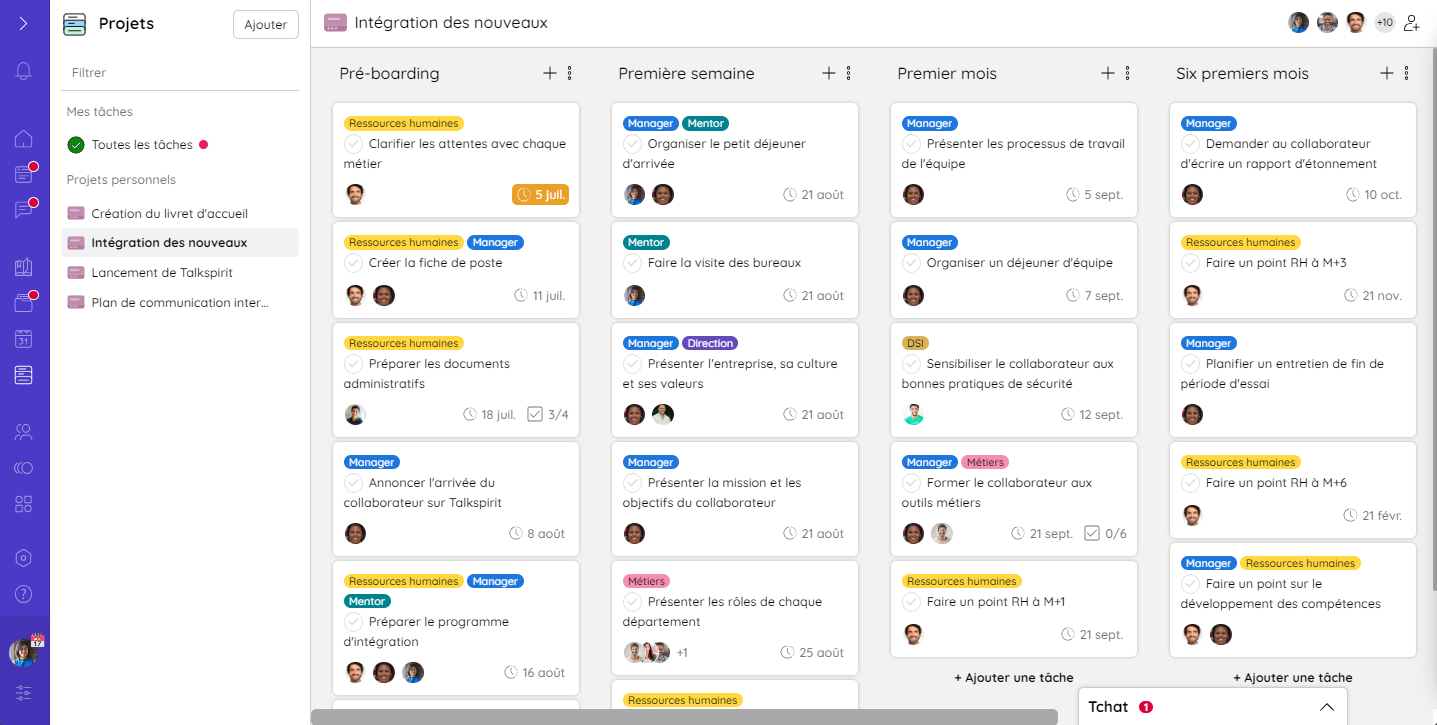
To share out the tasks between the various stakeholders as effectively as possible (in particular human resources, the manager and the mentor), we recommend using a project management tool. On Talkspirit, for example, you can use the Projects module to track the progress of your onboarding processes. It works very simply, all you have to do is:
- create a board called “Onboarding new employees”,
- add columns to it so you can track the different onboarding stages,
- fill each column with the tasks to complete, assign the responsible person(s), and set a deadline,
- tick off tasks as they are completed so you can see at a glance what is left to do.
Welcoming the New Employee
Next comes one of the most important periods of onboarding: the new employee’s arrival. This is THE moment to make a good impression, but also to give the employee confidence so that they can picture themselves in their role and in the company.
The First Days
To leave nothing to chance, we recommend building a schedule for the first few days, which can include:
- an office tour,
- a welcome breakfast,
- a presentation of the company’s business, its various departments, its culture and its values,
- a presentation of HR processes (expense reports, requesting leave, etc.) and benefits (health insurance, meal vouchers, remote working, etc.),
- as well as a presentation of the employee’s remit, role and objectives.
A good way to integrate the new employee into the company is to have them meet all the department heads in the business, or at least everyone whose work they will be in regular contact with. That way, they get a cross-functional view of what each department does, and of how they can contribute.
If your new recruit works 100 % remotely, you will obviously need to adapt this schedule accordingly, and plan all these conversations as video calls. Read our advice here on how to run a successful remote onboarding.
The First Month
The first month is the time to train the employee on the tools and processes of the company, so that they get up to speed quickly and start working on projects.
To make training as engaging as possible, we recommend varying the formats (video tutorials, webinars, in-person sessions…) and quickly assigning operational tasks linked to that training. Your new employee will be less prone to information overload, and will find more meaning in their work!

Finally, to integrate your new employee as well as possible, you can organise team-building events (a company offsite, an after-work drink or a team lunch, for example). It will help them get to know their colleagues better and build connections with them.
Providing Ongoing Support
Of course, the onboarding process does not stop at the first 30 days after the employee joins. It carries on throughout the probationary period, and beyond it once that period has been confirmed.
During the Probationary Period
During the probationary period, it is important to follow up regularly, for instance by holding a monthly HR catch-up and a weekly one with the manager. Beyond operational tasks, these catch-ups are an opportunity to cover:
- how the employee is feeling,
- how well they are settling into the company,
- what they enjoy (or do not enjoy) about their role,
- the topics they feel most and least comfortable with,
- what they understood, and understood less well, from the training they received,
- their satisfaction with the tools and equipment provided.
A good way to dig into these points is to ask your new employee to write a first-impressions report. In this document, they can describe in detail what surprised them most during their onboarding period, what they learned, and what they would suggest improving so that new employees are integrated more effectively. Thanks to this report, you can gather feedback on your HR onboarding, and think about new ways to make it more effective.
Shortly before the end of the probationary period, you will need to set up a meeting between the manager and the employee. This meeting is where the employee is given feedback and told whether their probationary period is confirmed, extended or ended, and why that decision was made. It is an important conversation for the employee and for the manager alike. To make it a success, we therefore recommend writing a set of questions they can both lean on during the meeting, and making yourself available to answer their questions.
After the Probationary Period
Once the probationary period is over, you will need to keep following up regularly for several months. With a different goal this time, since the aim is to help the employee develop their skills and to think through their prospects for growth within the company with them. For 89 % of employees and HR managers, this is a key lever for employee engagement. So do not forget to raise it!
We also encourage you to proactively discuss topics related to the employee’s wellbeing at work, for example:
- their remote working rhythm and schedule flexibility,
- physical and mental health,
- working conditions (equipment, tools, workspace quality…)
- pay,
- the right to disconnect,
- recognition at work,
- etc.

By holding regular catch-ups, you make sure the employee has the best possible conditions in which to do their job. Which is exactly what makes them want to stay with the company!
Conclusion
To integrate a new employee properly, creating a complete onboarding process is essential. Thanks to that process, your new recruits are 58 % more likely to stay with your company for at least three years¹. Which saves you time, money and, above all, effort!
So, are you ready to build your onboarding programme? To make life easier, we have created a template checklist for successful recruitment and onboarding of new employees. Download it to improve your onboarding process right now:
Access the Checklist
In our HR onboarding checklist, you will find: the key steps to follow to ensure successful recruitment and onboarding, the tasks to be carried out before, during and after the employee arrives, on both the HR and the manager side, and the key dates to keep in mind so that the new employee is properly integrated.
¹ Workelo White Paper, 2019
² Welcome to the Jungle White Paper, 2020