
[Expert Advice] Internal Communications: 4 Examples of Companies That Got It Right

.svg)
- Four internal communications leads (Believe, DataDome, Swile, Arkance Systems) walk through the initiatives they launched inside their companies.
- Believe runs a quarterly global webcast and shows a carousel-format newsletter on 24 screens installed across its offices.
- DataDome, which grew from 50 to 160 employees, started with employee personas before building a culture strategy and a monthly quiz.
- Swile relies on a network of People Partners and measures the effect of its initiatives with Pulse surveys.
- Arkance Systems set up an intranet mixing cold documents and hot information, alongside two annual seminars.
- None of these initiatives works without a shared prerequisite: knowing who speaks about what, to whom, and through which channel.
Setting up an internal communication strategy has become essential for every company. Yet one question keeps coming back: which initiatives should you launch first, and how do you make sure they pay off? Many Internal Communications Managers are still asking themselves exactly that.
To shed some light on the subject, we decided to go into the field and interview four companies that have launched initiatives to improve their internal communications:
- Believe: one of the world leaders in the digital music market. Believe’s mission is to support independent artists and labels by offering them digital solutions suited to their changing needs at every stage of their development.
- DataDome: a French company that provides innovative solutions to protect websites and APIs against online fraud and bot attacks.
- Swile: a French scale-up offering a card and an app dedicated to employee engagement.
- Arkance Systems: a company specialising in the deployment of AUTODESK and TRIMBLE solutions, helping businesses digitalise their construction projects.
Four employees working in these four companies walked us through their internal communication plans:
- Charlotte Garin, Global Internal Communication Senior Lead at Believe
- Marine Dufoix, Workplace and Culture Manager at DataDome
- A member of the People Care team at Swile
- Flore-Reine Collomb, Communication Officer at Arkance Systems France
In this article, discover examples of the actions they put in place to give their internal communications a boost and build employee engagement within their companies.

1. Believe
The main internal communication challenge at Believe is, first and foremost, to “create connections between employees”. For a simple reason: “the teams have grown a lot over the past two years, and with the Covid crisis some of them have never met”, explains Charlotte Garin, Global International Communication Senior Lead.
“Last year, our company went public, which also adds a certain complexity in terms of internal communications.”
The Role of Communication Tools
To meet these challenges, Believe has launched several initiatives, starting by rolling out communication and collaboration tools across the company.
“When I arrived in 2021, we stepped up our use of communication tools to cope with the new wave of remote work. Today, we use a digital workplace where we have created communities, and which lets us share content.” On top of that come two collaborative tools used for more real-time exchanges.
“These are tools we already had before, but were not making the most of. Today, we use them more, both to push information down and to give employees a voice. We have also put in place an internal communication policy that lets everyone clearly identify who is speaking”, and therefore give more visibility to the teams’ work.

Events to Build Cohesion
Events are a key part of Believe’s internal communication strategy.
“Every quarter, we run global webcasts by video conference, which all employees in France and abroad join. We present the results of the past quarter, our strategy and our position on certain topics, a Q&A and a success story from one department. And then we finish with an artist showcase. It makes sure everyone has access to the same level of information, and it gives everyone the opportunity to get to know the different teams better.”
Events are also held every month on site, in particular “breakfasts and ‘Tech Talks’ round tables, where we invite external experts to speak. On top of that come private showcases where our artists perform for the Believers. We have organised two this year, and a third one is coming soon!”
“Snackable” Digital Content
Beyond events, it is just as important to get both the substance and the form of your content right.
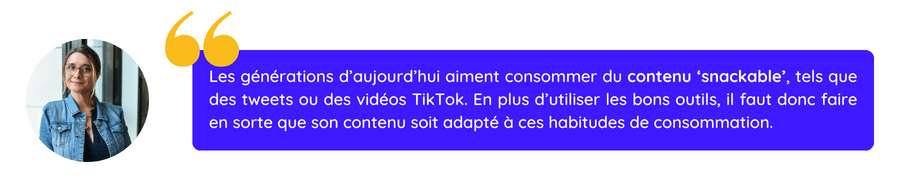
For Charlotte Garin, the conclusion is clear: “today’s generations like to consume ‘snackable’ content (that is, content that can be read and taken in quickly), such as tweets or TikTok videos. So on top of using the right tools, you have to make sure your content fits those habits. Instead of writing a long article, we will favour a short, effective message, or even a mini video.”
To adapt to these new habits, “we installed 24 vertical and horizontal screens in our offices, on which we project a carousel-format newsletter, as well as videos in Instagram Reels format (short, engaging videos). It is quick to read and it works!”
2. DataDome
Like Believe, DataDome is currently growing fast. “In 2021, there were 50 of us. And today we are 160. So our challenge is to maintain the culture in a growth environment and stay aligned with our four values, in order to preserve our company’s DNA”, says Marine Dufoix, Workplace and Culture Manager.
Personas to Better Understand Employee Profiles
Before building its internal communication strategy, Marine Dufoix and her team started by creating personas to identify employee profiles and better understand their needs.
“We surveyed employees to get a better sense of everyone’s personality and preferences. Through that exercise, we learned that some employees are shy, and others are history buffs. That then allows us to come up with ideas for events and initiatives that might interest them, and to attract talent who will thrive in a caring environment.”
Better Information Sharing
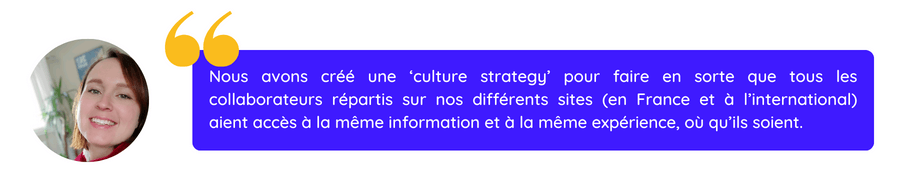
Once the personas were identified, “we created a ‘culture strategy’ to make sure that all employees across our different sites (both in France and abroad) have access to the same information and the same experience, wherever they are.”
To do that, “we started by creating groups on our collaborative tool to clarify who should post what and where, and which groups should be checked first.
We also try to keep the conversation alive on this tool by posting birthday messages and by gamifying internal communications. For example, if we want to announce the launch of a new internal tool, we will gamify it with a spot-the-difference game. It is more fun than a traditional format.”
To get its messages across, “it is important to do more digital and less text, for example by replacing long newsletters with short videos, or even an app. That is the approach we are trying to take at DataDome.”
Rituals to Unite Employees
“We have also introduced several rituals to maintain the company culture. For example, every month we run an online quiz, which I co-host with a colleague. On that occasion we hand out ‘top of the month’ prizes to reward, for instance, the best joke or the best comment on our collaborative tool. It captures attention while putting employees in the spotlight.
We also organise table football tournaments and themed evenings of all kinds in our Paris office, while being careful not to concentrate everything on site so as not to frustrate those who are remote”, adds Marine Dufoix.
An Academy to Ease New Hires In
DataDome’s next internal communication project? “Developing an academy to make it easier to onboard new employees and to spread the company culture. It would include information and videos about DataDome’s history, the company culture and its values.”
To gamify the concept, “we would also like to set up a tier system, which would let employees level up throughout their onboarding (for example, they would start as Cyber-guard, become Cyber-hunter after taking part in certain initiatives, then Cyber-master once fully onboarded). This gamification is a good way to build engagement, but also to encourage employees to take part in the events organised internally.”
3. Swile
At Swile, “the goal of internal communications is to ensure that all ‘People’ measures are harmonised at national and international level, so that everyone has access to the same information”, a member of the People Care team tells us.
A Network of Internal Liaisons
To that end, the company relies on “People Partners”, who act as an internal relay between employees, managers and the People team. “They are there to answer everyone’s questions, give visibility to the People initiatives that are put in place, and also offer advice on topics such as training, career development and personal growth.”
These internal liaisons play a key role in internal communications: they help deliver messages closer to the front line and gather immediate feedback from teams.
More recently, we also hired two Office Managers, who work alongside the People Partners to help managers communicate with their teams and suggest initiatives to strengthen cohesion.
Read also: How to Involve Managers in Internal Communications?

A Strong Focus on Onboarding
The company also pays close attention to onboarding its new recruits. “As soon as a new employee joins the team, we take the time to introduce them to the different roles that exist at Swile, but also to our ways of working, our product and our business model. So that after a week, new Swilers all have a general grasp of how the company works.”
On top of this general introduction, the People team highlights the various benefits employees have access to, such as free access to a coach or a psychologist through the mental health platform moka.care, which provides dedicated support on a range of topics.
Dedicated Events and a Collaborative Tool
To communicate more widely internally, Swile relies on a dedicated collaborative tool, which lets it share information in real time with all of its employees, wherever they are. That matters all the more for a company that favours hybrid work.
“‘All Hands’ events are held to highlight important news, company performance and upcoming product developments. On top of that come annual seminars that bring all Swilers together and strengthen the sense of belonging to the company”
Why Gathering Feedback Matters
Launching initiatives is one thing, but it is just as important to gather feedback from the teams. Swile has clearly understood that.
The company uses its own app to send Pulse surveys to its employees. “It lets us take the temperature on topics such as recognition, relationships with peers and with the manager, or work-life balance. Depending on the trends that emerge, we can then adjust our initiatives accordingly.”
Read also: [Webinar] Why and How to Build a Feedback Culture?
4. Arkance Systems
Since its acquisition by the Arkance group, Arkance Systems has had to completely rethink its internal communication strategy. Its key challenge? “Creating a European brand image (and not only a French one) and getting employees to buy into this new culture”, says Flore-Reine Collomb, Communication Officer.
An Intranet to Share Information and Spark Conversation
One of the company’s first initiatives was to “set up an intranet to make information and knowledge sharing easier”. This tool lets them bring together both cold documents (for example, PPT presentation templates, sales brochures, shortcuts to resources, and so on) and hot information (for example, posts announcing the arrival of a new employee or the signing of a partnership).

“We also share more engaging content there, such as quizzes or competitions. Recently, together with a charity, we ran a connected contest for the highest number of steps walked in a week, with a reward for the winning team. It allowed us to raise employee awareness of charitable causes while bringing a playful side to communications.”
Annual Seminars and Team-Building Events
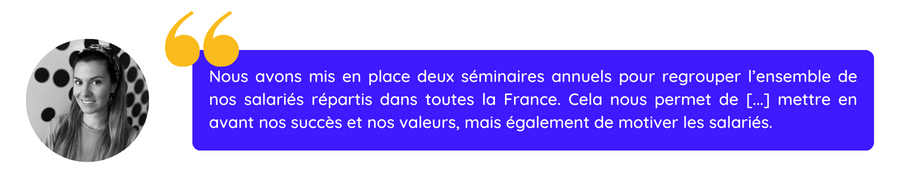
On the events side, “we set up two annual seminars to bring together all our employees spread across France. It lets us present the company objectives, highlight our successes and our values, but also motivate employees with fun activities and guest experts.
Last year, for that occasion, we brought in a TV columnist who attended the opening of the seminar and turned it into a humorous column. We also ran a 100% digital escape game with a host who split the participants into several groups through our video conferencing tool.
Beyond the annual seminars, the Communications team has launched coffee breaks over video conference, mixing employees from different departments. “As they do not necessarily know each other, we give them topic ideas beforehand to ‘break the ice’. It lets employees get to know each other and build connections with their colleagues”, explains Flore-Reine Collomb.
And that is not all! In the coming months, the company plans to offer its employees a real, in-person escape game, and the chance to try a Formula 1 simulator!
A Company That Listens to Its Employees
For Flore-Reine Collomb, the best recipe for improving internal communications is to “keep listening to employees, keep an open mind and keep an eye out for the initiatives launched in other sectors.” That makes it possible not only to check how effective the actions taken are, but also to adapt continuously to employee needs. “Sometimes they are even the ones who give us the best ideas for activities to organise”, she adds.
| Company | Context | Signature initiative | What to take away |
|---|---|---|---|
| CompanyBelieve | ContextFast headcount growth, company went public the previous year, teams that have never met | Signature initiativeQuarterly global webcasts and 24 screens showing a carousel newsletter | What to take awayGive everyone the same level of information, in a short format |
| CompanyDataDome | ContextFrom 50 to 160 employees, a company culture to preserve | Signature initiativeEmployee personas, then a culture strategy and a monthly quiz | What to take awayUnderstand the profiles before choosing the actions |
| CompanySwile | ContextTeams spread across France and abroad, hybrid work | Signature initiativeA network of People Partners and Pulse surveys | What to take awayHuman relays, and feedback to adjust with |
| CompanyArkance Systems | ContextAcquired by a European group, a new culture to get people to adopt | Signature initiativeAn intranet mixing cold documents and hot information, two annual seminars | What to take awayOne entry point, and events that bring people together |
*
* *
As you can see, there are plenty of different ways to approach internal communications in a company. What these examples show above all is how much it matters to choose the right tools, to favour digital, engaging content, to keep the conversation alive and to hold regular events that bring teams together. In short: think 360° communications!
One thing these four accounts share: no initiative stands on its own. The webcasts, the personas, the People Partners and the intranet work because someone settled beforehand who speaks about what, to whom, and through which channel. Internal communications carry a message only once the structure and the roles behind it are clear: a communication plan is worth writing at the same time as the governance it rests on.
To go further, we invite you to read our practical guide, which gathers 10 examples of internal communication initiatives launched by different companies:
Download the Practical Guide
In our practical guide “10 initiatives from our customers to improve internal communications”, you will find: 10 examples of companies using Talkspirit to improve their internal communications, plus tips and tricks to share information better and strengthen cohesion within your own company.
FAQ
Believe, DataDome, Swile and Arkance Systems. Charlotte Garin (Believe), Marine Dufoix (DataDome), a member of Swile’s People Care team and Flore-Reine Collomb (Arkance Systems France) each describe the initiatives launched inside their company.
Creating connections between employees. The teams grew a lot over two years and, with the Covid crisis, some of them have never met. The company going public the previous year adds a further layer of complexity.
By favouring snackable content that can be read quickly, rather than long articles. 24 vertical and horizontal screens were installed in the offices, showing a carousel-format newsletter and videos in Instagram Reels format.
To identify employee profiles and better understand their needs before building the internal communication strategy. The exercise revealed that some employees are shy and others are history buffs, which then helps to come up with event ideas likely to interest them.
On People Partners, who answer questions, give visibility to People initiatives and offer advice on training, career development and personal growth. Two Office Managers were hired more recently to help managers communicate with their teams.
An intranet gathering both cold documents and hot information, along with more engaging content such as quizzes or competitions. On the events side, the company runs two annual seminars and coffee breaks over video conference that mix employees from different departments.