How to Effectively Implement Workplace Gamification

.svg)
- Workplace gamification applies game mechanics (progress paths, badges, leaderboards, team challenges) to professional activities in order to engage and motivate employees.
- It works by tapping five intrinsic motivators: autonomy, mastery, social interaction, progress and achievement.
- The stakes are measurable: in Gallup's 2026 edition, 20% of employees worldwide say they are engaged at work, and only 12% in Europe.
- Five use cases hold up in practice: onboarding, training, internal tool adoption, team challenges, and safety or compliance routines.
- Five best practices frame the rollout, starting with this one: do not reward with money, which kills creativity and fuels rivalries.
- A summary table pairs each use case with its game mechanic and the metric to track.
Work hard, play harder!
With such staggering worker dissatisfaction and disengagement, we can’t help but wonder–what if we could harness that zen-like focus that people get when they are fully engrossed in a video game for twelve hours straight onto their real-life work instead?
This blog covers what workplace Gamification is all about, why you need it, and tips to implement it correctly to get the most out of it.
The disengagement is measurable. In the 2026 edition of its State of the Global Workplace study, Gallup counts only 20% of employees engaged at work worldwide, and 12% in Europe, the least engaged region on the planet. That is the ground workplace gamification is meant to work on.
What is Workplace Gamification?
First, let’s start with a broad definition of gamification!
Gamification is applying game elements to non-gaming activities in the real world. In other words, it is the application of fun and addicting game elements to almost anything and everything.
Workplace gamification is the process by which game dynamics and mechanics are applied to a professional environment and its systems to better engage and motivate employees to achieve the desired goals.
Gamification, as understood by most, is just a technology that involves a bunch of rewards, badges, etc., but it is beyond that. It is a psychology that motivates users toward intended behavioral outcomes, learning, and problem-solving.
Gamification does not have to stop at the training level. It can accelerate learning, encourage people to adopt different activities and applications, promote social connections, make technology fun and interesting, show a path to mastery & independence, and, most importantly, increase employee engagement.
According to a survey conducted by TalentLMS, 89% of people claimed that if a task is gamified, they are eager to complete it and that the activity places them in a competitive mood and mindset.
Why do you need Workplace Gamification?
Why do you need to gamify your professional environment? As mentioned earlier, it is not just a technology but psychology that taps into human emotions to improve behaviors and accomplish boring and mundane tasks by making them fun and interactive.
Tap into Intrinsic Motivators
Intrinsic motivation is performing an action because it is fun or challenging without any obvious external rewards. You do it because you want to and if you enjoy doing it without expecting anything in return.
And we humans share the primary intrinsic motivators and tend not to leave tasks unfinished. These motivators are the factors that drive us to take action and complete a task to achieve the “intrinsic” feeling of completion, which is highly motivating.
The five common motivators are autonomy (the power of control), mastery, social interaction, progress, and achievement.
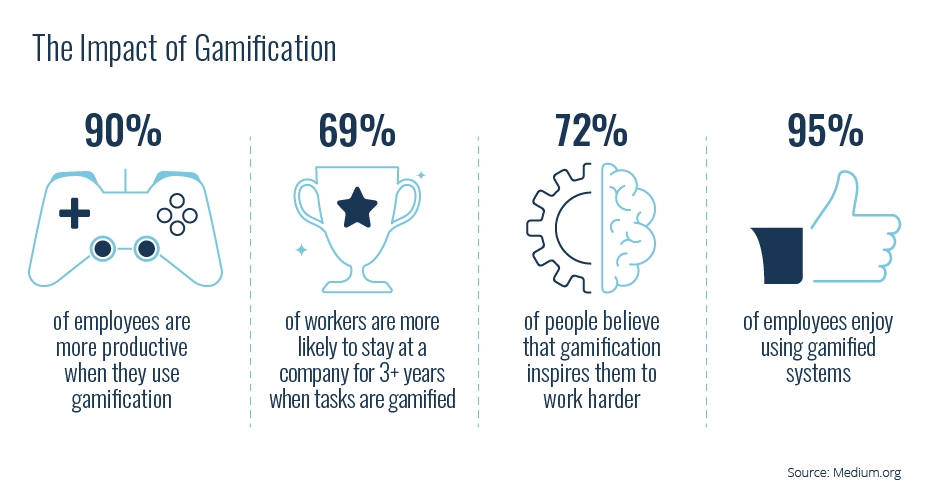
According to behavioral research, satisfying these intrinsic motivators can significantly increase work productivity. And gamification can use these motivators to help employees unlock their potential. You can apply it across different job titles and departments.
Make Data-Driven Decisions
Workplace gamification is also the best way to capture relevant data to show and track your employee performance.
Data provided, such as login data, completion rates, points & badges achieved, can encourage and appreciate your employees’ success.
Every workplace will look different in terms of what its data looks like and what data points it would like to focus on. Your business needs to know which numbers to track and monitor.
Increase Employee Output
Gamification aims to educate employees and can be implemented across almost every industry. From marketing to sales and employee training and processes, gamification can help drive your company forward, as well as help make your workplace highly interactive for the employees.
Gamification can be used to:
- Improve employee loyalty and increase revenue
- Drive-up employee knowledge with gamified training
- Increase feature adoption
- Boost engagement and retention rates
- Improve internal communication
Workplace gamification can be a positive force that can help improve employee engagement across all departments. It can bring all age groups together and make the workplace fun and productive.
Best Practices for Gamifying the Workplace
It is very easy for a business to get blown away by all the features and avenues that gamification opens up for a workplace. Gamification has the potential to be an integral part of the daily work and operations in any organization.
The key is not to implement everything without having a well-thought plan. The gamification strategy should be well-designed and implemented properly in a phased manner.
Keep these best practices in mind to have the right gamification strategy for your workplace and reduce the risk of failure.
1. Use the Correct form of Motivation
People want to progress and evolve for the better. If allowed to see their progress through badges, employees will have a clearer picture of their achievements.
Care should be taken only to monitor the employees’ success and not to control it.
Constantly ‘watched’ employees might be uninterested in participating in the gamification program. Employees are of two different types: collaborators and competitors.
Competitive employees prefer rankings and competition, whereas cooperative employees prefer to gain higher social status and be more talented. It is important to understand intrinsic and extrinsic motivation before designing the gamification strategy for different kinds of employees.
2. Don’t use Money as a Motivation
Rewarding employees with money is a bad idea because extrinsic rewards rarely work in the corporate space. When rewarded with money, employees lose focus on other things that should motivate them, like the sense of team unity and pride in doing their job.
Money kills creativity and also fosters unhealthy rivalries among employees.
Employees should be encouraged to perform well using intrinsic motivators and intrinsically valued rewards. These could be their ability to achieve goals, demonstrate valuable skills, and think outside the box for a solution.
3. Develop a Professional Game
Gamification’s roots in game design technology don’t imply that your workplace application should have a game in it. The basic principles of gamification, namely measurement of behavior, goals, and visible rewards (badges, etc.), should be designed and adapted keeping the target audience in mind.
The theme and design should match the corporate style and standards. Communicate the rewards to your employees clearly. For instance, if an employee has been pivotal to the company meeting its goals or performing well, they should earn a badge. Employees could then share these badges on your enterprise social network.
4. Plan the Gamification Design before its Application
The strategy must be well-thought, well-designed, and structured. Take care of these points during the planning process.
- Keep in mind your corporate culture.
Create a reward program that binds your employees to your corporate culture. Think hard about what rewards will ensure greater motivation.
- Don’t lose sight of your organization’s goals.
This is the most important yet overlooked step during the planning phase. Set your objectives in the initial planning phase to avoid losing sight of what’s important during execution.
- Focus on positive behavior to encourage and negative behavior to discourage
Identify the activities and triggers that influence the behavior you want to change.
- Focus on improving people rather than just improving their productivity
- Periodically modify the bonus reward system to ensure employees don’t get bored with the same incentives and remain engaged with the system.
5. Encourage team building with easy collaboration
Gamification doesn’t always have to be about games, badges or rewards. Initiatives such as intra and inter-team collaborations to get two teams or individuals to work together create a positive impact on the employees. It also boosts networking and visibility and fosters a team-building culture.
Where Gamification Actually Works: Five Use Cases
Gamification fails when it is spread across the whole company at once. It holds when it targets one precise activity, with a game mechanic and a metric chosen in advance. Here are five grounds where it produces measurable results.
1. Onboarding new hires
The first weeks lend themselves to a progress path: visible steps, milestones passed, a clear finish line. New hires know where they stand without having to ask, and so does their manager. What to track: the completion rate of the onboarding process and the time before the first independent contribution.
2. Training and skills
This is the oldest and best documented use case. Quizzes, answer streaks, levels to unlock: gamified modules get finished more often than linear ones. What to track: the completion rate of your online training sessions and knowledge retention after thirty days, not just the score on the day.
3. Adoption of internal tools
An intranet or a collaborative platform is worth only what teams publish on it. A launch challenge over a few weeks, on a simple goal (every team posts its first update), gets usage started far better than a memo does. What to track: the share of active teams and posts per week, not the number of accounts created.
4. Team challenges and rituals
The team challenge is the easiest form of gamification to launch, because it needs no dedicated tool: a shared goal, a deadline, a scoreboard by team. Company activities built around a sporting event are a good example, as are seasonal challenges. What to track: the participation rate and the number of interactions between teams that do not usually work together.
5. Safety and compliance routines
Recurring obligations (cyber training, safety checks, regulatory updates) are exactly the kind of task nobody performs for pleasure. A streak to keep alive, a team score and a visible reminder are often enough to lift on-time completion. What to track: deadlines met and the number of issues reported voluntarily.
Pick the metric before the mechanic
One simple rule avoids most failures: decide what you want to move before choosing the game mechanic. A badge that matches no tracked metric becomes decoration within weeks, and the program dies on its own.
| Use case | Game mechanic | What to measure |
|---|---|---|
| Use caseOnboarding | Game mechanicProgress path, milestones | What to measureOnboarding completion rate, time to first contribution |
| Use caseTraining | Game mechanicQuizzes, levels, answer streaks | What to measureCompletion rate, knowledge retention after 30 days |
| Use caseInternal tool adoption | Game mechanicLaunch challenge, team goal | What to measureShare of active teams, posts per week |
| Use caseTeam challenges | Game mechanicShared goal, scoreboard by team | What to measureParticipation rate, cross-team interactions |
| Use caseSafety and compliance | Game mechanicStreak to keep alive, team score | What to measureDeadlines met, issues reported voluntarily |
The bottom line
Disengagement remains a major cause of lost productivity, across every function and every industry. Gamification is not a universal answer, but it does address one precise thing: making visible a form of progress that otherwise stays invisible.
To get started, one use case is enough. Pick the activity that suffers most from a lack of visibility, one game mechanic, one metric, and give yourself a quarter before judging. If the metric does not move, it is the mechanic that needs changing, not the dose of badges.
One condition decides the rest: the scheme has to build on your teams' intrinsic motivators rather than replace them with an external reward.
About the author

Architaa Pandey
Architaa works as a Content writer and strategist at Upshot.ai. When not working, she loves to write fictional stories and dreams of getting them published. Being an avid reader, she loves collecting books. She also likes to research Customer engagement and retention strategies for different industries.
FAQ
Gamification is applying game elements to non-gaming activities in the real world. Workplace gamification is the process by which game dynamics and mechanics are applied to a professional environment and its systems to better engage and motivate employees to achieve the desired goals.
It is not just a technology but a psychology that motivates users toward intended behavioral outcomes, learning, and problem-solving. It taps into intrinsic motivators; the five common ones are autonomy (the power of control), mastery, social interaction, progress, and achievement.
According to a survey conducted by TalentLMS, 89% of people claimed that if a task is gamified, they are eager to complete it, and that the activity places them in a competitive mood and mindset.
No. Rewarding employees with money is a bad idea because extrinsic rewards rarely work in the corporate space: employees lose focus on other things that should motivate them, like the sense of team unity and pride in doing their job. Money kills creativity and also fosters unhealthy rivalries among employees.
No. Employees are of two different types: collaborators and competitors. Competitive employees prefer rankings and competition, whereas cooperative employees prefer to gain higher social status and be more talented, so both intrinsic and extrinsic motivation should be understood before designing the strategy.
Keep your corporate culture in mind when creating the reward program, set your objectives in the initial planning phase so you don't lose sight of the organization's goals, identify the activities and triggers that influence the behavior you want to change, focus on improving people rather than just their productivity, and periodically modify the bonus reward system to ensure employees don't get bored with the same incentives.