[Cisco Study 2022] Remote Work: Impact on Productivity and Wellbeing

.svg)
Long overlooked by companies, remote work has now become a key asset for improving the employee experience, productivity and lworkplace wellbeing. As a result, more and more employees now consider it a non-negotiable criterion when looking for a new job.
But how can you actually measure the real impact of remote work? How can your organisation make the most of it? And what are the best practices for making hybrid work a success?
We analysed a global Cisco study from 2022 that surveyed more than 28,000 employees across 27 countries (including France) on these very topics. Read on for the key takeaways 👇
The Positive Effects of Remote Work
Since the beginning of the Covid crisis, remote work has expanded significantly across organisations, bringing many benefits for employees, including increased productivity and improved wellbeing at work. Here is a closer look at these two key benefits.
Increased Productivity
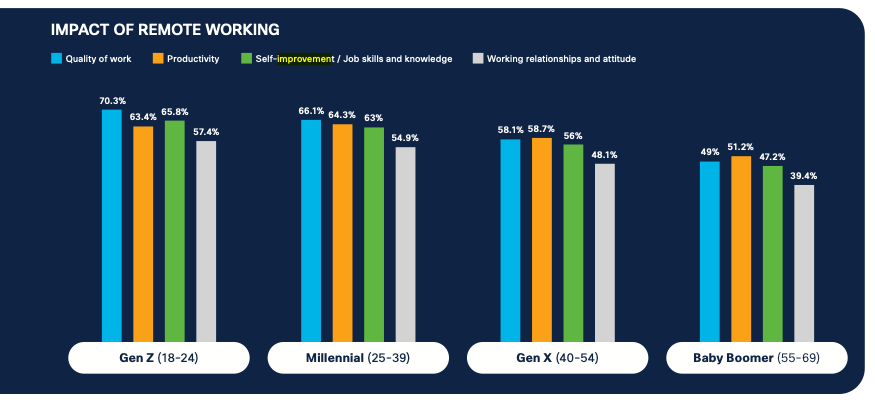
The first benefit of remote work: it contributes to boosting employee productivity. Indeed, 60% of French employees surveyed feel they are more productive and produce higher-quality work when they have the option to work remotely. This trend is especially pronounced among Generation Z and Millennials (people aged 18 to 39).
Improved Wellbeing at Work
For three quarters of French employees surveyed, remote work is also a source of workplace wellbeing, as it gives them greater flexibility and allows them to reduce (or even eliminate) their daily commute. For 70% of them, this flexibility translates into a better work-life balance.
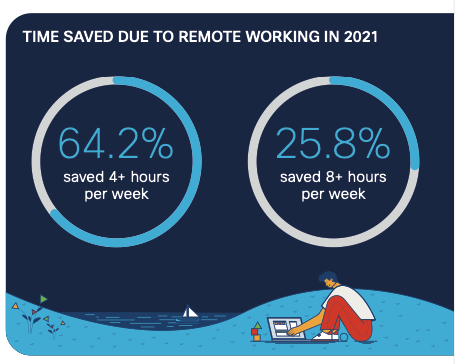
In 2021, 64% of respondents were able to gain more than 4 hours per week thanks to remote work. As a result, they could devote more time to personal activities, including sport, cooking, and spending time with family and friends.
Better wellbeing also means reduced stress: a benefit felt by 55% of employees working in hybrid mode (that is, combining remote and in-office work).
In short, promoting remote work both improves the physical and mental wellbeing of your employees and helps them build healthier lifestyle habits.
Keys to Successful Hybrid Work
Given all these benefits, employees are firmly on board. 87% of them want to work in hybrid mode or fully remote going forward.
Yet while hybrid work is now common in many organisations, its implementation still leaves room for improvement. This is confirmed by the study, which reveals that only a quarter of French employees believe their company is adequately prepared for hybrid work.
Here are some keys to managing this new way of working effectively.
Rely on Digital Tools
For 77% of employees, digital technologies — in particular collaborative tools and video conferencing — are among the essentials of hybrid work. This makes them the most important success factor after management support and scheduling flexibility.
To support hybrid work, organisations should prioritise investment in these tools and take the time to train employees so they can get the most out of them and boost productivity.
Beyond training, it is also important to choose a tool that fits your organisation's needs and those of your team. To help you through this process, we have put together a methodology guide covering the 8 key steps to choosing your collaborative platform, which you can access by clicking the banner below.
 end HubSpot Call-to-Action Code
 If you want to save time during your benchmarking, we also invite you to consult our comparison of the best collaborative tools.
Evolve Your Collaboration Practices
But that's not all! To get the most out of these tools, you also need to evolve your collaboration practices, and in particular promote the right usage norms and guidelines for each solution.
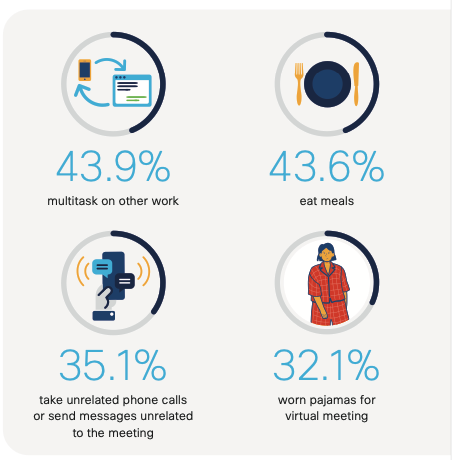
65% of employees feel, for example, that fewer than half of the remote meetings they attend are genuinely productive. And 53% believe it is acceptable to multitask during this type of meeting. This clearly illustrates the need for dedicated guidelines to improve meeting effectiveness.
According to the study, 43% of respondents have already worked on other tasks or eaten a meal during a video call. 35% have answered a phone call unrelated to the meeting, and 32% have joined a remote meeting in their pyjamas.
Read also: Recap of the webinar: "How to Put an End to Meeting Overload!"
Build an Inclusive Company Culture
Finally, it is essential to build an inclusive company culture that offers equal opportunities and working conditions to all employees, regardless of their working arrangement (hybrid, fully remote, or fully in-office).
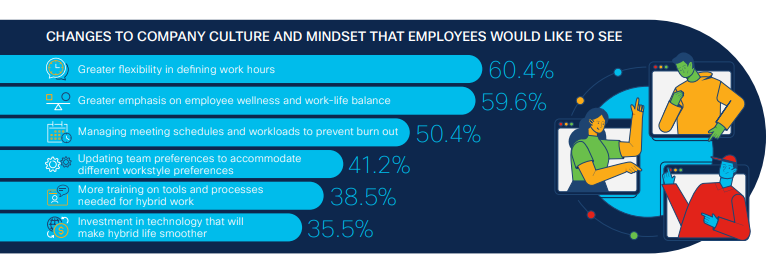
To drive this change, employees want their organisation to implement initiatives to:
- improve the flexibility of working hours (60.4%),
- promote wellbeing at work and work-life balance (59.6%),
- optimise the scheduling of meetings and workloads (50.4%),
- update working preferences across different teams (41.2%),
- train employees on the tools and processes required for hybrid work (38.5%),
- and invest in the technology needed to facilitate remote work (35.5%).
*
* *
You now have a clear picture of the main benefits of remote and hybrid work, along with the best practices to implement them successfully in your organisation. The top takeaway? Make sure your teams are properly equipped!
With over 10 years of expertise, Talkspirit offers a French collaborative platform tailored to the needs of any organisation, combining all the features you need to streamline the work of your hybrid teams (chat, video conferencing, project management, office suite, drive, calendar, etc.). All in one single tool.
Want to find out more? Schedule a demo with our team to explore our platform in detail and receive personalised support throughout your project.
Explore our support plans
–
Author: Emmanuelle Abensur