.webp)
4 Employee Experience Trends to Watch in 2022, According to Qualtrics

.svg)
35 % of French employees plan to look for a new job within the next 12 months.¹ Burnout, stress, the search for better opportunities and/or greater flexibility… The reasons for resigning are many. To address this, there is one clear solution: invest more in the employee experience.
To better understand which topics to prioritize, we analyzed the Qualtrics study titled “2022 Employee Experience Trends”. In this study, 14,000 employees from 27 different countries (including France) were surveyed on the key trends in employee experience.
What are the main challenges HR and IT leaders will face in 2022? And which actions will have the greatest impact on employee experience?
Here is a summary of the 4 employee experience trends identified by the study.

1. The Manager Exodus
The managers have played a key role throughout the Covid crisis. On top of their usual responsibilities, they often had to provide psychological, technical, and/or organizational support to their teams.
Moreover, managers are now expected to implement initiatives to support employee well-being of their employees, foster a sense of belonging, promote diversity and equity, and more.
As a result, many are feeling exhausted. According to the 2021 Empreinte Humaine barometer, 39 % of managers report being “severely emotionally exhausted”. And 18 % are experiencing severe burnout. This psychological distress is driving an increasing number of senior managers — particularly women — to resign.
Read also: Isolation, Overwork… The Risks of Hybrid Work
Qualtrics estimates that only 68 % of senior women managers plan to stay with their company in 2022 — a drop of 18 percentage points compared to the previous year.
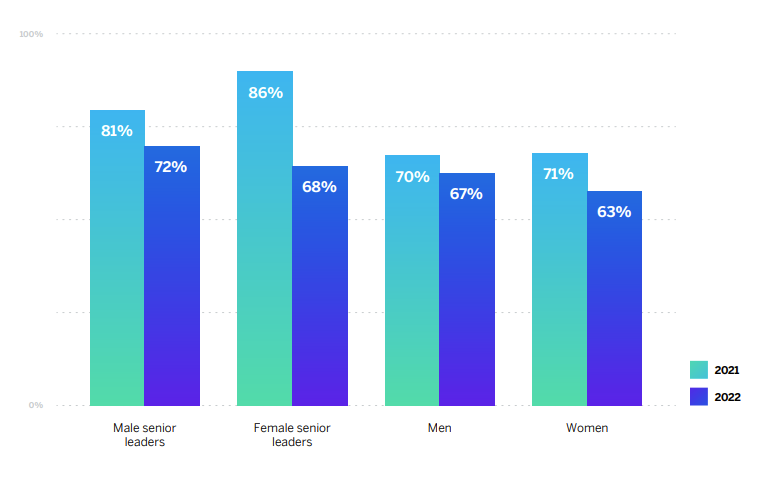
To prevent this “Great Resignation”, companies need to work closely with managers — especially senior profiles — to understand their needs and give them the means to achieve their goals.
Here are a few initiatives to better support managers:
- Provide them with the necessary resources — both technological and human — to better listen to their teams and respond to their needs
- Train them on inclusion and equity topics
- Reassess team objectives in collaboration with managers to prevent burnout
- Facilitate access to continuous learning and tools that promote workplace well-being
2. Reimagining the Workplace
One of the biggest trends to anticipate for improving the employee experience in hybrid mode? Optimize both physical and digital workspaces, to enable employees to collaborate effectively whether in the office or remotely.
Read also: [Julhiet Sterwen Barometer 2021] Toward a “Phygital Workplace”?
Qualtrics notes that there is a gap between what employers think they are providing to employees, and what employees actually need to work effectively.
For example, only 30 % of surveyed employees say that their technology experience at work exceeds their expectations. And 37 % feel that their in-office experience is not satisfying.
Yet, the quality of the work environment — physical and digital — has a direct impact on employee engagement. Case in point: employees with the right technologies to boost their productivity have an engagement rate of 91%, compared to just 24% for those without these tools.
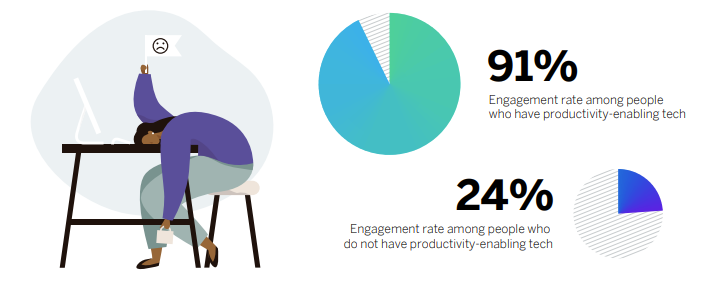
Beyond equipment and space design, it is also important to offer employees flexibility. In fact, more than one-third of respondents say they would be more likely to look for a new job if their company pushed them to return to 100 % on-site work.
Internal communication must also be as transparent as possible, which in practice is not always the case. Indeed, more than one-third of surveyed employees feel that their company does not communicate openly and honestly enough.
Whether you are an HR professional or a CIO, it is time to design a hybrid work experience that works for all your employees, wherever they are.
3. Commitment to Diversity, Equity, Inclusion, and Belonging (DEIB)
More and more organizations are seeking to improve diversity, equity, inclusion, and belonging (DEIB) within their teams. However, there is still a long way to go.
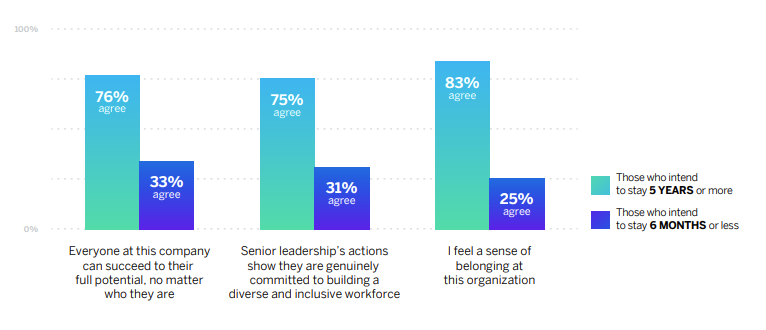
According to Qualtrics, only 70 % of employees feel that their company has made sufficient progress on diversity, equity, inclusion, and belonging (DEIB). And 67 % believe their leadership is genuinely committed to building a more inclusive workplace.
In a context of fierce competition for talent, implementing DEIB initiatives is a key differentiating factor for organizations, as it fosters a strong sense of belonging.
However, leadership and employees do not always share the same view. While 80% of senior managers believe their actions demonstrate their commitment to DEIB, only 58 % of employees agree. This figure drops even further among employees who do not plan to stay with the company for more than six months.
Closing this gap is a key challenge for organizations this year, as it will allow them to retain more employees, including those on the fence about staying.
Read also: Why and How to Implement a CSR Strategy in Your Organization?
Regardless of where they stand, organizations should double down on their diversity, equity, inclusion, and belonging efforts.
4. Initiatives to Improve Workplace Well-Being
Since the start of the Covid crisis, the boundary between professional and personal life has become increasingly blurred. Many employees have started working longer hours with no real limits.
Despite this growing distress, workplace well-being is often not seen as a priority by organizations, which only worsens the problem. For example, 29 % of employees report not always taking sick leave when they should. The reason? An excessive workload that prevents them from catching up on their backlog upon return.
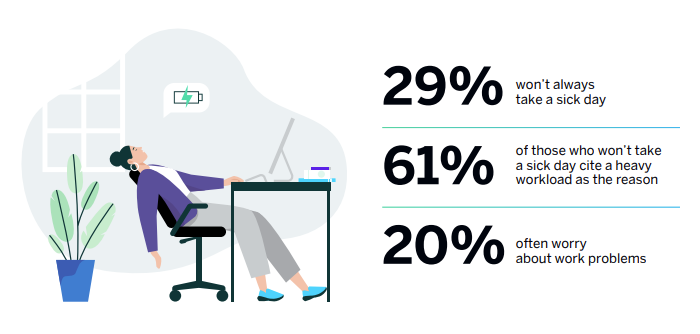
Many organizations are attempting to put in place initiatives to combat burnout. However, these tend to be too superficial and do not address the root cause: a toxic company culture that rewards work martyrs rather than those who seek a healthy work-life balance.
If companies genuinely want to improve employee well-being, they need to:
- Practice what they preach, starting from the top. In practice, this means managers should lead by example — working reasonable hours and respecting employees’ right to disconnect (for example, by turning off notifications on their collaboration tools after a certain time). This will encourage employees to do the same.
- Engage openly with employees to break down mental health stigmas and encourage the sharing of feedback with managers. For example, why not create a dedicated group on your collaborative platform
- Build a culture of well-being that prioritizes physical and mental health at work. For example, you could create a workplace well-being guide sharing best practices and distribute it via the news feed of your collaborative platform.
Conclusion
The trends are clear: to improve the employee experience in 2022, HR and IT departments must take targeted action to support managers, optimize workspace design, promote well-being, and advance diversity and inclusion. These initiatives will help retain top talent and mitigate the impact of the Great Resignation.
Read also: HR’s 5 Top Priorities for 2022, According to Gartner
Want to discover more trends and best practices to improve the employee experience? Download our practical guide on the topic:
Download the Practical Guide
In our practical guide “10 Best Practices to Improve Employee Experience”, you will find: advice for creating a quality employee experience, examples of initiatives implemented by our clients, and tools to put in place within your organization.