.webp)
[Julhiet Sterwen Barometer 2021] Toward a "Phygital Workplace"?
.svg)
According to the 2021 barometer "From digital workplace to phygital workplace," 72% of French employees believe the COVID crisis has accelerated the transformation of four key dimensions within their company: modes of organization and management, tools, and the work environment.
Conducted by Ifop for Julhiet Sterwen between October and November 2020, this study surveyed more than 1,000 employees from companies with more than 500 staff, including 350 managers, to gauge their perception of the changes underway in their organizations.
The key topics it covered:
- the impact of remote work on employee engagement, team cohesion, and management
- employees' new expectations in terms of workspaces
- the use of digital tools in the age of the digital workplace
Here is an analysis of the barometer's key findings.
Remote work: what impact on employees?
According to Julhiet Sterwen, 2020 highlighted three key employee competencies that have become essential in the era of hybrid work:
- adaptability,
- individual engagement,
- and autonomy.
The COVID crisis also had a strong impact on engagement levels and sense of belonging among employees. This period of "forced remote work," which lasted a full year in some organizations, has left its mark.
Some employees progressively disengaged for various reasons (stress, isolation, organizational difficulties, lack of motivation, absent managers…). Others, on the contrary, over-engaged in their work — an equally harmful pattern for physical and mental health, sometimes leading to burnout.
Read also: [Expert insight] Brigitte Vaudolon: psychosocial risks in remote work
The study also highlights the role played by digital tools in strengthening team cohesion (according to 30% of managers, but only 19% of employees). But it is clear that this role was insufficient. Proof — if any were needed — that the unprecedented, emergency shift to remote work was often imposed and insufficiently supported.
Even if the particular nature of the lockdown context makes definitive conclusions about remote work impossible (which is most commonly chosen, organized, supported, and properly equipped), the large-scale experiment of "forced remote work" has helped identify the excesses and risks.
Toward hybrid management
With the rise of hybrid work, the manager's role has been transformed. Gone is the vertical management model where power resided solely at the top of the pyramid. Today, the emphasis is on horizontal management and the reduction (or at least mitigation) of hierarchical levels.
Read also: [Expert insight] Bertrand Duperrin: toward a hybrid way of working
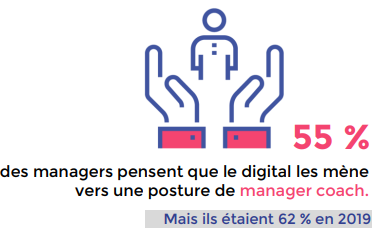
Indeed, 55% of managers believe that digital is pushing them toward a coaching posture. Being a manager is therefore no longer just about setting objectives and checking that work has been completed. To keep teams performing and motivated, the hybrid manager must remain attentive to their needs, provide personalized support, and maintain cohesion.
In this new configuration, the challenge is to find "the right balance between maintaining collective bonds and respecting the freedom of the employee."
72% of managers believe this means granting more trust to their teams. Moreover, more than three quarters of them feel that digital will allow them to develop employee autonomy. Hence the importance for managers of mastering digital tools.
Read also: Recap: "Managing Hybrid Teams: A How-To Guide" webinar
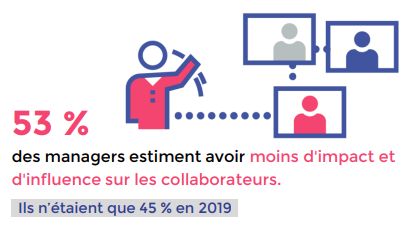
Of course, not all managers share the same attitude toward this digital revolution. More than half of them are worried about losing their ability to monitor remote employees' work. This illustrates the deep-rootedness of command & control management in French companies.
To help managers evolve their posture, 19% of employees expect the company to offer them dedicated support.
A work environment in full transformation
Management is not the only dimension affected by the evolution of working patterns. The work environment itself is undergoing a profound transformation.
Since the crisis, employees' expectations in terms of workspaces have evolved significantly. According to the barometer, 36% want to work in a private, closed office, and 27% from home. Only 12% want to work in an open-plan office, and 5% in a co-working space or third place.
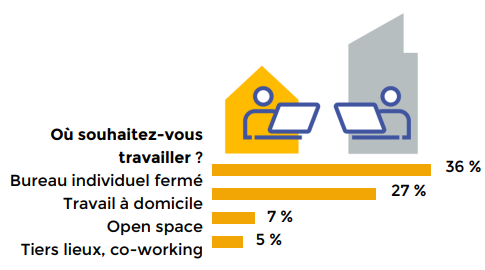
Faced with such figures, it is legitimate to ask: will remote work spell the end of the open-plan office?
Read also: Remote work: the death of the office?
For Julien Lever, Deputy Managing Director of Julhiet Sterwen, it is unlikely that the open-plan office will disappear. The real challenge will be to "find the right balance between private offices and open-plan spaces," he explains in the podcast Le Journal du télétravail. "Because while the closed office promotes concentration, the open-plan space facilitates collaboration and project-based working." The goal should be to combine the best of both worlds!
To encourage employees to return to open-plan spaces, companies will need to rethink their work environment — for instance, by creating modular spaces that adapt to individual needs. Julhiet Sterwen also recommends introducing more collective initiatives to improve the well-being at work of employees.
Read also: [Expert insight] Noémie Le Menn: how to support the return to the office?
Digital tools: usage to develop
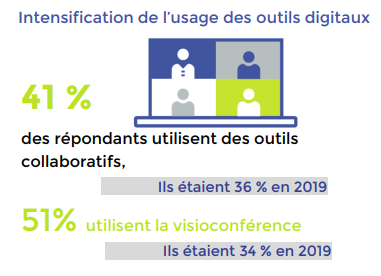
In just one year, the use of digital tools has increased significantly:
- 41% of respondents use collaborative tools (vs. 36% in 2019)
- 51% use video conferencing tools (vs. 34% in 2019)
Discover: Top video conferencing tools for business.
Read also: Collaboration: the "trending" apps and features of 2020, according to Okta
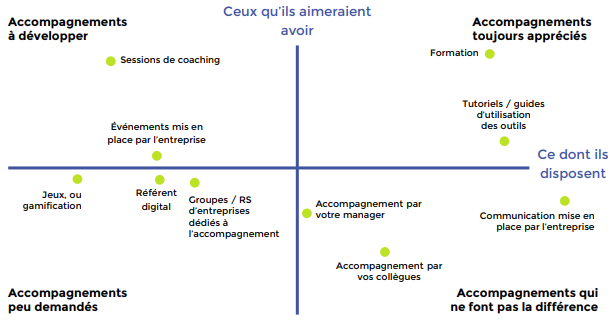
To help employees make better use of these tools, companies must introduce more personalized support and coaching initiatives.
To do so, they can leverage:
- internal events,
- usage tutorials,
- a gamification approach,
- a digital champion,
- dedicated groups.
Toward a "phygital workplace"?
A few years ago, analysts expected the digital workplace to embody the Future of Work.
The COVID crisis — which imposed forced remote work overnight on millions of people — recently demonstrated that digital alone is not enough to deliver an optimal work experience for employees. The lack of social interaction resulting from successive lockdowns sometimes led to feelings of isolation, a deterioration of relationships with colleagues or managers, and even a loss of purpose at work.
To remain productive and healthy, employees need direct, frequent human contact with their colleagues. The question then becomes: what is the right balance between physical and digital interactions?
To achieve this "phygital" balance, companies will need to rethink the various dimensions that contribute to the hybrid work experience (for example: office layout, digital tools, employee services, management…).
Ultimately, isn't the direction of travel pointing toward the gradual emergence of a "phygital workplace"?
Read also: Phygital work: the new frontier of employee experience
*
* *
Want to learn more about the challenges and best practices of hybrid work? Download our white paper:
Access the White Paper
In our white paper "The Future of Work: Embrace Hybrid Work!," you will discover: the key challenges and benefits of hybrid work; best practices for managers, HR, internal communications, IT, and employees; as well as the tools to put in place to boost the efficiency of your hybrid teams.
_
Author: Emmanuelle Abensur