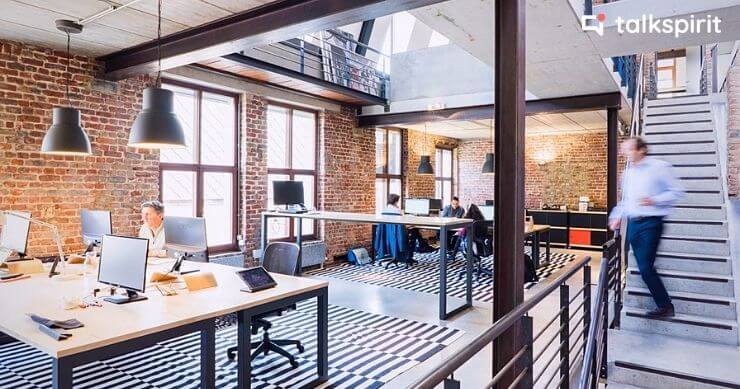
Expert Interview: Office Design Trends for 2021
.svg)
This article was published in June 2021. The trends it describes are those of that year; we are keeping it as it stands, as a record of its time.
According to a Parella study, 40% of French companies believe their office layout does not align with their strategy and is poorly suited to new ways of working. As hybrid work becomes widespread, companies now need to rethink the workplace, to make it more collaborative, welcoming, and comfortable.
To better understand which office layouts to prioritize this year, we spoke with three experts on the topic:
- Anne-Sophie Mulliez, Interior Architect, Co-founder and President of Bloom Inside, a firm specializing in design-driven, ergonomic, and eco-responsible workspaces
- Henri Coulloumme, Associate Consultant specializing in lighting and acoustics at Bloom Inside
- Camille Rabineau, New Workplace Consultant and Founder of Comme on travaille, a consulting firm specializing in collaborative design of innovative work environments
In this cross-interview, they share the latest office design trends and their benefits for companies and employees.
The Workplace as a Driver of Quality of Work Life
For Anne-Sophie Mulliez, “office design plays an essential role in quality of work life (QWL). That is why companies must create a working environment that is as comfortable, stimulating and collaborative as possible for their employees.”
However, “the office is no silver bullet,” adds Camille Rabineau. “Because quality of work life lies at the heart of work itself: it depends on the job description, type of tasks, workload, relationships with colleagues, and so on.
You can have the finest offices in the world, but if the pace of work is unsustainable and management ignores employee well-being, the office quickly becomes irrelevant.
Ideally, workplace design must therefore be part of a broader approach that encompasses all dimensions of QWL.”

Office Design Trends
Long-standing Trends Gaining Momentum
For Camille Rabineau, “the Covid crisis has reinforced several office design trends that had already existed for several years.”
The flex office
First, “there is strong demand for flex office”, in other words an office where employees do not have an assigned desk.
“Indeed, the rise of remote work allows companies to optimize their real estate footprint by rotating on-site employees. Some use this to reduce floor space or reinvest it in more collaborative areas”, explains Anne-Sophie Mulliez.
Open-plan Layouts
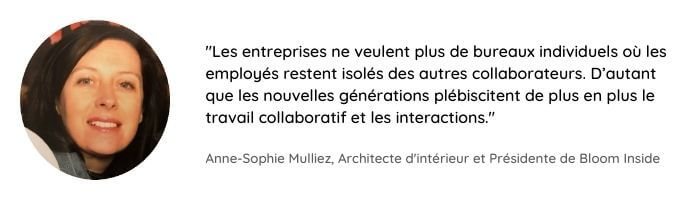
For all three experts, the move away from closed offices continues to gain ground. “Companies no longer want individual offices where employees remain isolated from their colleagues. Younger generations increasingly embrace collaborative work and interactions.
The challenge now is to make open-plan spaces more welcoming and collaborative, while minimizing their downsides: limited space, noise, poor lighting, and so on,”, says the interior architect.
Activity-based Design
As a result of this open-plan shift, “companies will seek to offer employees a greater variety of workspaces, in particular:
- spaces for individual work,
- spaces for collaboration,
- and spaces for socialising.
Depending on the task at hand, employees can choose the zone that suits them best”, explains Camille Rabineau.
New Trends for 2021
Since the Covid crisis, the office has taken on a new purpose. It is no longer just a place to work, but a space to connect, collaborate, and stay close to colleagues. In response to these needs, several new trends have emerged this year.
A Healthier Workplace
Health and physical distancing measures in place for over a year have changed how we perceive the office. “Employees now want to work in a healthy environment”, one that protects their physical and mental health, says the founder of Comme on travaille.
In practice, this means reinforcing standard hygiene measures, as well as “investing more in air quality, for instance by installing filtration systems”, adds Henri Coulloumme.
More Ergonomic and Smart Workstations
“One key priority will be to better equip offices for collaborative work and video conferencing, both in terms of infrastructure and software”, continues Camille Rabineau. “Be careful, however, not to overdo video conference meetings to avoid collaborative overload.”
“Beyond video conferencing, companies can invest in room booking systems, to optimize office space utilization”, concludes Henri Coulloumme.
“We will also move toward flexible and smart furniture and equipment. For example, individual lighting systems with adjustable brightness are recommended. As well as acoustic panels to absorb noise.
For flex-office companies, the challenge will be to raise furniture quality standards across the board, so that employees always find a high level of comfort regardless of where they choose to sit.”
More Modular Furniture
“In my view, traditional meeting rooms are no longer suited to how we work. Collaborative spaces will need to be equipped with more modular furniture and lighter, to encourage interaction and participatory meeting formats”, reveals Camille Rabineau.
“For example, large fixed tables and chairs can be replaced by bean bags, rolling stools, and sit-stand tables that allow people to move freely around the space.”
Personalised decoration
On the décor front, “the trend is toward greening spaces, using real and artificial plants alike. Jungle effects can be created with living walls or botanical wall coverings.
The industrial style, featuring glass partitions and a mix of wood and black metal legs, remains highly sought after. It can be refreshed with ethnic colors and patterns, and rattan or bamboo accessories.
Some companies also opt for a “mix and match” approach, combining existing furniture with vintage pieces of various styles for a deliberately eclectic and colorful effect,” explains Anne-Sophie Mulliez.
“The aim is to create a personalized design by mixing styles, to avoid anything that feels too standardized”, adds Henri Coulloumme.
Embracing Eco-responsible Practices
“Companies also place great importance on the durability of furniture in their design projects”, the consultant continues.
“That is why we recommend purchasing eco-designed or second-hand furniture. We also favor recyclable or repairable fabrics and materials, including wood from sustainably managed forests.” An environmental concern that, according to Henri Coulloumme, is set to intensify in the years ahead.
Benefits for Companies and Employees
These office design trends can bring significant benefits for both companies and employees. Here are the key takeaways:
Benefits for Companies
“One of the main benefits for companies will be making employees want to come back to the office more often”, says Camille Rabineau. Because office design is also what helps improve the employee experience and retain talent. “The result: a stronger company culture, improved productivity, and a stronger employer brand”, adds Anne-Sophie Mulliez.
Some layouts can also help companies save money. For example, “flex office could reduce the number of workstations by 25% on average. That is a saving of €4,000 per year per employee”, estimates Henri Coulloumme.
“Be careful, however, to reinvest all or part of these savings in improving the comfort and services offered to employees, to make this way of organising work sustainable in the long term.”
Benefits for Employees
For employees, these changes are an opportunity to “work in better conditions, but also to reconnect with their team”, explains Camille Rabineau.
“I believe the office will become a refuge where employees come to work and stay connected with their colleagues. There is no denying it: maintaining good relationships with coworkers is a key factor in workplace well-being”.
How to Measure the ROI of These Office Designs
Once your office redesign is complete, you are probably wondering how to measure the return on investment. Here are the qualitative and quantitative indicators you can track.
For Henri Coulloumme, “it is important to regularly survey employees to measure satisfaction with their work environment, for example using the IBET© index”.
“Through these surveys, you can in particular assess employees’ motivation to come into the office. If you find that employees dislike coming in and want to work remotely more than usual, you can conclude there is room for improvement”, adds Camille Rabineau.
“Several quantitative indicators can also be tracked, including:
- savings on workstations,
- energy and operational savings from purchasing higher-performance, durable furniture and equipment,
- turnover rate,
- absenteeism rate,
- individual employee performance in the office”, concludes Henri Coulloumme.
*
* *
You now know all the design trends to follow to create an optimal workplace. All that remains is to put them in place and measure their impact on your employees. Do you have questions or want to share your experience on this topic? Contact us.
Looking for more ideas to improve the work experience for your employees? Download our practical guide!