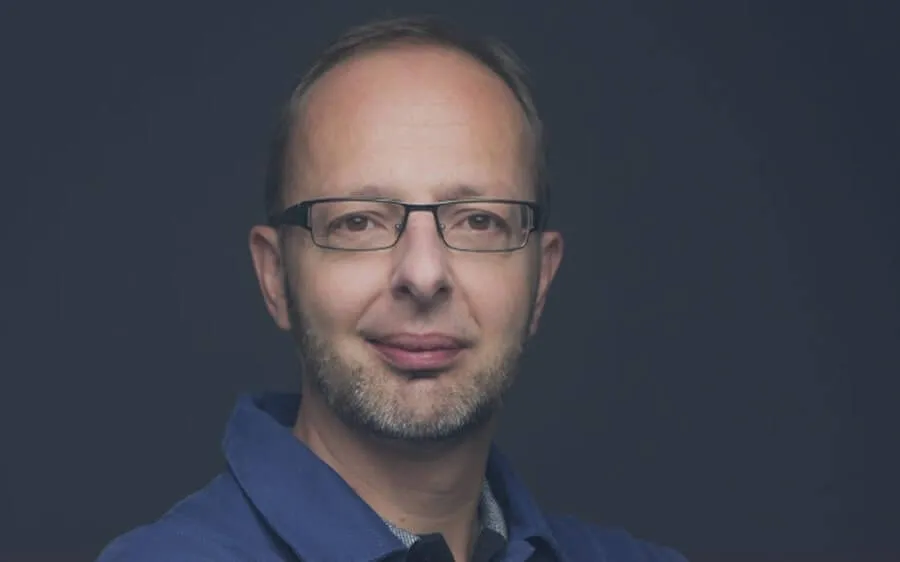
Vincent Montet, EFAP: "Training Is One of the Answers to Digital Darwinism"
.svg)
Digital transformation is a collective, organizational endeavor. But let us return to the scale of the individual and respect singularity, advises Vincent Montet, CDO of EFAP. Better yet, let us bet on training to boost everyone's skills and leave no one behind. A conversation in the spirit of a manifesto.
You chose the word "individual" to speak to us about innovation. Why does that word resonate with you today in your thinking on digital transformation?
Vincent Montet: It may come as a surprise, but digital transformation and its innovations are too often approached from a systemic standpoint — either as a sum of technologies and data exchanges, or as a challenge of disruption for organizations, management, or the broader economy. It seems to me that the most important innovation in the revolution we have been living through for the past thirty years does not, in fact, belong to technology, but to the experience of use. Experience is, above all, individual. The mastery of digital as a skill — in both professional and personal life — is the foundation of all change. The digital divide is no illusion; digital illiteracy — recently brought into focus by the SPS — affects 11 million people in France, even as the word "curator" enters the dictionary!
"Individual" — doesn't that risk sounding too individualistic? Isn't digital more about collective intelligence?
Vincent Montet: Collective intelligence was amplified by the Web 2.0 wave, but it existed long before; it just had a narrower reach. Animals are also very good at leveraging it ;-).
Read also: Benoit Anger, NEOMA Business School. Beyond digital transformation: digital metamorphosis.
But you are right — the term "collective" captures one of the most profound shifts brought about by digital. For the first time in history, each of us is a medium, and we are all potentially interconnected. This is no longer a monopoly of the state or of corporations. The individual is now face to face with brands, companies, media, the state, and so on. The collective also means vital interdependence. Our ecological collapse is titanic and global — we can no longer act as though we were isolated, whether as individuals or as nations. Digital transformation is a politically correct term for a revolution that touches every area of human activity. Let us recall these words from one of France's greatest contemporary philosophers, who left us recently — Michel Serres — in his philosophical pamphlet Thumbelina: "All our institutions are obsolete." In other words, the digitalization of life in all its aspects is a process already underway. Thinkers and economists such as Jeremy Rifkin and Gilles Babinet are proposing and questioning new models of circular economies, reinventions of work, and even of capital.
The word "individual" evokes the idea that each person is unique. Does that go hand in hand with the notion of diversity — of taking into account each person's differences to rebuild the collective?
Vincent Montet: Exactly — the individual means respecting the uniqueness of each person: my history, my culture, my genes, everything about me is unique; that is my singularity. The work Unique(s) by Alexandre Pachulsky is worth recommending on this theme. My difference becomes a strength within a collective project. Faced with the ethical challenges brought about by artificial intelligence, or the organizational challenges created by blockchain, the human being must return to center stage. We are hearing more and more, for example, about Digital Soft Skills. Technical know-how — Hard Skills — is becoming ephemeral, automated, "AI-able"; everyone must master the digital in order to… know how to be.
How do organizations account for the individual in change? How do you take a personalized approach to change — and is that personalization what Generations Y and Z especially expect in their search for purpose?
Vincent Montet: Digital illiteracy is not only a generational issue. While Generations Y and Z may need little or no training in basic usage, they are far from mastering the operational and structural stakes of digital transformation. They must of course be included — and better yet, teams should be diversified by mixing generations. Organizations are made up of people, whether leaders, managers, or employees. Action must therefore be possible at all levels. Training is, in my view, one of the keys to a successful transformation. In the recent V2 of the ACSEL (Association for the Digital Economy) Growth & Digital Barometer, a third of companies reported that one of the main barriers to transformation was a lack of employee skills and training. Offering a learning pathway — an enriched pedagogical experience that blends human interaction with digital learning — can unleash enormous creative energy and boost organizations' capacity for adaptation. Training is one of the answers to digital Darwinism.
I will not venture into the question of purpose-seeking among Generations X and Y. Over twenty years of experience in higher education, I have simply observed that they wanted, sometimes even desperately, to be heard and taken into account within the organization. Personalization is one of the tools that partly addresses this new posture. It is true in management and training, but equally true in marketing, product and service design, and communications.
Do you think that large organizations still neglect the human dimension too often?
Vincent Montet: We have seen the emergence of Chief Happiness Officers — a digital drift for some, evidence of a deeper shift in awareness for others. The notion of "well-being at work" is no longer just a dinner-party conversation. We now speak of employee experience. Even nations are paying attention, with initiatives such as the OECD Better Life Index, which challenges the authority of GDP as a measure of national ranking and counters it with quality of life as a new benchmark! As for digital, #TechForGood and its players (startups and change makers) are becoming proof of success and of value beyond a stock market listing. I would say there is progress, but we are only at the beginning.
In your view, what are the major challenges companies will face in the coming years?
Vincent Montet: I speak of revolution. Imagine the challenges. Naturally, I could mention artificial intelligence, transhumanism, biotechnologies, genetic medicine, and so on. Whistleblowers such as Laurent Alexandre or Jean-Michel Billaut all summarize quite well the violence of these changes.
But from a business perspective, I believe that human resources and the reinvention of work will be major workstreams.
If you had just one piece of advice to give, what would it be?
Vincent Montet: We need to return to the individual — and therefore return to the full potential of the human being. We are losing our expertise: only lifelong learning and humility will allow us to build — and save — this new world.