
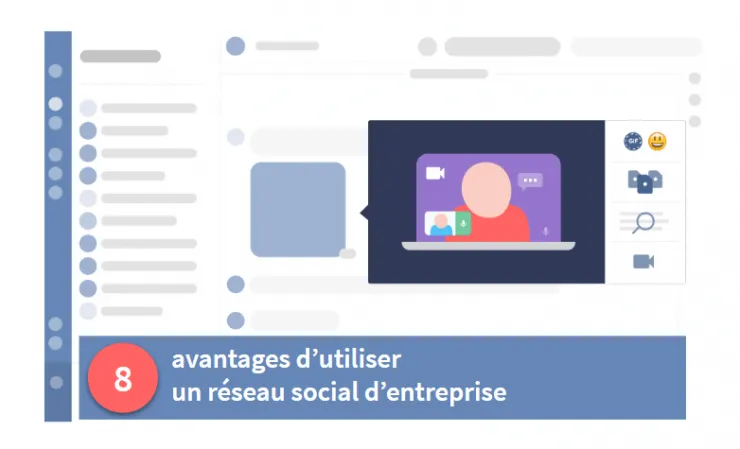
8 advantages of using an enterprise social network
.svg)
- An enterprise social network is a platform closed to the organisation’s ecosystem, employees and partners, that borrows the conventions of public social networks to move work information around.
- Its eight advantages: reducing the weight of hierarchy, enabling cross-functional communication, encouraging knowledge sharing, facilitating project management, strengthening the sense of belonging, freeing up email boxes, fighting the mania for meetings and giving meaning to work.
- What separates it from a public social network comes down to three things: who gets in, what gets published, and who keeps control of the data.
- Four pitfalls stall deployments: adoption left to chance, information overload moved rather than reduced, no governance, and data sovereignty handled after signature instead of before.
- A summary table links each advantage to what changes day to day and to the sign that the network is working.
An enterprise social network (or ESN) is a collaborative platform that reappropriates the conventions of the social networks that we all use on a daily basis. It is only accessible to people who belong to the company’s ecosystem: both internal stakeholders (executives, managers and employees) and external stakeholders (customers, suppliers, service providers, partners and subcontractors), and it aims to change communication practices within the company’s ecosystem.
There are many advantages to using an enterprise social network. The Talkspirit team has put together for you the 8 main advantages of a corporate social network.
Read also : Top 12 best enterprise social network software
Public social networks and enterprise social networks: clearing up the confusion
Both families of tools share the same conventions, a news feed, posts, reactions, comments, but they do not serve the same purpose. A public social network addresses an open audience and competes for attention. An enterprise social network addresses a closed perimeter, the organisation’s ecosystem, and exists to move work information around.
Three things separate them: who gets in (a professional identity granted by the company, not an account open to anyone), what gets published (work topics, decisions and documents rather than private life) and who keeps control of the data (the company, with hosting and retention rules it chooses). That last point is what separates an ESN from a consumer messaging app repurposed as an internal tool, a common habit and rarely a governed one.
Read also: Email, Intranet, or Collaborative Platform: What’s the Difference?
Reduce the weight of hierarchy
On an enterprise social network, communication is often less conventional, less fixed, less formal than by email. This way, information flows more naturally. Hierarchical barriers are reduced.
Executives can post comments in the workflow like any other employee, and thus exchange with everyone at the same time. This allows them to be more accessible.
Read also: 7 Arguments to Convince Your Leadership to Deploy an Enterprise Social Network
Enable cross-functional communication
With enterprise social networks, the whole way we communicate is changing. No more email exchanges that lead nowhere, with an endless list of people Cc’ing each other. No more emails where no one really knows who they’re addressing, and whether to reply to them. No more attachments sitting at the bottom of the inboxes of colleagues who have left the company. No more lost information.
On your enterprise social network, communication is more cross-functional, more distributed. Exchanges are shared and information is accessible to all, in real time. It is so much easier to find a document retrospectively! In Benelux organisations, where teams often work in Dutch, French and English at once, a single feed per topic also removes the guesswork about which distribution list to copy. Read also: 12 alternatives to internal email.
Encourage the exchange of knowledge
A definite advantage of using an enterprise social network is that it simplifies the connection between employees who sometimes do not have the same skills, do not belong to the same department/service, and do not even work on the same site. In short, it creates bridges between employees.
There’s nothing like it to create internal emulation and encourage peer-to-peer knowledge sharing. Thanks to enterprise social networks, it is easier for everyone to develop skills on new issues through peer-to-peer transmission, by sharing best practices in a community or by filing what a team has learned in a shared knowledge library that stays searchable once the people who wrote it have moved on.
Facilitate project management
Managing a project or organizing an event often requires a lot of email exchanges. With an internal social network, instant messaging and especially groups/communities will greatly simplify the organization of your events.
Exchange files and important information, which will appear in the discussion thread of all collaborators linked to the project. On some ESN (e.g. Talkspirit), a system for assigning tasks and tracking the status of each task makes project management easier.
Read also : Know everything about the digital workplace, Definition
Strengthen your employees’ sense of belonging
The enterprise social network also has the advantage of bringing the corporate culture to life and strengthening the sense of belonging. The achievements of one another, the collective successes, are easily showcased.
All of this facilitates the development of a common vision, around which your various employees can come together. Pride of belonging and cohesion are created and strengthened. The effect is strongest in organisations spread over several sites, where colleagues otherwise only meet through their manager. Read also: internal communication in multi-site companies.
Free up your employees’ email boxes
Receiving dozens or even hundreds of emails a day is harmful in many ways: it overloads messaging and mail servers, wastes employees’ time, and disrupts our ability to concentrate.
Who hasn’t interrupted a task to take a look at their email or answer one of them? The ESN makes it possible to limit the exchange of internal emails, or even to replace internal emails completely with chat features or group conversations. Benefits for the employee: freeing up time and relieving everyone’s mind.
Fight the mania for meetings
The business world, as we know, is fond of meetings. Sometimes to an excessive degree. Everyone has already experienced this type of meeting where his presence was not frankly useful, and has already attended one of those endless meetings that do not lead to any decision making.
These time-consuming meetings are often very frustrating for employees who are involved in their work and who want to “get things going”.
The good news is that the enterprise social network will help you fight against this mania for meetings.
- via chat or discussion groups, exchanges can take place without the need for a formal meeting;
- via videoconferencing, your collaborators can exchange without the need for a physical meeting.
A serious time saver, and one less frustration for your most committed members.
Give meaning to your employees’ work
As a small ant in a big machine, especially in a large group, it is not always easy for an employee to understand the meaning of his work and his missions in the middle of complex cogs.
By showcasing the achievements of employees and making them visible to their colleagues, the enterprise social network allows everyone to appreciate the importance of their work and that of others. It is also an opportunity for management to give feedback and to congratulate / encourage teams.
This way everyone can better situate themselves and strengthen the esteem in which they are held by the other employees of the company. Gaining more meaning: an essential motivational element, at the heart of what is called the “employee experience“. The latter, which is crucial for the attractiveness of the company and the retention of talent, has become essential for the Human Resources managers in our companies.
The limits of an enterprise social network, and how to avoid them
None of these eight advantages appears just because the platform is switched on. Four pitfalls come back in deployments that run out of steam.
- Adoption that drops after launch. A network opened without precise use cases empties out within weeks. Adoption has to be worked on as a project in its own right, with ambassadors and publishing rituals.
- Information overload moved rather than reduced. Replacing emails with a stream of notifications frees nobody. Groups with a clear scope, publishing rules and notification-free slots are what make the difference. Read: how to reduce information overload associated with work tools.
- No governance. Who creates a group, who archives it, who arbitrates sensitive content, within what response time? Without written answers to those questions the network becomes a grey area, and managers walk away from it.
- Data sovereignty left aside. An ESN concentrates internal exchanges, and therefore sensitive information. Hosting location, applicable law and reversibility are checked before signature, not after. Read: digital sovereignty, what companies stand to gain.
Read also: How to implement an enterprise social network in your company.
| Advantage | What changes day to day | The sign it is working |
|---|---|---|
| AdvantageReduce the weight of hierarchy | What changes day to dayExecutives post and comment in the same feed as the teams | The sign it is workingAnswers from leadership are visible to everyone, not sent as private messages |
| AdvantageEnable cross-functional communication | What changes day to dayInformation travels by topic and by group, no longer by recipient list | The sign it is workingTopics followed by people from several departments |
| AdvantageEncourage the exchange of knowledge | What changes day to dayBest practices get published and found again instead of travelling as attachments | The sign it is workingA question asked in public gets answered without going through a single expert |
| AdvantageFacilitate project management | What changes day to dayDiscussions, files, tasks and deadlines in one place | The sign it is workingProject progress can be read without a status meeting |
| AdvantageStrengthen the sense of belonging | What changes day to dayAchievements and collective wins become visible beyond the team | The sign it is workingPeople from different sites recognise each other’s work |
| AdvantageFree up email boxes | What changes day to dayInternal exchanges leave the mailbox for chat and groups | The sign it is workingThe inbox is only used for external correspondence |
| AdvantageFight the mania for meetings | What changes day to dayInformation points are settled in writing, asynchronously | The sign it is workingFewer meetings, and the remaining ones make decisions |
| AdvantageGive meaning to work | What changes day to dayEveryone sees where their contribution fits in the whole | The sign it is workingFeedback given publicly, not only at the annual review |
The ESN is therefore deeply rooted in the life of the company, and has beneficial effects on a wide range of issues. The advantages of an enterprise social network are numerous!
Are you interested in setting up an ESN within your company? Or reconsidering the direction of your current enterprise social network? Get in touch, or book a demo to see the platform live: the Talkspirit teams are at your service to advise and support you.
Read also: 5 examples that show how different organizations can leverage a collaborative platform, and how to boost the adoption of new collaborative tools.
Author: Paul Maubareyt
FAQ
A collaborative platform that borrows the conventions of everyday social networks but is accessible only to people who belong to the company's ecosystem: executives, managers and employees, plus customers, suppliers, service providers, partners and subcontractors.
Communication on it is less conventional, less fixed and less formal than email, so information flows more naturally and hierarchical barriers are reduced. Executives can post like anyone else and exchange with everyone at the same time, which makes them more accessible.
Three things separate them. Who gets in: an ESN only accepts professional identities granted by the company, whereas a public network is open to anyone. What gets published: work topics, decisions and documents. Who keeps control of the data: the company, with hosting and retention rules it chooses.
Instant messaging and, above all, groups and communities simplify organizing events, and shared files and information appear in the discussion thread of everyone linked to the project. On some ESN such as Talkspirit, a system for assigning tasks and tracking their status makes it easier still.
Four pitfalls come back: adoption that drops after launch for lack of precise use cases, information overload moved from email to notifications, no governance (who creates a group, who archives it, who arbitrates sensitive content) and data sovereignty handled after signature rather than before.
By showcasing achievements and making them visible to colleagues, so everyone can appreciate the importance of their own work and that of others. It also gives management an opportunity to provide feedback and congratulate teams, feeding the employee experience that matters for attractiveness and talent retention.