
Digital Sovereignty: What Our Companies Stand to Gain
.svg)
According to a Hewlett-Packard Enterprise study, 65% of French executives and senior managers consider digital sovereignty a major challenge for their organisation.
But what are we actually talking about? Emerging in the 2000s, the term "digital sovereignty" refers to a state's ability to assert its authority in cyberspace — meaning controlling its data and limiting the dominance of foreign powers. Today, it is clear that we are far from achieving this…
Despite European initiatives aimed at achieving digital sovereignty — such as the Digital Services Act — our dependence on digital giants (American and increasingly Chinese) continues to grow. Evidence of this: at the end of 2020, the combined market capitalisation of the GAFAM (Google, Apple, Facebook (now Meta), Amazon and Microsoft) was nearly three times that of the entire CAC 40.¹
What are the main challenges of digital sovereignty? Why should companies favour sovereign solutions? And what do they stand to gain by breaking the "GAFAM reflex"?
This article will answer all your questions on the subject.

The challenges of digital sovereignty
A strategic challenge
Digital sovereignty is first and foremost a strategic issue, as it enables French companies to develop their autonomy and grow on their own terms. In doing so, they act as a counterweight to digital giants that tend to impose their own rules within cyberspace.
Read also: [Les Échos] Let's not become digital vassals of the GAFAs!
Unlike European companies, the GAFAM are subject to extraterritoriality rules (such as the Cloud Act) that allow them to access data transiting through their servers, without informing their clients or users.
Given that 92% of Western data is hosted in the United States, this type of legislation poses a threat to our companies. The risk: becoming a "digital colony" of the United States. It is therefore essential to protect our strategic data (particularly data related to innovation), regulate the activities of American platforms in Europe, and invest more heavily in European solutions.
An economic challenge
According to the European Commission, American digital giants pay on average only 9% tax on their profits (compared to 23% for European companies). As a result, the money spent by our companies to access these services contributes very little to the French and European economy.
To offset this low tax rate and restore fairer competition, the French Parliament passed the "GAFA tax" in 2019. The objective: to levy a 3% tax on the digital revenues generated by these companies in France, i.e. revenues from targeted advertising and intermediation services.
However, this initiative is far from solving the problem, as the GAFAM are estimated to conceal nearly three-quarters of their turnover in tax havens (amounting to €9.4 billion in 2017).²
An ethical challenge
As highlighted in the latest CERNA report (the Ethics Committee for Digital Research in France), digital sovereignty also carries an ethical dimension, notably concerning "every individual's right to protect their privacy".
Whether it's our interests, our consumption habits or our political opinions, the GAFAM know everything about us. And not solely for the purpose of improving their services. The data collected, sometimes illegally, represents an invaluable source of revenue for them, enabling them to sell ever more targeted advertising to advertisers.
Moreover, as the Cambridge Analytica scandal demonstrated, data collected on these digital platforms can be used to influence our behaviour — raising serious ethical concerns.
A data privacy challenge
According to an Ifop survey from January 2021, 69% of French people are concerned about how their personal data is used. And 66% would be willing to give up a digital service due to a lack of transparency about how their personal data is hosted and used.
Despite these growing concerns, many French companies continue to use the services of American companies, all of which are subject to the Cloud Act. Enacted in 2018, this law allows US law enforcement agencies or intelligence services to obtain, on demand, all data stored on their servers — whether located in the United States or even… in Europe.
In practice, if you use American software, this means the US government can potentially access your data and use it for surveillance purposes.
See also: [Video] Digital sovereignty — a cold shower? With Tariq Krim and Bernard Benhamou
What's in it for French and European companies?
Today, the use of foreign products and services is particularly widespread in our companies. IT equipment, professional software, online data hosting solutions — all these categories are dominated by foreign firms.
When it comes to professional software, American solutions are everywhere: as early as 2016, 80% of CAC 40 companies were using Microsoft 365. Since then, many have added Slack, Zoom and Meta's Workplace. As explained above (see Cloud Act), this choice is not without consequences for data privacy.
You've got the picture: if we want to develop and safeguard our digital sovereignty, we must now think before giving in to the GAFAM reflex, and turn — wherever possible — towards sovereign French or European solutions.
Read also: [France Inter] Digital sovereignty — what's the point?
But concretely, what do companies stand to gain by choosing made in Europe?
Protecting their / your data
Opting for European solutions provides an essential guarantee in terms of data protection. Beyond the obligation to comply with GDPR, European solutions are not subject to the Cloud Act, and therefore more effectively protect your data, your employees' data and your clients' data.
This is particularly important for companies that handle sensitive data in sectors such as defence, security or healthcare, as well as those seeking to protect their intellectual property and avoid industrial espionage.
It was partly these security constraints that led the CEA (the French Alternative Energies and Atomic Energy Commission) to use exclusively French software for its digital workplace.
Read also: Working differently: a challenge tackled in just a few months by the CEA, with Talkspirit
Reassuring your clients
In the wake of recent waves of data leaks and breaches involving American publishers, companies are paying increasingly close attention to how their data is secured and hosted.
Citizens already have firm views on this: 44% of French people trust a French or European provider more to protect their personal data (compared to only 2% for an American provider).³
By choosing European solutions, a company gains an additional way to reassure its clients and demonstrate that data privacy is its top priority.
Benefiting from greater proximity and responsiveness
Last but not least: often smaller in size, a local provider is more attuned to your needs and can respond to them far more quickly than a large company serving millions of customers and users.
No need to write emails in English to a remote support team — you can directly contact a dedicated French-speaking team that will get to know you and go above and beyond to understand your specific needs and improve your experience.
This proximity is one of the reasons why Gîtes de France turned to Talkspirit, a collaborative platform developed by a human-sized publisher.
Read also: Improving information flow with Talkspirit: the Gîtes de France story
Local players — a viable alternative to GAFAM?
According to the Ifop study, 69% of French people feel they have no choice but to use the services of American giants due to a lack of European alternatives.
Yet Europe is home to digital players that are more than a match for the major American companies — and, unlike them, are not subject to the Cloud Act.
However, due to the intense competition in this market, European alternatives often lack visibility. If we want to nurture our own unicorns, it is essential to support them concretely, by choosing — wherever possible — made in Europe.
So the next time you need professional software, a digital platform or a secure storage solution, start by asking yourself: is this solution French (or European)? And if so, where does it host its data?
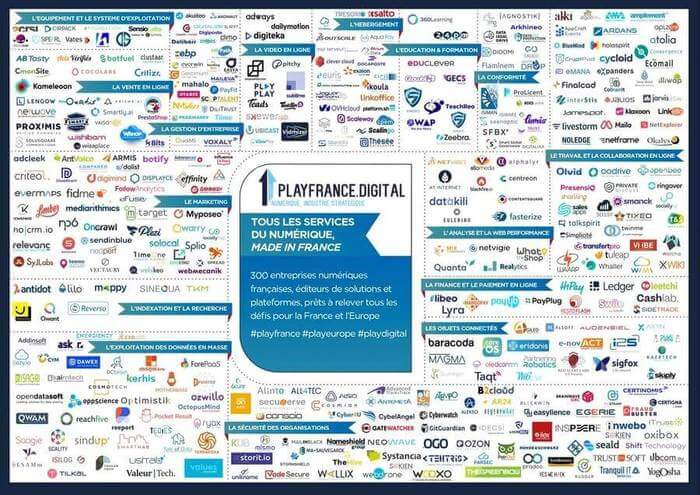
If you are not yet familiar with French alternatives to GAFAM, you can consult this directory of 400 software solutions compiled by Solainn, or this mapping of 300 digital players by PlayFrance.digital.
And if you are looking for a European collaborative tool to support your teams, particularly when working remotely, check out this article.
Read also: [BFM Business] French tech gems rivalling the GAFAM
*
* *
Establishing our digital sovereignty is today essential for France and Europe to protect our values and our digital identity and limit the dominance of GAFAM. To compete internationally, nearly 9 out of 10 French people believe it is our duty to support French or European players³. The stakes are high: fostering a digital ecosystem aligned with European principles and values, and protective of our personal data.
Want to learn more about the challenges of digital sovereignty? Download our practical guide "Digital sovereignty explained to organisations" to keep the key takeaways in mind:
Access the Practical Guide
In this practical guide, you will discover: the 4 main challenges of digital sovereignty, the risks of using American tools, 4 good reasons to favour sovereign solutions, and the best resources for finding them easily.
¹ FABERnovel GAFAnomics Quarterly Study (2021)
² Attac Study (2019)
³ Ifop study "French people and digital sovereignty" (2021)
_
Author: Emmanuelle Abensur



.webp)