
The future of work in Europe, according to McKinsey

.svg)
- The McKinsey Global Institute report of June 2020 covers more than 1,000 cities and regions across 27 European countries.
- 22% of European jobs, or 53 million, could be automated by 2030, and almost 59 million jobs were put at risk by the Covid crisis.
- 21 million European workers will have to change occupation by 2030, and more than 90 million will need new skills in their current role.
- Employment is concentrating in large cities: Europe's 48 largest megacities are expected to capture more than half of job growth.
- 2026 update: McKinsey now measures hours rather than jobs, and finds 58% of work hours across ten European economies technically automatable.
- Three quarters of the skills European employers ask for are used in automatable and non-automatable work alike.
If the Covid-19 crisis has had a heavy impact on the labour market, it has also resulted in the rise of new technologies and an acceleration of the change in working methods. For example, in the next ten years, automation and artificial intelligence are expected to profoundly change the distribution of jobs and skills needs. According to a McKinsey report of June 2020, approximately 22% of jobs in Europe (or 53 million) could be automated by 2030.
In this report, the strategy consulting firm identifies the trends shaping the future of work of more than 1,000 cities and regions in 27 European countries. Here is a summary of these trends, and several initiatives to be implemented to address them. That report dates from 2020, so the last section of this article sets it against what McKinsey has measured since, in 2024 and then in 2026.
The impact of Covid and automation on the European labor market
Jobs at risk
According to McKinsey, almost 59 million European jobs were threatened by the Covid-19 crisis through reductions in working hours, pay cuts, temporary leaves or layoffs.
Three sectors account for half of the jobs at risk in Europe:
- commerce (wholesale and retail), which alone accounts for 25% of the most vulnerable jobs
- catering
- manufacturing
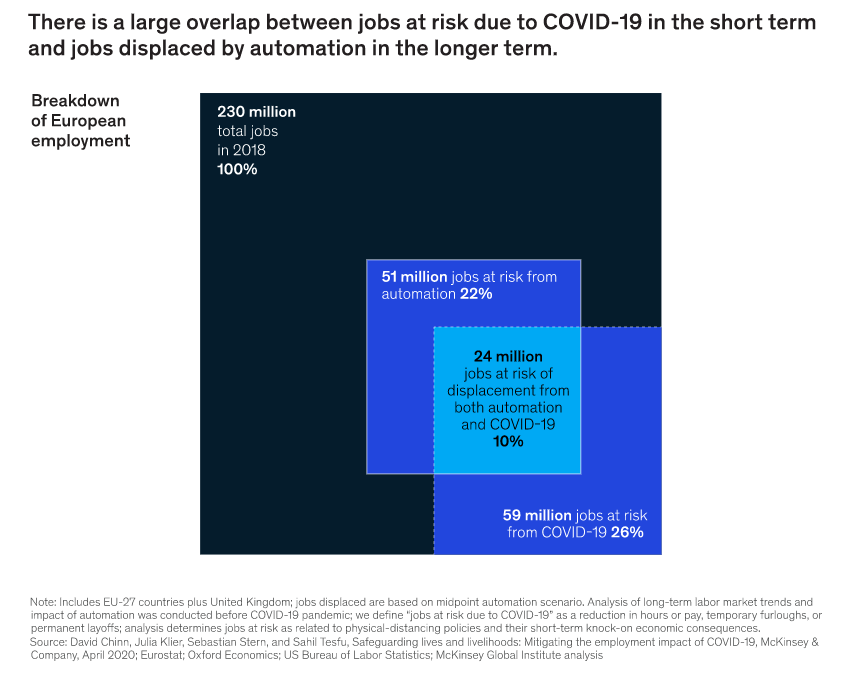
The jobs most affected by the pandemic are those that were already most at risk from automation. In the retail and wholesale trade, for example, almost 70% of jobs already “at risk” due to automation are also threatened by the crisis. Covid-19 could thus accelerate the destruction of certain jobs and the emergence of others.
Also read: Covid’s Impact on the Digitalization of Companies: A Summary of the McKinsey Study (2020)
Low-skilled workers and youth will be the most affected. In fact, 80% of the jobs that are at risk of being eliminated or transformed are held by people with no higher education.
A change in the distribution of jobs
The distribution of employment by industry is also expected to change. In more than half of today’soccupations, at least 30% of the work could be automated using current technology. As a result, administrative, production and customer service jobs are expected to decline significantly in the coming years.
According to the report, automation is accelerating the transition to knowledge-intensive sectors such as education, information and communication technologies, healthcare and social services. For example, STEM (science, technology, engineering and mathematics), business, legal and medical professions are expected to grow by more than 20 percent over the next 10 years, creating about 4 million jobs.
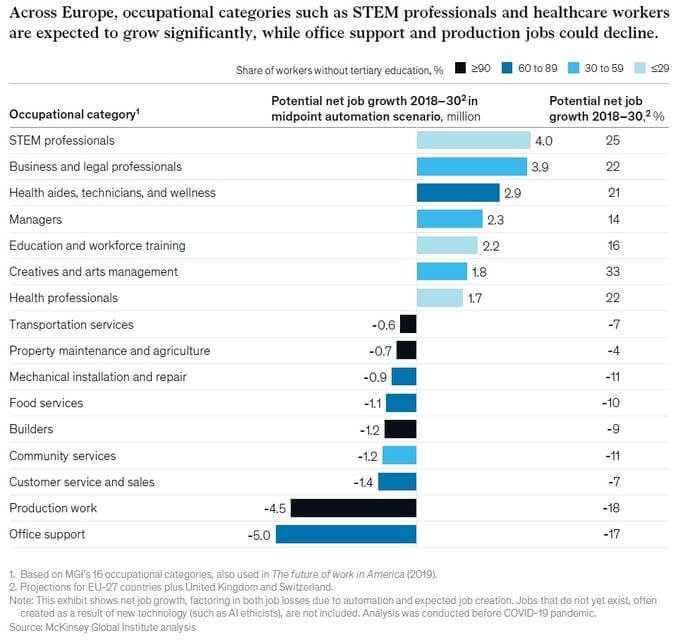
Fifteen occupations could account for almost 30% of potential employment growth, including software developers, healthcare professionals and marketing professionals.
New skills needed
The majority of jobs that will be filled by 2030 will require a higher level of skills than today. For example, 21 million European workers will have to change occupations by 2030, and more than 90 million will need to acquire new skills in their current jobs.
Two types of skills will be particularly in demand:
- social-emotional skills, such as teaching or empathy
- technological skills, such as programming or R&D
Also read: [Expert opinion] Mathilde Héliès (CEO of Fullémo): Emotional intelligence, a Key Management Skill
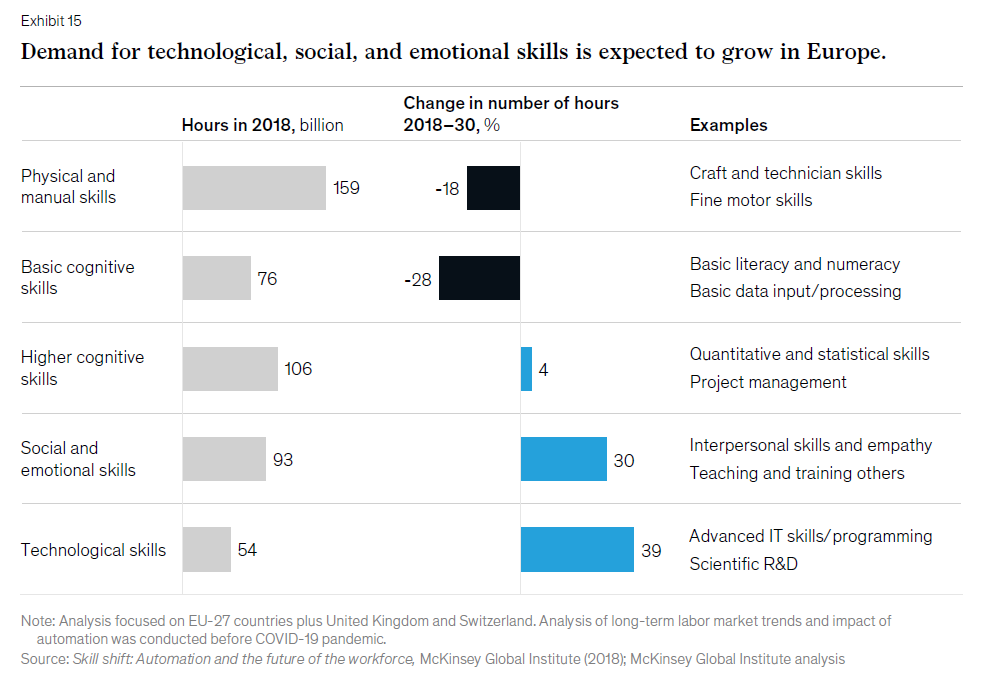
Employees in declining occupations will also have to develop these new skills in order to be able to evolve. For example, some salespeople will be able to take specific training to convert to nursing or personal assistance roles, which are expected to grow by 25% by 2030.
A shortage of skilled labour
Once Europe recovers from the crisis, it could face a shortage of skilled workers, especially in large cities. At issue is the shrinking of the working population, largely due to demographic ageing.
Today, only 40% of Europe’s population has a higher education, but that’s not enough: 60% of growing jobs require such profiles. Over the next ten years, it will therefore be more difficult for companies to find the skills they need, particularly in the IT and healthcare sectors.
An increasing geographical concentration of employment
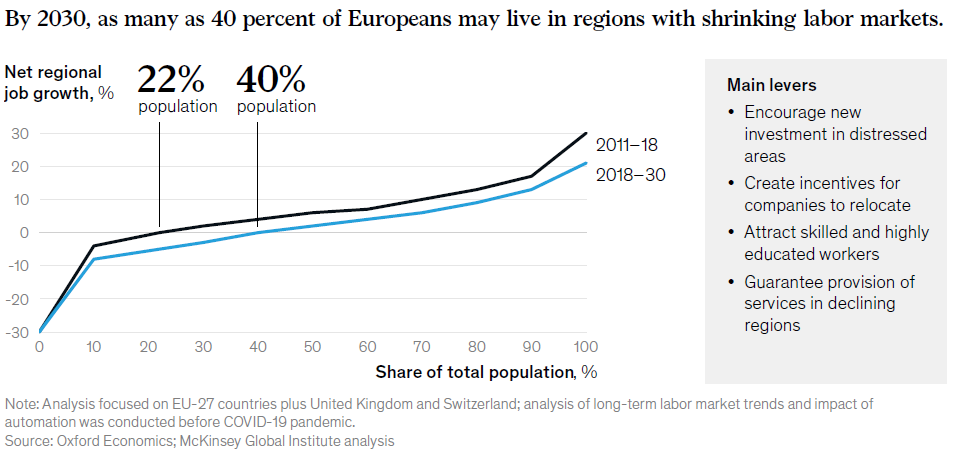
By 2030, jobs will be increasingly concentrated in large cities. Thus, Europe’s 48 largest megacities are expected to capture more than 50% of employment growth, compared with only 10% for declining regions.
According to McKinsey, 40 percent of Europeans live in areas where the number of jobs is expected to decline. This is particularly the case in Eastern Europe, East Germany, Southern Italy and Portugal.
However, this trend could be tempered by the increase in teleworking, which could reduce the attractiveness of large cities and encourage geographically decentralized work.
How Europe can meet these challenges
To adapt to these trends and lead the future of work, European companies and governments must focus their efforts on four major themes:
Addressing the skills shortage
To address the shortage of skilled labour, companies must first invest in fostering employee skills. To achieve this, they’ll have to upgrade their training programs and place continuing education at the heart of their corporate culture.
Also read: Vincent Montet, EFAP: “Training is One of the Answers to Digital Darwinism”
Skills assessment will be an important step in identifying workers who need to train or even retrain.
Employers will be able to partner with universities to develop curricula that are relevant to the world of work.
They’ll also be able to rely on digital platforms to improve the transparency of job offers and propose career paths that match workers’ skills.
Along with training and retraining, investing more heavily in recruitment will be needed to attract key talent and find new ways of identifying less traditional profiles.
Improving access to employment
By 2030, fewer than 60% of all jobs in megacities will be filled by their current inhabitants. To fill this labor shortage, several million more people will have to move to these larger cities, requiring investment in transportation infrastructure and the creation of more affordable housing in urban areas.
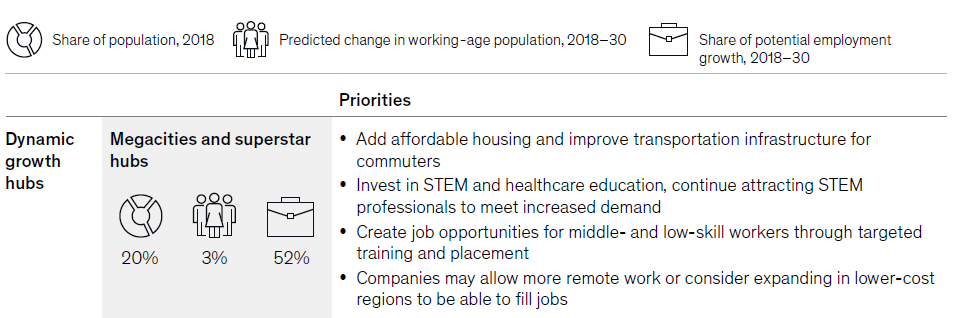
To develop their talent pool, companies have several alternatives:
- develop in areas with smaller populations
- recruit remote workers
- turn to freelance or outsourcing
Supporting a declining labor market
European governments can also implement several initiatives to bolster the labor market:
- create targeted funding programs such as Horizon Europe, the successor to Horizon 2020
- offer economic incentives that encourage companies to relocate
- stimulate investment in education and health services
- provide financial incentives to attract skilled foreign workers
Increasing labor market participation
In the long term, the challenge will be to increase the participation rate to cope with the shrinking labor force. To counteract this trend, Europe will need to focus on attracting and retaining skilled workers, as well as boosting the participation of older people, women and youth.
There are two options that can help retain workers longer:
- reforming the pension system, for example, by increasing the retirement age
- creating more flexible part-time jobs that allow employees to gradually retire over two or more phases
To attract women, employers can offer more flexible hours, part-time work, distance work and childcare.
Finally, it’s crucial to ensure that graduates are trained in the skills that are actually in demand in the labor market. Public subsidies can also be given to companies that hire them to support youth employment.
What McKinsey has measured since: the 2024 and 2026 editions
The report summarised above dates from June 2020. The McKinsey Global Institute has revisited the same question twice since, with generative AI and then agents and robotics at the centre of the analysis. Those editions do not invalidate the 2020 one: they shift the unit of measurement.
2024: up to 12 million occupational transitions
In A new future of work: The race to deploy AI and raise skills in Europe and beyond (May 2024), the firm estimates that Europe could need up to 12 million occupational transitions by 2030, affecting 6.5% of current employment, double the pace seen before the pandemic. The direction set out in 2020 holds: demand rises in STEM, healthcare and other high-skill occupations, and falls in office work, production and customer service.
2026: 58% of work hours are technically automatable
In Agents, robots, and us: How AI reshapes work and skills in Europe (May 2026), the measure is no longer jobs but work hours. Across ten European economies, 58% of the hours worked today could be automated with technologies that already exist. The report is explicit that this is technical feasibility, not a forecast: the real pace will depend on cost, regulation, the availability of skills and how ready organisations are. In a midpoint adoption scenario, that automation would represent up to 1.9 trillion dollars of value in Europe by 2030.
The same report pushes back on the idea that AI simply replaces people: three quarters of the skills European employers ask for today are used in work that is automatable and in work that is not. Most occupations are being recomposed around AI rather than removed by it. For companies in the Benelux and elsewhere in Europe, the practical question is less which jobs disappear than which tasks move, and who is trained for what remains.
Also read: Beyond AI: Evolving How We Work, with Rhea Ong Yiu
| McKinsey report | What it measures | Headline figure |
|---|---|---|
| McKinsey reportThe future of work in Europe (June 2020) | What it measuresShare of jobs that could be automated by 2030 | Headline figure22% of European jobs, or 53 million |
| McKinsey reportA new future of work (May 2024) | What it measuresOccupational transitions needed by 2030 | Headline figureUp to 12 million in Europe, or 6.5% of employment |
| McKinsey reportAgents, robots, and us (May 2026) | What it measuresShare of work hours that are technically automatable | Headline figure58% across ten European economies |
The three figures are not directly comparable: they use different units and cover different sets of countries. What does compare is the direction, and it has not changed in six years. Office work, production and customer service are shrinking; technical and care occupations are growing; and the skills gap remains the bottleneck.
What has aged is the framing. The 2020 report reads the labour market through the health crisis, while the later editions read it through AI adoption. The 59 million jobs at risk describe a moment, not a long-run trend.
Also read: 5 Interesting Ways AI Can Transform Knowledge Management Processes
*
* *
Over the next ten years, automation is expected to create, transform and eliminate many jobs. In order to occupy the professions of tomorrow, most employees will have to develop their skills, or even retrain completely.
An effort that companies will have to support by investing massively in training, but also in digital tools. They will also be able to turn to remote work, hybrid work or freelancing in order to expand their talent pool.
Want to learn more about the challenges of the future of work? Read our white paper: “Future of Work: Make Way for Hybrid Work.”
Access White Paper
In our white paper “The Future of Work: Make Way for Hybrid Work!” you’ll discover the eight main challenges of hybrid work; best practices managers, HR, internal communication, IT and employees all can adopt; and the tools for facilitating hybrid work.
FAQ
According to the McKinsey report of June 2020, around 22% of jobs in Europe, or 53 million, could be automated by 2030. Its May 2026 edition measures differently: 58% of work hours across ten European economies are technically automatable with technologies that already exist.
Almost 59 million European jobs were threatened in 2020, through reductions in working hours, pay cuts, temporary leave or layoffs.
Three account for half of the jobs at risk in Europe: wholesale and retail trade, which alone accounts for 25% of the most vulnerable jobs, catering, and manufacturing.
21 million European workers will have to change occupation by 2030, and more than 90 million will need new skills in their current role. McKinsey's May 2024 report puts the need at up to 12 million occupational transitions, affecting 6.5% of European employment, double the prepandemic pace.
In more than half of today's occupations, at least 30% of the work could be automated using current technology. Administrative, production and customer service jobs are expected to decline significantly as a result.
Two follow-up reports. In May 2024, Europe could need up to 12 million occupational transitions by 2030. In May 2026, 58% of European work hours are technically automatable, and three quarters of the skills employers ask for are used in automatable and non-automatable work alike.


Explore similar articles
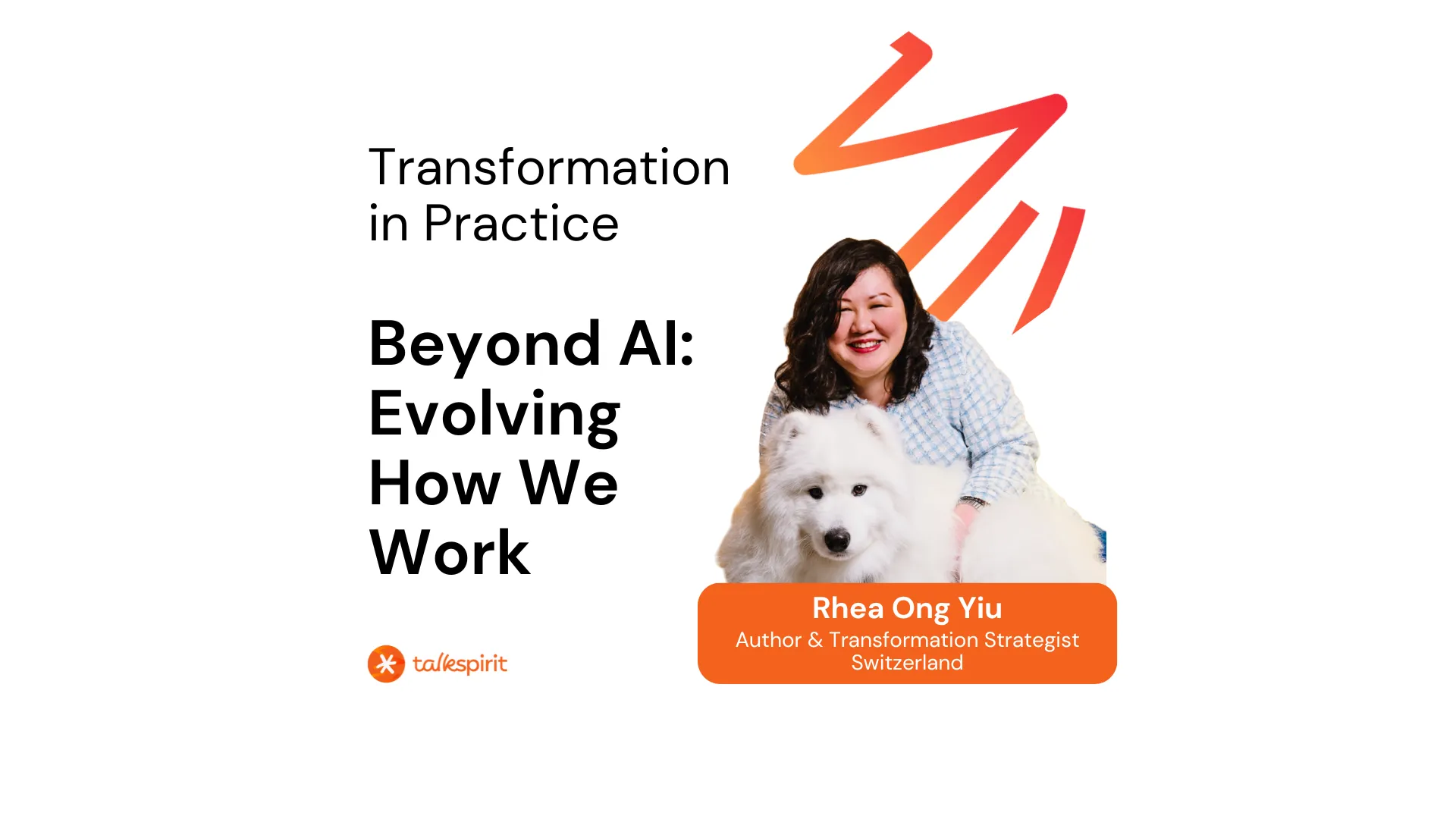
Beyond AI: Evolving How We Work, with Rhea Ong Yiu
In this conversation, transformation strategist and author Rhea Ong Yiu explains why the rise of AI is not the core challenge for organisations. The real issue, she argues, is structural: unclear roles, outdated governance, and decision-making systems that no longer match the pace of change. Drawing on her experience in organisational design, alternative governance models and human-centred transformation, Rhea outlines how leaders can redesign roles, rituals and relational practices so humans and AI can coexist in ways that strengthen clarity, innovation and trust.