How to Manage a Remote Sales Team

.svg)
Managing a remote sales team is no easy feat — communication can be difficult, and misunderstandings are frequent. How can your sales team perform at its best if it doesn't trust itself enough to collaborate transparently?
On top of that, working from home can lead to a sense of isolation and team disengagement. This is very bad for motivation — an essential ingredient of sales success.
Don't panic! There are excellent ways and tools to make managing your remote sales team easier, and we'll cover all of them in this article 🙂
Read also: Hybrid Work: Best Management Practices
#1 Set Up Structured Processes
Good processes provide the structure and direction needed to get work done, especially when sales teams are spread across multiple time zones and need to be managed remotely.
But how do you get your salespeople to actually follow these processes?
Don't just store your process documents in a shared folder and wait for people to read and apply them. Instead, define them in terms of tasks.
Define These Processes as Tasks
The advantage: most CRM tools for managing an opportunity pipeline now handle task lists and make it easier to implement processes. Pipedrive, for example, lets you identify tasks, schedule alerts, and as soon as one task is completed, schedule the next one.
You can have templates for processes such as sending a prospecting email, creating a proposal, delivering a demo, and so on.
CRMs like Pipedrive also make it easy to send and track the opening of your proposals and quotes directly from the user interface.
Hold Your Teams Accountable
One process followed by many high-performing remote teams is to set up an accountability routine. Once a week, all team members post an update on the leads they will follow up on the following week and the goals they have already achieved.
This keeps all team members on the same page regarding project goals and holds everyone accountable to the rest of the team. Accountability helps teams hit their targets on time and keeps team members engaged.
This way, "micro-managing" your team to check that they follow the processes becomes completely unnecessary. You'll also avoid seeing some team members consider a career change.
#2 Manage Sales Activities
You could simply set a target for your salespeople and ask them to hit it.
But is that really enough?
No, smart sales managers know they need to track their salespeople's activities. This is especially important in a remote sales team where you can't see what your salespeople are working on.
You won't have the opportunity to coach your team members as regularly and effectively as you would in a physical office. It's therefore essential to use the right technology to make managing your team easier.
Track Client Appointments
If you have an outside sales team, you can use Badger Maps to track your sales representatives' visits. Badger Maps integrates with a large number of CRM solutions and this data will automatically be added to your CRM.
Manage Time Usage
It is also essential that your salespeople allocate their time wisely and focus it on the right opportunities. There's no point getting distracted and spending too much time on prospects that are too small or have a low conversion probability.
Use a time tracking tool such as Time Doctor (below) to see which projects and opportunities your salespeople are working on.
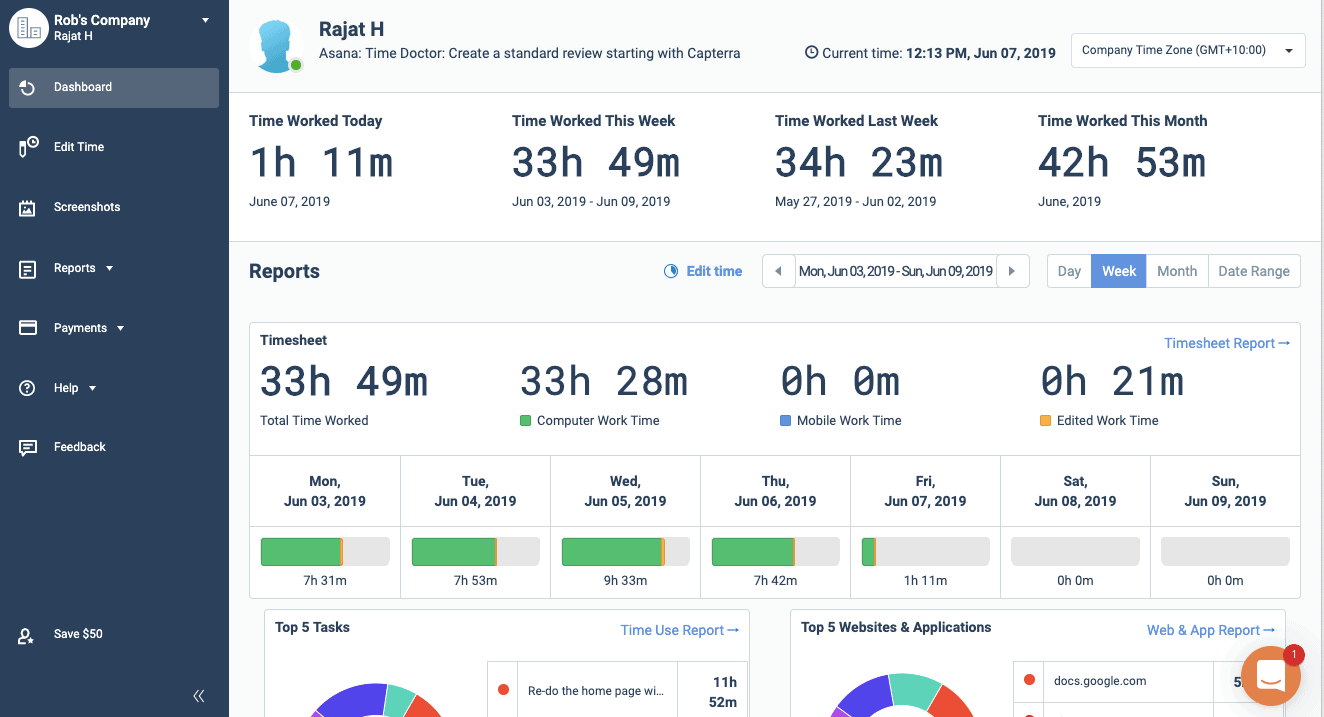
Moreover, a time tracking tool helps teams maintain "consistent" working hours. Distractions at home are one of the biggest challenges for remote employees.
Simplify CRM Adoption
Encouraging your salespeople to record their sales activities in a CRM is truly important for a remote team, but it's also much harder! Therefore, use a CRM like Nimble that makes manual data entry almost unnecessary. It integrates with G Suite, Microsoft 365, Twitter, and more, giving you a complete record of your emails and social media conversations.
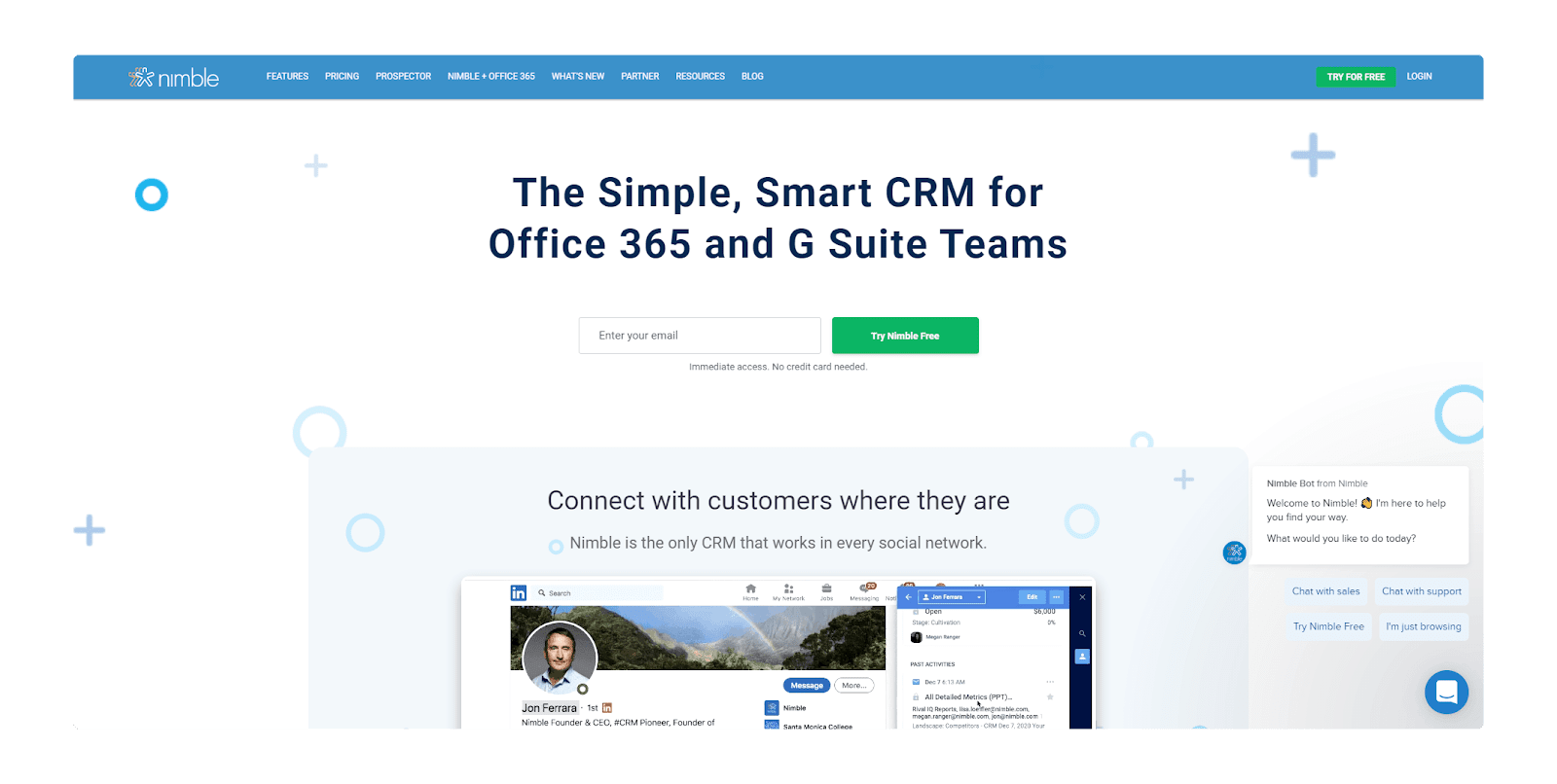
You'll no longer have to chase people to update their CRM!
#3 Build Trust
Trust builds within a team over time. When you don't spend eight hours a day in the same physical office, it naturally takes longer.
In almost every sales team, individual achievements on specific deals can receive more recognition than the teamwork that contributed to them. This can lead to internal conflict, unhealthy competition, and mistrust.
This is a bad state for any team, but in a remote environment it can cause serious setbacks. Here are a few ways to address it.
Promote Teamwork
A team that doesn't trust each other has little chance of collaborating or supporting one another. That's why you need to take active steps to promote effective teamwork among your remote employees — for example by striking the right balance between individual recognition and team recognition, by regularly asking for feedback, by clarifying roles in the sales process, and so on.
Read also: Webinar Recap: “Why and How to Build a Feedback Culture?”
One of the main barriers to trust in a distributed team is the lack of non-verbal communication.
How can you address this?
Over-communicate — send updates regularly, respond to messages quickly, and be available at key moments. Encourage your team members to "talk" frequently, not just with you but also with each other. Opt for a video call via Skype or your company chat rather than having a "cold" conversation by email or instant message.
Deploy Internal Communication
Tools If you want to take your remote sales team's camaraderie to the next level, use an internal communication tool like Talkspirit to transform the employee experience. An internal communication tool that fosters transparency by facilitating conversations across levels and teams, and enabling knowledge sharing.
Read also: Best Internal Communication Software in 2021
#4 Promote Employee Engagement
Engaged employees can sometimes be 10 times more productive than disengaged ones. In remote teams, where human contact is minimal, it's easy to lose engagement. That's why it's essential to take proactive steps to motivate people and reduce the factors that frustrate your employees.
Here are a few options at your disposal.
Reduce Frustrations
When you try to improve employee engagement, start by making their work easier.
For instance, one of the activities salespeople dislike the most is prospecting. Besides, a great salesperson is not necessarily a great prospector. But what if you don't have the budget or bandwidth to build a prospecting team?
Use a tool like Interseller — an all-in-one prospecting, email-finding, and email outreach tool. It will save your team at least 20% of their time. But more importantly, it will eliminate the “pain point” of finding prospects.
These two tasks are routine tasks that frustrate most talented salespeople. So why not hand these tasks over to software, which will do a much better job anyway. Another solution is to improve your inbound marketing approach through SEO work and link-building platforms, which will help you climb search engine rankings and be less dependent on outbound prospecting.
Share Successes and Offer Support
Hold a weekly video call to share achievements — how someone closed four major deals in a week, or which tactic was used to convert a reluctant buyer.
We draw motivation from others. The more you share achievements, the more excited each salesperson will feel about closing big deals.
Read also: Internal Communication: The Multi-Site Company Challenge – Better Showcasing Internal Successes
Regular meetings do more than energize people — they’re also excellent for brainstorming on sales strategies or tackling complex challenges. Don’t leave people to tackle those challenges alone. Create an atmosphere where people can find help and support when they need it.
Since remote workers don’t get to gather around the water cooler, encourage discussions on your company chat about everyday topics, while respecting the right to disconnect!
Read also: [White Paper] Right to Disconnect: A Survival Guide for Remote Work
Hold In-Person Meetings
Just because you’re remote doesn’t mean you should never meet in person!
Quarterly gatherings or annual meetups are also very useful for strengthening team cohesion and relationships among remote workers. These social bonds will not only foster positive energy among team members but also combat loneliness at work.
Read also: Webinar Recap: “Hybrid Work: How to Maintain Team Relationships?”
*
* *
Want to learn more about best practices for remote management? Watch the replay of our webinar “Managing Hybrid Teams: A Practical Guide”: