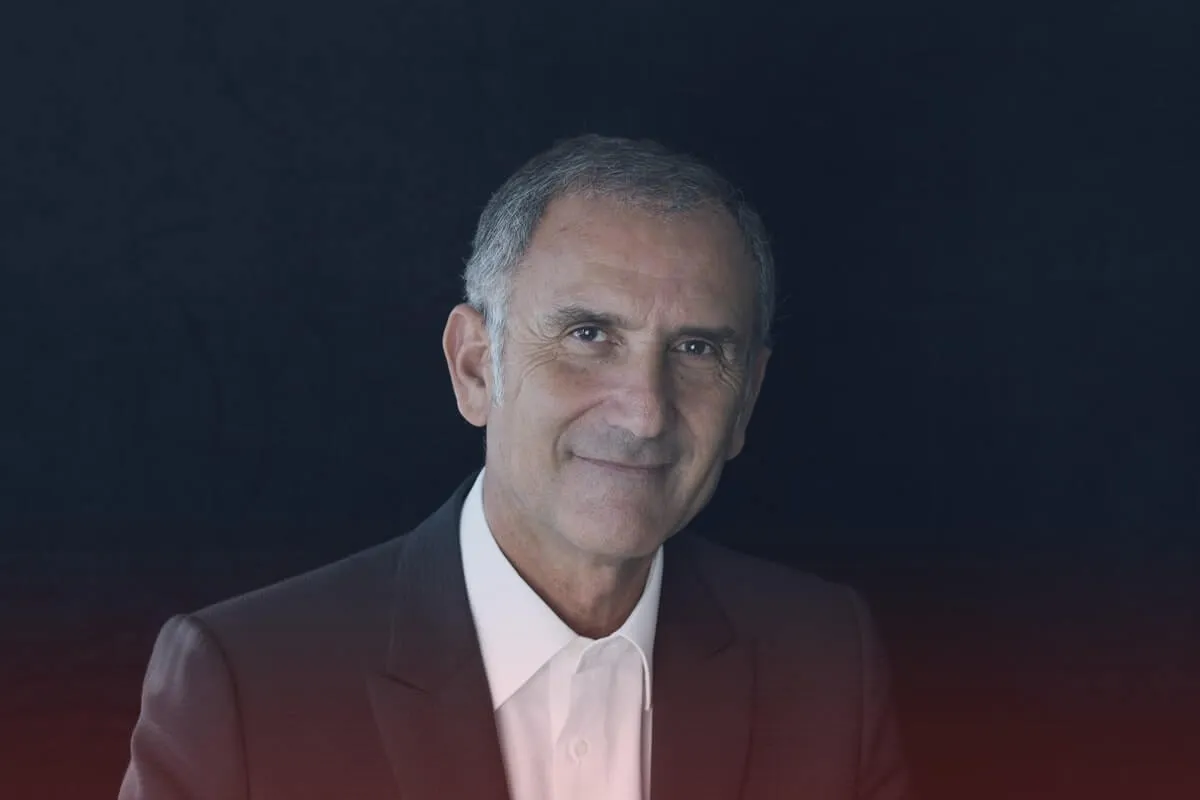
Guy Mamou-Mani, Open: The Future of Work
.svg)
We sat down with Guy Mamou-Mani, co-president of the Open group. Also the author of L’apocalypse numérique n’aura pas lieu, he shared with us the humanist vision of technology that he develops in his book. But only if everyone takes up the subject! In his view, it is by projecting a shared vision that we will be able to build a better world. So the keyword he holds up to bring us together is, of course, “future”.
You chose the word “Future” to talk to us about digital transformation. Why?
Guy Mamou-Mani: To me, that word is fundamental today because it symbolises everything that is happening in our society, in our companies, in our humanity. You can see it in our environments: there is a whole questioning going on in the search for meaning, and not only among Millennials. And I would say that this search is based on our future: what is going to happen to us, what kind of society are we heading towards? What are we going to build? It is very important that everyone takes up this subject. I would not want us to endure the building of that future; so in this context, digital transformation becomes a tool for building our future.
People have long wondered about their future and about the impact of technology on our lives, through science fiction novels and films for instance. So what makes today different?
Guy Mamou-Mani: We are living through a unique moment in human history. Perhaps it resembles the invention of the printing press, but I think it goes even further. We are changing notions that seem so self-evident, such as time, distance, employment and the idea of ownership. It is clear that digital technology is creating a break with fundamentals that have held for several millennia. Do we still buy a car today? Less and less, because we are more concerned with the best way to get around, the most environmentally friendly one, so we would rather share. Do we buy a second home? We use platforms to share rentals instead. All of this creates a historic moment in which we are breaking down old concepts and building a new type of society. The question then becomes: how do we avoid repeating the same mistakes and biases, such as the lack of gender diversity?
Read also: Merete Buljo: “To Succeed at Digital Transmutation, You Must Be Ready to Question Everything”
On that point, by the way, there is no reason for our world to reproduce the misogyny we have known. So I encourage men to get involved with a different vision, with #JamaisSansElles for example, and I also tell women to take action themselves, because if they wait for seats to be handed to them, not much will happen. Women must get involved, do coding, do artificial intelligence. These are the tools for building this new world. We can have a great deal of hope for this society, provided that we take hold of it. We can see how hard it is for young people from disadvantaged neighbourhoods to find their place: digital technology is inclusive by nature. So we must seize that opportunity.
The future, in the general sense, has a very “technological” colour to it. Looking ahead a little, how do you see technology in tomorrow’s world?
Guy Mamou-Mani: From Jules Verne to Philip K. Dick, and among science fiction writers in general, technology is the building block of the future. Education and training are, in fact, key subjects in my book: building the future starts in primary school. So what exactly are we talking about, the disappearance of certain jobs? Given that this building of the future will rest on technology, it is essential to give a basic education to everyone, to every citizen, so that these technologies are used responsibly and help create a better, more harmonious world.
Read also: Nelly Brossard: “Technology Used Well Creates and Strengthens Social Bonds”
For the first time, we have a technology-friendly Minister of National Education who introduced coding in schools and champions this vision. But I think we could go further and faster. In my book I say that schools must teach reading, writing, arithmetic… and coding. That is debatable, of course, but personally I want to convey the message that having a technical grounding is very important.
How do you see the future of work, the work of tomorrow?
Guy Mamou-Mani: Indeed, in breaking down all these norms, one is being particularly challenged: the very notion of employment. I prefer, by the way, to speak of employment rather than of work. Our politicians sometimes confuse the two. I am convinced that work will always exist. What is changing, on the other hand, is the forms employment takes. What does a 35-hour week mean? What does a workplace mean? It is perfectly possible to work from home, at the airport, or in a place where everyone gathers. The workplace as we know it is a legacy of the industrial revolution. When an employee spends an hour on social media and then logs on at home and works for five hours, do you count that in their working time? Today, working time and the workplace no longer make sense. As for salaried employment, is it still the ideal that must be protected? That is up for debate. Many freelancers no longer have any intention of returning to salaried work. The very concept of salaried employment is shifting.
Read also: Jonathan Chan: “Agility Is the Skill of Tomorrow”
What is certain is that employment will no longer follow a single standard model. But that does not mean we should dismantle the structure of society, we still need a framework. What we are currently doing is forcing a framework built for the industrial revolution onto a world that has completely changed. Let us create a social, fiscal, and labour framework suited to this new world. For me, that is the real challenge.
And what about you, how do you take part in the digital transformation of our society?
Guy Mamou-Mani: I am fortunate, and in fact perfectly happy: my job is consistent with my commitments. When we help a company transform, through consulting or development, we contribute to building the future. That is what we do with our clients, for example with the French state, which allows me every day to give meaning to what we do. We work on very large state modernisation projects. Look at what you are contributing to, I say it every morning. Because I too am always very sensitive to the search for meaning. It is important to understand what you are committing to. It is very motivating day to day. For instance, we worked with the French finance ministry to develop electronic invoicing. I find that to be of public benefit. And we have many projects like that. I like to align my ideals, my values and my daily life. There is a pride in being part of a company that respects women. For example, two or three years ago I insisted that we make up the pay gap for women on maternity leave. That is one of the things that earned us a score of 94 out of 100 on the index set up by Labour Minister Muriel Pénicaud on pay equality. With #JamaisSansElles, we consider ourselves feminists. Because fighting for women’s rights is also fighting for men’s rights. It is a humanist cause. Work-life balance is a fight for women and for men too! Men, too, have the right to leave early to look after their children.
Digital technology is transforming work, yet we still hold a notion of work and engagement based on time spent, with a culture of presenteeism. But if a job is done in two hours rather than ten and it is just as effective, where is the problem?