EU Score: beyond GDPR, measuring how European your software really is
.svg)
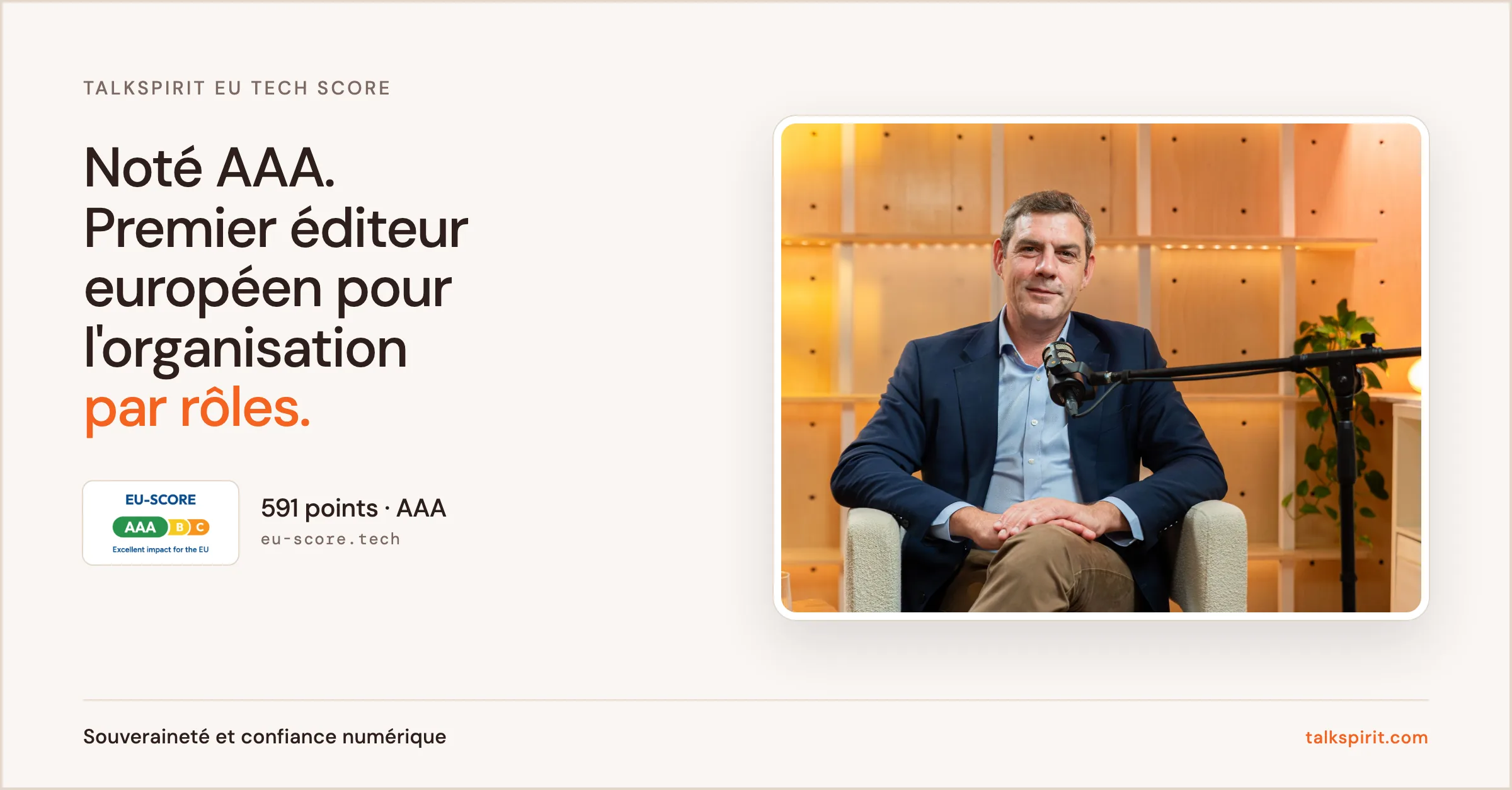
- Talkspirit scores 591 points and earns AAA, the highest level of the EU Score, the benchmark behind the EU Tech 300.
- Talkspirit is the only European vendor listed in the "role-based organisation" competence, opened at our initiative.
- The EU Score measures European anchoring, not security: it complements ISO 27001 certification without replacing it.
- In a tender, ask every vendor for its EU Score or its answers to the six criteria.
The essentials
Talkspirit earns the AAA rating on the EU Score, the independent benchmark that measures how European software vendors really are. This score underpins the EU Tech 300, the ranking of European tech published in June 2026 with La Tribune and L'Express. Talkspirit is also the first European vendor listed there in a competence that did not exist before: role-based organisation.
Since 2026, the question is no longer "is this software GDPR-compliant?". It has become: "who owns this vendor, where are its teams, who are its suppliers, where do its servers run?". The CIOs and mid-sized company leaders we meet ask these questions at every renewal. Until now, they had to settle for the vendor's answer. The EU Score gives them a public, verifiable grid, the same for everyone.
What is the EU Score?
The EU Score is a public rating, from C to AAA, that measures the positive impact of a technology solution for the European Union. It is run by YSIABS (Yellow Sparks In A Blue Sky), a non-profit founded by Olivier Rohou, former founder of eLamp. The association presents it as "the Nutri-Score of European tech", and the platform eu-score.tech lists more than 2,000 entries.
The score rests on six criteria, each expressed as a European percentage:
- Workforce: share of employees based in the EU.
- Capital: share of European shareholders.
- Suppliers: share of European technology suppliers.
- Values: published ESG and DEI commitments.
- Hosting: where the solution's servers are located.
- Source code: ownership and maintenance of the code within the EU.
Certifications (ISO 27001, SecNumCloud, HDS) and identified customers complete the entry. The method is published, the weightings are voted by a supervisory committee, and each entry can be edited by the vendor and is then verified by the community. The CIANum report on digital sovereignty, published in May 2026, cites the EU Score as an "inspiring example".
What is the EU Tech 300?
The EU Tech 300 is the ranking built on the EU Score. It was published for the first time in June 2026, with La Tribune and L'Express as media partners, and will be renewed every year. The principle is simple: for each competence (cybersecurity, cloud, business messaging, project management and so on), the ranking features up to five vendors headquartered in the European Union, ranked by EU Score. Each vendor is attached to a single competence.
What the ranking says between the lines matters as much as what it displays. In most competences, credible European vendors exist today. Buying American by default is no longer a technical constraint. It is a choice.
What does the Talkspirit entry say?
The Talkspirit entry, available at eu-score.tech/solutions/talkspirit, shows 591 points and the AAA rating as of 14 September 2026.
- Workforce: 100% in the EU (20 out of 20).
- Capital: 100% European.
- Suppliers: 71% European (30 out of 42).
- Values: 2 commitments out of 2.
- Hosting: France, 100%.
- Source code: 100% owned and maintained in the EU.
- Certification: ISO 27001 (2026).
Talkspirit is listed in eight competences. Three of them did not exist on the platform before we proposed them: role-based organisation, organisation chart and organisational operating system. Role-based organisation is our main expertise, and we are today the only European vendor listed there. That is a choice. We could have filed ourselves under an existing competence and taken an honourable place in it. We prefer to open the category that describes what we build: not one more tool, but the layer on which an organisation runs its roles, its decisions and its work.
Two figures deserve an honest comment. The first, 71% European suppliers, is the only criterion where we are not at 100%. It is also the hardest to move, because it means replacing technical building blocks that are in production. Each replaced supplier will be the subject of a public note. The second, two identified customers, simply reflects the fact that few of our customers have yet declared their suppliers on the platform. We come back to this below.
Why open the role-based organisation competence?
Because the question we answer is neither "how do we chat" nor "how do we share a file". It is: who decides what, in which role, with what authority, and how does that structure stay legible when the organisation changes. Software grids still classify vendors by use: messaging, project management, document management. Role-based organisation cuts across these uses. It is the underlying layer, the one that gives every message a context and every decision an author.
This layer is becoming strategic for two reasons. The first is AI: an agent can only reason about a legible organisation, with explicit roles, responsibilities and decision rights. The second is sovereignty: an organisation's structure is one of its most sensitive data sets, and most European organisations today entrust it, without thinking about it, to platforms they do not control.
On eu-score.tech, the role-based organisation competence counts one European vendor. We want it to count several. The EU Tech 300 only displays a competence once several European vendors are listed in it, and a category only becomes a market once it has competitors. So we invite European vendors working on roles, governance and organisational structure to list themselves in this competence. We would rather be compared than stand alone.
What this score measures
The EU Score measures a vendor's European anchoring: who owns it, who works there, who supplies it, where it hosts, who maintains its code. It is an impact score for Europe. It is neither a security score nor a sovereignty certification.
We hold to this distinction. The security of your data is proven with security frameworks: our ISO 27001 certification, and the SecNumCloud trajectory Talkspirit is committed to. Sovereignty is proven by verifiable facts: where the servers are, which law applies, who can access them. The EU Score adds a third, complementary reading: who benefits from your software budget? An AAA does not replace a certification. It answers a question that certifications do not ask.
Why it matters for a mid-sized company choosing its software
In most of the tenders we read, hosting is a box to tick and European anchoring appears nowhere. The reason is well known: buyers only require what vendors can show, and as long as few vendors show anything, nobody dares to require it. The circle closes on itself.
The EU Score breaks that circle through transparency. A vendor that publishes its score before being asked gives the buyer a criterion it can now put to every other vendor. If you are preparing a tender, the approach fits in one line: ask every vendor for its EU Score or, failing that, its answers to the six criteria. Those who do not answer will already have told you something.
For an organisation of 250 to 5,000 people, this choice goes beyond compliance. The software on which you run your roles, your decisions and your communication is infrastructure. Knowing who owns it and who maintains it is part of the clarity you owe your organisation. In the age of AI, organisational clarity is the new productivity.
"We changed nothing to obtain this score. We simply declared what we have been since day one: a European company, owned by its founders, whose teams, code and servers are in Europe. What changes is that a buyer can now verify it without taking our word for it."
Philippe Pinault, co-founder and CEO of Talkspirit
FAQ
The EU Score is a public rating, from C to AAA, that measures how European a vendor and its solution are, on six criteria: workforce, capital, suppliers, values, hosting and source code. It is run by the non-profit YSIABS on eu-score.tech, with a published methodology.
Talkspirit scores 591 points and earns AAA, the highest level, as of 14 September 2026. The entry shows 100% of the workforce in the European Union, 100% European capital, 71% European suppliers, hosting in France and source code owned and maintained within the European perimeter defined by the methodology.
The EU Tech 300 is the ranking of European vendors built on the EU Score, first published in June 2026 with La Tribune and L'Express. For each technology competence, it features the listed European vendors, according to their score and the ranking rules.
Talkspirit is listed on the EU Score, the benchmark behind the EU Tech 300, with 591 points and the AAA rating. Talkspirit is today the first European vendor listed in the "role-based organisation" competence. The category will take its full meaning in the ranking once other European vendors list themselves in it.
No. The EU Score measures a vendor's European anchoring, not the security of its solution. Security is demonstrated through dedicated frameworks: Talkspirit is ISO 27001 certified and committed to a SecNumCloud trajectory.
Ask every vendor for its EU Score or, if it has no entry, its answers to the six criteria: distribution of teams, capital structure, European share of suppliers, hosting location, perimeter of code ownership and maintenance. A missing answer is itself useful information.