Nelly Brossard: "Technology Used Well Creates and Strengthens Social Bonds"
.svg)
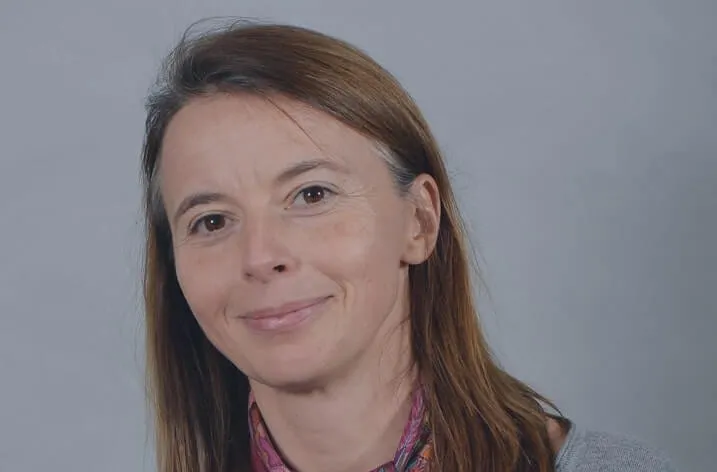
Technologies, innovations, artificial intelligence, algorithms, blockchain, connected objects: our world and our organisations are going digital. But let us take our eyes off the technology for a moment and look at who is affected. It is us, the men and women who, every day, transform the way we work together. We share this vision of a “human centric” digitalisation with Nelly Brossard, Deputy Chief Executive of Mutuelle des Motards (@nelbro). Here is what we discussed.
You chose the word “human” to talk about digital transformation. Why does that word make sense to you today in the way you think about transformation?
Nelly Brossard: I chose the word human, because after all my different experiences, it is clear that it really is people who make it possible to transform a company, at every level. People are at the centre of transformation, not technology or tools.
Tools, whether digital or not, and technology are not ends in themselves, but simply means, for example to cooperate, share, exchange, streamline workflows and work together more effectively.
Read also: Merete Buljo: “To succeed at your digital transmutation, you have to be ready to question yourself completely”
This word, human, is truly key in my view; it is even at the heart of transformation. Because it is crucial to carry out this transformation with employees.
In concrete terms, that means: giving them meaning, helping them understand what is at stake, engaging them participatively, involving them, supporting them through change, and of course supporting managers whose roles are evolving rapidly.
Employee engagement is the true cornerstone of a successful transformation.
The priority is to support teams through cultural change. It is important to be alongside them, to be a facilitator and a developer of collective intelligence, and to do so continuously.
In concrete terms, talking about people in digital transformation means talking about what: about collaboration, about collective intelligence?
Nelly Brossard:Absolutely. It is about working, operating and exchanging in collaborative mode, within an organisation where people take on their full dimension, based on cross-functionality, transparent communication, interactions and connections. That makes it possible to share skills and expertise, thinking and problem-solving capacity, and to develop collective intelligence. This collective intelligence releases energy, it creates synergies, and it allows every employee to flourish.
Do technological tools allow us to work differently and to create social bonds?
Nelly Brossard: Technological and digital tools give access to information, and make it possible to share and to work differently.
Social networks, for example, play a key role and are an integral part of daily life: easy access to information, openness to others and to the world, sharing of information and points of view, freedom of speech, connections with others, and cross-fertilisation.
They let information circulate, they let us communicate and broaden our horizons, sometimes go further in our exchanges and meet one another. According to various studies, including one by the “MIT Sloan Review”, for example, employees who use Twitter have more ideas than those who do not, and there is a strong correlation between Twitter diversity and the quality of ideas. Twitter users are idea connectors. They have a more diverse network of contacts than those who do not use it.
Read also: Aurélien Gohier: “Digital transformation: let us stop creating guilt”
More broadly, technological tools facilitate a work organisation built on cross-functionality, transparent communication, connection and collective intelligence. They transform relationships and interactions with customers, with the ecosystem, and between employees and teams.
They make it easier to put agile working methods in place, to have shorter launch cycles, to build in “test and learn” and continuous improvement, to shorten decision times and to give employees more responsibility. Value creation happens in a more flexible, agile and fast way. That is necessary in an uncertain environment that fluctuates and demands faster market launches and rapid action.
I am convinced that technological tools, when used well, create, strengthen and facilitate social bonds.
Talking about people means talking about the organisation itself and everyone in it, not about processes. What happens to those people when a company goes through its technological shift? At the level of the organisation? At the individual level?
Nelly Brossard:When a company transforms itself and carries out its “technological shift”, the situation is often experienced as “difficult” by most employees, individually, within their team, and at the level of the organisation as a whole.
One of the main obstacles in a transformation process also comes down to people. Changing culture in order to transform and innovate is a long and often difficult road, given the weight of what already exists and of habits… Transforming is not instant: you have to help people think differently and remove obstacles one after another, because the weight of the years sometimes anchors practices and reflexes very deeply!
To succeed at transformation, it is essential to give meaning by stating, explaining and sharing the strategic vision and the vital need to change and evolve. It is truly crucial that leadership answers this demand for meaning. It allows clarification and transparent exchange about the “why”, and gives everyone in the company a clear line of sight.
Read also: Arnault Chatel: “Absolutely everyone must be trained in digital”
To bring teams on board, everyone needs to have this clear and shared vision of the company’s strategy, and above all to become aware of the stakes and benefits of digital transformation. The company then has to support its implementation. Supporting managers and teams is a key success factor.
Given this shift, it is key to define and build a coherent, structured and coordinated approach across the whole company, with everyone’s contributions, in order to reach the common goal.
That approach has to be fully in line with the company’s values, culture and strategic objectives. Taking this mature, structured approach makes it possible to align all the strengths of the company and its ecosystem.
In your view, does digital make it possible to humanise management?
Nelly Brossard:The digital revolution has flattened organisations. It allows a new model with a more open, more cross-functional, agile framework, without silos, where information circulates instantly. It implies a very collaborative and participative style of management, where everyone can propose, dare, act and find their place, with freedom, trust, permission to take risks, and the right to make mistakes.
This participative practice is extremely virtuous, it is highly empowering and it creates a climate that favours innovation and quality of work, in order to reach a common goal and to humanise relationships.
What skills do employees need today?
Nelly Brossard:Soft skills, those human, personal and social abilities that come directly from emotional or cognitive intelligence, and hard skills, the more technical, measurable abilities linked to logical intelligence, are two highly complementary types of skill.
That said, it is clear, we see it every day and many studies confirm it, that today, at a time when digital transformation and artificial intelligence are booming and call for even greater investment in human capital, skills are truly key.
According to the study published by the World Economic Forum, ten skills are considered essential: problem-solving, critical thinking, creativity, people management, coordination, cooperation, and the ability to work with others, emotional intelligence, judgment and decision-making, service orientation, negotiation, and cognitive flexibility.
To my mind, the main ones are cooperation with others, emotional intelligence, critical thinking, the ability to solve problems, creativity and customer focus. Not forgetting curiosity and the ability to learn: to learn new things, but also to learn from others and from yourself, and not to forget learning how to learn.
Read also: Pierre-Philippe Cormeraie: “Evangelising means making the company’s digital strategy shine”
These elements are truly strategic and indispensable.
Management also has an essential role in encouraging skills development. And managing a team means, above all, knowing how to trust, how to delegate, how to unleash talent, how to help each person grow, how to encourage employees to be bold, how to encourage risk-taking, how to give them a vision of their role, how to inspire and motivate the team.
If you had only one piece of advice to give companies, what would it be?
Nelly Brossard: Transformation is above all a matter of culture and of ways of working. It is customer-centred, and it requires both vision and the capacity to execute…
Not forgetting a good dose of courage, exemplary behaviour from top management, and pragmatism…