
Collective vs. Individual Performance: Finding the Right Balance
.webp)
.svg)
- Individual performance covers the objectives and results achieved by one employee; collective performance covers those achieved by a team or any other group.
- The two feed each other: a strong performer who shares what they know lifts the whole team, and a team that beats its targets makes every member more engaged.
- In most companies, bonuses and promotions still reward individual results far more than collective ones, which quietly encourages individualism.
- Three levers rebalance it: psychological safety, information transparency and recognition.
- Four practices measure both: team and individual OKRs linked together, quantitative and qualitative KPIs, a continuous evaluation system, and a check on skills development.
Would you rather hire someone with strong individual performance or someone with a great team spirit? HR managers and leaders know this dilemma well. And while they try to balance both, the reality is that individual performance often takes precedence over collective achievement. This is reflected in bonus and promotion systems that, in most companies, tend to reward individual results more than collective ones, a dynamic that can encourage individualism, undermine team spirit, and even hurt overall company performance.
A legitimate question arises: how do you find the right balance between collective and individual performance? Several levers can be activated to get there: transparency, recognition, compensation… it’s up to you to pull the right ones!
In this article, we share best practices for effectively improving and measuring the performance of your employees and teams.
Collective vs. individual performance: what’s the difference?
Definitions
Not sure about the difference between individual and collective performance? Here are some definitions to help clarify things.
Individual performance refers to the objectives and results achieved by an employee on an individual basis. It is often evaluated during annual reviews, but also during more regular rituals such as performance check-ins.
Collective performance, on the other hand, concerns the objectives and results achieved by a team or any other group within the company. It is measured during team and company objective reviews, quarterly, semi-annually, and/or annually.
| Criterion | Individual performance | Collective performance |
|---|---|---|
| CriterionWhat is measured | Individual performanceThe objectives and results achieved by one employee | Collective performanceThe objectives and results achieved by a team, or any other group in the company |
| CriterionWhen it is assessed | Individual performanceAt the annual review, and during more regular performance check-ins | Collective performanceAt the team and company objective review, quarterly, half-yearly or yearly |
| CriterionTypical indicators | Individual performanceIndividual OKR achievement rate, tasks delivered on time, quality of deliverables | Collective performanceTeam OKR achievement rate, shared deadline adherence, satisfaction of partner teams |
| CriterionWho assesses it | Individual performanceThe manager and HR, complemented by self-assessment and 360° feedback | Collective performanceThe manager and the team itself, during the objective review |
| CriterionThe risk of looking at it alone | Individual performanceRewarding individualism and eroding team spirit | Collective performanceLosing sight of what each person actually contributes |
Two intrinsically linked concepts
While they differ in several ways, collective and individual performance have a direct impact on each other.
Let’s start with an obvious observation: each team member’s individual performance inevitably influences collective performance. Consider a team with one particularly high-performing employee alongside others who are somewhat less so. The top performer can help their colleagues grow by sharing knowledge, which will ultimately boost the motivation and performance of the whole team.
Conversely, collective performance can also influence individual performance. Being part of a high-performing team that exceeds its targets and continually innovates is far more engaging than being on a team that misses its goals. It helps create a work environment where everyone is encouraged to go the extra mile, rather than simply going through the motions.
Rather than focusing solely on collective or individual performance, you need to incorporate both into your strategic thinking!
See also: [Webinar] Make your teams a driver of organizational performance
What’s at stake for the company?
Now that you understand the difference, and above all the complementarity, between collective and individual performance, let’s explore what this means for your company.
Financial stakes
The main reason companies place such importance on performance is that they depend on it to stay competitive and ensure their long-term viability. When teams reach ambitious goals aligned with company objectives, this contributes to boosting profitability and creating financial stability. These gains can then be reinvested in the company to hire new people, purchase new equipment, and increase the budget allocated to each team.
Human stakes
Though less visible, the human dimension plays a crucial role in company performance. The data is clear: a happy employee is on average 31% more productive than an unhappy one. Beyond performing better, they’re also more motivated, more attached to the company, and less likely to leave. Investing in the employee experience is therefore a direct investment in talent retention and performance!
See also: Does employee well-being really impact productivity?
How to find the right balance
Improving both collective and individual performance is essential to address your company’s human and financial challenges. So which levers should you activate? Here are 3 to keep in mind.
Psychological safety
To unlock your teams’ potential, start by creating a work environment where people feel free to express their opinions and take risks. Considered essential by 89% of American employees, psychological safety encourages initiative, idea sharing, and feedback, all elements that feed both individual and collective performance.
Transparency
According to a study conducted with Ipsos in 2024, 44% of French employees believe that sharing information transparently boosts company performance. And rightly so: the more employees have access to the right information, the better equipped they are to make informed decisions and be effective at work. Conversely, an employee who spends their time hunting down the right contact or the right information to unblock a situation will inevitably see their productivity suffer.
Recognition
Recognizing your employees’ work can increase their engagement and performance by as much as 14%! This is a key lever not to be overlooked when improving individual and collective performance.
Several forms of recognition are worth prioritizing:
- thanks and congratulations (both written and verbal),
- bonuses and gifts,
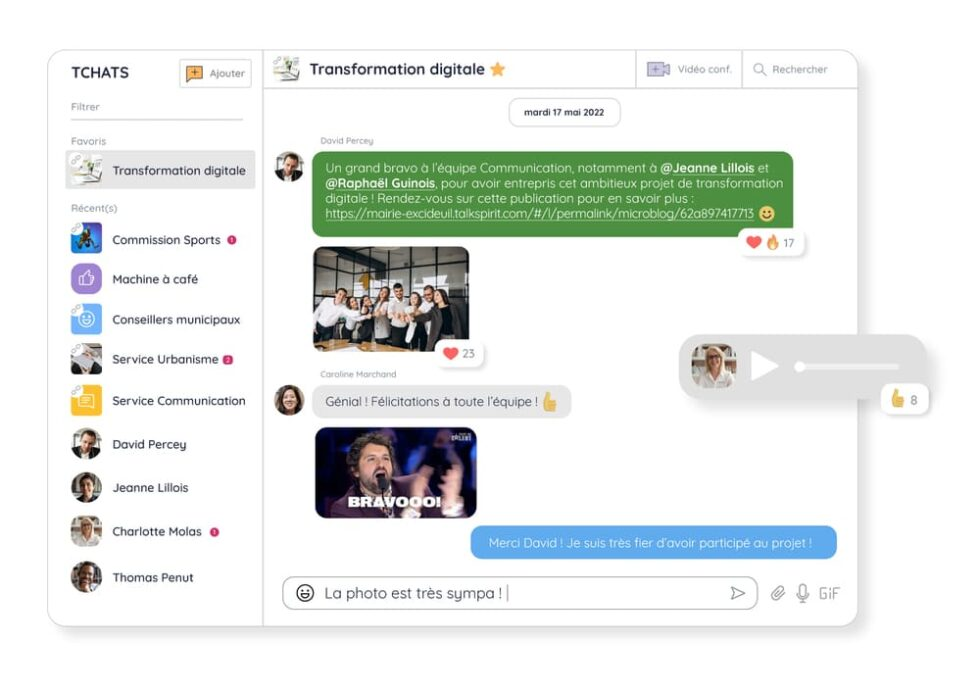
- spotlighting individual and collective successes (via a post on an enterprise social network like Talkspirit).
How to effectively measure collective and individual performance
You now know 3 levers for improving collective and individual performance. But do you know how to measure that performance effectively?
Here are our best tips for doing so!
Setting team and individual OKRs
OKRs (Objectives and Key Results) are an excellent way to set clear, ambitious, and easily measurable goals. You can define them at the company, team, and individual level, and link them together so that team goals are properly aligned with company objectives. Watch out for the classic mistakes in writing OKRs, which quickly turn the exercise into a plain to-do list.
For example, here’s what OKRs look like for an HR team on the Holaspirit platform:
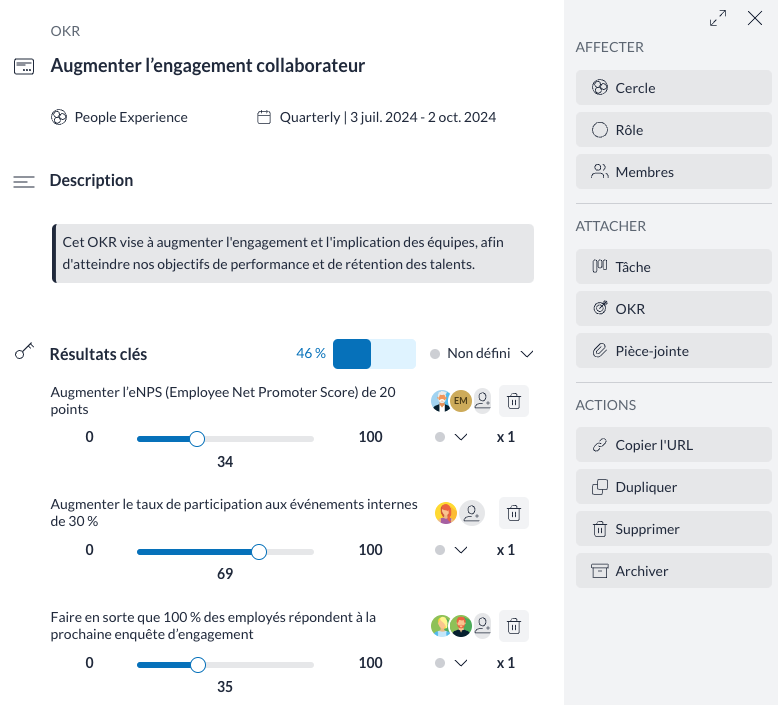
Beyond measuring performance effectively, OKRs help every employee understand how their work contributes to the growth of the company. Make the most of it!
Focus on outcomes
Nothing beats looking at actual results to measure team performance! But be careful to choose the right indicators. Ideally, you should track both quantitative and qualitative KPIs, in order to account for the quality and impact of contributions, not just the quantity of effort put in.
Some examples of quantitative KPIs:
- Individual and team OKR achievement rate (for reference, an OKR achieved at 70% is considered successful)
- Number of tasks and/or projects completed within a given timeframe
- Deadline adherence rate
Some examples of qualitative KPIs:
- Quality of deliverables
- Satisfaction level of colleagues and partners
- Ability to innovate and improve existing processes
Implement a continuous evaluation system
Measuring collective and individual performance also requires setting up a continuous evaluation system that goes beyond annual reviews. This system enables regular feedback and continuous performance improvement.
Several evaluation methods can be combined to track performance over time:
- An OKR review, which allows you to regularly check how each team or employee is progressing toward their goals.
- A 360° evaluation, which measures individual performance by gathering feedback from different stakeholders (not just team members).
- A self-assessment, which encourages every employee to reflect on their strengths and areas for improvement.
By combining these rituals with a culture of continuous feedback, teams can respond more quickly to challenges and support each other to sustain a high level of performance.
See also: Performance management: 4 keys to making your teams effective
Assessing skills development
A high-performing team isn’t just one that hits its targets. It’s also a team capable of developing new skills and adapting to the organization’s evolving needs. So how do you measure skills development?
Creating a skills framework that maps all the soft skills and hard skills expected for each role is a good starting point. But most importantly, it’s crucial to conduct regular check-ins through one-on-one conversations with HR and/or the manager.
Through these conversations, you can:
- Identify skills already mastered by each employee/team, and those that need further development.
- Align the training needs of teams with the skills requirements of the organization, identifying which competencies to prioritize.
- Track progress made by each employee/team following training, and measure the impact on individual and collective performance.
Conclusion
Finding the right balance between collective and individual performance is essential for the success of both the company and its employees. To achieve this, organizations need to combine transparency, psychological safety, and recognition with effective performance measurement practices. Above all: they need the right tools in place!
It’s often overlooked, but the tools we use play a key role in team performance. Among the essential platforms, we find those that help improve communication and collaborative work (like Talkspirit), as well as those that bring more transparency and agility (like Holaspirit). If these solutions interest you, don’t hesitate to contact our team!
And if you’d like more best practices for improving employee productivity, here’s a practical guide that should interest you 👇
Access the Practical Guide
In our methodology guide “10 tips for boosting your team’s productivity,” you will discover: all our best practices for saving your employees’ time, helping them manage their workload, prioritize key tasks, and measure their performance.
FAQ
Individual performance refers to the objectives and results achieved by an employee on their own. It is assessed during annual reviews, and in more regular rituals such as performance check-ins. Collective performance covers the objectives and results achieved by a team, or any other group in the company, and is measured at the team and company objective review.
Yes, and in both directions. Each team member’s individual performance inevitably influences collective performance: a high performer who shares knowledge helps colleagues grow. And being part of a team that exceeds its targets is far more engaging than being on a team that misses them.
Because the effect is measurable: a happy employee is on average 31% more productive than an unhappy one. They are also more motivated, more attached to the company and less likely to leave, so investing in the employee experience is a direct investment in retention.
According to a study run with Ipsos in 2024, 44% of French employees believe that sharing information transparently boosts company performance. The reverse holds too: an employee who spends their time hunting down the right contact or the right document inevitably loses productivity.
Recognising employees’ work can lift their engagement and performance by as much as 14%. The signs worth prioritising: written and spoken thanks, bonuses and gifts, and spotlighting individual and collective wins.
By setting team and individual OKRs, linked together so that team goals stay aligned with company ones (an OKR achieved at 70% is considered a success). By tracking both quantitative and qualitative KPIs. And by running a continuous evaluation system that goes beyond the annual review.