
Performance Management: 4 Keys to Building Effective Teams

.svg)
- Performance management is a continuous process: set objectives, track progress, review, train, then start again.
- It is not the annual appraisal, which looks back once every twelve months.
- Four practices hold it together: clarify roles and objectives, create monitoring rituals, evaluate with several methods, train continuously.
- The rituals that matter: the weekly tactical meeting, the one-on-one with the manager, the quarterly or half-yearly performance review.
- On evaluation, 360-degree feedback, self-assessment, the 9-box grid and the BARS model complement each other rather than replace each other.
- A summary table puts the four stages of the cycle back in order, with the cadence of each.
It’s hard to perform better at work when you don’t know exactly what’s expected of you. Unclear objectives, sporadic feedback, ill-defined roles: this is the daily reality for many employees. These organizational shortcomings lead not only to project stagnation and poor productivity, but also a rise in turnover.
How, then, do you maximize team efficiency without losing your top talent? Some managers have already found the solution, namely to set up a performance management system. How does such a system work, and how do you implement it in your organization? Stay tuned until the end, as we reveal 4 best practices for improving your teams’ performance.
What’s performance management?
Performance management is a continuous process that seeks to maximize individual and collective performance. This process includes setting clear goals as well as routinely monitoring and evaluating performance and sharing feedback. These are all practices that enable all employees to give their best.
Performance management vs. the annual appraisal
The annual appraisal is a moment; performance management is a cycle. The first looks back and grades what already happened, the second sets objectives, tracks progress, reviews and trains, all year long. The annual appraisal keeps its use, but it comes round once every twelve months, usually too late to correct the course of a project. Hence the shift: less retrospective grading, more continuous monitoring and development.
What’s at stake for your organization?
Performance management addresses a number of key organizational issues, including:
- Measuring performance and tracking the achievement of objectives, thereby identifying and rewarding “top performers”
- Breathing meaning into work by aligning teams’ daily tasks with the company’s strategic objectives
- Increasing employee engagement and productivity through clearer expectations and goals
- Improving transparency within the company, to enable all to understand who does what, and which projects help attain which goals
- Creating a culture of feedback and continuous improvement
How do you set up a performance management system?
Let’s move right to the heart of the matter: how can I set up my own effective performance management system? What follows are four best practices.
1. Clarify roles, responsibilities, and objectives
The first thing to do is to clarify roles, responsibilities and objectives, both individually and collectively.
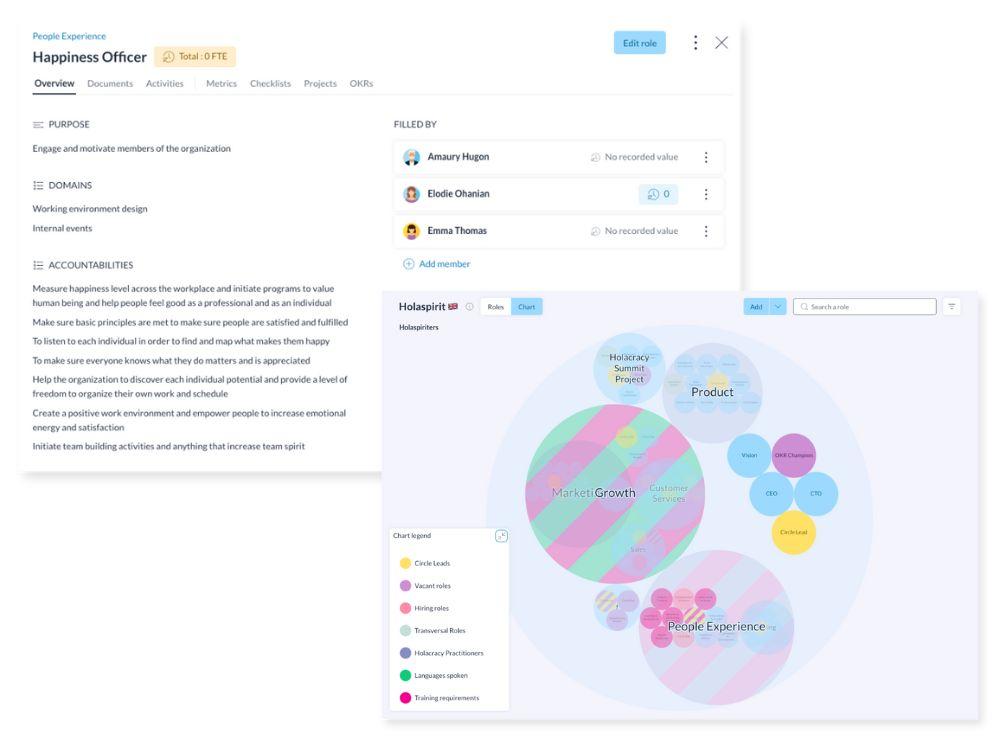
Start by clearly defining who does what throughout the organization. For each role, specify responsibilities and expectations, as well as accountabilities to other roles. Then, map out these roles in a dedicated tool so that everyone can visualize all of them more easily.
A tool such as Holaspirit can easily help you achieve this. Among other features, this platform lets you create an organization chart with different views and document each role via adaptable templates.
Once you’ve outlined everyone’s roles, it’s time to start setting those goals! Start with those that concern your whole organization. Then, break them down into team and individual goals.
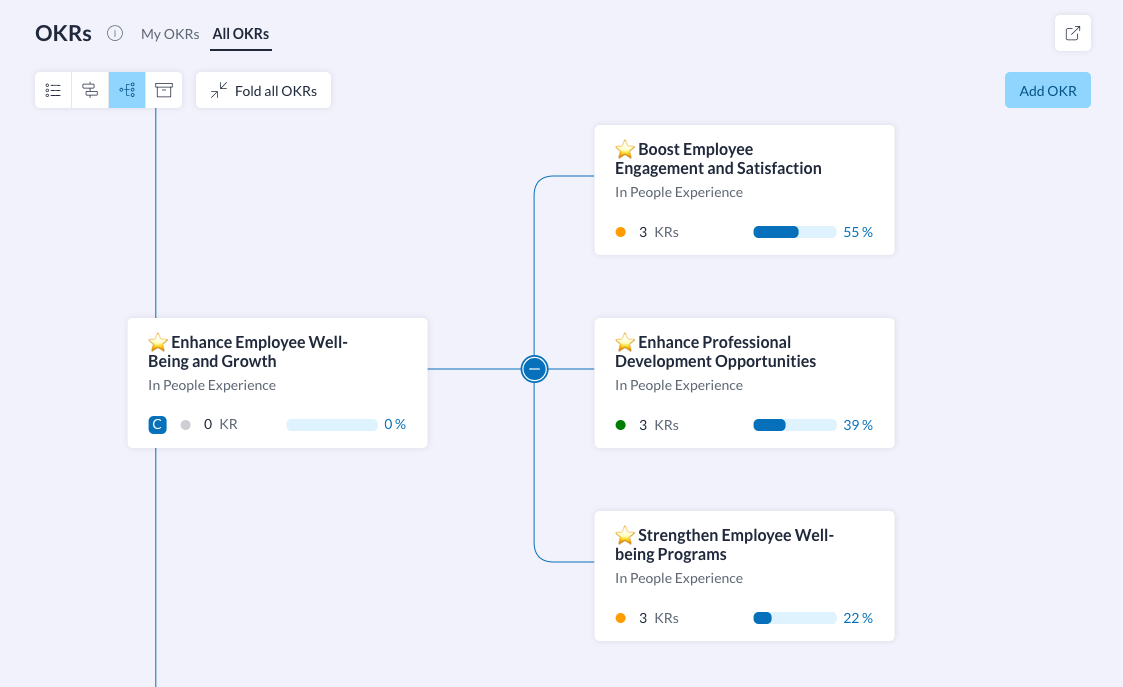
One good way of structuring this approach is through the OKR methodology (objectives and key results) while maintaining alignment between organizational and team goals. This allows you to define ambitious objectives that you can then measure by key result. For example, if your goal is to improve your team’s performance, one of your key results could be to cut time spent in meetings by half. If you plug OKRs into your projects, go through the do’s and don’ts first.
Once you’ve defined your goals, you can then add them to Holaspirit to allow all stakeholders to not only visualize company and team OKRs but also link them to your various projects. In this way, you can better understand which projects contribute to which goals.
2. Create performance monitoring rituals
A performance management system cannot function effectively without regular monitoring rituals. These rituals are essential to maintain employee engagement, ensure constant alignment with objectives and make rapid adjustments when necessary. Here are a few examples of rituals you can implement:
Important meetings
- Tactical meetings: these are operational get togethers, often weekly, that permit the team to coordinate actions they need to take on each project. They provide an opportunity to discuss issues and adjust priorities where necessary.
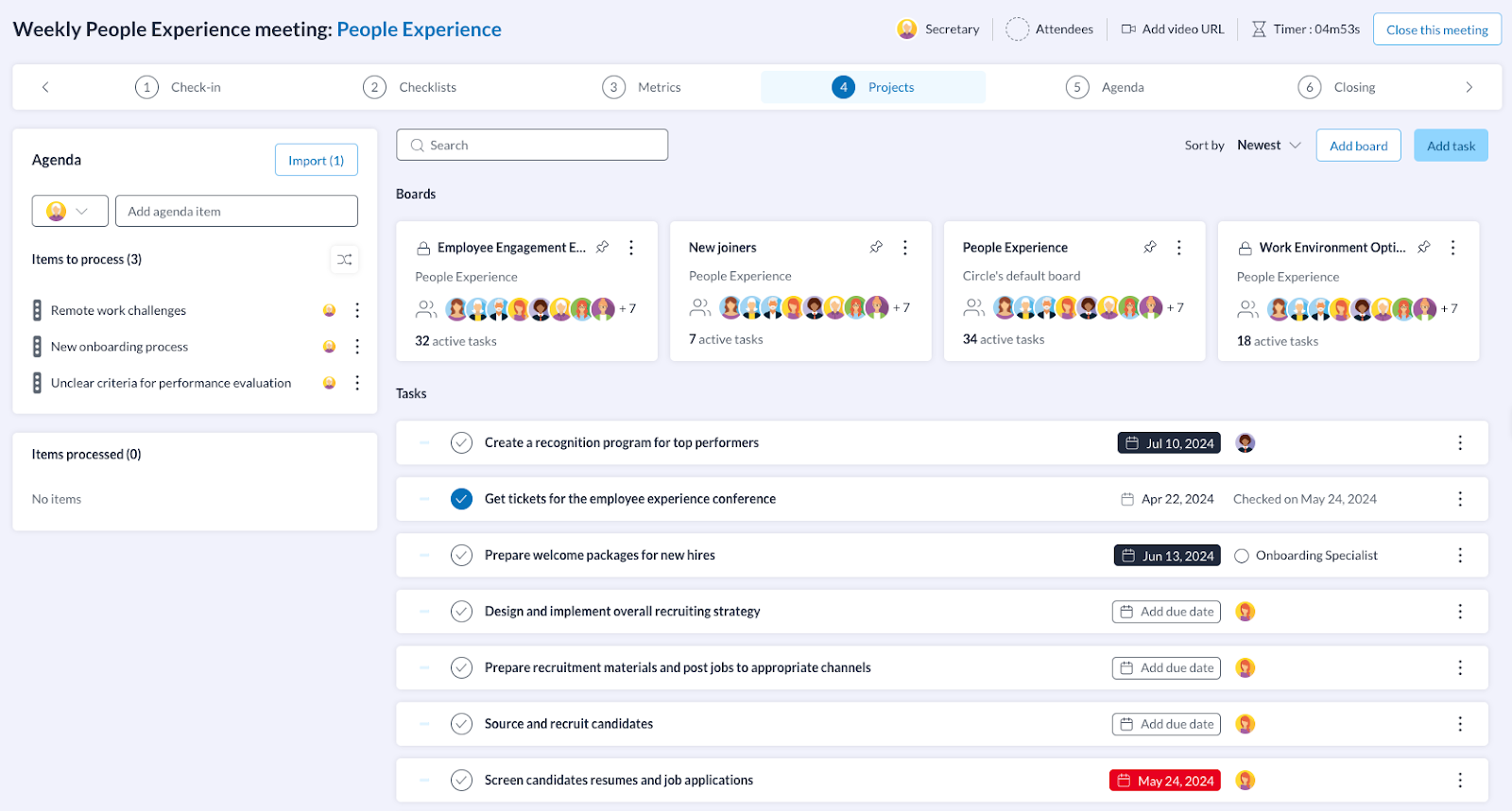
- One-on-ones with the manager: these meetings allow the manager to discuss with each employee in greater depth. We discuss both operational issues (what are your priorities this week?) and more “human” matters such as how individuals are faring and any issues or concerns they’ve run into. The aim is not only to clear any barriers the employee might encounter but also to share constructive feedback.
- Performance reviews and annual appraisals: these are key moments for assessing employee performance against targets, recognizing and congratulating hard work, and discussing opportunities for professional development.
Daily exchanges
- Synchronous exchanges: not really a ritual, but more an indispensable communication practice, especially where teams work in hybrid mode. Rather than holding a meeting, a simple chat message or a two-minute video call can sometimes resolve a problem quickly. It’s also a good way of keeping everyone up to date on where they’re at with projects.
- Asynchronous exchanges: your collaborative tool can also help you share information asynchronously with your team. On Talkspirit, for example, you can use the news feed to share the right information with the right group of people. You can use this channel to distribute market news, strategic documents or even surveys.

3. Set up a performance evaluation system
To keep track of your teams’ performance, you need to set up a performance evaluation system. Here are a few effective methods. One question to settle before you pick one: what exactly you are measuring, individual performance or collective performance.
Performance assessment
Often carried out quarterly or biannually, this appraisal enables us to monitor the progress made by the employee, and to identify any changes that need to be made to turn things around. It is generally a 1:1 discussion between a manager and an employee.
360-degree assessment
This evaluation method involves gathering feedback from various people the employee works with daily: superiors, colleagues, subordinates, and sometimes even customers. The result is a comprehensive overview of the employee’s performance, strengths, and weaknesses.
Self-evaluation
It enables employees to assess their own performance and identify areas where they feel they can improve. This evaluation method encourages self-reflection and perspective-taking. It should be carried out at least once a year.
Evaluating individual and team OKRs
If you’ve been using the OKR method to set your objectives, then it may be worth using it for team and individual performance reviews, too. That said, to make it work, regular reviews and updates to individual and team OKRs are important (like at those tactical meetings we mentioned earlier). Also, keep in mind that it’s normal not to reach an OKR 100% (and if this ever happens, it most likely wasn’t ambitious enough to begin with!).
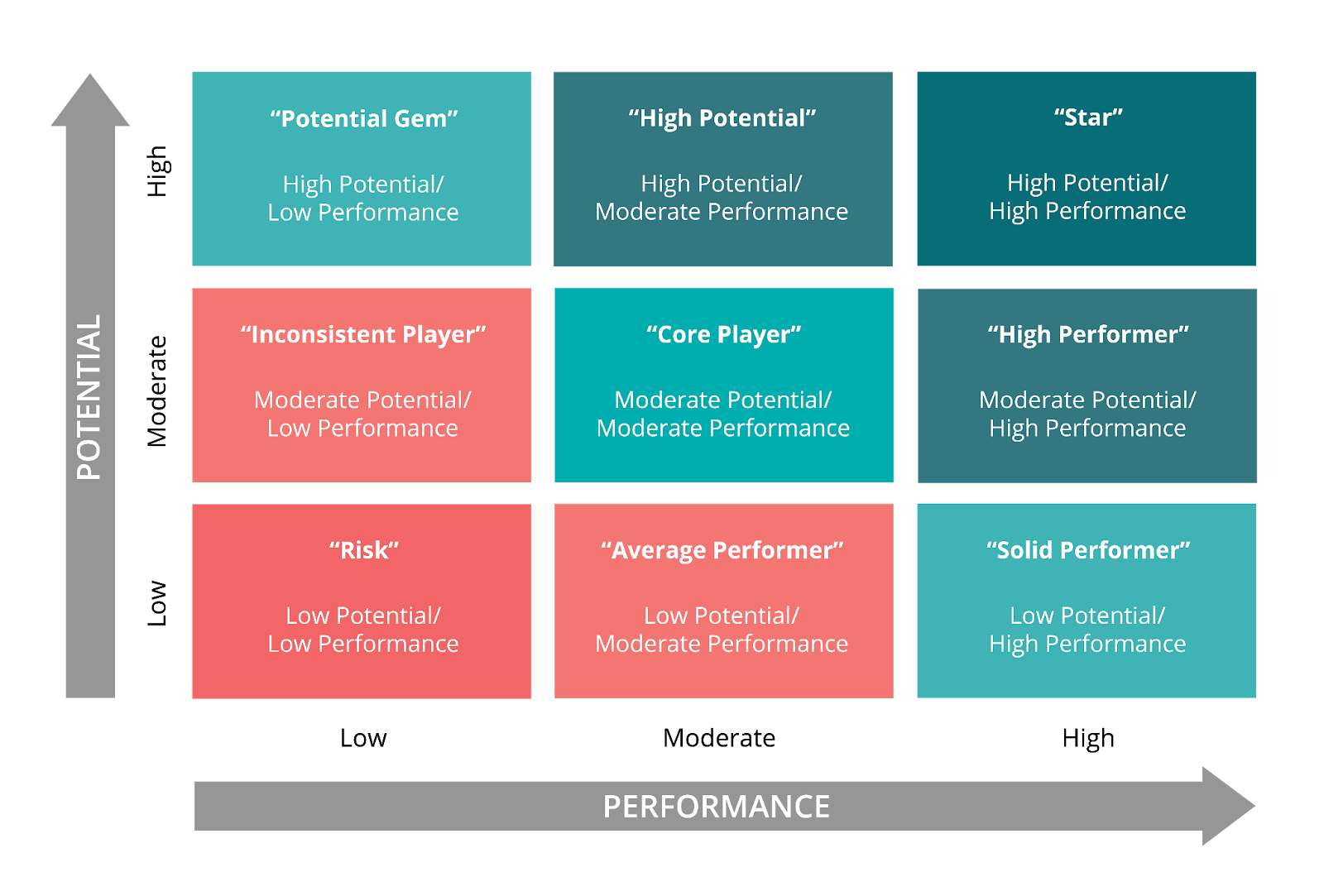
The 9-box grid
This matrix evaluates employees according to two main criteria: their current performance and their future potential. It is divided into nine cells, each representing different combinations of performance and potential. It’s a good way of identifying high-potential employees, those who need to develop their skills, and those who might be better off in another position.
The Behaviorally Anchored Rating Scales (BARS)
To assess performance, the BARS model uses rating scales grounded in specific observable behaviors rather than subjective criteria. Each level of performance on the scale is associated with concrete examples of behaviors that illustrate that level.
For example, to assess the skill necessary for “project management,” the highest level of performance could be described by a behavior such as “anticipates potential obstacles and develops action plans to overcome them,” while a lower level might be “reacts to problems as they arise, without prior planning.”
4. Ongoing training for employees and managers
Training is an essential component of performance management. It enables the continuous development of employee and manager skills, thus improving team agility. Here’s how to structure an effective continuous training program.
Identify skills needs
Start by assessing employees’ current skills, and then identify any gaps or barriers that may be limiting their performance. To gather this information, use the methods described above such as 360-degree evaluation or self-assessment. This will give you an idea of the areas in which your employees need to develop their skills.
Create tailored training programs
Develop training programs that meet your organization’s specific needs. These programs can include technical training, soft-skills training, or coaching sessions. Make sure that any training content is relevant and adapted to your employees’ skill levels. Don’t hesitate to vary formats: mix in face-to-face training, distance learning, MOOCs, cheat sheets, webinars, and video tutorials.
Finally, seek pre- and post-training evaluations to maximize impact. Use the Talkspirit platform to survey participants on the strengths and weaknesses of their training. For any future training programs, you can then adjust accordingly.
Encourage continuous learning
Organizing training courses for employees is all very well. But ideally, it should become a habit.
Foster a culture of continuous learning by encouraging employees to continually seek out development opportunities. For example, this may involve attending conferences, reading relevant books and articles, or joining a professional community to exchange ideas with peers. Internal workgroups can also be powerful learning vehicles. So don’t hesitate to create one on your Talkspirit platform. 😉
The performance management cycle, at a glance
The four practices above are not a shopping list: they form a cycle that runs all year. You plan, you monitor, you review, you develop, then you plan again. The table below puts them back in that order, with the cadence at which each stage comes round. Read it against the levers of company performance specific to your organization.
| Cycle stage | What gets decided | Usual cadence |
|---|---|---|
| Cycle stagePlan | What gets decidedRoles, accountabilities and company objectives, broken down into team then individual goals | Usual cadenceAt the start of the year or the quarter |
| Cycle stageMonitor | What gets decidedProject progress, blockers to clear, priorities to readjust | Usual cadenceWeekly in the tactical meeting, monthly in the one-on-one |
| Cycle stageReview | What gets decidedThe gap between results and objectives, strengths and blind spots | Usual cadenceQuarterly or half-yearly |
| Cycle stageDevelop and recognize | What gets decidedTraining to open up, internal moves to consider, work to acknowledge | Usual cadenceContinuously, with an annual checkpoint |
A final word
Performance management is an essential strategic lever for any organization wishing to maximize the efficiency and engagement of its teams. By clarifying roles, establishing rigorous follow-up rituals, diversifying evaluation methods, and investing in training, you’ll have full set of keys at hand to create a sustainable performance management system.
Finally, don’t forget to put the right tools in place. Talkspirit and Holaspirit offer complete solutions to facilitate communication, collaboration and performance monitoring, so don’t hesitate to contact us to find out more about their added value.
To find out more, we’re inviting you to download our white paper on management in next-generation companies. You’ll find best practices for engaging, motivating and boosting your teams’ performance. 👇
Access White Paper
In the Next-Generation Leadership white paper, you will discover: the skills that every great leader should possess, the different possible management styles, as well as methods and best practices for implementing them within your organization.
FAQ
A continuous process that seeks to maximize individual and collective performance. It includes setting clear goals, routinely monitoring and evaluating performance, and sharing feedback, practices that let every employee give their best.
Four, running one after the other and then starting again: plan (roles, accountabilities and company objectives broken down into team then individual goals), monitor (progress, blockers, priorities), review (the gap between results and objectives), develop and recognize (training, internal moves, acknowledging the work done).
Tactical meetings, often weekly, where the team coordinates actions on each project, discusses issues and adjusts priorities. And one-on-ones with the manager, for the longer conversations. Between the two, synchronous and asynchronous exchanges keep everyone up to date.
An evaluation that gathers feedback from the various people an employee works with daily (superiors, colleagues, subordinates, sometimes even customers) to give a comprehensive view of their performance, strengths and weaknesses.
A matrix that evaluates employees on two criteria, current performance and future potential, across nine cells. It helps identify high-potential employees, those who need to develop their skills, and those who might be better off in another position.
Behaviorally Anchored Rating Scales: rating scales grounded in specific observable behaviours rather than subjective criteria. Each level of performance is tied to concrete examples of behaviour that illustrate it.


.webp)