[Julhiet Sterwen Barometer 2023] What Is the Impact of Hybrid Work in Companies?

.svg)
80% of employees in large French companies now have the option of working in hybrid mode¹ — that is, working remotely one or more days a week and coming into the office the rest of the time. This represents a major quantitative leap compared to the pre-COVID-19 period. However, hybrid work is not without challenges for companies, which must navigate a host of new issues. The most important? Achieving a seamless phygital employee experience that blends physical and digital work environments.
What do employees and managers think of the transformations underway in their organizations? How does hybrid work affect their day-to-day lives? And what tools and best practices should be implemented to best combine remote work and office work?
This is the focus of the 2023 phygital workplace barometer conducted by IFOP in December 2022 for Julhiet Sterwen, focused on companies with more than 500 employees. Here is a summary of the key figures from the study, along with an analysis of the results drawn from an interview with David Gautron, Partner and leader of the Phygital Employee Experience practice at Julhiet Sterwen.

A transformation experienced differently by employees and managers
The impact of hybrid work is not the same for everyone. Employees and managers hold divergent views on several topics. When asked whether they feel they are living through a revolution with digital transformation, 74% of managers say yes, compared to 51% of employees.
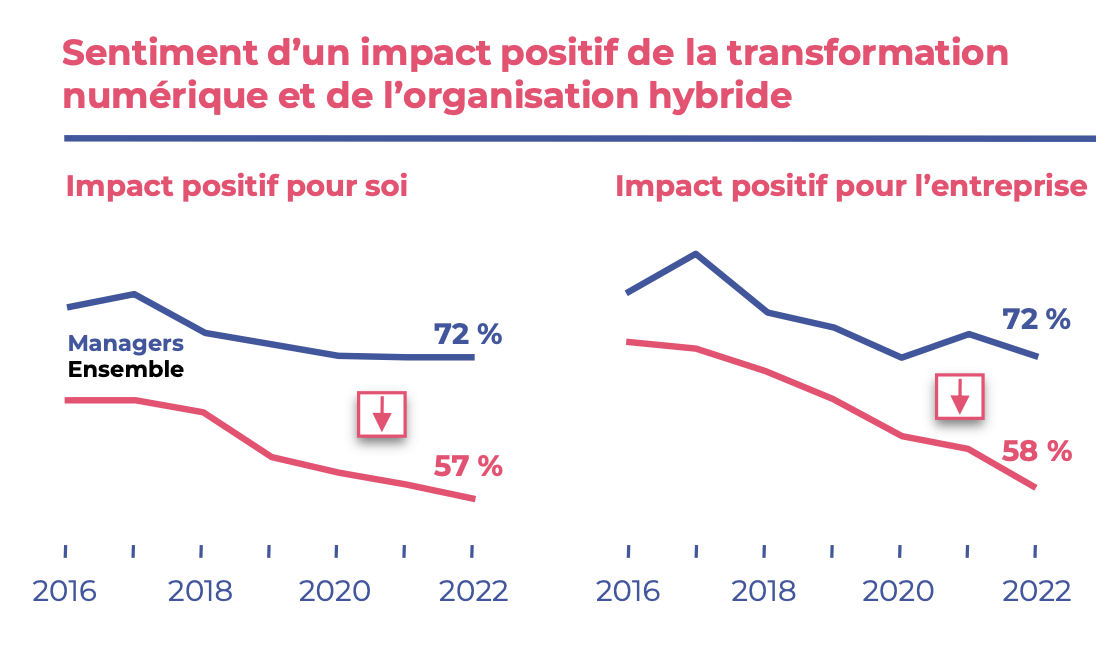
Similarly, 72% of managers feel that hybrid work has a positive impact on them, while only 57% of non-managers share this sentiment. Managers are also convinced they manage to build stronger relationships with their teams, while only 20% of employees feel this is truly the case.
The difference in perception is particularly visible on the notion of trust, which is present for 87% of managers but only 60% of employees.
For David Gautron, Partner at Julhiet Sterwen, this divergence of views is explained by a desynchronization between managers and employees.
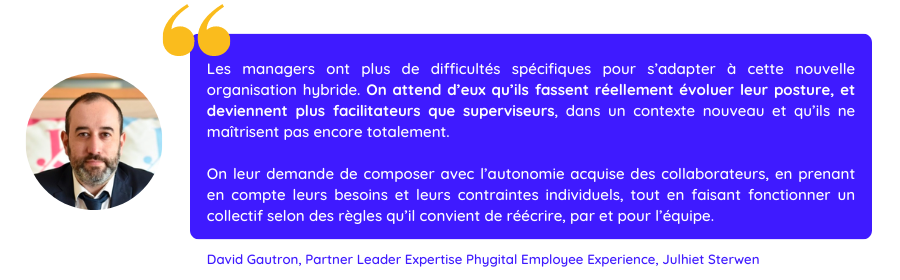
Managers and their teams therefore need to (re)examine the fundamentals of how they work together:
- What does their typical day/week look like?
- What tools do they need to carry out their work?
- When do they prefer to work remotely, in the office, or on the move?
- Are some of our activities more "tele-fragile" than others?
It is by adopting this facilitative, resource-person posture that managers can partly rebuild or strengthen relationships of trust and begin to bridge the sometimes-widening gap between themselves and their teams.
Read also: [Alan Study] Reinventing management to create meaning at work!
Has hybrid work become the new normal for companies?
A well-established model…
Three years after the start of the COVID-19 crisis, hybrid work continues to grow and is becoming increasingly organized. 64% of the companies surveyed now have a remote work agreement.
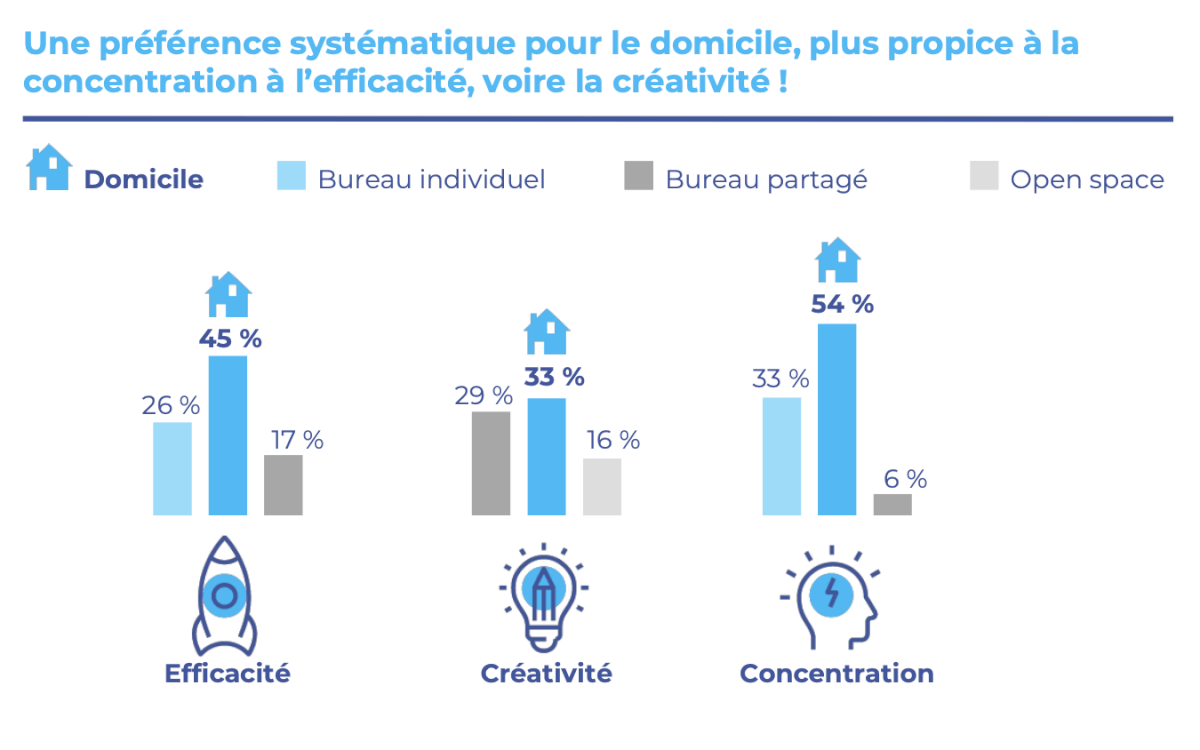
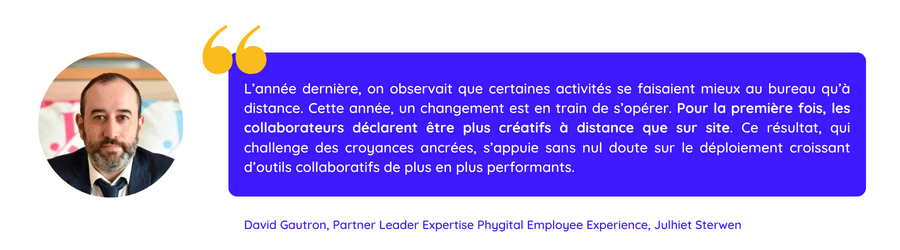
As a result, with practice, remote work has firmly entered mainstream culture. Employees actually show a notable preference for it. They report feeling more focused (45%), efficient (54%), and creative (33%) at home than in the office — regardless of the type of workspace, whether private, shared, or open-plan.
Read also: [Julhiet Sterwen Barometer 2021] Toward a "phygital workplace"?
…but not all employees are affected
However, hybrid work is still far from the norm for all employees. According to the barometer, 56% say they are not affected by remote work. More often than not, those who do not work remotely are constrained by roles that simply do not allow for this mode of work.
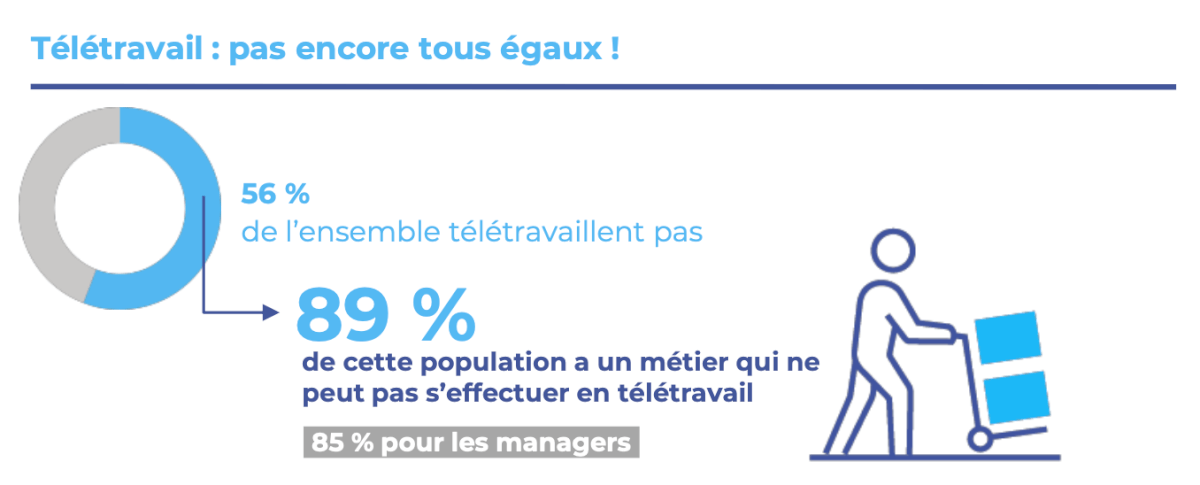
Indeed, "some activities are more tele-robust than others," explains David Gautron. "Frontliners — that is, employees working in the field — often technically cannot work remotely. A major challenge is to look at these roles with fresh eyes, and to rethink mobile-first usage in order to offer as many people as possible this option, wherever feasible."
How to create a successful phygital employee experience?
Delivering the most seamless work experience possible requires a phygital reimagining of the employee journey: that is the challenge organizations face today! To meet it, the key is to analyze the effects of complementarity, modularity, and even reversibility generated by a hybrid work environment, while involving employees in redefining its practical arrangements.

Re-enchanting the office
Now accustomed to remote work, many employees see returning to the office as an obligation. 48% of those who travel to the office say they do so because they cannot work remotely, and 25% indicate they need to be there on certain days to reconnect with their team. For others, constraints can also be related to equipment levels, which are sometimes still more suited to the office than to the home.
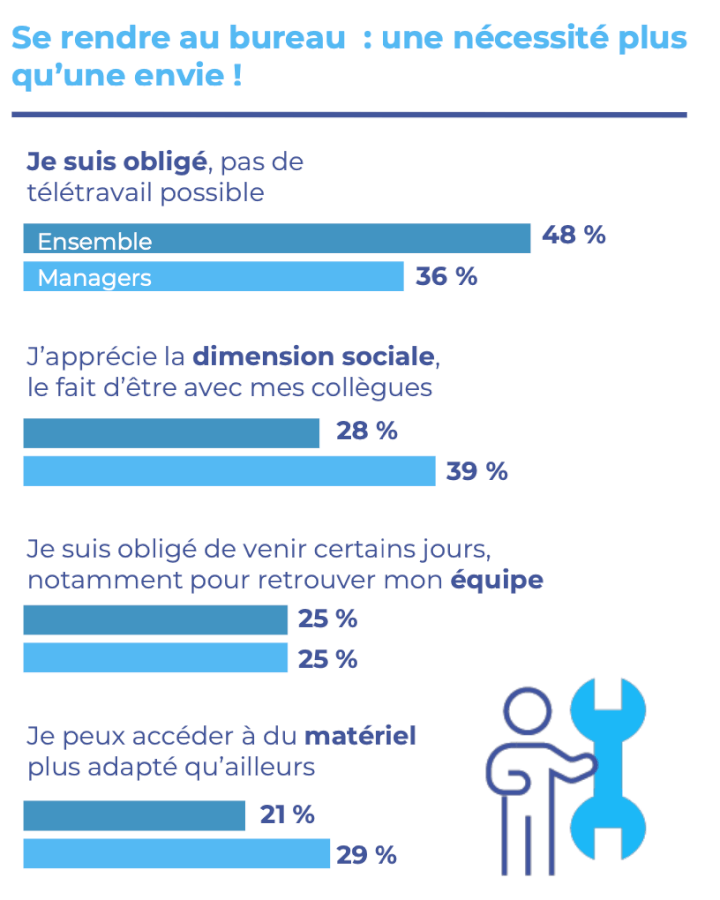
28% however appreciate the social dimension of the office, which allows them to exchange and socialize with colleagues.
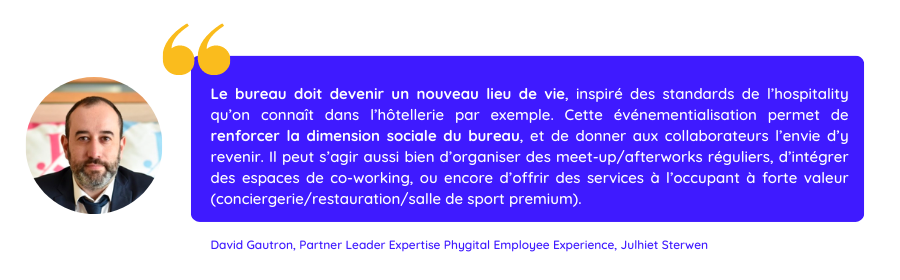
To make the return to the office feel less like a constraint, companies must provide employees with quality equipment and services, but also offer a social added value they cannot replicate while working remotely. To achieve this, David Gautron recommends re-eventifying the relationship with the employee at the office — where people will come less often but with the expectation of an "emotionally" richer experience.
Supporting digital usage
A democratization of collaborative tools…
Digital tools — and in particular collaborative tools — have a key role to play in the employee experience. With the growth of hybrid work, they have by their very nature become indispensable in the workplace.
45% of employees say they have been using these tools for one to three years — to work efficiently, wherever they are, and securely. After ATAWAD, we now see the emerging need for a SATAWADAC digital workplace (Secure AnyTime AnyWhere Any Device Any Content). This figure clearly shows that hybridization is having an unprecedented impact on our ways of working!
Read also: 8 trends to ride to improve collaboration in your company
All-in-one collaborative platforms like Talkspirit can be particularly useful for bringing employees and managers together and facilitating remote collaboration. Their key advantage? No need to juggle multiple tools — everything is available in one place 🙌.
…but a digital divide to bridge
Despite accelerated digital transformation, digital usage remains uneven in many companies. To reduce this internal digital divide, it is important to offer more personalized support to employees (for example, through tutorials, coaching, training, etc.) that adapts to the needs of each role.
Strengthening support will also help improve employee satisfaction with their digital tools, which is not yet complete for half of them (only 51% describe themselves as fully satisfied with their tools).
Putting the employee at the center of the approach
The most important thing for creating a successful phygital experience? Put the employee back at the center, by involving them in how hybrid work is organized. Several topics can be addressed collaboratively with teams, including:
- the days to dedicate to in-person vs. remote work,
- the time slots to prioritize for teamwork vs. activities requiring concentration,
- the preferred meeting format,
- asynchronous work best practices,
- etc.
To involve employees, it is also important to regularly seek their feedback — for example, by asking them to complete short surveys on topics that concern them, or supplement the annual barometer with regular pulse-style check-ins.
Read also: [Webinar] Why and how to build a feedback culture?
*
* *
In conclusion
The positive impact of hybrid work is now undeniable, as it becomes the norm. Yet organizations still face many challenges to improve the work experience and the effectiveness of employees in hybrid mode. Several avenues are worth exploring, including: a shift in management posture, the protection of collective in-person moments, channeling exchanges onto a single collaborative platform, and personalizing the "employee journey."
Want to learn more about the impact of hybrid work and the best practices to put in place for organizing it effectively? Download our white paper:
Access the White Paper
In our White Paper "The Future of Work: Embrace Hybrid Work!," you will discover: the 8 main challenges of hybrid work; best practices for managers, HR, internal communications, IT, and employees; as well as the tools to put in place to facilitate hybrid work.