Reinventing Management to Make Work Meaningful

.svg)
Doing work that is meaningful and that allows employees to maintain a healthy work-life balance: this is one of the key expectations of today's workforce. Employees no longer want to work just for the sake of it — they want to contribute to something useful and pursue a shared goal. In the era of the Great Resignation, improving employee well-being and giving work meaning have become top priorities for organisations.
To better understand these emerging trends, we analysed the latest Alan barometer on the search for meaning and mental well-being. Conducted in August 2022, this study surveyed over 4,000 French private-sector employees about their relationship with work and their expectations in terms of quality of working life.
Here is a summary of the key figures and takeaways from this barometer.
Mental well-being: a priority
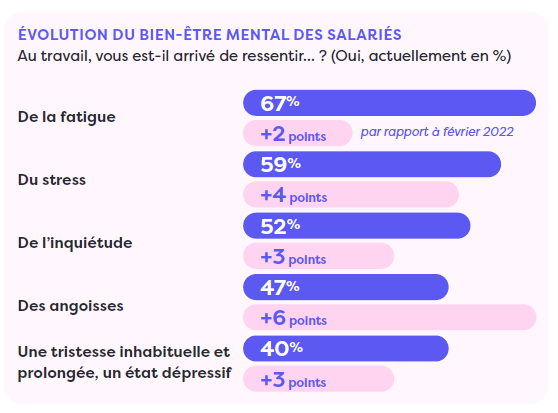
Let's start with a snapshot: in the second half of 2022, 59% of employees report feeling stressed, and 47% experience anxiety (an increase of 4 and 6 percentage points respectively compared to the previous half-year).
Read also: [Expert insight] Brigitte Vaudolon: the psychosocial risks of remote work
Against the backdrop of the war in Ukraine, inflation and the looming recession of 2023, it also comes as no surprise that one in two French people has no confidence in the future.
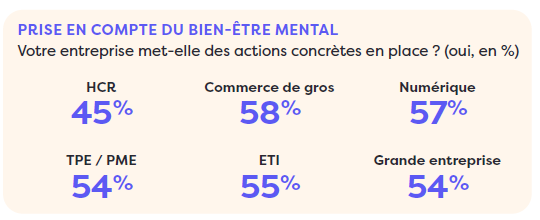
In this context, organisations have a key role to play. 87% of employees believe it is their employer's responsibility to take care of their mental well-being. This is an issue employers are increasingly aware of: 52% of employees say their employer has implemented concrete solutions to improve their mental well-being, up 9 points compared to the February 2022 barometer.
Read also: HR: 5 trends to watch in 2023, according to Gartner
However, more effort is still needed to encourage open dialogue on this topic. Indeed, only 10% of surveyed employees feel it is "very easy" to talk about their mental state with their manager or HR department.
Employees in search of meaning
Meaningful work is now one of the primary drivers of workplace well-being. Evidence of this: 64% of employees are willing to earn less to do more meaningful work. This quest for meaning has intensified since the Covid crisis and affects both white-collar workers and blue-collar workers alike.
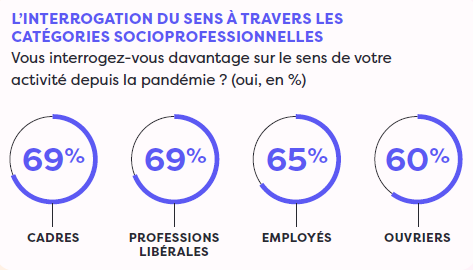
The stakes are high for organisations: one in two employees admits to struggling to find meaning in their work. This loss of meaning is particularly pronounced in large companies, as well as among employees who lack autonomy and trust in their management.
87% of surveyed employees believe it is up to the company to help them find meaning in their work. Yet 44% report that no solution has been put in place to address this need.
If companies want to retain, motivate and engage their talent more effectively, they must make this a top priority. To do so, they can implement initiatives to:
- improve work-life balance,
- give employees greater autonomy,
- increase compensation,
- recognise employees' work,
- reduce workload,
- develop new ways of working (such as remote work or hybrid work),
- clarify career development prospects,
- etc.
Read also: [Cisco 2022 Study] Remote work: what impact on productivity and well-being at work?
A Great Resignation to put in perspective
According to Dares, nearly 520,000 resignations per quarter were recorded in late 2021 and early 2022 — a record figure since the 2008 financial crisis. However, this Great Resignation phenomenon should be put in perspective, as the resignation rate remains below that of the early 2000s. Moreover, given the post-Covid context and labour market tensions, it is not surprising that many employees are resigning.
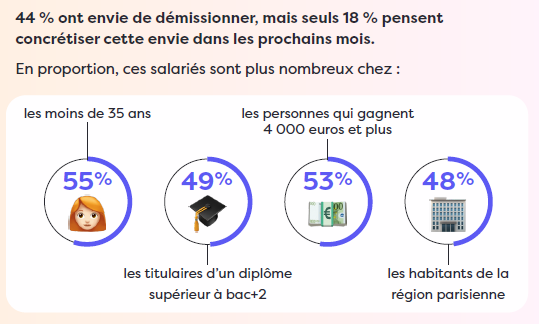
According to the Alan barometer, 44% of employees are currently considering resigning, and 18% plan to do so in the coming months. The most represented groups are managers and those under 35, as the job market is more favourable to them, and they are more sensitive to meaningful work, work-life balance and CSR issues (Corporate Social Responsibility).
Read also: Why and how to implement a CSR approach within your organisation?
Several reasons explain this desire to resign, including:
- the desire to find work that is more aligned with personal values (for 71% of resignees),
- difficulty balancing professional and personal life,
- psychological distress (notably stress, burnout and isolation), experienced particularly by those under 35,
- difficulty projecting into the future,
- a lack of career development prospects (6 in 10 employees feel the need to discuss their professional future with their manager).
Towards a transformation of management styles
To address these challenges, organisations must reinvent their management practices, providing employees with greater recognition, autonomy and support. Several changes can be considered for managers, including:
- Being more available and listening more attentively to their team, both on work itself and on well-being topics,
- Developing recognition and a culture of feedback (nearly one in two employees feels they receive no recognition at work!),
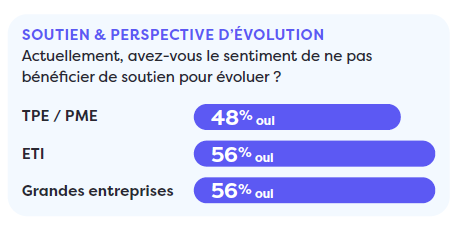
- Supporting skills development and facilitating career progression (51% of employees feel they don't have the support they need to grow professionally),
- Giving work meaning by clearly articulating the company's mission and values,
- Trusting employees more and moving away from micromanagement (one in three employees feels they don't have enough autonomy at work).
Developing these new management styles will not happen on its own. The priority will be to train and support managers so they can build new skills and take on a coaching role within their teams.
Read also: Hybrid work: management best practices
*
* *
Giving work meaning is essential to improving well-being at work, productivity and employees' sense of belonging. This requires a better work-life balance, greater autonomy, recognition and clearer development prospects — topics that concern both HR teams and managers alike, and that require proper support.
If you too are looking to give your employees' work more meaning and develop their well-being at work, then this practical guide should be of interest to you 👇
Access the Practical Guide
In our practical guide "10 examples of initiatives to improve well-being at work", you will discover: 10 examples of quality-of-work-life initiatives implemented by French and international companies, along with tips, best practices and tools to help ensure the success of your approach.