How to Create an Effective Employee Training Plan

.svg)
In a world where technologies and ways of working are evolving at a dizzying pace, employee training has become more than just a competitive advantage — it is now an absolute necessity. Case in point: 67% of employees and managers surveyed in the 2023 professional training barometer feel their job is evolving too fast. Building an effective training plan helps your employees continuously sharpen their skills and stay ahead of the curve.
Employee training can also be a powerful lever for attracting and retaining top talent. The more you invest in your people, the more they will improve their performance and autonomy, and the more motivated they will be at work. Over the long term, this contributes to retaining them and to driving the growth of your company.
In this article, we will explore the key steps to building a training plan that truly delivers, bringing real added value to both your organization and your employees.
Why Invest in Employee Training
Implementing a training program can deliver a real return on investment. The reason is straightforward: employees who develop their skills are more productive. They can deliver high-quality work faster, move ahead on their projects more efficiently, and contribute to the company’s overall performance.
This increased performance also fosters a genuine sense of satisfaction and well-being at work. Investing in training signals to your employees that their professional growth matters to you. This builds their sense of belonging— and above all, keeps them loyal to the company!

How to Build an Effective Development Plan for Your Employees
To build an effective training plan, here are 7 key steps to follow.

1. Identify Your Training Needs
The first step is identifying your training needs. This means going beyond understanding the company’s needs — you must also consider those of your employees. To do this, we recommend running HR surveys and performance reviews. These will help you pinpoint exactly which teams need training and which competencies they need to build.
Before sending out these surveys, make sure to communicate internally about your approach. The goal is to set the stage so that every employee understands why they are being asked to take part, and what is expected of them.
Once your survey is complete, take the time to cross-reference employee needs with business needs, and analyze what comes up most on each side. This will help you prioritize the topics to include in your training plan.
2. Define Your Objectives and Key Results
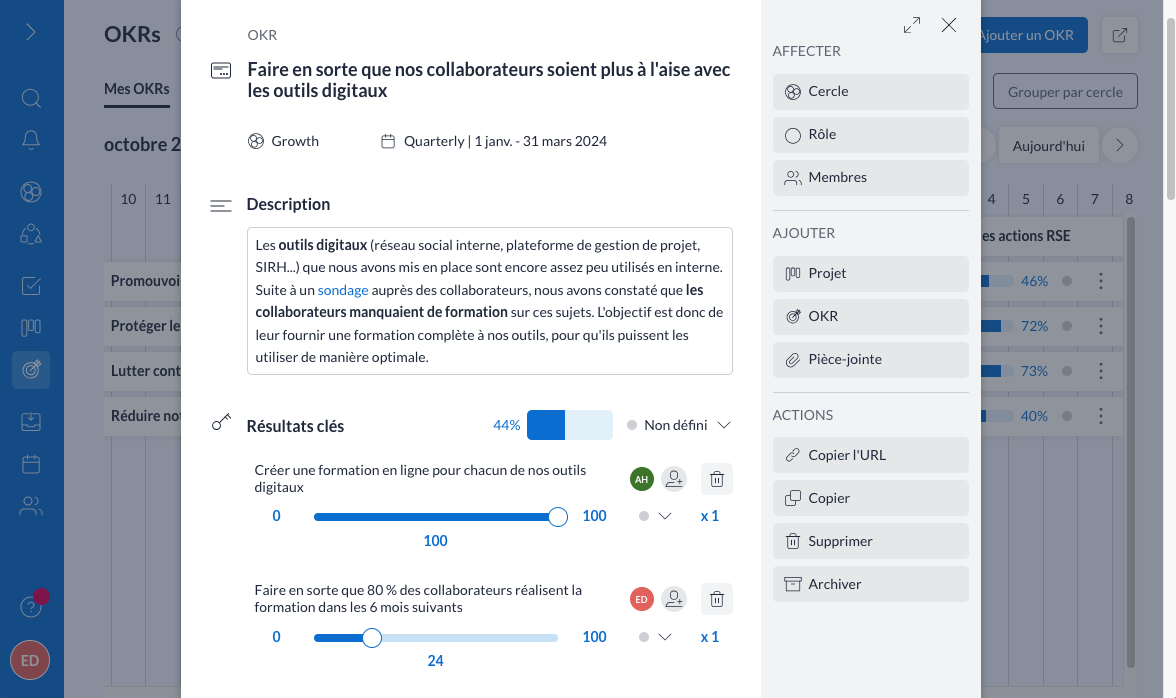
Once you have identified your needs, it is time to define Objectives and Key Results (OKR) at both the company and team levels. This method enables you to set ambitious (yet achievable!) objectives, which you can then measure through key results. For example, if your goal is to improve your employees’ digital skills, you could set the following key results:
- create an online training course for each of your digital tools,
- ensure that 80% of employees complete it within the next 6 months,
- increase the engagement rate on your digital platforms by 10%.
Read also: How to Train Your Teams on a New Digital Tool?
To set and track your training objectives, you can use a tool like Holaspirit. With Holaspirit, you can link your training objectives directly to your company’s strategic goals. Your employees can then see how their newly acquired skills contribute to driving revenue.
Each objective can be linked to key results and projects to implement. Thanks to the kanban board system, you can list the tasks to complete, resources to allocate, and deadlines to meet for each training program.
Explore Holaspirit
3. Choose the Right Training Methods
Depending on your needs, you can choose from several types of training:
- In-person training : employees must be physically present at the training venue and interact directly with other participants and the trainer
- Video-based training video conferencing: employees attend the training remotely in real time, via a video conferencing tool.
- The hybrid (or blended) model: this format combines in-person and remote sessions, giving employees greater flexibility.
- E-learning: unlike the three formats above, e-learning does not require attending a session in real time. It is an online format that allows employees to access learning content anytime, anywhere, and progress through modules at their own pace.
Each format has its own advantages and drawbacks. For instance, in-person training encourages the most interaction, making it easy for participants to ask questions. However, it tends to be more expensive, as travel costs for trainers and employees must be covered.
Remote training has the advantage of being less costly and more convenient for teams spread across multiple locations. However, it can sometimes lack interaction. E-learning, for its part, lets employees schedule their training whenever it suits them, though it works best for those who are comfortable learning independently.
Choose the format that best fits your needs to build an effective training plan.

4. Select Qualified Trainers
Choosing the right trainer is just as important as the training content itself. A great trainer must not only be a subject-matter expert but also know how to convey knowledge effectively.
If you prefer to hire an external provider, it can be useful to review ratings and testimonials left by previous participants. To streamline this process, you can use a recruitment platform like Jobaffinity, which helps you quickly identify trainers who match your criteria.
That said, if the expertise already exists within your organization, it can be equally worthwhile to ask one of your own employees to deliver the training. Simply make sure that the person you choose is comfortable with the topics covered, has strong teaching skills, and — above all — has enough time to create the training content.
5. Schedule Your Training Sessions
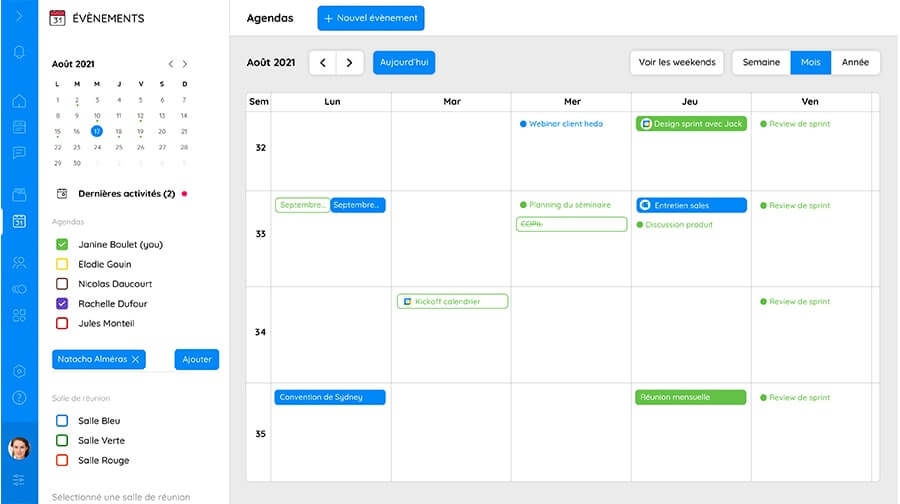
Once your trainer and training content are in place, the next step is to schedule your training sessions. To do this, you can use the Talkspirit shared calendar, which lets you check availability at both the individual and group level. This calendar gives you a clear view of availability across:
- an entire department (HR, marketing, IT…),
- everyone working on a specific project,
- or all employees interested in a specific topic (such as digital transformation, market intelligence, and so on).
6. Encourage Employee Participation
An effective training plan requires your employees to be actively involved. Don’t hesitate to use collaborative platforms like Talkspirit to drive engagement! On these platforms, you can:
- create discussion groups to facilitate exchanges between participants,
- run polls to ask employees what they want to learn through training,
- encourage everyone to share their feedback and experience, their challenges and wins, to enrich training with real-world examples.
Read also: Internal Communications: 7 Tips to Boost Employee Engagement

7. Evaluate Training Effectiveness
Evaluation should not be an afterthought — it must be built into your training plan from the start. Before training even begins, it is important to survey participants about their expectations, asking them:
- the challenges they face on a daily basis,
- the skills they want to develop,
- and the goals they want to achieve.
Once training is complete, participants can then more easily assess whether it met their expectations. This final evaluation can take the form of a satisfaction survey, or it can be done verbally by asking everyone for their thoughts at the end of the session.
When designing your survey, you should think carefully about the key performance indicators (KPIs) you want to track, such as:
- The quality of the content delivered,
- The level of participant satisfaction,
- The likelihood that participants would recommend the training to peers (also known as the Net Promoter Score),
- The attendance rate (for in-person or video-based training)
- The completion rate (for e-learning).
- The return on investment (ROI) of the training — that is, the ability of participants to generate results whose financial value exceeds the cost of the training.
Using participant feedback, you will be able to assess whether training has met its stated objectives, and — if needed — put corrective actions in place to improve it.
Read also: Webinar recap: “Why and How to Build a Feedback Culture?”

Conclusion
Building an effective training plan is a strategic investment that can bring significant benefits to your organization. With the right tools and careful planning, you can develop a program that not only enhances your employees’ skills but also helps drive your business goals.
Tools like Talkspirit and Holaspirit can support you every step of the way. Get in touch to find out how we can help!
Contact an expert