
Collaborative Platform: Definition and Challenges

.svg)
- A collaborative platform is a digital tool, usually delivered as SaaS, that supports work and communication between an organisation's internal and external stakeholders.
- It differs from an enterprise social network, which is built for internal communication, and from a digital workplace, which brings both uses together on a single platform.
- Its core features are instant messaging, video and audio conferencing, meeting rooms, work groups, project management, document storage and co-authoring, and a shared calendar.
- It addresses six challenges: digital transformation, access to information, productivity, project management, remote working and the security of exchanges.
- Gartner reports that 47% of digital workers struggle to find the information they need; centralising exchanges and documents in one place answers that directly.
- On security, ISO 27001 certification and where the data is hosted are two criteria worth adding to your shortlist.
Over 80% of employees have been using it since the Covid-19 crisis. We’re talking, of course, about the collaborative platform! Today, this solution is indispensable for communicating and collaborating effectively, especially when your stakeholders are geographically dispersed. It’s particularly useful for multi-site companies, franchise networks, local authorities, and all organizations that regularly telecommute.
However, before deploying a collaborative platform, it’s important to get a few things straight, including:
- What’s a collaborative platform?
- How does it differ from tools such as the enterprise social network?
- What features does it offer?
- What challenges does this platform address?
If these are your questions, you’re in the right place. We answer those and more in this article.😉
What is a collaborative platform?
Definition
Let’s start with a clear definition.
A collaborative platform is a digital tool that facilitates collaborative work and communication between an organization’s internal and/or external stakeholders.
Often available as SaaS (Software as a Service), it can be accessed anywhere, anytime. Your employees, partners, and service providers can use it to exchange information synchronously or asynchronously: the distance between them should create no constraints.
Collaborative platform vs. enterprise social network vs. digital workplace
There’s often a lot of jargon associated with collaborative tools. Just do a little research, and you’ll quickly see a host of terms for these platforms pop up: collaborative platform, enterprise social network, digital workplace, and more. Here’s how to tell the difference.
Collaborative platforms are simply designed to enable employees to work together more effectively. These are tools used to collaborate, share information, and manage multi-stakeholder projects.
Enterprise social networks are rather designed to boost internal communication and foster employee engagement. They’re used to send information up and down the chain (and among chains), as well as to better share knowledge and best practices. However, they’re not really intended to facilitate actual work.
A digital workplace brings all these uses together on a single platform. It facilitates collaborative working, internal communication, project management and knowledge management. This makes it the ideal platform for organizations looking for an all-in-one solution.
| Tool | What it is for | Typical uses | When to choose it |
|---|---|---|---|
| ToolCollaborative platform | What it is forHelping several stakeholders work together | Typical usesCollaborating, sharing information, managing multi-stakeholder projects | When to choose itWhen the need is teamwork and project work first |
| ToolEnterprise social network | What it is forBoosting internal communication and employee engagement | Typical usesPassing information up and down the chain, sharing knowledge and best practices | When to choose itWhen the need is communication rather than project work |
| ToolDigital workplace | What it is forBringing all these uses together on one platform | Typical usesCollaborative work, internal communication, project and knowledge management | When to choose itWhen you are looking for an all-in-one solution |
What are its features?
Primary features
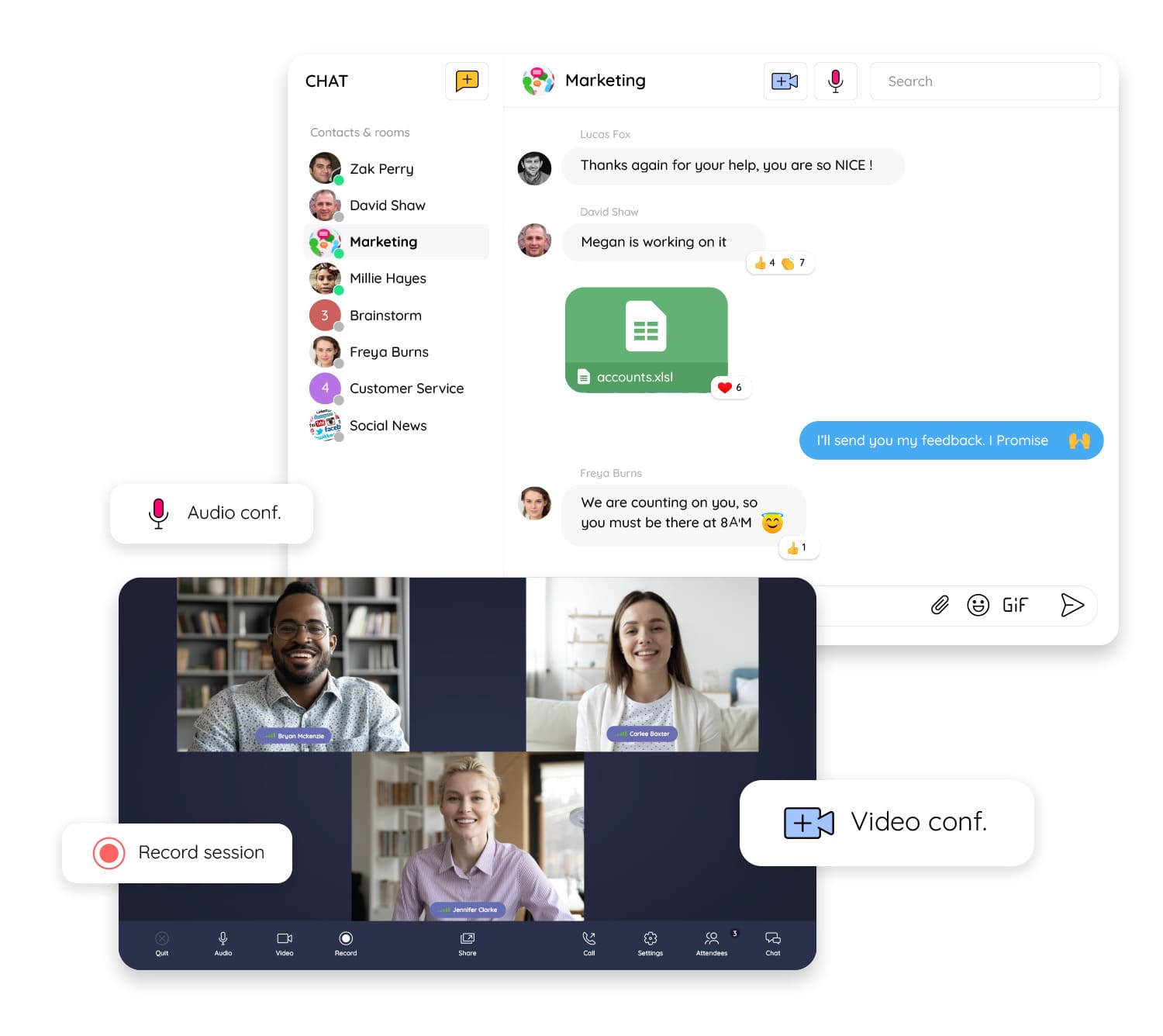
On a collaborative platform, you can find several features focused on collaboration. The main ones are:
- instant messaging
- videoconferencing and audioconferencing
- virtual meeting rooms
- work groups
- project management
- task scheduling
- document storage, sharing, and real-time co-authoring
- shared calendar
Secondary features
Other features focused on communication and knowledge sharing can also be found on collaborative platforms, including:
- newsfeed
- home portal
- polls
- chatbot
- knowledge base/wiki
- directories
- statistics
Note that the more comprehensive the collaborative platform is, the more it starts to look and function like a digital workplace rather than a simple collaboration tool.
What challenges does it address?
Let’s take a look at the challenges that a collaborative platform can address, that is, what it can do for you.
Accelerate digital transformation
Setting up a collaborative platform is a good way of developing the use of digital technologies and digitizing enterprise work processes.
It’s an essential part of any digital transformation project, once you’ve made an initial diagnosis and defined your objectives.
Make information more accessible
According to Gartner, 47% of digital workers have difficulty finding the information they need to work effectively. As a result, they waste time, make poor decisions, and miss out on important information. The collaborative platform can help!
On a collaborative platform, all your exchanges, documents and working partners are centralized in one place. You can organize them into groups or directories for easy retrieval, making information more accessible.
Improve productivity
Inevitably, the less time you waste searching for information and finding the right contact, the more time you have to devote to your work. That’s why the collaborative platform also tends to improve team productivity.
Unlike email, the collaborative platform is particularly well suited to real-time communication. This means you can solve problems and discuss “hot” topics much more quickly than with other tools, which are better suited to asynchronous exchanges.
Optimize project management
Do you find it hard to organize your staff’s work? Understanding who is responsible for which task? How to fit your actions into a project schedule?
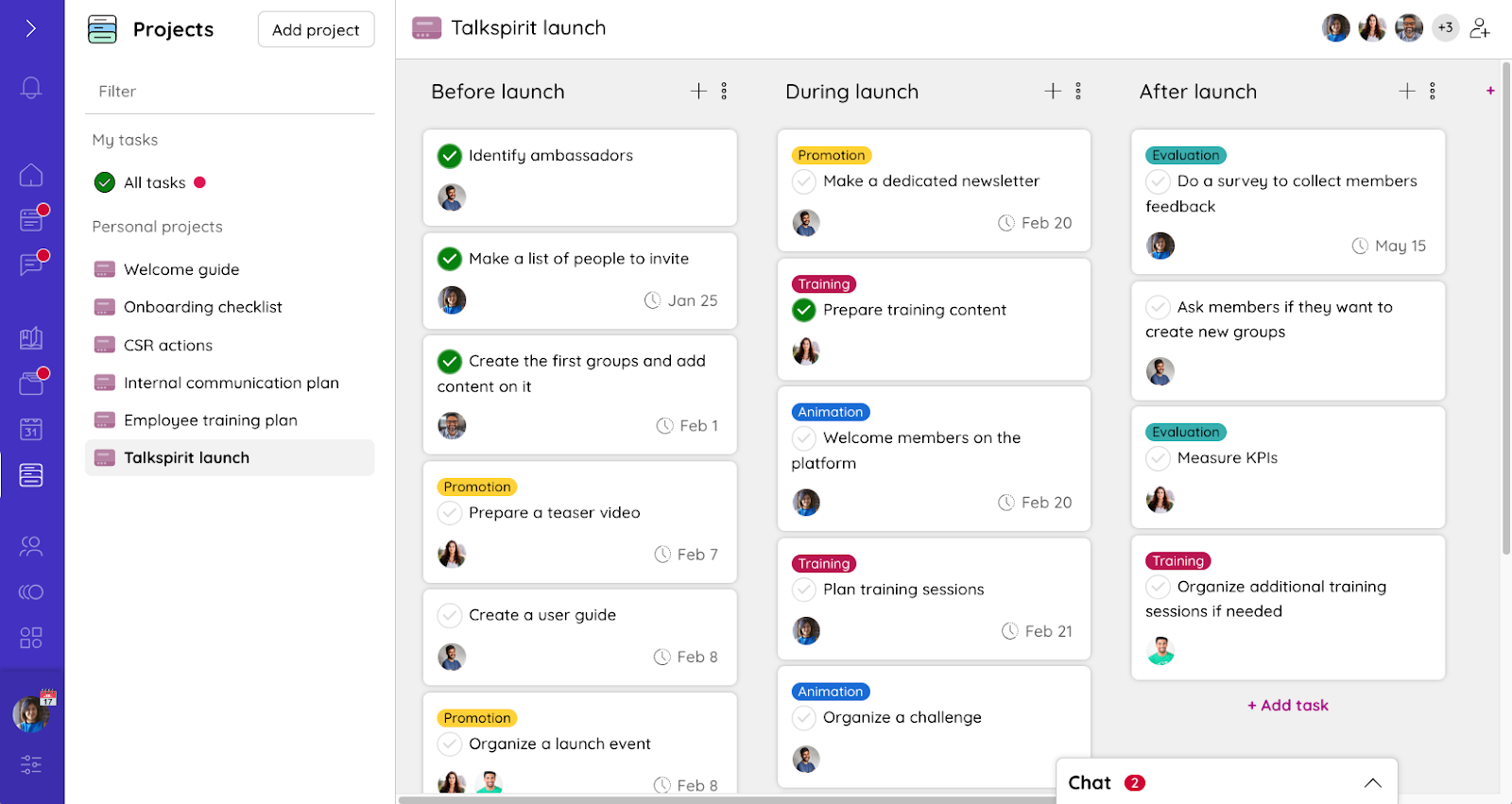
A collaborative platform can help you optimize your project management, and say goodbye to all the problems associated with it. Often equipped with a dedicated module, it lets you organize your projects, assign tasks, set deadlines, and ask everyone where they stand to make sure the work gets done on time.
Facilitate remote working and communication
One of the main advantages of a collaborative platform is that it facilitates communication and collaborative working from a distance. With such a tool, there’s no need to force your staff to come into the office every day. You can work in hybrid or 100% remote mode, and be just as efficient!
Of course, a digital tool is no substitute for face-to-face exchanges. So be sure to inject a little face-to-face interaction into your organization to keep your teams close-knit.
Secure exchanges
Data security is a key issue for many organizations, in particular for government agencies, local authorities and companies handling sensitive data.
Opting for a collaborative platform allows you to centralize this information, and if necessary limit access to it, to minimize the surface area for attack. Several platforms have certifications (notably ISO 27001) that guarantee a high level of security, so include this in your criteria if it’s an issue for you.
Read also: 5 examples that show how different organizations can leverage the same collaborative platform
Talkspirit, the all-in-one collaborative platform
Looking for an all-in-one digital workplace that’s customizable, easy to use and deploy? We’ve got just what you need!
Talkspirit lets you tailor your collaborative platform your way, integrating only the features you need. You can use it to:
- manage and track the progress of your projects
- create work channels
- communicate in real time
- hold remote meetings
- share information asynchronously
- co-publish documents
- much more!
On Talkspirit, you can invite all your internal as well as external stakeholders. Our tool is accessible via PC, mobile, and tablet, even for anyone who might lack a professional email address. It can thus be used by employees in or out of the office, or on the move.
Since seeing is believing, we invite you to decide for yourself by booking a convenient time with our team. 😉
A final word
Setting up a collaborative platform or digital workplace offers many advantages for organizations. It can help you reduce your email volume (internal and external), collaborate more effectively with stakeholders, share information more efficiently, and by extension, boost your teams’ performance.
Now that you’ve got a good understanding of what a collaborative platform is, you’re probably asking yourself a few more questions. How do you choose your platform? How do you deploy it? And above all: where to start?
Contact our team today for answers to all your questions. 😉
FAQ
A collaborative platform is a digital tool that facilitates collaborative work and communication between an organization's internal and/or external stakeholders. Often available as SaaS, it can be accessed anywhere, anytime, for synchronous or asynchronous exchanges.
An enterprise social network is built to boost internal communication and employee engagement, while a collaborative platform is built to help several stakeholders work together. The first is used to pass information up and down the chain, the second to collaborate, share documents and manage projects. The more comprehensive a collaborative platform becomes, the closer it gets to a digital workplace, which covers both uses.
The main ones are instant messaging, videoconferencing and audioconferencing, virtual meeting rooms, work groups, project management, task scheduling, document storage, sharing and real-time co-authoring, and a shared calendar. Secondary ones include a newsfeed, a home portal, polls, a chatbot, a knowledge base, directories and statistics.
According to Gartner, 47% of digital workers have difficulty finding the information they need to work effectively. They waste time, make poor decisions and miss important information, which is the gap a collaborative platform fills by centralising exchanges, documents and contacts in one place.
Because it is built for real-time communication. Unlike email, the collaborative platform is particularly well suited to solving problems and discussing hot topics quickly, where other tools are better suited to asynchronous exchanges.
No. A digital tool is no substitute for face-to-face exchanges. It makes hybrid or fully remote work as efficient as office work, but keeping some in-person interaction is what holds teams together over time.