Key Challenges to Overcome in Any Digital Transformation Project

.svg)
Digital transformation: it's been the buzzword on everyone's lips since the Covid-19 crisis. Globally, businesses are estimated to have invested $1.8 trillion in their digital transformation in 2022, according to IDC. Why all this investment? Simply because digital is a powerful driver of growth for organizations! Indeed, 41% of SMEs and mid-caps surveyed by Ipsos in 2021 believe it contributes to increasing their revenue.
Beyond being a growth driver, digital transformation projects can also increase information transparency, boost team agility, streamline ways of working, drive employee engagement, and improve customer satisfaction. No wonder they're so widely embraced in both public and private sectors!
However, this transformation also raises many challenges. Legacy management, internal resistance, lack of digital maturity… What are the main challenges of digital transformation? And how do you overcome them? Here's everything you need to know to make your next digital project a success!

1. Defining a clear vision and objectives
A lack of vision is one of the main reasons digital transformation projects fail. This vision represents what the organization aspires to be and become — in other words, the why behind what it does. It's what will inspire and motivate teams, and determine the actions needed to move closer to that ideal.
Read also: Fred Cavazza: "Vision is the rallying cry of digital transformation"
Vision is therefore the foundation of your digital transformation strategy. Once this vision is clear, it's also important to define the project's objectives. We recommend using the OKR approach (Objectives and Key Results), which clearly frames objectives and associates measurable key results with them.
Of course, the idea isn't to define these objectives arbitrarily, but rather to base them on concrete analyses and feedback you've gathered. For example, if your ambition is to streamline team collaboration, ask yourself…
- what processes are in place for collaborative work?
- which collaborative platforms are teams using?
- what is their level of satisfaction with these tools (and why)?
- how much time do they spend on them each day?
Analyzing this data can help determine whether a change of tools or processes would be relevant, and whether the change will be well accepted internally. This can then help you set precise objectives for the project!

2. Getting leadership buy-in
Getting leadership buy-in is one of the essential steps in any digital transformation project — and it's often a real challenge! Leadership is not always enthusiastic about major change. You'll therefore need to prepare your case well and clearly articulate:
- the reason why you want to launch this project,
- the problems it will solve,
- the concrete benefits it will bring to the organization and all its stakeholders (employees, clients, partners, etc.),
- the measurable results you will be able to achieve,
- the potential obstacles you might encounter, and how to address them.
Beforehand, don't hesitate to also sound out leadership members informally, with a few casual questions over coffee 😉. What do they think of a company that has implemented a digital workplace? Are they familiar with agile working methods, and have they considered adopting them? These questions — however casual — are a great way to take the temperature and identify the arguments needed to persuade.
3. Modernizing the information system
The digital transformation challenge also concerns the IT department, which often has to work with legacy systems. Legacy systems are all the outdated software and hardware still in use within the organization that cannot interact with new systems. These aging systems are often difficult and expensive to maintain, which can delay and complicate digital transformation projects.
According to a Couchbase survey, 60% of architects waste their time managing legacy systems rather than driving digital transformation, and 72% believe it slows down the implementation of their digital projects.
To successfully complete their digital transformation, IT departments must therefore modernize their information system. Several approaches can reduce technical debt, such as migrating to the cloud, moving to a microservices architecture (which integrates multiple services within a single application), or refactoring, which involves changing code structure without changing its original function.
Not sure which approach to choose? Discover all our best practices for modernizing your information system here.

4. Deploying the right digital tools
More often than not, a digital transformation project also involves deploying new digital tools — either to replace existing ones that no longer meet needs, or to address new ones.
Here are our tips for tackling these digital transformation challenges:
- Assess your digital maturity by examining how digital tools are used in your organization: how are they used? Do they meet user needs? Are they truly effective?
- Identify the tools to implement and replace
- Draw up a requirements document listing the needs of leadership and employees, and the main selection criteria (in terms of features, accessibility, security, price, usability, etc.)
- Conduct a benchmark to identify the best solutions meeting your criteria
- Test pre-selected solutions and choose the one that best fits your needs

Depending on the needs expressed and the solutions already in place, you may opt for an all-in-one solution (bringing multiple applications together in one place) or a "best-of-breed" software (specialized in a specific area). Some platforms also allow you to combine these approaches by enabling you to activate the modules of your choice. This is notably the case with Talkspirit, a 100% French digital workplace that can be used to facilitate internal communication, community engagement, collaborative work, or all three at once!
5. Establishing governance
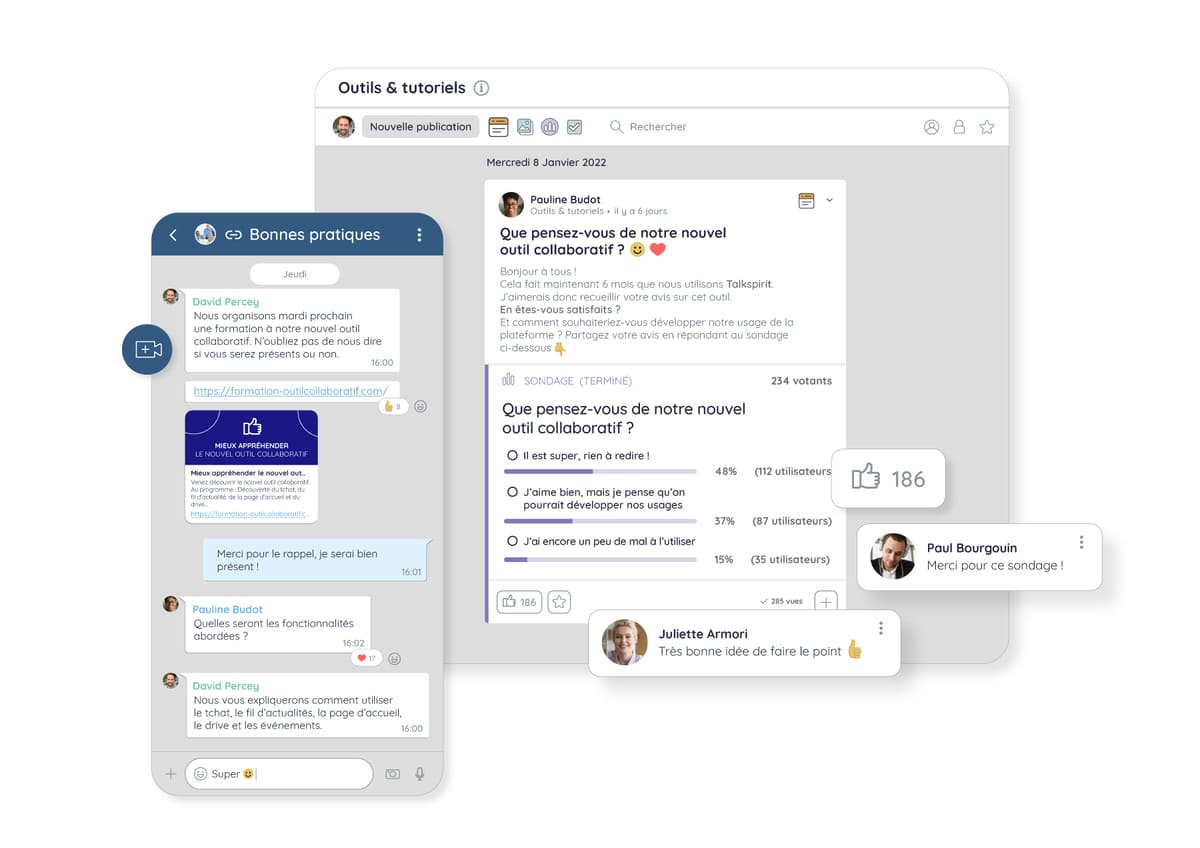
Establishing governance is another challenge to tackle in any digital transformation project. It's what will allow you to clarify all the policies and processes related to the project, and thus set a clear framework for teams.
Take the example of an enterprise social network (ESN) project. Most often, the organization already uses other tools before implementing an ESN. It's therefore important to define from the outset:
- what is the role of this platform within the existing tool ecosystem,
- how your different tools interact with one another,
- what uses the ESN should be used for,
- and how information should be shared on the tool (via a post, a chat message, the creation of a content page in your library, etc.).
Clarifying these different processes may seem tedious, but trust us: it's an indispensable investment to accelerate your digital transformation!
6. Overcoming resistance to change
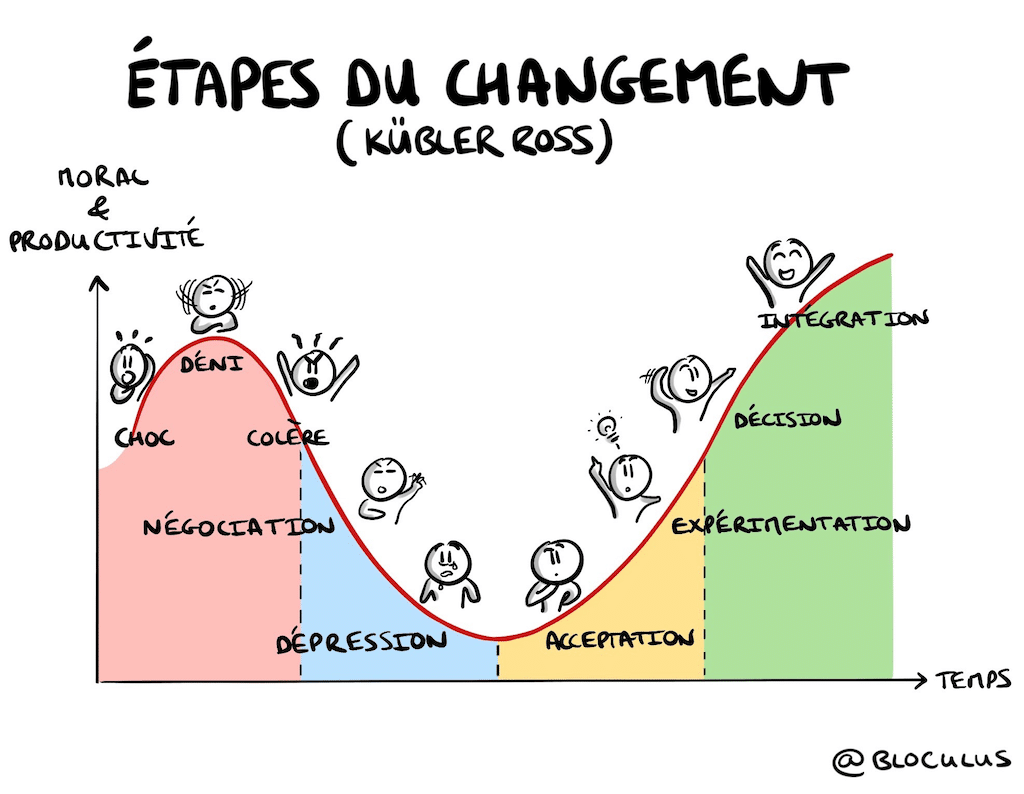
Change generates strong emotions! Shock, fear, denial, anger… Everyone reacts to change in their own way, often passing through several stages, as illustrated by the Kübler-Ross curve below. But how do you overcome this resistance to change? It's yet another challenge of digital transformation.
To best anticipate resistance to change, you must first get to know the employees who will have to adapt. In particular, ask yourself:
- What are their work habits?
- What do they stand to gain from your digital transformation project?
- Are they comfortable with digital tools?
- Are they more likely to accept or resist change?
Clarifying these questions upfront will make it easier to identify which employees are most likely to resist change, and to think through the best way to announce this transformation. Because yes: good change management starts with good communication!
Here are our tips for ensuring optimal change management:
- Involve employees as early as possible in the project and include them in decision-making
- Develop a communication plan tailored to your target audience to explain why and when the change is happening, what it involves, how it will impact employees, and what benefits it will bring them
- Prepare a training program to develop the teams' digital skills and help them adapt to the transformation
- Listen closely to employees' feedback and frustrations
- Demonstrate clearly that your digital transformation project will help them in their day-to-day work (proof by example is often the most convincing!)
7. Limiting environmental impact
Undertaking a digital transformation project can also present environmental challenges. According to a report by ADEME and Arcep, digital technology accounts for 3 to 4% of greenhouse gas emissions worldwide. And if nothing is done to address this, our digital carbon footprint could grow by 60% by 2040!
The message is clear: embracing digital sobriety is now essential to limit the environmental impact of digital transformation. This approach requires, among other things:
- Rationalize your applications by eliminating duplicates and opting for all-in-one software (like Talkspirit!),
- prioritize the use of less energy-intensive digital tools (for example, use chat rather than email for internal communication),
- promote responsible use of these tools and the IT equipment we use,
- raise employee awareness of the importance of digital sobriety.
Read also: Why and how to implement a CSR approach within your organization?
At Talkspirit, we are committed to helping organizations implement this digital sobriety approach. That's why we provide them with an all-in-one collaborative tool that can replace multiple specialized tools, as well as tailored support services to promote responsible digital use within teams. Contact our team to find out more!
Contact an expert
8. Measuring return on investment
It's time to take stock! Every digital transformation project must demonstrate a return on investment (ROI). Yet that's far from easy! According to an EY study, 3 in 5 companies don't know how much they spent on digital in 2021, and only 41% have measured the ROI (though this represents an improvement over the previous year).
How do you calculate this ROI? And which indicators should you use? It's one of the digital transformation challenges we'll help you tackle.
Before measuring return on investment, you must first define success indicators (or KPIs) adapted to the scope and objectives of the project. For example, if your objective is to improve team performance, you can integrate several performance levers into your KPIs: employee engagement level, time saved through task automation, information transparency level, speed at which projects are completed and decisions are made, etc.
All these KPIs should be measured regularly, over precise periods defined in advance. During analysis, take the time to explain the figures: how do they contribute to achieving the project's objectives, and more broadly the organization's objectives? Through this analysis, you'll be able to get a sense of the return on investment of your digital transformation, and thus justify the importance of the project internally.
*
* *
Conclusion
Tackling the challenges of digital transformation can often seem complex, particularly when the organization is not very digitalized and/or has little experience in the area. But the good news is that solutions exist! Remember also that digital transformation is everyone's business. It's therefore important to involve all departments in your digital projects — both to build trust and to facilitate change management. And of course, don't hesitate to seek support! Whether you're looking to implement new digital tools or processes, our team can provide advice and best practices to help you succeed. Contact us to discuss.
Would you like to discover how other companies have overcome the challenges of digital transformation? Download our practical guide featuring 10 examples of digital initiatives 👇
Access the Practical Guide
In our practical guide "10 examples of successful digital transformation projects", you'll discover how 10 international companies successfully accelerated their digital transformation, the challenges they faced, the strategies they adopted, and the results they achieved.