
[Arctus 2023 Study] What Is the Role of the Intranet in the Workplace?
.svg)
The intranet — is it on its way out? Far from it! Considered essential for accelerating digital transformation within companies, the intranet still has a bright future ahead. More popular than the digital workplace, this tool is a key asset for improving internal communication and boosting employee engagement.
What is the role of the intranet in today's workplace? What challenges does it help address? How do employees use it? And which levers can organizations pull to improve their satisfaction with the intranet?
To explore these questions, we analyzed the 2023 Intranet and Digital Communication Observatory study, conducted by Arctus among 377 companies that have deployed an internal digital platform (intranet, enterprise social network, collaborative platform, digital workplace, etc.). Among the respondents were: communications professionals (33%), general management (21%), IT department (9%), and HR department (8%).
So, what are the key takeaways? Here is our summary 👇

Digital: a mix of challenges and opportunities for internal teams
Digital transformation brings its share of challenges and opportunities internally. Some are naturally more pressing than others — notably internal communication, which is seen as the primary challenge by 69% of companies surveyed. This is followed by knowledge capture and transfer, and then operational efficiency, cited by 59% of respondents.
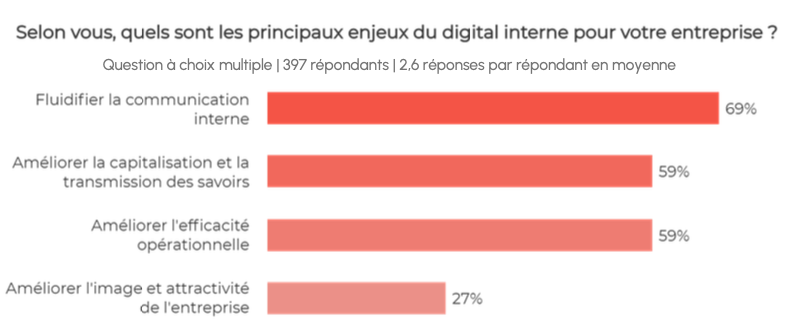
Internally, digital also gives companies the opportunity to strengthen social bonds between employees (for 59% of respondents), to engage and retain talent (36%), and to facilitate remote work (34%). These figures correlate with the rise of hybrid working, and the growing need to better connect remote teams.
Read also: [Julhiet Sterwen Barometer 2023] What is the impact of hybrid working in companies?
More good news: this period has helped increase engagement across all workforce segments (general management, managers, and employees) toward digital transformation.
One population, however, remains disengaged and left behind: non-connected employees.
Working mostly in the field, these individuals often have limited time to access information and don't always have the technical means to connect to the intranet. The challenge for companies is therefore to better include these employees so they can receive the same information as their connected counterparts.
Read also: Better connecting your "Deskless Workers" (employees without email)
Adoption barriers still present
Faced with these challenges and opportunities, the question arises: what prevents companies from driving adoption of new internal digital practices? Lack of time tops the list (48%), followed by lack of training (28%), lack of clarity or absence of governance, lack of skills (20%), and lack of accessibility (18%).
It is worth noting, however, that 17% of companies encounter no barriers to adoption — an increase of 7 percentage points compared to 2021.
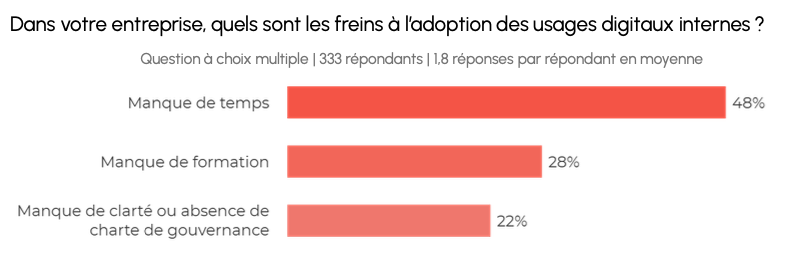
These barriers underscore the need for companies to deploy an intranet that is easy to set up and use, while also clarifying the tool's objectives and establishing governance before launch.
PS: Find 8 best practices for setting up your intranet in this article, and reduce adoption barriers.
The intranet: an essential tool for companies…
Nearly two-thirds of companies regularly use the intranet, which clearly demonstrates its central role in the organization. It serves to distribute news, evergreen content, videos and multimedia content, events, newsletters, podcasts, and much more!
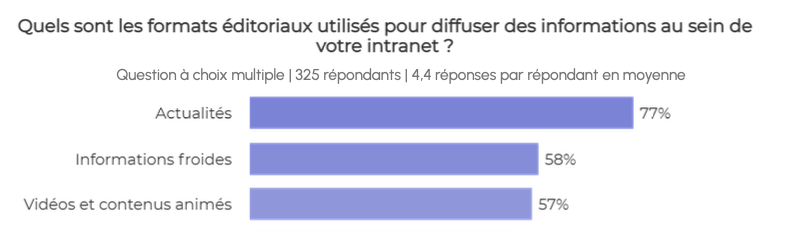
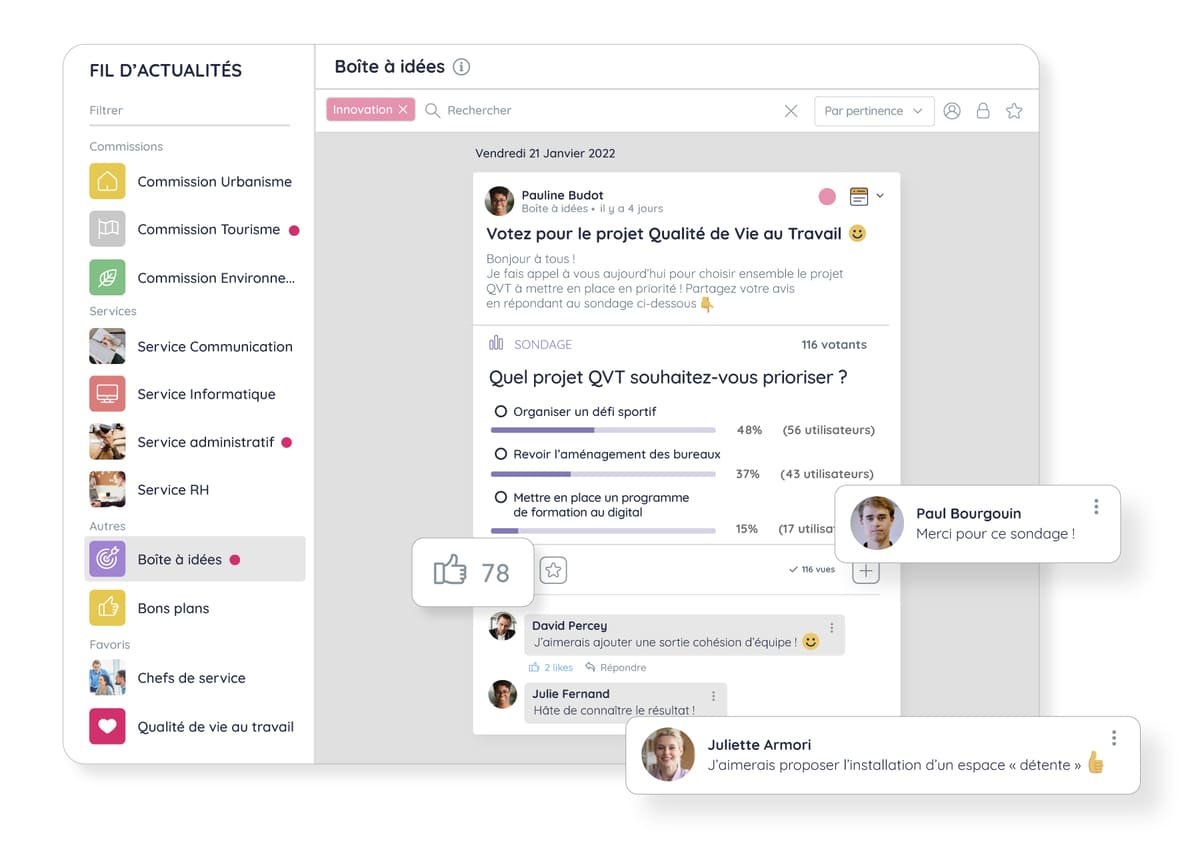
Used by more than three-quarters of organizations, the "news" format is the most common on intranets. To drive engagement, one in two intranets also offers specific features, such as polls (found on a third of intranets), or onboarding services for new joiners.
On the Talkspirit platform, for example, it is possible to run polls as posts to gather members' opinions, create groups to ease the onboarding of new employees, or configure a FAQ chatbot to automatically answer everyone's questions.
…not as outdated as you might think…
The intranet is getting younger. And no, that's not a figure of speech 😉. This year, two out of 3 companies have a platform that is three years old or less. When you consider that only 20% of intranets were under 3 years old in 2009, it is clear how much things have changed!
The reason is simple: intranet features have evolved significantly in recent years. Today, an intranet is no longer a static website — it is a social tool that allows teams to share information, but also to exchange ideas, react, and give feedback.
It comes as no surprise, then, that social features such as directories, likes, and comments now appear on the majority of enterprise intranet solutions. The cross-platform search engine, available in one company out of two, is also an essential function as it makes it easier to find information on the platform.
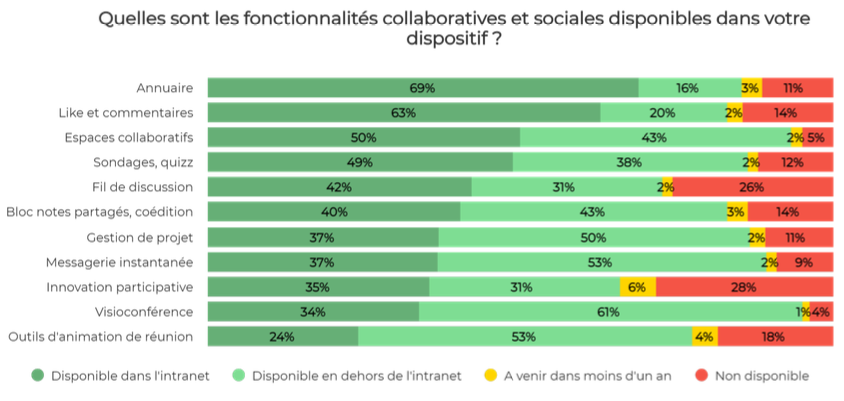
Collaborative features are also increasingly present on intranets. Consider:
- one in two intranets offers a collaborative workspace
- 46% offer electronic document management (EDM)
- 40% allow multiple users to co-edit documents
- 37% include instant messaging
By contrast, meeting facilitation tools and decision-making tools remain less popular on intranets.
… but facing several challenges
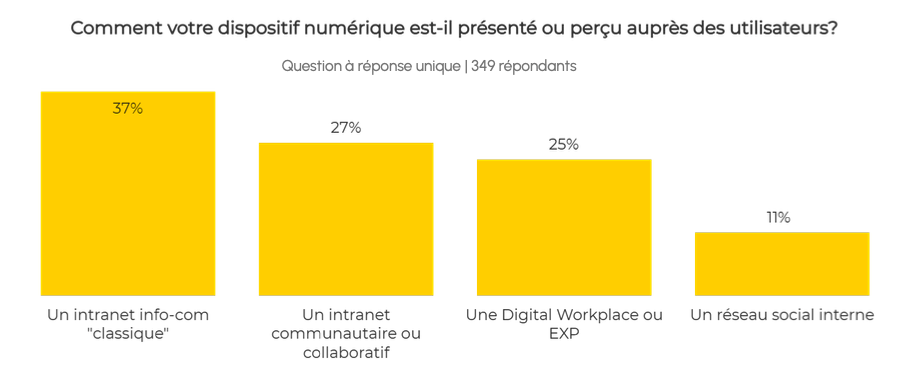
Despite their modernization, internal digital platforms are still perceived as "classic" information and communication intranets by more than a third of respondents. Meanwhile, the more recent term "digital workplace" is only used by 25% of companies. It will therefore take more time for these new platforms to become the norm.
Whereas the digital workplace integrates into the work environment, the intranet platform remains poorly interoperable. 67% of platforms offer simple links to business applications. But only a quarter have advanced integrations. The reasons: technological and organizational complexity, lack of governance, and the significant costs associated with these integrations.
Beyond this integration challenge, it is also important to mention the challenge of digital sovereignty, and the hegemony of Big Tech. As has been the case for many years, Microsoft 365 remains the leading office suite deployed in companies.
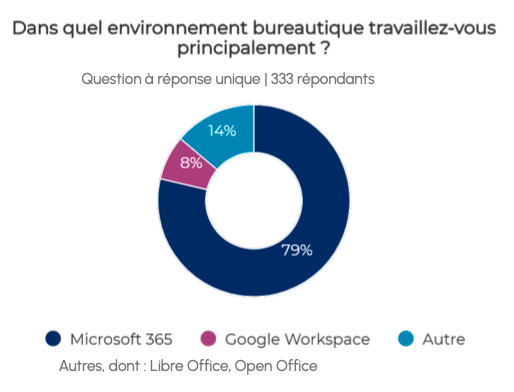
14% of companies opt for solutions other than Microsoft or Google out of concern for data sovereignty and security — and also on principle. By choosing a European platform, companies can maintain control over their data and ensure it remains confidential. This is not the case with American platforms, which are subject to the Cloud Act.

A priority placed on governance and support
The intranet now brings together a wide variety of content. This is pushing companies to establish governance to better manage the content production and distribution chain. The majority of these platforms are steered by an editorial committee, an operational committee, or a technical decision-making body — reflecting the growing importance placed on content strategy.
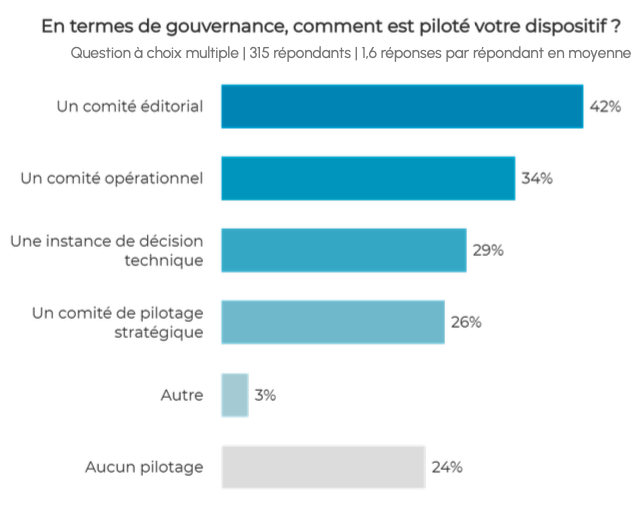
The Communications Department remains one of the main stakeholders represented on these steering bodies, followed by General Management, the IT Department, and Intranet Managers. The HR Department, meanwhile, is represented in only 25% of organizations.
Business departments are not the only ones publishing content, however. In 40% of organizations, all departments publish on the intranet! This helps boost engagement on the platform and increase visibility across different business units.
Support programs (training sessions, peer communities, etc.) are often put in place to support these contributors. However, content creation responsibilities are included in job descriptions in only 17% of cases. There is therefore still work to be done to better recognize and reward intranet contributors.
Read also: Turn your employees into ambassadors for your enterprise social network!
Levers to activate for improving intranet satisfaction
On average, intranet users have a satisfaction rate of 6.5/10. So how can organizations improve this? It is the million-dollar question for any organization that has deployed an intranet.
Several best practices can help you increase this satisfaction rate. Here are some from the study:
- Choose an ergonomic intranet with rich functionality
- Involve the digital director or Chief Digital Officer (CDO) in the project
- Create a steering committee to establish clear governance
- Use engagement features (for example, polls, recognition mechanisms, etc.)
- Offer varied content (for example, photos, videos, podcasts, short articles, etc.)
- Encourage contributions from different business departments
- Regularly assess intranet performance using precise KPIs
Read also: 6 best practices for streamlining internal communication with an intranet
Talkspirit: the modern intranet your employees will love
Looking for a modern, intuitive intranet that meets the needs of your employees and leadership? Why not try Talkspirit? 100% French, our intranet includes a wide range of social and collaborative features to help streamline communication and collaboration across your teams.
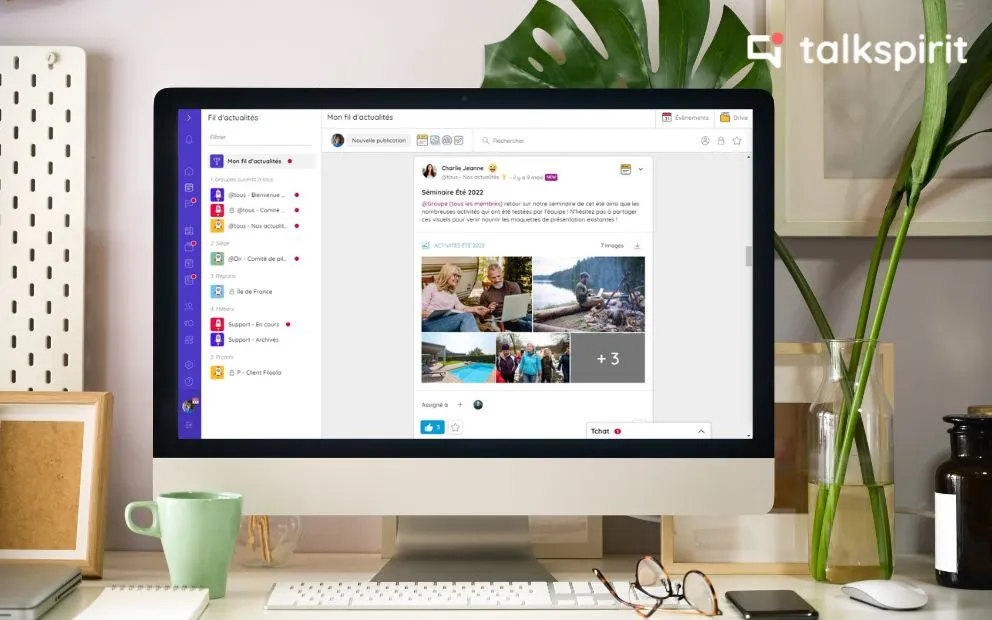
You can find, among other things, a customizable welcome portal, a news feed, a document storage and co-editing space, a chat and video conferencing module, a directory, and much more!
Easy to use and deploy, Talkspirit can be up and running in just a few weeks. Try it and you'll be hooked!
*
* *
In conclusion
The intranet is far from obsolete in today's workplace. In fact, more and more employees are contributing to it — both to share information with colleagues and to increase visibility across departments. In some organizations, the intranet is even used as a collaborative space, bringing together all team communications in one place.
Thinking about deploying an intranet but not sure where to start? Download our methodology sheet for our best advice.
Access the Methodology Sheet
In this methodology sheet, you will find: the 8 steps to setting up your intranet, the questions to ask to identify your needs, the key criteria for selecting your solution, the elements to include in your communication plan, and our best tips for driving platform adoption.