Can Companies Really Go Without Big Tech Tools?
.svg)
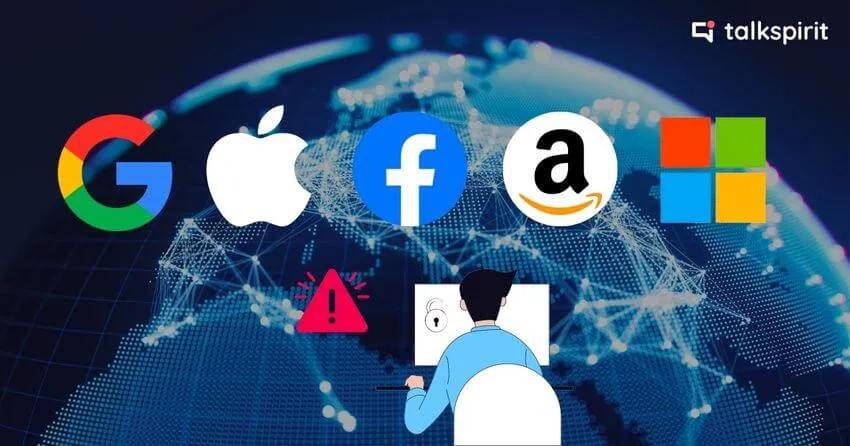
It's a fact: Amazon, Microsoft, and Google now control 80 % of the French cloud market¹. These American digital giants—also known as Big Tech (Google, Apple, Facebook, Amazon, and Microsoft)—exert considerable influence over French companies. Faced with this growing dependency, the question arises: is it truly possible to go without Big Tech tools?
According to an Ifop study, nearly 7 in 10 French people feel they are forced to use the services of these large American companies due to the lack of European alternatives. Many French companies share this view, continuing—sometimes reluctantly—to use Big Tech tools to stay competitive and drive growth.
So how do we explain Big Tech's dominance in the digital sector? What are the possible solutions for reducing this dependency? And is it truly in our interest to ban American tools from our companies entirely? Here is our analysis 🔎.

Why are we so dependent on Big Tech?
Our dependency on Big Tech tools is nothing new. In the early days of the internet in the 2000s, Google had already established itself as THE go-to search engine. Meanwhile, Microsoft continued to gain ground, embedding itself firmly in our companies, public institutions, schools, and personal computers.
This longevity in the market has certainly contributed to Big Tech's success. But it's far from the only factor explaining Europe's dependency on American solutions.
Familiarity
For many companies, adopting an American tool is the path of least resistance. For a simple reason: these are tools employees already know. From school benches, we grew accustomed to using Microsoft or Google suites to create documents and presentations, or sharing posts on our Facebook walls.
Deploying Big Tech tools is therefore much simpler for companies, since employees have already learned to use them at school or in previous jobs. No major change management effort is needed, which suits a lot of people just fine!
Performance
It's hard to say, but it's true: Big Tech tools are often perceived as more powerful than their European counterparts. There are of course exceptions in certain markets—for example, in the collaborative tools space, where a number of strong alternatives now exist, represented by the #Fab8 collective (made up of Talkspirit, Jalios, Jamespot, Netframe, Twake, Whaller, and WIMI).
See also: Sovereign cloud: 8 French players emerge as alternatives to Microsoft 365
However, the reality is that—in some markets—European alternatives are still not quite on par. This forces companies to make trade-offs. Either they choose to use only sovereign solutions—sometimes less powerful than Big Tech's—at the risk of hampering their growth. Or they rely entirely on American tools, and face challenges around security and data sovereignty.

Faced with this dilemma, at Talkspirit we have chosen a hybrid approach for our internal needs (a policy independent of our product). Whenever a European solution exists that is equally or more powerful than the American alternative, we choose the sovereign tool. But when European alternatives are non-existent or less capable, we prefer to go with American tools.
Like other sovereign software vendors, we have opted for the American marketing automation tool HubSpot, which we found to be more powerful than European alternatives. We also chose a plan that hosts our data in the European Union, to ensure compliance with GDPR.
The lack of European alternatives
If we are so dependent on Big Tech, isn't it because there are simply not enough strong European alternatives? At Talkspirit, we believe that building these alternatives requires investment first! Initiatives—such as the national cloud strategy—have already been launched by the government, but they are not yet sufficient to enable European vendors to offer solutions that can fully replace Big Tech.
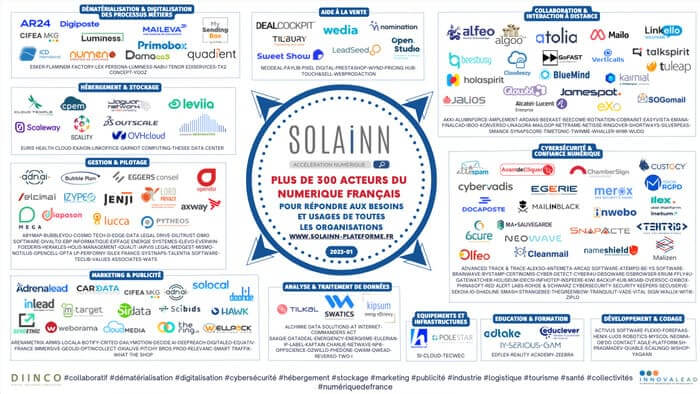
To break this vicious cycle, it is essential that the government provides greater support to French companies. But also that our companies support each other. Joint actions—such as the #Fab8 initiative or the Solainn platform, which offers a directory of French digital solutions—can be considered to give French vendors greater visibility and help them grow faster.
See also: [BFM Business] French tech gems competing with Big Tech
Finally, it is also important to regulate the activities of Big Tech on European soil, in order to ensure fair competition between sovereign players and Big Tech. This is notably the goal of the Digital Markets Act (DMA), which officially came into force on May 2, 2023.
What is the Digital Markets Act (DMA)?
The Digital Markets Act is legislation passed by the European Parliament in July 2022. Its objective: “to combat the anti-competitive practices of internet giants and correct the imbalances of their dominance in the European digital market.” (Source: Vie publique)
Banning Big Tech in the workplace: is it really possible?
Three-quarters of French people believe Europe is not doing enough to limit Big Tech's dominance in the digital sector². And they're right! As we've seen, several initiatives could be launched by the government and companies to promote made-in-France digital solutions. However, these efforts remain limited.
Looking at the public sector, however, the situation is quite different. Recently, the government decided to ban Big Tech tools from local authorities and schools, in order to guarantee the security and sovereignty of our data.
See also: [SQOOL TV]: Big Tech banned by the French National Education Ministry
This decision naturally sparks debate and raises a question: can the same policy apply to companies? Our answer is… no. Or at least, not yet.
While we are strong advocates for digital sovereignty, we are also realistic about the European market's capacity to surpass Big Tech. Currently, Big Tech holds 80% of the global SaaS software market³.
Without the necessary investments, it would be unrealistic for French companies to go entirely without Big Tech. Ask any company whether it uses American tools and the answer will almost certainly be “yes,” for the reasons outlined above. Those are precisely the reasons why we—Talkspirit—continue to use some of these solutions internally.
Building strong sovereign solutions to counter Big Tech
While we do use some American tools internally (for advertising, social media, and marketing, for example), we remain convinced that it is possible to build 100% sovereign solutions, natively integrating European and open-source technology building blocks. Several already exist in the collaborative tools market, which you can discover here.
For example, our Talkspirit platform is built on the following open-source tools:
- the video conferencing module from Jitsi,
- the office suite from OnlyOffice,
- the analytics component from Matomo,
- and soon, a messaging solution from a European provider 👀.
To facilitate integration with each company's existing business tools, we also offer third-party integrations with American solutions such as Google Drive, Trello, and Pipedrive. Of course, these integrations do not give American vendors access to our data, and therefore cannot compromise the integrity of our platform. They exist solely to facilitate communication between tools.
For us, the conclusion is clear: if we want French companies to stand out in today's competitive landscape, it is important to prioritize performance. That means offering powerful sovereign native integrations, while also making it easy to access all company tools—whether European or American.
It is by developing more solutions of this kind that we can limit Big Tech's hegemony, and—eventually—consider banning them entirely from our companies.
*
* *
Conclusion
To the question “can companies completely go without Big Tech tools,” our answer is no… for now! Given the lack of strong European alternatives in certain markets, banning American tools from our companies would be unrealistic. However, it is possible—through collective effort—to gradually reduce our reliance on these solutions, by investing more in European and French tools. With the goal of—someday, we hope—seeing them become true Big Tech alternatives.
In the collaborative tools market—and even in others—we are convinced it is already possible to go without Big Tech, because several European vendors offer sovereign AND effective tools, which represent genuine Big Tech alternatives. What matters now is to continue this momentum in other markets, so that companies don't have to choose between security and performance.
In the meantime, if you're looking to implement a digital tool that is both powerful AND secure, we invite you to consult our checklist of 10 questions to evaluate the security level of your tools:
Access the Checklist
In our checklist “10 questions to evaluate the security of a digital tool”, you will find: the security criteria to consider when choosing or replacing a platform, a summary of the key certifications to know, and best practices for raising employee awareness.
¹ Markess by Exaegis study (2022)
² Ifop study on the French and digital sovereignty (2021)
³ Synergy Research Group study (2019)