[Webinar] Accelerating Digital Transformation in the Public Sector
.svg)
According to a survey by Acteurs publics, 33 % of civil servants believe that the public sector is lagging behind in digital transformation. This view was shared by 60 % of the participants in our webinar of March 29, 2023, dedicated to the digitalisation of the public sector.
And for good reason: "French administrations have largely completed their digital transition, but have not yet finished their digital transformation"¹. Indeed, the tools used internally are not always suited to the organisation's needs. Likewise, working methods and information management practices must continue to evolve to complete this digital transformation — without putting the organisation's data security at risk.
What are the tools and best practices to put in place in order to accelerate digital transformation in the public sector? What should you pay attention to in order to keep your data secure? And how do you manage change?
These are the questions addressed by our three speakers during the webinar, namely:
- Adèle Hošek, Lead Customer Success at Talkspirit
- Carine Ponsot, Internal Communications Officer at the Municipality of Venelles
- Philippe Sanmartin, Director General of Services at the Municipality of Venelles
Below is a summary and replay of their presentations.
The Challenges of Digital Transformation in the Public Sector
For Adèle Hošek, Lead Customer Success at Talkspirit, digital transformation brings two key challenges for public organisations, their users, and their agents:
- For the organisation: the need to modernise its tools and services, while maintaining ease of use and staying close to the public.
- For users and agents: the need to adapt to new ways of working and the new tools introduced by the organisation.
To meet these challenges, digital transformation in the public sector must be carried out step by step. Here are the 3 key steps to keep in mind 👇
Steps to Accelerate Digital Transformation in the Public Sector
1. Conduct a diagnosis
The first step to a successful digital transformation is to conduct a diagnosis to identify the tools, practices, and habits that need to evolve.
To do this, Adèle Hošek recommends putting the following actions in place:
- Assess the digital maturity of your organisation — that is, its capacity to use new technologies optimally and to continuously adapt to digital change.
- Map the tools you use and how they are used across the different departments, to ensure they genuinely meet identified needs.
- Formalise existing practices and processes to capture the organisation's collective knowledge and make information easier to find.
- Define the target audience of this digital transformation, so you can identify their pain points and remove barriers more effectively.
- Appoint project managers who will form the steering committee and be responsible for clarifying the organisation's needs.
- Survey your agents on their needs to complete your diagnosis and properly configure your tool.
- Identify ambassadors who are close to your target audience, able to conduct this survey, and ready to help drive change internally.
Read also: [Webinar] Methodology and Tools for a Successful Digital Transformation
2. Support adoption
Once the diagnosis is complete, it is time to implement the new tools and practices that will accelerate the organisation's digital transformation. At this stage, what matters most is effectively supporting adoption, as this is what will largely drive employee engagement with the project.
A first good practice is to develop a communications plan. The goal here is to inform agents before, during, and after the rollout of the project, and to reassure them along the way. These communications should clarify:
- why the organisation is introducing a new tool or practice,
- who is affected and who can answer their questions,
- how the rollout will proceed and what the expected timeline is,
- where to find information related to the project.
Also consider testing your new tool or practice with your steering committee and ambassadors. This lets you verify that the tool or best practice genuinely meets the expressed needs, and make any necessary improvements before rolling out the project.
3. Sustain information
After preparation comes the long-term sustainability of the information. In this final stage, the challenge is to make the tool or practice a reference for all agents (and elected officials where relevant).
Ambassadors have a key role to play here, since they are the ones who will carry the message to agents and elected officials on the ground, showing them how to use the tool or best practice in their day-to-day work. To ensure they fully fulfil this role, you need to train them thoroughly — both on the new tool and new practices, and on their own role.
On your new tool, it can also be worthwhile to create a welcome portal where you can share useful information and documents (the tool's usage policy, a getting-started kit, tutorials, and so on).
One month after launch, you can then survey your agents, elected officials, and ambassadors to identify areas for improvement, and continuously evolve your practices.
Finally, we also suggest monitoring usage statistics for your new tool to see how it is being used, and comparing them with statistics from your previous tool. This will help you understand whether the actions taken are meeting users' needs — and what improvements have been made.
PS: want to know how to implement these three steps in practice? Watch the replay to discover the customer case study presented by Adèle Hošek during the webinar.
Feedback from the Municipality of Venelles
Digital transformation is a key challenge for many public organisations and administrations. One such example is the municipality of Venelles, a town of 8,600 inhabitants located near Aix-en-Provence.
In 2020, it deployed the Talkspirit platform to accelerate its digital transformation and streamline communication and collaboration among its agents. Here is their experience.
Read also: Boosting Internal Communications with Talkspirit: Feedback from the Municipality of Venelles
A need to streamline communication and collaboration
"When I arrived in 2015, I noticed a complete absence of collaborative practices within the municipality. Teams were working in silos, using almost proprietary tools", explains Philippe Sanmartin, Director General of Services at the municipality.
On top of that, communication was very top-down, happening almost exclusively by email. There was a lack of fluidity in exchanges between managers and agents, and between agents themselves.
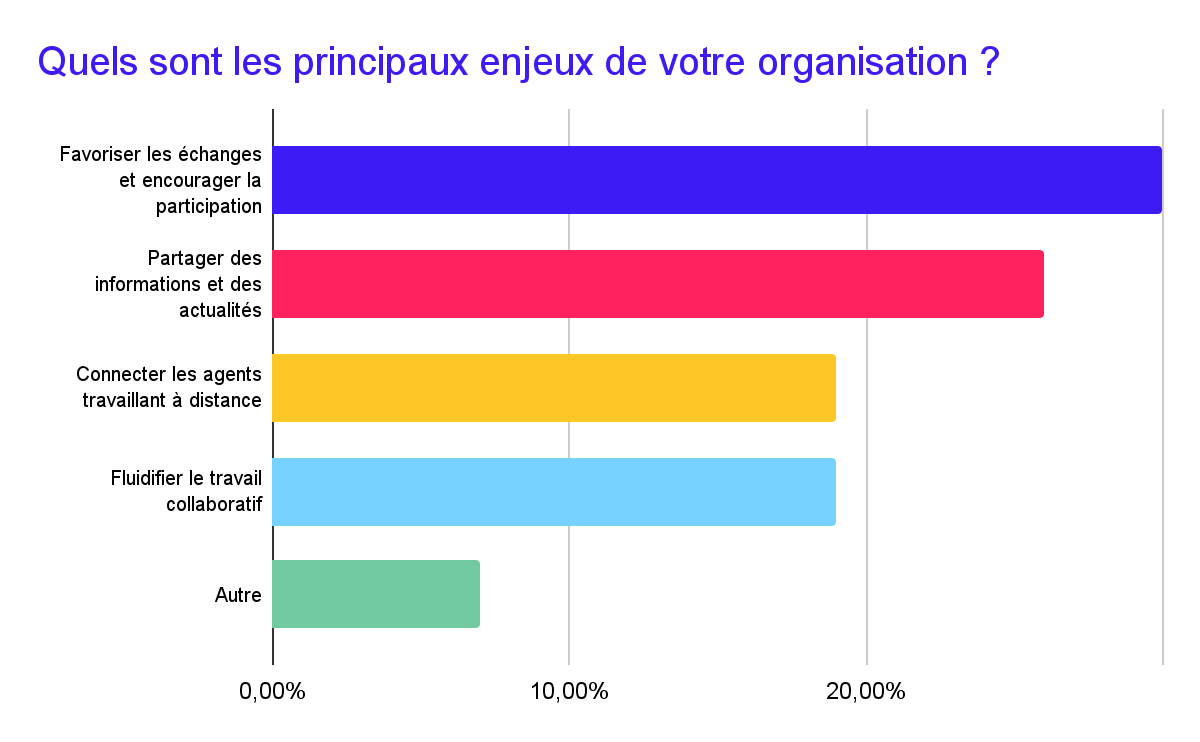
To address these challenges, the municipality of Venelles went in search of a collaborative tool that would allow it to:
- easily share information and news with everyone,
- connect its 160 agents spread across the municipality's various sites — in offices and in the field,
- encourage exchanges and participation,
- streamline collaborative work on cross-functional topics.
These are challenges shared by the majority of webinar participants as well 👇
Talkspirit: a sovereign solution tailored to the municipality's needs
"One day, our IT director introduced me to Talkspirit. And when we saw it, we thought: this is exactly what we were looking for!", recalls Philippe Sanmartin.
100 % French, the Talkspirit platform perfectly met the municipality's needs in terms of data hosting, ergonomics, and ease of use. The mobile app was also a real asset for allowing field agents to access internal information.
At the end of 2019, the municipality first deployed the platform on an experimental basis. Access was then granted to all office-based agents in March 2020, at the start of the lockdown linked to the Covid-19 crisis.
Read also: Local Authorities: Why Implement a Collaborative Platform?
A tool used for both work and informal exchanges
Today, the tool is used for a wide range of purposes. First, it helps to streamline collaborative work across the various departments through groups, chat, and projects.
One concrete example is the "Emergency Cell" group, which is activated when the Municipal Emergency Plan is triggered to manage a crisis.
"When we activate a municipal emergency plan, we follow events in real time on our Talkspirit group", explains the Director General of Services. This means everyone is kept informed of what is happening as it unfolds, enabling better crisis management.
Beyond crisis management, the municipality of Venelles also uses Talkspirit to share news and events with all agents via the news feed (for example, the internal newsletter, as well as each team's projects).
To engage agents, "we sometimes run challenges", adds Carine Ponsot, Internal Communications Officer at the municipality. "Over the holiday season, for example, I launched an ugly Christmas jumper contest. It creates a sense of togetherness and encourages agents to log on to the platform."
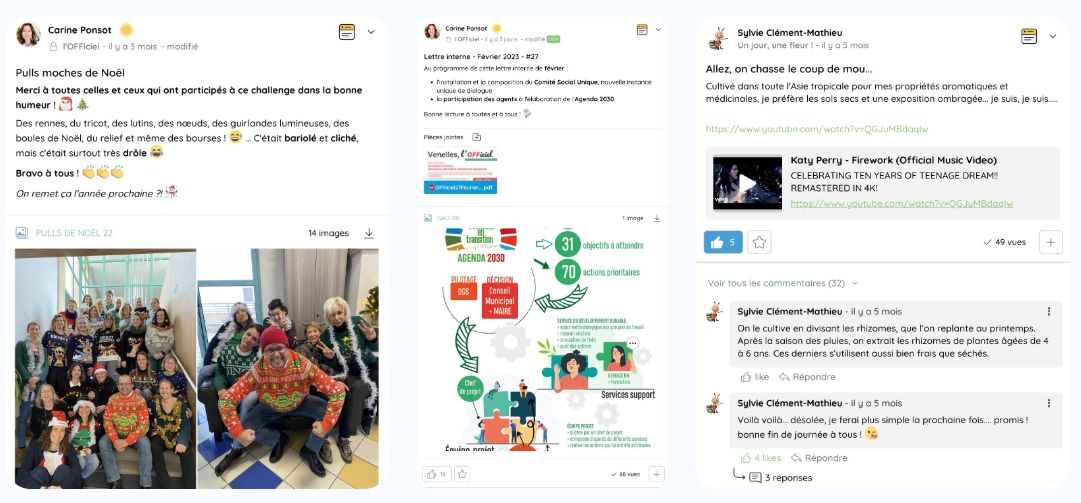
Examples of posts on the Talkspirit platform of the municipality of Venelles
Agents themselves also contribute to this spirit of togetherness. For instance, the municipality's gardener, Nicolas Greff, posts a plant riddle every morning in the "One day, one flower" group.
Fewer internal emails, and more team spirit
The benefits of Talkspirit for the municipality of Venelles are numerous. The platform helps to:
- optimise team productivity, whether on-site or remote,
- sustain the adoption of remote working,
- reduce internal email volume,
- build conviviality and team cohesion,
- and recognise agents' work.
"Since we deployed Talkspirit, we have had zero service interruptions" , reports Philippe Sanmartin.
Best practices for a successful deployment
For the municipality of Venelles, three elements contributed to the success of the Talkspirit rollout:
- Management sponsorship of the project, which helped drive adoption of the tool
- The fact that all important information is posted on the platform, rather than communicated by email.
- Continuously evolving usage, which develops over time. Recently, for example, the municipality introduced the chatbot and the library on their platform.
*
* *
The digital transformation of the public sector is well underway! To accelerate it, it is important to follow several best practices: conduct a diagnosis, involve agents and management in the project, test your tool, train your users, and continuously evolve your ways of working.
Watch the webinar replay to hear all the presentations and access the Q&A session 👇