.webp)
[Webinar] Digital Workplace: Reconciling Data Sovereignty and User Experience

.svg)
Setting up a digital workplace is now essential to improving team performance and collaboration across the organisation. Yet choosing the right solution means weighing up two critical factors: user experience and digital sovereignty. Whichever challenge matters most to you, we firmly believe that compromises should not be on the table — your users deserve a great experience, and your data deserves to stay secure.
Yet today, most organisations rely on dominant — often American — platforms because those vendors have set the bar for user experience in ways that are hard to move away from. Choosing them means making significant trade-offs on digital sovereignty: questionable data protection, commercial imbalances, technological and contractual lock-ins, planned hardware and software obsolescence…
So, how can organisations reconcile digital sovereignty and user experience ? What requirements should go into a platform RFP? And which sovereign alternatives are worth considering? ?
These were the questions we explored in our June 8th webinar with:
- Pierre Baudracco, CEO of Bluemind, Europe's leading email software vendor
- Philippe Pinault, CEO and Co-founder of Talkspirit, the French digital workplace that streamlines team communication and collaboration
Here is a summary of their discussion.
The state of the digital workplace market
“To this day, US players continue to dominate the digital workplace market in digital. According to a Synergy Research study, they held 85 % of the European cloud market in Q2 2022”, explains Philippe Pinault.
This dominant position creates several problems, including:
- dependence on American platforms and their commercial policies, which drives up costs and stifles diversity and innovation,
- security risks and data confidentiality concerns,
- lost opportunities for European cloud providers, which remain marginal players on their own continent.
Sovereign alternatives are out there
The good news? “There are now many sovereign alternatives mature enough to deliver the best possible UX while protecting your users’ data.”
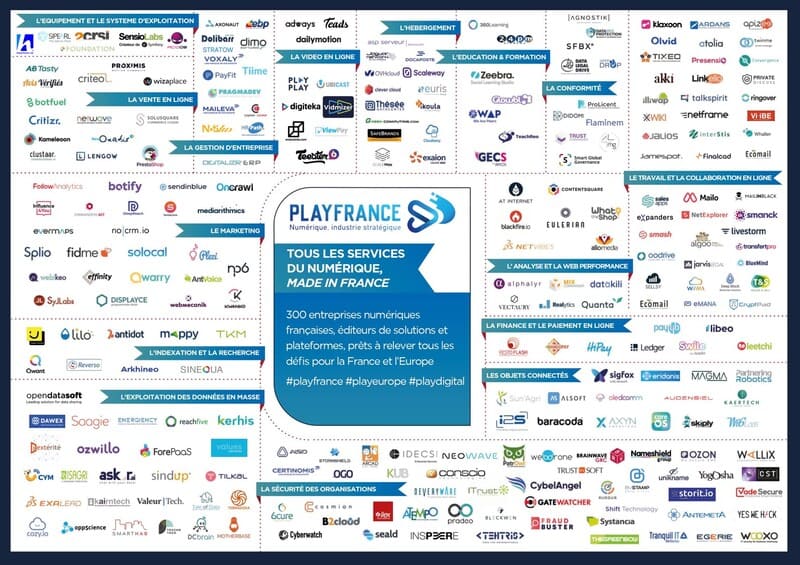
PlayFrance.Digital map of 300 French digital companies
Some of these alternatives can be found on the PlayFrance.Digital map, which catalogs 300 French digital players. “The challenge is no longer finding alternatives – they already exist – but embedding them into companies’ daily routines”, notes Philippe Pinault.
Among these communication and collaboration solutions, email remains by far the most widely used: according to Lecko, 64 % of employees rely on it, compared with 43 % for team messaging apps, 40 % for video-conferencing tools, and 27 % for collaborative platforms. This year also saw a surge in digital workplace adoption, now used by a quarter of employees (up from just 7 % in 2022).
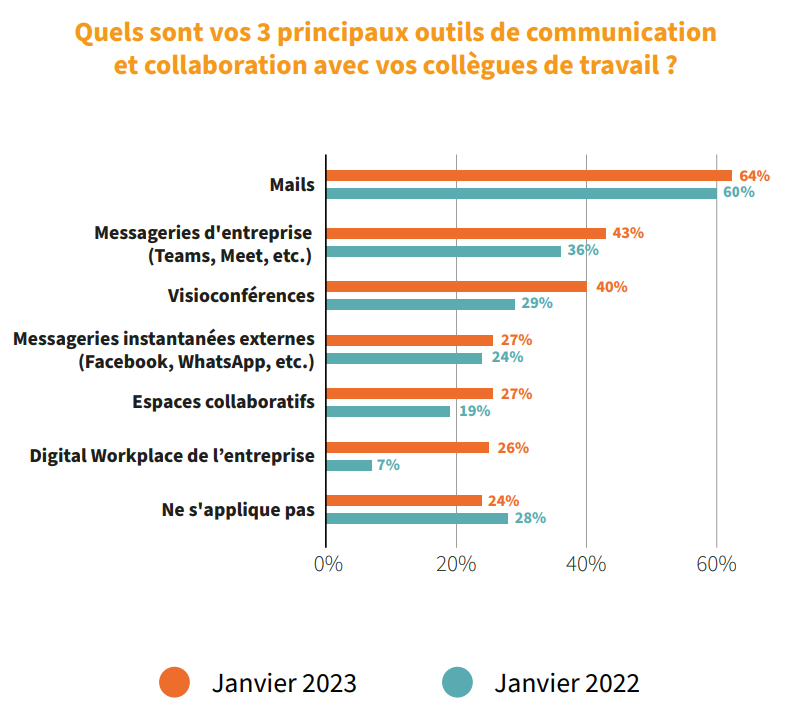
Source: State of the Art of Internal Transformation in Organisations, Lecko, 2023
This surge is driven by a growing need for organisations to rationalise their application stack, enabling:
- better data governance and control over associated costs,
- an optimal user experience,
- smoother collaboration,
- and greater organisational performance.
Key factors when choosing a digital workplace
The question then becomes: how do you choose the right digital workplace? For Philippe Pinault and Pierre Baudracco, four key factors must be weighed: independence, user experience, regulatory compliance and data confidentiality.

1. Independence
When selecting a digital workplace, the first question to ask is whether you can maintain independence and control over your data. This is precisely why opting for a sovereign solution is essential.
Indeed, relying on American platforms can expose organisations to significant risks for businesses. MongoDB users experienced this first-hand when the company announced in March 2023, following Russia’s invasion of Ukraine, that all data belonging to its Russian and Belarusian users stored on its platform would be destroyed.
“Investing in sovereign solutions also means preserving your freedom of choice. If we lose the capacity to build our own solutions, sovereignty will remain an illusion and we will stay dependent”, says Pierre Baudracco.
Read also: Why Choose a Secure Digital Workplace?
2. User experience
That investment in sovereignty and independence must not, however, come at the expense of user experience. Quite the opposite!
On average, an employee today uses 10 applications, 25 times a day¹. This creates a significant information overload that prevents people from focusing on high-value work.
To address this, your digital workplace must deliver the best possible user experience — one that combines a broad functional scope with best practices that are easy to adopt.
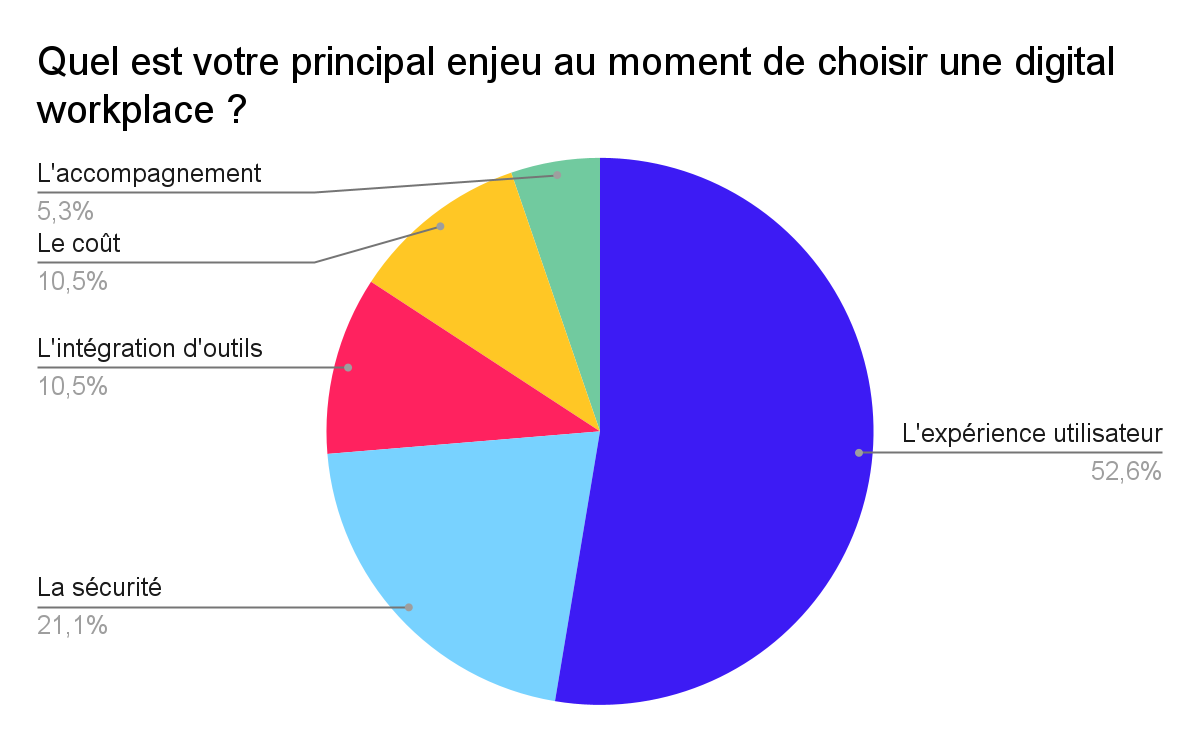
Webinar participants ranked delivering a great user experience as the most important criterion when choosing a digital workplace, ahead of security, tool integration, and cost.
This is precisely why Talkspirit brings together on a single platform all the features employees need to communicate and collaborate every day — on an intuitive, sovereign platform that is easy to use.
3. Regulatory compliance
Sovereignty and data security concerns are increasingly translating into regulatory requirements, in both the public and private sectors.
“In September 2021, DINUM issued a directive banning the use of Office 365 in French government ministries. The reason was straightforward: non-compliance with the GDPR.”
At the European level, two regulations are also aimed at curbing the dominance of US tech giants:
- the DMA (Digital Markets Act), which aims to restore fairer competition in digital markets,
- the DSA (Digital Services Act), which will regulate content shared on these platforms.
4. Data confidentiality
The final factor to consider is data confidentiality — a concern that has become especially pressing in the wake of high-profile scandals such as the Snowden Affair and Cambridge Analytica.
In 2008, an amendment to the FISA Act authorised US intelligence services to collect and monitor data at scale. In 2018, the CLOUD Act came into force, allowing the US government to access data stored on the servers of any American internet service provider on request, with no recourse for affected users.
By contrast, choosing a sovereign digital workplace means you are not subject to these extraterritorial laws — enabling you to guarantee the confidentiality of your data and that of your clients. This is one of the key reasons why the CEA (French Alternative Energies and Atomic Energy Commission) chose Talkspirit, a French collaborative solution that addresses both its sovereignty and user experience requirements.
A desire for sovereignty, but a fear of change
Building digital sovereignty requires all relevant stakeholders to get on board. According to an Ipsos survey for PlayFrance.Digital, 86 % of French people believe the government, the public sector and French companies should source at least half their software purchases from European vendors.
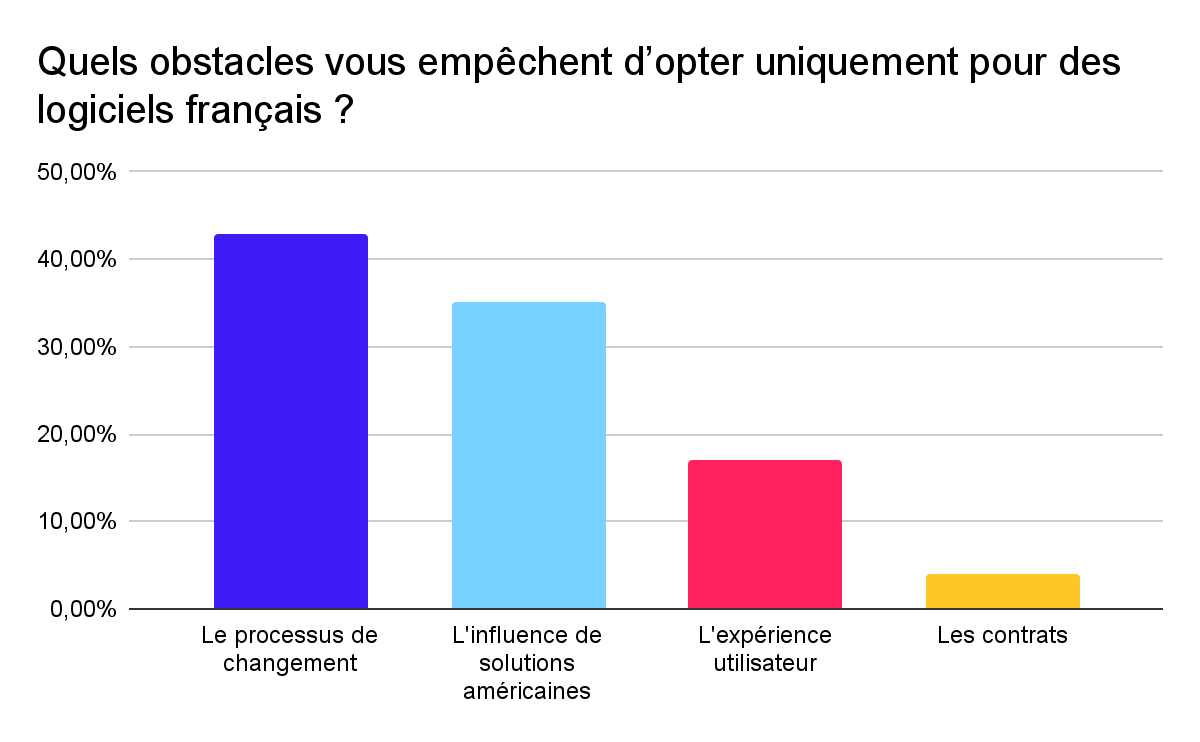
Despite this, many organisations still turn to American software. To understand why, we asked webinar participants what prevents them from choosing French solutions.
The change management process (43 %) and the pull of American solutions (35 %) were the most frequently cited barriers. This underscores the importance of strengthening the legal framework governing these tech giants, as well as managing change thoughtfully, for example by rolling out use cases one at a time, with the support of the software vendor.
A digital workplace that delivers both sovereignty and great UX
The best of Talkspirit and Bluemind
As we’ve seen: it is still very hard to do without email in business, especially for external communication. That is why we partnered with Bluemind to build a complete digital workplace that lets you address both your sovereignty and user experience requirements in one place.
This digital workplace will include all the features needed to communicate and collaborate, both internally and externally. With Bluemind email integrated into Talkspirit, our clients will be able to move seamlessly between internal and external use cases. For example, it will be possible to:
- turn an email into a chat conversation in Talkspirit,
- sync contacts and calendars between your email client and Talkspirit,
- create and store documents in Talkspirit and send them by email in one click.
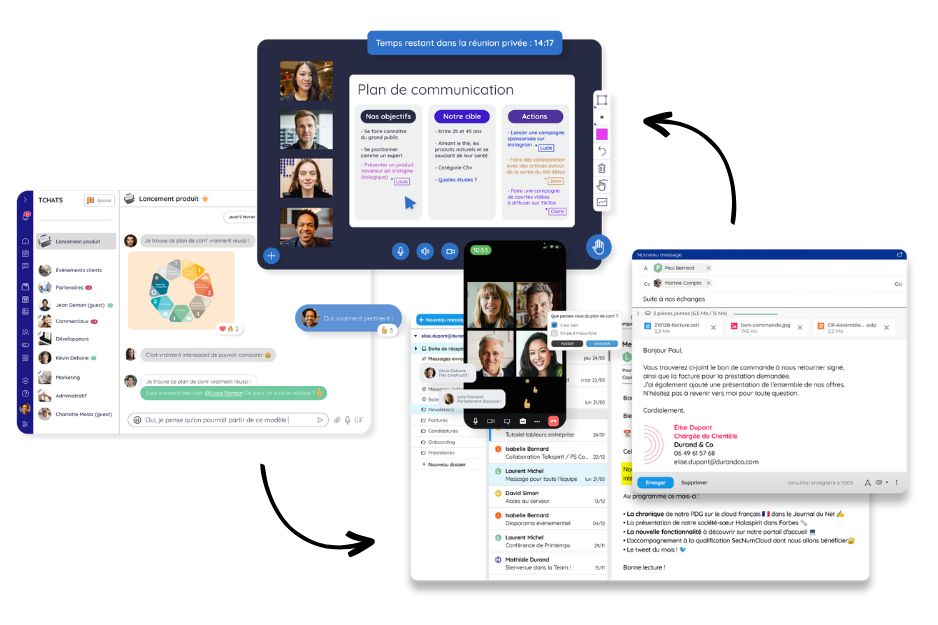
Thanks to our modular approach, clients can choose which modules to activate on their platform (for example, email, the news feed, chat and the welcome portal for internal communications and external). Our team can then support them in rolling out these features step by step, continuously evolving their usage over time.
Learn more about email integration in Talkspirit
What BlueMind offers
Email is (and remains) the most widely used tool in business. Contracts, documents, invoices, appointments… everything flows through it. And yet, even on such a business-critical tool, the user is king. People stick with the clients they’ve always known — typically those from dominant American platforms.
BlueMind, Europe’s leading collaborative email vendor, reconciles your need for sovereignty with the requirement to keep users happy. Battle-tested, open-source, and sovereign, BlueMind is the only solution compatible with every email client: native Outlook, best-in-class support for Thunderbird, webmail, Mac, mobile…
Preserve your employees’ existing habits without compromising on data sovereignty.
*
* *
You now have a clear picture of the factors to consider when choosing your digital workplace, along with existing alternatives that combine data sovereignty and a high-quality user experience. To explore this topic further, we invite you to watch the webinar replay and to get in touch with our team for more information.