.webp)
[Bodet Software Study 2022] What Levers Drive Post-Covid Employee Engagement?

.svg)
Increased digitalization, the widespread adoption of hybrid work, rising employee expectations around well-being… There is no doubt that the Covid-19 crisis has completely disrupted our ways of working. These are changes that organizations must adapt to quickly if they want to attract and retain more talent.
On the HR side, a new priority has emerged: improving employee engagement. A genuine strategic challenge, employee engagement plays a key role in company performance. And for good reason: according to Gallup, companies with highly engaged employees see their productivity and profitability rise by 18% and 23% respectively.
How has the health crisis reshaped employee engagement? And what levers can organizations activate to (re)motivate their employees in the post-Covid era? These are the questions addressed in the new study by Usine Nouvelle and Bodet Software.
Conducted in April 2022 among more than 1,000 employees and HR decision-makers, the study offers a dual perspective on employee engagement within organizations. Here is a summary of the key figures to keep in mind.

The Impact of Covid on Employee Engagement
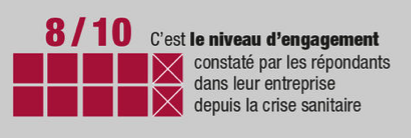
Contrary to what one might expect, the Covid crisis did not reduce employee engagement. Quite the opposite — survey respondents rate the level of engagement within their organization at approximately 8/10. That said, these results should be qualified for certain organizations.
Source: Usine Nouvelle
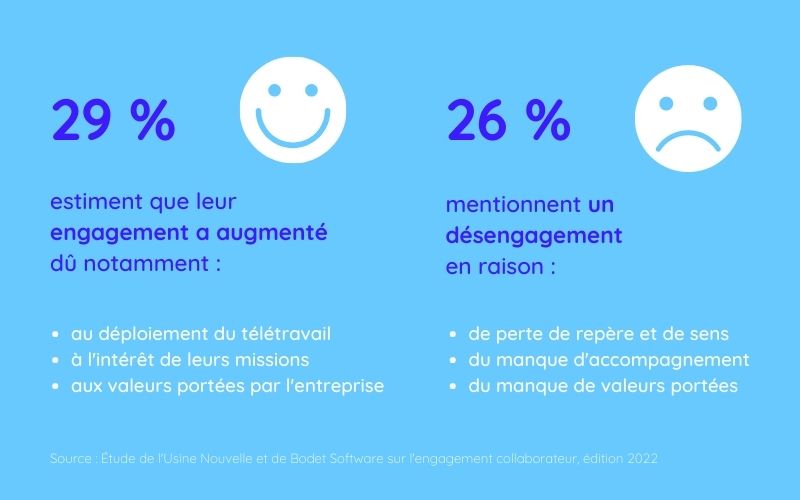
For more than a quarter of employees and HR decision-makers, engagement has clearly declined, for three main reasons:
- a loss of bearings and a lack of meaning in their work,
- a lack of support from managers, HR, or leadership,
- a lack of values embodied by the company.
Also contributing (though to a lesser extent): organizational disarray, the distance and isolation linked to remote work, shifting work rhythms, and increased workloads (which, according to 30% of CHROs, have risen since March 2020).
Conversely, 29% of respondents report being more engaged or having observed an increase in engagement within their organization since the crisis, notably thanks to the rollout of remote work.
The Main Post-Covid Engagement Levers
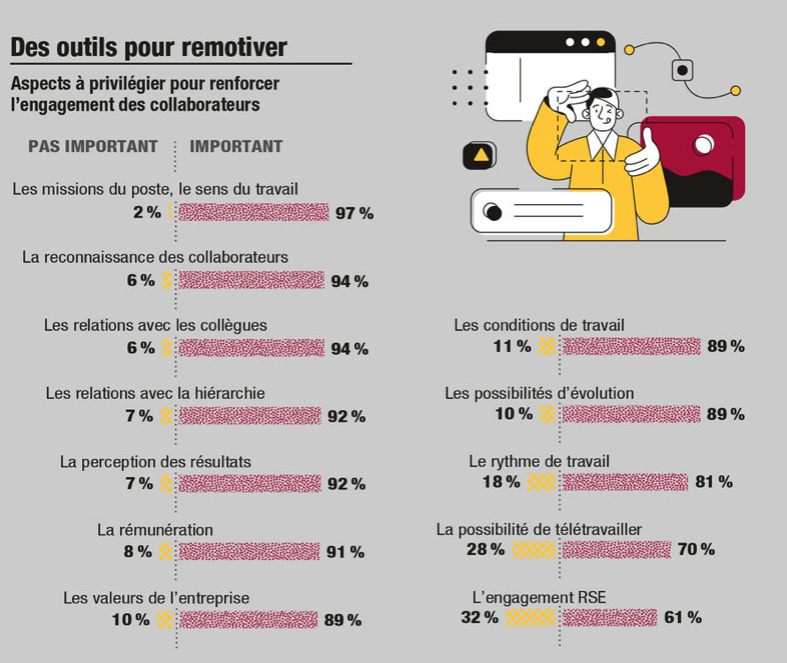
According to respondents, several key levers can help (re)engage employees in the post-Covid era. The most important is meaningful work, considered a critical factor by 97% of those surveyed. Respondents also consider it essential to act on the following:
- employee recognition and acknowledgment of their impact on company performance,
- relationships with management and colleagues,
- company values, vision, and CSR commitments,
- working conditions,
- compensation,
- career development opportunities within the company,
- remote work flexibility and work rhythm.
Source: Usine Nouvelle
Read also: Internal Communications: 7 Tips to Boost Employee Engagement
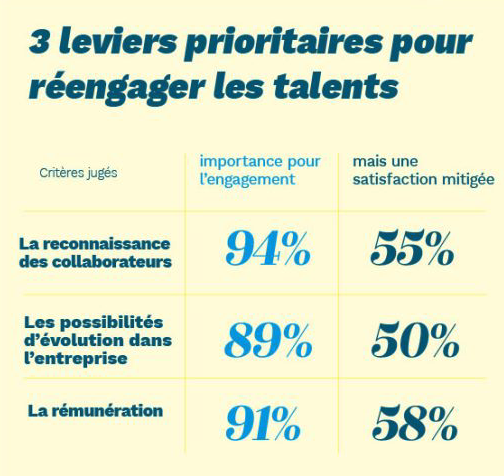
Some of these levers need to be prioritized over others. This is particularly true of career development opportunities, employee recognition, and compensation, with more than 40% of respondents reporting dissatisfaction in these areas.
To improve employee engagement, organizations should therefore:
- invest more in training,
- make career paths more visible,
- foster a feedback culture,
- better recognize employees' work and reward their performance (including through salary increases).
Source: Bodet Software
HR Tools to Drive Employee Engagement
Of course, carrying out these actions requires the right tools. According to the CHROs and employees surveyed, the most essential are:
- absence request tools,
- appraisal tracking tools,
- remote work request and tracking tools,
- skills management platforms,
- internal survey tools.
And not least: HR portals that make it easy to share internal company news.
These platforms can be an effective way to showcase your employees' achievements, simplify their day-to-day work, and strengthen their engagement.
Within this category, two types of solutions stand out: more administrative tools (for example, for leave management, skills tracking, etc.), and intranet-style tools (i.e., HR portals).
In this latter segment, Talkspirit offers an all-in-one solution that is perfectly suited to the communication and collaboration needs of HR teams. 100% made in France, the platform includes:
- a customizable welcome portal and a news feed to streamline information sharing with employees,
- a shared calendar that lets you see at a glance employee absences and remote work days,
- a survey module to gather employee feedback on specific topics,
- a project management module, to organize and track your recruitment and training projects,
- and much more!
Want to learn more about our platform? Schedule a demo with our team!
Conclusion
While the Covid crisis had little impact on overall employee engagement levels, the drivers of engagement have continued to evolve. To improve employee engagement, organizations must give employees greater recognition, offer more career development opportunities, and ensure they are fairly compensated.
Improving employee engagement also means providing a positive work experience for your employees. This is something Talkspirit takes very seriously. As proof, many of our clients use our platform to improve employee engagement and the quality of the work experience. Discover in this guide the initiatives they have implemented:
Access the Practical Guide
In our practical guide "10 best practices to improve the employee experience", you will find: tips to boost employee engagement and create a high-quality work experience, examples of initiatives implemented by our clients, and tools you can deploy within your organization.