Is Slack really worth it?

.svg)
Slack works like IRC chat rooms 2.0: persistent channels organized by topic, integrations with tools such as Github and Trello, searchable content and drag-and-drop file sharing. This post argues it breaks down as teams grow, because conversations are a reverse-chronological stream that ages out, the basic plan only searches the 10,000 most recent chats (about 20 days for a typical 10-person team), and nothing can be classified, organized or converted into a task. Its rule of thumb: great for 4 to 10 people, noisy at 10 to 50, and very difficult to manage above 50.
Slack is a cloud-based communication tool aiming to simplify collaboration within teams and organizations. The service, founded by Stewart Butterfield, was officially launched in February 2014 and literally blew up — valued at over $1billion in October 2014! Slack continues its rapid growth with more than 2 million daily active users. The company is based in San Francisco and has more than 250 employees.
If you haven’t been living under a rock, you’ve probably heard about Slack, maybe you’re even one their users. A lot of businesses are moving to Slack like web start-ups, and here is the reason why.
Some advantages of Slack
- Think of it like an IRC Chat Rooms 2.0 : keep Slack open all day like a group chat window — it’s very well optimized for that use case. You can create persistent chat rooms (channels) organized by topic, as well as private groups and direct messaging and discuss with your teammates all the day long.
- Slack integrates with a large number of third-party services teams are using everyday (like Github, Trello, …): this way, the team can be synchronized, notified in real time of what’s happening outside of Slack.
- All content inside Slack is searchable very easily, including files, conversations, and people.
- You can drag and drop files and TADA : your files are shared with your teammates. And of course, Slack integrates with services such as Dropox or Google Drive so that you can share documents hosted on these services.
- Slack can be with you all the time : it offers very good apps support — even desktop applications for both OS X and Windows.
Why this post ?
There are 1001 things to say about Slack, how it can streamline collaboration for instance or perhaps strengthen one’s business. However, this post isn’t about listing facts everyone already knows right?
So why exactly is Slack so popular for the time being? Has it something to do with being located in Silicon Valley – thus having access to the world’s best resources in terms of media, sponsors and VCs. Or perhaps it is related to the fact that Slack is being run by the founder of Flickr? Nonetheless, Slack somehow appears to get things right, after all, the numbers don’t lie!
By now it is safe to say that Slack is a very good tool that fits the needs of many teams – perhaps even yours. However, as time passes by, it appears that Slack is most certainly not a perfect fit for everyone.
Tarzan in the Jungle
Upon first sight, one would think that it’s very easy to follow and participate in a Slack conversation: you simply enter a channel, fill in your text in the input field, hit enter and you’re done!
But things are not always as they seem: In Slack, like any other chat app, conversations are a constant, reverse-chronological stream of messages – but what does that mean exactly? It means that teams chat with one another through the so-called ‘channels’ – each channel can be about ‘anything’ and has a different purpose.
Let’s assume you’re using slack whilst trying to keep up with 10 different channels at once. On the very moment you lose focus for even so much as half an hour, you may find yourself staring at hundreds of missed messages. Losing unnecessary valuable time checking every channel, finding out whether or not you actually missed something important – rather than the occasional cat gifs.
Now let’s assume you’re going to keep it basic, only joining that channels that are truly necessary. Even then, you will find yourself trapped between multiple conversations, with numerous people that are chatting simultaneously in the same or several channels all at once. Jumping from channel to channel, trying to keep up with the latest topics whilst not losing track of what’s really important. Trying to keep up with the manifold conversations in your manifold teams and channels almost requires a Skynet-like meta-presence.
In a nutshell: losing track of important documents and conversations among the thousands and thousands of sent messages, whilst trying to stay up-to-date whenever you occasionally went to the toilet, almost becomes inevitable. With Slack, you’re like Tarzan in the jungle, jumping from message to message in order to find your way…
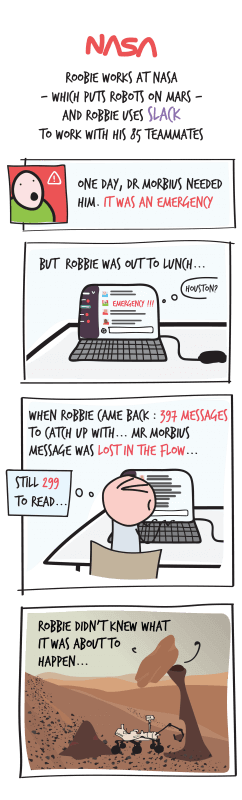
Losing track
‘Synchronous communication’ – quite a mouth full, but what does it mean exactly? For what it’s worth, Slack’s discussions are synchronous, meaning that there is a constant flow of messages, stacking upon each other every single day. Consequently, discussions are pretty much over as soon as they scroll of the page. Restarting a discussion that took place a few days ago will therefore become quite difficult – let alone discussions that happened a few months ago! And that’s a big deal, especially since keeping track of important messages, documents and conversations is key within ‘any’ organisation.
Let’s imagine an important discussion took place about a client in the business development channel. Presuming information is being shared pretty much every, finding this one discussion is like finding a needle in a haystack – although the haystack in this particular case is a deep stream of thousands of messages.
Additionally, the Slack’s basic plan allows its users to search up to 10.000 of the most recent chats – that’s for about 20 days for a typical 10-person team.
Is our team really more productive ?
“ We’re on a mission to make your working life simpler, more pleasant, and more productive”
Slack’s mission
Although do they? Does Slack really keep its promise? Clearly the main aim of using Slack is to make your team more productive right? However, has the overall productivity increased, or did you find yourself constantly trying to keep up with the latest gossip?
It so happens to be that Slack is often being compared to a water cooler – which seems quite odd at first. However, a water cooler is rather important; after all, it keeps everyone in the office hydrated. On the other end of the spectrum, the water cooler functions as a social beacon, where team-members can occasionally chat with one another about life, kids, weekend plans, anything basically. In a sense, this water cooler plays a key role when it comes to ‘team-collaboration’. And everyone – including myself – likes to go to the water cooler from time to time. But the main question at hand is whether you would like to work just next to that water cooler? I don’t think so!
Slack is asynchronish
This productivity problem is compounded by the fact Slack, or at least conversations on Slack are not really synchronous, neither asynchronous by the way: as I was saying, you cannot be available / online all the time. Neither your co-workers!
And even if a user is online, it becomes hard to keep up if there are too many conversations and you cannot respond immediately all the time.
I like the word used in a blog post: Slack is asynchronish, neither really synchronous, nor really asynchronous.
The main problem is that in a channel, you don’t know who is really keeping up with the conversation, and who’s not. And so, you send a message like in a bottle thrown into the sea: hoping for a response, you don’t know if it will come in a few seconds or a few hours… Don’t wait for too long… 😉
What Slack actually is
Last but not least, it is important to understand what Slack is and what it is not. Yes, Slack is a super effective instant messaging and collaboration system – an information inbox that serves as a notification tray for an entire team.
What Slack is not, however, is a communication that platform allows organization, overview and stimulates movement. Conversations do not generally lead to ‘action’ – meaning that if a message is not somehow written down, it will slowly drown in the circulation messages. Additionally, conversations cannot be classified, organized or be converted into tasks. At the end of the day, Slack is simply not a project management tool.
Mostly due to Slack’s recent popularity, people often tend to expect ‘more’ resulting in complaints and disappointments. It is therefore important to understand what Slack actually is, and how it can be used. Understand ‘how’ your organization works, and ‘what’ platform it needs to meet all expectations and desires.
To provide a somewhat broader idea, here are some general situations on when Slack should and shouldn’t be used:
- 4–10 people: Slack is great! Channels work more than fine, whilst the feedback loop closes faster to speed-up decision-making.
- 10–50 people: Here it is getting noisier! Rules have to be established to make slack work in order to not kill the productivity.
- Above 50 people: Slack will become very difficult to manage; therefore, using a more manageable communication platform is highly suggested – platforms such as Talkspirit are able to provide this.
Illustrations by Serge Rohani • UX designer @ talkspirit.com
Words by Jean Carriere • talkspirit.com
FAQ
You can create persistent chat rooms (channels) organized by topic, plus private groups and direct messaging. Slack also integrates with third-party services teams use every day, makes all content searchable, supports drag-and-drop file sharing, and offers desktop applications for both OS X and Windows.
In Slack, conversations are a constant, reverse-chronological stream of messages spread across channels. Lose focus for as little as half an hour and you can find yourself staring at hundreds of missed messages, jumping from channel to channel to work out what actually mattered.
The basic plan allows users to search up to 10,000 of the most recent chats, which the article estimates at about 20 days for a typical 10-person team. Anything older is like finding a needle in a haystack.
It means Slack is neither really synchronous nor really asynchronous. You cannot be online all the time and neither can your co-workers, and inside a channel you never know who is actually keeping up, so a reply may come in a few seconds or a few hours.
No. Conversations on Slack cannot be classified, organized or converted into tasks, and if a message is not written down somewhere it drowns in the circulation of messages. The article states plainly that Slack is simply not a project management tool.
The article gives three brackets: 4 to 10 people, where channels work more than fine; 10 to 50 people, where rules have to be established so the noise does not kill productivity; and above 50 people, where Slack becomes very difficult to manage and a more manageable platform is suggested.