
4 best practices to develop collective intelligence in your company

.svg)
- Collective intelligence is a team's combined intelligence: what a group understands and produces together, beyond what any member would have produced alone.
- A 2010 study published in Science, covering 699 people, identifies a "c factor" that explains a group's performance across a wide variety of tasks.
- That c factor is not correlated with members' individual intelligence, but with their social sensitivity, the equality of conversational turn-taking, and the proportion of women in the group.
- Four practices develop it: foster the right kind of collaboration, give people time to work alone, create psychological safety, and invest in the right tools.
- The stake is measurable: Gallup puts the median gap between engaged and disengaged teams at 14% higher productivity and 78% less absenteeism.
Collective intelligence is a team's combined intelligence: what a group understands and produces together, beyond what any of its members would have produced alone.
Investing the time to develop collective intelligence in your organisation pays off in measurable ways: better productivity, more creativity, and a more efficient use of resources.
That leaves the practical question: how do you actually develop it? Four practices are enough, and research is fairly precise about which ones.
What is collective intelligence, and why develop it in your company?
This shared intelligence builds up when groups of people work together, each contributing their own thoughts, ideas and experience to the collective. Over time, the knowledge of the group reaches a level no individual would have reached on their own.
What the research shows
In 2010, a team from MIT, Carnegie Mellon and Union College published, in Science, the study that became the reference on the subject. Across two experiments with 699 people working in groups of two to five, the researchers found evidence of a general collective intelligence factor, the "c factor", that explains a group's performance across a wide variety of tasks.
The counter-intuitive finding fits in one sentence: that c factor is not strongly correlated with the average individual intelligence of group members, nor with the intelligence of the brightest one. It correlates with three things: the average social sensitivity of the members, the equality in the distribution of conversational turn-taking, and the proportion of women in the group.
In other words, you do not build a smart team by hiring the smartest individuals. You build it by working on how its members listen to one another and share the floor. The four practices below aim at exactly that.
The main benefits to expect:
- Better critical thinking and problem solving. Everyone's mind works differently, so when a team solves a problem together, each person is exposed to other ways of thinking and processing information. That exposure builds a deeper understanding of the problem among all contributors, and deeper understanding produces better solutions.
- More creativity and innovation. On a new project, each person brings their own ideas, and the group builds on them: it moves forward with the strongest, or combines several into something entirely new. The result is more original ideas, and more of them.
- Higher employee engagement. Developing collective intelligence means giving every employee a voice. Everyone gets to contribute and have those contributions heard, considered and valued. And when people feel what they bring is recognised, they invest more in their work. (Gallup puts the median gap between engaged and disengaged teams at 14% higher productivity, 23% higher profitability and 78% less absenteeism.)
1. Foster the right kind of collaboration
To develop collective intelligence, people need to work as a collective. But not every team that works collaboratively develops collective intelligence: you have to be purposeful about fostering the right kind of team collaboration. Two levers matter most.
Build diverse teams
Part of the power of collective intelligence is bringing together people with different thinking and problem-solving styles, so they can learn from each other. If you want collective intelligence in your company, build teams with different backgrounds, professional experience and ways of approaching work. (As a bonus, diverse teams perform better overall. According to research from Boston Consulting Group, companies with the most diverse leadership teams draw a noticeably larger share of their revenue from innovation.)
Leverage emotional intelligence
People with high emotional intelligence (also known as EQ) can identify and manage their own emotions while understanding and empathising with those of others. That is precisely the "social sensitivity" the Science study puts at the top of the factors correlated with a group's performance.
Why does it matter? Because emotionally intelligent people know how to work as a collective. They share their own ideas while creating space for the ideas of others. They actively listen. They are less likely to get reactive when the group moves forward with someone else's plan. You can hire for it, and you can also build it: see our 7 best practices for leveraging emotional intelligence as a leader.
2. Give team members time and space to work on their own
To develop collective intelligence, people need to work together, but they also need time and space to develop their own ideas. For many, having time to think and process information independently is what produces the more creative, original ideas they then bring back to the collective.
It is also a question of equal speaking time, the second factor identified by the Science study. Some employees struggle to contribute in high-pressure settings. (Introverts, for instance, may not feel comfortable speaking up during remote meetings.) Adapt the setting to different communication styles: an anonymous whiteboard where everyone drops their ideas, a written collection round before the meeting rather than an improvised tour de table, an explicit decision-making method that guarantees every view is asked for. Everyone then contributes, each in the way that works for them.
3. Create a sense of psychological safety
Every person on the team needs to feel comfortable enough to share ideas, to disagree, and to solve problems with the others. Effective collaboration only happens when employees feel safe with their colleagues, their managers and the organisation as a whole. Creating a sense of psychological safety is therefore not optional.
It takes time, but leaders can work at it deliberately and build a welcoming company culture, the kind of environment that lets collective intelligence grow. A few ways to get there:
- Be open to feedback. Ask your employees for feedback, and ask regularly: monthly one-on-ones, a quarterly survey, a twice-a-year sit-down with your leadership team. Give people the chance to voice concerns, make suggestions and say what they would like to see change. (And do not forget to ask what is going well.)
- Listen, then act. Asking for feedback is one thing. For it to carry weight, you need to listen properly and then do something. Show attention by asking questions and repeating back what you understood, then, and this is the decisive part, act on what you heard whenever you can. Feedback that is requested and then dropped costs more than no feedback at all.
- Model authenticity and empathy. A healthy culture starts at the top. If you want a psychologically safe workplace, leaders need to model the behaviour: transparency, empathy in the way they communicate, zero tolerance for bullying or intimidation.
- Make mistakes acceptable. Part of psychological safety is being safe to get it wrong. Encourage risk-taking, including when it does not pay off. And when you make a mistake yourself, name it, fix it openly, and move on. That is the most convincing proof that mistakes are allowed.
4. Invest in the right tools
Strategy alone is not enough: you also need the technology that carries it. Without a shared space, ideas stay in people's heads and inboxes, and the three practices above have nowhere to land.
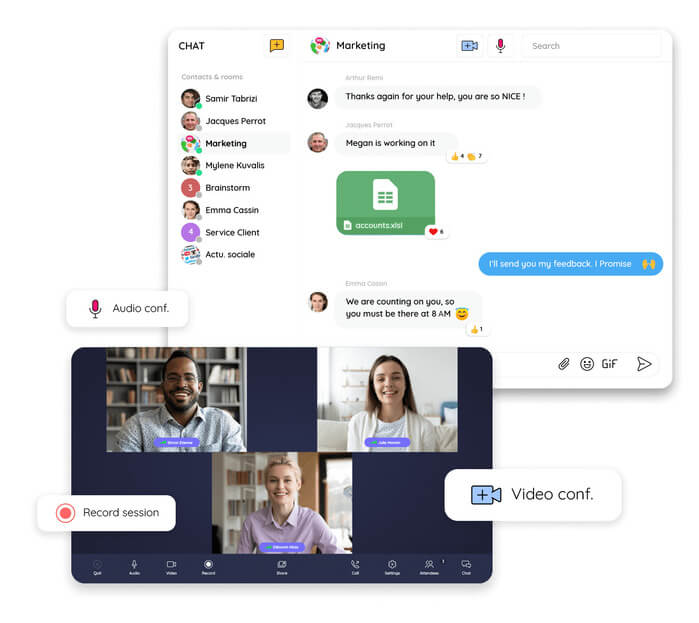
Talkspirit is an organisational operating system that brings together what you need to develop collective intelligence:
- a chat and video conferencing module for day-to-day exchanges,
- polls to collect everyone's view, including from the people who do not speak up in meetings,
- a meetings module that structures the agenda and keeps a record of decisions,
- a project management tool to organise the work,
- a news feed to push relevant information across the organisation.
To see what this looks like in a real organisation, read how Anne Chabert and her team work with collective intelligence at idehō, in Canada.
The four practices at a glance
| Practice | What it changes day to day | What blocks it |
|---|---|---|
| PracticeFoster the right kind of collaboration | What it changes day to dayDifferent profiles and ways of reasoning meet, instead of echoing each other | What blocks itHomogeneous teams, hired on the same background and the same profile |
| PracticeGive people time to work alone | What it changes day to dayEveryone walks into the meeting with a formed idea, and speaking time spreads more evenly | What blocks itA meeting-only culture, where only the confident speakers contribute |
| PracticeCreate psychological safety | What it changes day to dayDisagreements and mistakes get voiced, so they get fixed early | What blocks itManagement that punishes mistakes or ignores the feedback it asked for |
| PracticeInvest in the right tools | What it changes day to dayIdeas, decisions and documents stay accessible to everyone, in one place | What blocks itConversations scattered across inboxes, private threads and local files |
With Talkspirit, you can empower your teams to do their best work, and to do it together, developing the collective intelligence that takes your organisation to the next level.
Ready to see how Talkspirit can help you develop collective intelligence in your organisation? Book a demo, or talk it through with one of our experts.
FAQ
A team's combined intelligence. It emerges when people contribute their individual thoughts, ideas and experience to the collective, until the knowledge of the group surpasses what any individual on the team could produce alone.
A 2010 study published in Science by researchers from MIT, Carnegie Mellon and Union College, across two experiments with 699 people working in groups of two to five, found evidence of a general collective intelligence factor, the "c factor". It is not strongly correlated with the average individual intelligence of group members, but with their social sensitivity, the equality in the distribution of conversational turn-taking, and the proportion of women in the group. (See the study.)
Better critical thinking and problem solving, more creativity and innovation, and higher employee engagement. Gallup puts the median gap between engaged and disengaged teams at 14% higher productivity, 23% higher profitability and 78% less absenteeism.
Because the power of collective intelligence comes from bringing together people with different thinking and problem-solving styles. Varied backgrounds, professional experience and ways of working widen the range of solutions considered, where a homogeneous team keeps circling the same reflexes.
No. People also need time to think and process information independently before sharing with the collective. Some employees struggle to speak up under pressure: an anonymous whiteboard, a written collection round before the meeting, or an explicit decision-making method lets everyone contribute without having to take the floor.
Ask for feedback regularly, through monthly one-on-ones or quarterly surveys; listen properly and then act on what you hear; model authenticity and empathy at leadership level; and build a culture in which mistakes are acceptable and risk-taking is encouraged.


Explore similar articles

Collective Intelligence at Work with Anne Chabert, idehō, Canada
In this interview, Anne Chabert, co-founder of idehō, shares her vision of a transformation grounded in organisational clarity, trust and shared accountability. She explains how clarity — far from being rigid — allows teams to find their bearings, collaborate meaningfully and strengthen their collective intelligence.