
How to Implement Agile Decision-Making in Your Team

.svg)
- Agile decision-making is collaborative, iterative and transparent: the team decides, then adapts as real feedback arrives, instead of waiting weeks for a hierarchy to sign off.
- Five steps to implement it: define clear goals, choose a decision-making process, use data-driven approaches, keep short feedback loops, and prioritize flexibility.
- The prerequisite is cultural, not procedural: open communication and psychological safety, which are not a given when only 42% of managers feel psychologically safe.
- Reversibility sets the speed: a decision you can walk back goes fast and gets corrected at the next review, while one that is expensive to undo earns a slower, more formal path.
- 72% of business leaders say the volume of data, and their lack of trust in it, has stopped them making decisions at times.
- Start with small, low-risk decisions: the quick wins build the confidence needed to hand over the bigger ones.
Agile decision-making is a collaborative, iterative, and transparent way to make decisions within your organization or team.
It supports data-driven decisions and continuous learning, and helps to decentralize decision-making, empowering individuals and teams, and improving your team’s agility and responsiveness.
As you might expect, agile decision-making is particularly popular with teams that are using the Agile approach to project management (particularly software development companies). But any team can use aspects of agile decision-making, even if they’re not fully implementing the Agile methodology.
In this guide, we’ll take a look at how agile decision-making differs from traditional decision-making, why a more agile approach is best for teams, and how to implement it within your team (even if you think there will be barriers to change), using the best tools.
Let’s dig in.
Agile Decision-Making vs Traditional Decision-Making
The traditional approach to decision-making in many companies revolves around hierarchies, with people at the top at least having to sign off on a decision … and potentially blocking it altogether. Decisions don’t happen quickly, either: it can potentially take weeks or months to get even a relatively small decision approved. Plus, decisions can be stressful, with 72% of business leaders saying that the volume of data (and their lack of trust in data) has stopped them making decisions at times.
With an agile approach, decision-making is in the hands of teams themselves. There’s a focus on collaborating to come to an agreement, and on adjusting based on real-world feedback. Instead of going through a lengthy analysis process, agile decision-making focuses on making decisions effectively, then adapting quickly as needed.
Why Is Agile Decision-Making the Best Approach for Most Teams?
While in some contexts, a methodical and analytical approach to decision-making may work (despite the time costs), an agile approach makes the most sense for many teams.
Agile decision-making:
- Empowers team members, giving them more of a say.
- Connects the decision with the people who it affects.
- Allows for flexibility, with decisions being easily revisited as needed.
- Avoids opaque decisions that team members aren’t on board with.
- Reduces bureaucracy and helps keep costs low.
- Makes for a more high-performing team overall.
As Grant Aldrich, Founder of Preppy, explains, “If you’re trying to deliver a great service at a low price, you can’t afford to waste time dithering over every decision. Instead, you want to empower your employees to make decisions quickly and collaboratively, that way, they can keep everything moving forward.”
Preparing Your Team for Agile Decision-Making
Before you announce a new approach to decision-making on your team, you want to pave the way for it. You might need to do some work ahead of time to make sure everyone’s receptive.
A good starting point is to think about your existing team culture. Ask yourself questions like:
- Do people feel able to communicate openly with one another?
- Is there a good sense of collaboration and cohesion on your team?
- Are team members willing to speak up if they feel a process could be improved?
- How comfortable is your team with change? (Keep in mind that 71% of employees may feel overwhelmed by the amount of change at work.)
If you feel your team may be resistant to adopting agile decision-making, it might be a sign that you need to address the team culture. That could mean deliberately supporting more open and collaborative ways of working, or creating opportunities for team members to speak up, without fear of negative consequences. (For more on this, take a look at our article on psychological safety at work, and remember that this can affect managers too, with only 42% of managers feeling psychologically safe.)
Tom Golubovich, Head of Marketing & Media Relations at Ninja Transfers, says, “Even if you’re a fantastic boss, some people on your team will have come from workplaces where they were expected to just fall in line, not speak out. You might need to spend time encouraging team members to have their say, and reassuring them that you want to hear their opinions.”
Five Steps to Implement Agile Decision-Making
Think your team is ready to adopt an agile approach to decisions? Here’s how to implement agile decision-making within your team.
Step 1. Define Clear Goals and Objectives Before Asking for a Decision
It’s going to be very hard for your employees to make an informed decision if they don’t know what they’re aiming to achieve.
Hopefully, you’re already in the practice of sharing clear goals so that each member of your team is working towards the same objective. But if there’s any uncertainty, or if team members feel more like a “cog in the machine”, knowing only a small part of the goal, make sure you’re upfront about what you’re aiming to achieve.
It’s also vital to be clear about who’s in overall charge of achieving a goal (and what role they have in the decision-making process) … as well as who has specific responsibility for different steps along the way.
Tip: Using the OKR (Objective and Key Result) framework is a fantastic way to define clear goals and objectives at the organizational and team level, so that everyone has complete clarity on what’s expected of them.
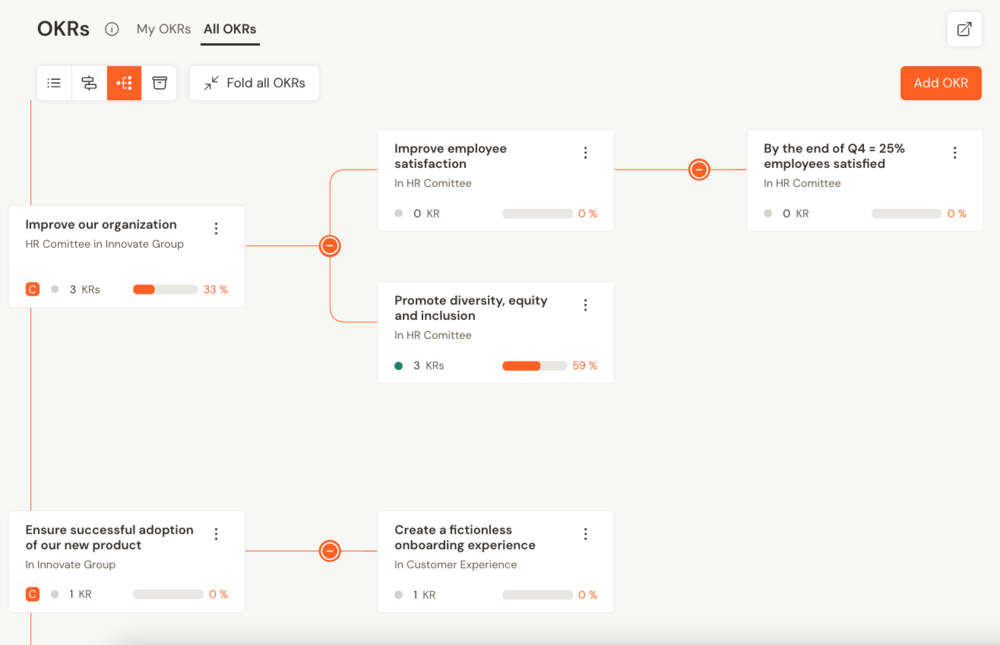
Michael Nemeroff, Co-founder & CEO at RushOrderTees, says, “You can’t get the best from people if they don’t know what they’re supposed to be aiming for. Be clear and transparent about your goals. Not only will it help your team members step up, it sets a great example of the kind of communication you want to see within the team.”
Step 2. Choose the Right Decision-Making Process
In Agile, there’s no single rule for how teams should make decisions. Instead, teams are encouraged to adopt a decision-making process that fits their context and working style. Here are a few commonly used approaches:
- Cynefin Framework: A domain-based model that helps categorize decisions as complex, complicated, chaotic, clear, or confused, guiding teams toward the right approach based on the nature of the situation.
- SWOT analysis: A classic strategic tool used to assess Strengths, Weaknesses, Opportunities, and Threats before making a decision.
- Decider protocol: An iterative decision-making process where team members vote (yes, no, maybe) on a proposal and refine it together until they reach unanimous consensus.
- Fist of five: A quick and informal voting method where participants show a number of fingers (five = strong agreement, one = strong disagreement) to gauge support.
- Forced ranking: A prioritization method where a list of up to 10 items is ranked by assigning each a unique value based on importance.
- Integrative Decision-Making : A structured process used in Holacracy and other self-management frameworks. It involves surfacing objections to a proposal, integrating those objections into improvements, and moving forward once all valid concerns are addressed.
Some decision-making models also include clearly defined roles. For example, one team member may act as the “proposer,” presenting a solution or decision on a specific issue. The rest of the team can then vote and provide input until either consent (no one is actively opposed) or consensus (everyone agrees) is reached.
To make the process even smoother, you can use a tool like Talkspirit to run decisions synchronously, during a meeting, or asynchronously, by enabling team members to vote or comment on proposals at different times.
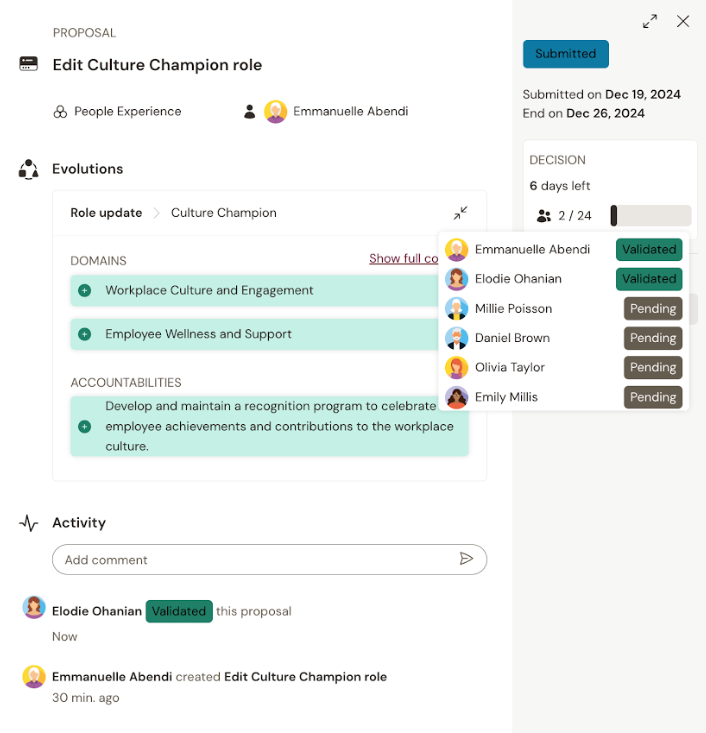
Another option is to assign a rotating decision-maker, someone responsible for leading the process and making the final call, with the role changing each time a new decision is needed.
Step 3. Use Data-Driven Approaches to Decision-Making
While it might be fast to make decisions by rolling dice or drawing straws, those methods aren’t likely to result in the best business outcomes. The same goes for letting people pick based on hunches.
Instead, you want your team to use data-driven approaches to making decisions. For instance, if the decision is about whether or not to add a new software feature, relevant data will include things like:
- What percentage of users say they’d like this feature?
- How much would it cost to implement this feature (both upfront and ongoing costs)?
- Is there a different new feature that’s more popular and/or cheaper?
Adrian Iorga, Founder & President at 617 Boston Movers, points out, “While you don’t want people to hold back on their ideas because of the potential cost, at some point, you need everyone to be realistic about the financial implications of a decision. Something that’s ‘nice to have’ may simply not be affordable, especially if there’s a different option that’s downright essential.”
Step 4. Have Short Feedback Loops and Use Software Tools to Assist
The whole point of Agile is to move quickly and to iterate upon your work. You don’t want your team to make a decision and treat it as something set in stone. Instead, it’s important to regularly review decisions, making sure that it still makes sense as new data emerge.
With a very time-sensitive decision, you may need to review data on a daily basis, or even more frequently. (Think product launches and promotions, for instance, where you might need to change tack partway through a week of planned promos.)
In most cases, however, a weekly review is sufficient. This allows teams to reflect on any new insights that might require an adjustment.
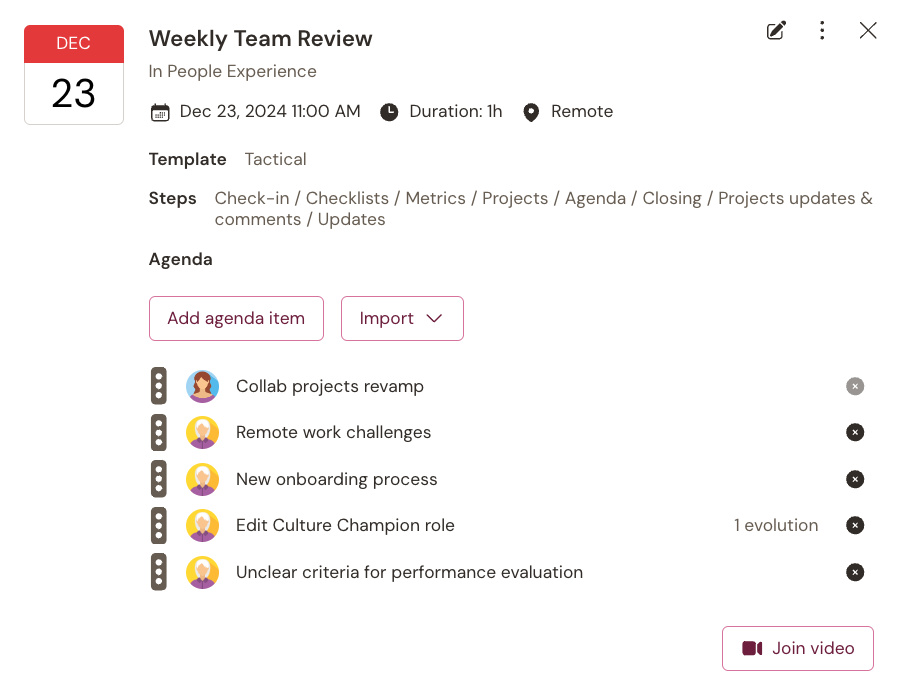
Conrad Wang, Managing Director at EnableU, suggests, “You probably already have a weekly team meeting that’s on everyone’s calendars. This is a great place to review decisions and check that they’re still working as planned.”
Also read: The Best Collaborative Decision-Making Tools
Make sure you have good processes in place for feedback, and use software like Talkspirit to support them. This makes it fast and easy to schedule regular reviews and make sure everyone’s voice is heard.

Step 5. Prioritize Flexibility and Adaptability
To begin with, you may find that team members are anxious about making the “right” decision. While you of course want decisions to be data-backed, what’s even more important is that your team is willing to be flexible and adapt if the decision needs to be adjusted.
You don’t want team members to feel so attached to the original decision that they defend it even if new data suggests it wasn’t quite the right approach.
Peter Čuček, Owner at Tuuli says, “None of us can predict the future. You want to encourage team members to make the best decisions they can with what they can currently know … while being open to changing those decisions at any time, as needed.”
Make sure that you and your team are prepared for unexpected challenges to come up, too. Perhaps the decision itself was solid, but a sudden shift in the marketplace (like a new competitor arriving on the scene) means that you now need to revisit the decision.
Also read: [Expert Opinion] How to Build Resilience in the Workplace?
Which Decisions Can Move Fast, and Which Cannot
Agile decision-making is often read as "decide faster". A more useful reading is "decide at the speed the decision deserves". The filter that does most of the work here is reversibility: can you walk the decision back, and at what cost?
A reversible decision can be made quickly, by whoever is closest to the work, and corrected at the next review. A decision that is expensive to undo earns the slower path: more people around the table, more data, and a process that surfaces objections before the decision ships, such as integrative decision-making. Applying the same ceremony to both is how teams end up slow on the small decisions and rushed on the big ones.
The second filter is timing. Deciding at the last responsible moment, that is, just before the options start closing, keeps a team from locking in the least informed version of a decision. It is not a licence to postpone: once an option has disappeared, the moment has passed.
| Type of decision | Reversible? | Who decides | Review cadence |
|---|---|---|---|
| Type of decisionDay-to-day adjustment (task order, meeting format, wording of a message) | Reversible?Yes, at no cost | Who decidesThe person or team doing the work | Review cadenceAt the weekly review |
| Type of decisionChoice of a tool or a method for one team | Reversible?Yes, at the cost of switching back | Who decidesThe team, with one named decider | Review cadenceAfter a trial cycle, then quarterly |
| Type of decisionCommitment made outside the team (deadline, price, announced scope) | Reversible?Hard to undo | Who decidesThe team, together with the role that owns the relationship | Review cadenceBefore each new commitment |
| Type of decisionStructural decision (hiring, architecture, stopping a product) | Reversible?No, or at a high cost | Who decidesA formal process that surfaces objections and integrates them | Review cadencePost-mortem, not a quick reversal |
| Type of decisionCall made during an incident | Reversible?Reversible once the incident is closed | Who decidesOne person mandated on the spot | Review cadenceSystematically, as soon as the incident closes |
Sorting decisions this way has a side effect worth naming: it stops every decision from converging on the same two or three people, which is where decision fatigue comes from.
Start Implementing Agile Decision-Making Today
Start with small decisions so that your team can experience quick wins, without much risk. Once confidence builds, you can move on to larger, more complex decisions.
Jerry Han, CMO at PrizeRebel, explains, “If you’re the person who’s been calling the shots in the past, start handing over any decisions you can. Begin with the small stuff, then scale up to bigger, more complex decisions. You might just be surprised by what your team comes up with.”
If you’re facing resistance from your team, then starting small is also a great way to reassure them. It shows that no single decision will make or break everything, and gives them the space to learn and grow.
Agile decision-making can dramatically speed up your team’s workflow, reduce your own decision-making burden, and cut your workload in the process. It empowers teams to act autonomously, adapt quickly, and revisit decisions when needed.
Still unsure how to introduce this shift in your team?
👉 Download our white paper, "How to Successfully Lead Change in an Organization," to get actionable strategies on managing resistance, building engagement, and making new ways of working stick. Whether you want to implement agile decision-making or drive a broader transformation, this guide will help you lead with clarity and confidence.
Access the White Paper
In our white paper “How to Successfully Lead Change in an Organization?”, you’ll discover:
- The challenges of managing change in the workplace
- Examples of models and strategies to overcome these challenges
- Best practices for effectively leading change in your organization
- Case studies highlighting how 7 companies successfully implemented change

FAQ
It is a collaborative, iterative, and transparent way to make decisions within your organization or team. It supports data-driven decisions and continuous learning, and helps decentralize decision-making, empowering individuals and teams and improving responsiveness.
Traditional decision-making revolves around hierarchies, with people at the top having to sign off on a decision and potentially blocking it altogether; it can potentially take weeks or months to get even a relatively small decision approved. With an agile approach, decision-making is in the hands of the teams themselves, who decide effectively and then adapt quickly as needed.
Teams commonly use six: the Cynefin framework, SWOT analysis, the decider protocol where members vote yes, no or maybe until unanimous consensus, fist of five, forced ranking of a list of up to 10 items, and Integrative Decision-Making, a structured process used in Holacracy and other self-management frameworks.
With a very time-sensitive decision, such as a product launch or a promotion, you may need to review data on a daily basis or even more frequently. In most cases a weekly review is sufficient, which lets teams reflect on any new insights that might require an adjustment.
Start with small decisions so the team can experience quick wins without much risk, then move on to larger, more complex ones. Resistance may also signal a culture issue: 71% of employees may feel overwhelmed by the amount of change at work, and only 42% of managers feel psychologically safe.
Share clear goals so each member of the team is working towards the same objective, and be explicit about who's in overall charge of achieving a goal and who has responsibility for the different steps. Using the OKR framework is recommended to define clear goals at both organizational and team level.



.webp)