
4 bonnes pratiques pour développer l'intelligence collective en entreprise

.svg)
- L'intelligence collective, c'est l'intelligence combinée d'une équipe : ce que le groupe comprend et produit ensemble, au-delà de ce que chacun aurait produit seul.
- Une étude publiée dans Science en 2010, sur 699 personnes, identifie un « facteur c » qui explique la performance d'un groupe sur des tâches variées.
- Ce facteur c n'est pas corrélé à l'intelligence individuelle des membres, mais à leur sensibilité sociale, à l'égalité des tours de parole et à la proportion de femmes dans le groupe.
- Quatre pratiques la développent : favoriser le bon type de collaboration, laisser du temps au travail individuel, créer la sécurité psychologique, investir dans les bons outils.
- L'enjeu est mesurable : Gallup chiffre l'écart médian entre équipes engagées et désengagées à 14 % de productivité en plus et 78 % d'absentéisme en moins.
L'intelligence collective, c'est l'intelligence combinée d'une équipe : ce que le groupe comprend et produit ensemble, et qui dépasse ce que chacun de ses membres aurait produit seul.
Investir du temps pour développer l'intelligence collective dans votre organisation génère des bénéfices mesurables : une meilleure productivité, plus de créativité, un usage plus efficace des ressources.
Reste la question pratique : comment la développe-t-on, concrètement ? Quatre pratiques y suffisent, et la recherche dit assez précisément lesquelles.
Qu'est-ce que l'intelligence collective, et pourquoi la développer en entreprise ?
Cette intelligence partagée se construit quand un groupe travaille ensemble, chacun apportant ses réflexions, ses idées et son expérience au collectif. Avec le temps, la connaissance du groupe atteint un niveau que personne n'aurait atteint isolément.
Ce que dit la recherche
En 2010, une équipe du MIT, de Carnegie Mellon et d'Union College publie dans Science l'étude devenue la référence sur le sujet. Sur deux expériences réunissant 699 personnes réparties en groupes de deux à cinq, les chercheurs mettent en évidence un facteur général d'intelligence collective, le « facteur c », qui explique la performance d'un groupe sur des tâches très différentes les unes des autres.
Le résultat contre-intuitif tient en une phrase : ce facteur c n'est pas fortement corrélé à l'intelligence individuelle moyenne des membres du groupe, ni à celle du plus brillant d'entre eux. Il est corrélé à trois choses : la sensibilité sociale moyenne des membres, l'égalité dans la distribution des tours de parole, et la proportion de femmes dans le groupe.
Autrement dit, on ne fabrique pas une équipe intelligente en recrutant les individus les plus intelligents. On la fabrique en travaillant la façon dont ses membres s'écoutent et se répartissent la parole. Les quatre pratiques qui suivent visent exactement cela.
Parmi les principaux bénéfices attendus :
- Une meilleure pensée critique et une meilleure résolution de problèmes. Chaque cerveau fonctionne différemment. Quand une équipe résout un problème ensemble, chacun est exposé à d'autres manières de penser et de traiter l'information. Cette exposition produit une compréhension plus profonde du problème chez tous les contributeurs, et une compréhension plus profonde produit de meilleures solutions.
- Plus de créativité et d'innovation. Sur un nouveau projet, chacun apporte ses idées, puis le groupe les fait grandir : il retient la plus solide, ou combine plusieurs pistes pour en tirer une idée entièrement neuve. Le résultat, ce sont des idées plus originales, et davantage d'idées.
- Un engagement plus fort. Développer l'intelligence collective, c'est donner une voix à chaque collaborateur. Chacun peut contribuer et voir sa contribution entendue, examinée, prise en compte. Or, quand un salarié sent que ce qu'il apporte est reconnu, il s'investit davantage. (Gallup chiffre l'écart médian entre équipes engagées et équipes désengagées à 14 % de productivité en plus, 23 % de rentabilité en plus et 78 % d'absentéisme en moins.)
1. Favoriser le bon type de collaboration
Pour développer l'intelligence collective, il faut travailler en collectif. Mais toute équipe qui collabore ne produit pas pour autant de l'intelligence collective : il faut cultiver délibérément le bon type de collaboration d'équipe. Deux leviers, en particulier.
Constituer des équipes diversifiées
Une part de la puissance de l'intelligence collective vient du fait de réunir des personnes qui pensent et résolvent les problèmes différemment, pour qu'elles apprennent les unes des autres. Si vous voulez développer l'intelligence collective, composez donc des équipes aux parcours, aux expériences professionnelles et aux façons de travailler variés. (Bénéfice secondaire : les équipes diversifiées performent mieux. Selon une étude du Boston Consulting Group, les entreprises dont l'équipe dirigeante est la plus diversifiée tirent une part sensiblement plus grande de leur chiffre d'affaires de l'innovation.)
Miser sur l'intelligence émotionnelle
Les personnes dotées d'une forte intelligence émotionnelle savent identifier et réguler leurs propres émotions, tout en comprenant celles des autres. C'est très exactement la « sensibilité sociale » que l'étude de Science place en tête des facteurs corrélés à la performance d'un groupe.
Pourquoi ? Parce que ces personnes savent travailler en collectif. Elles exposent leurs idées tout en laissant de la place à celles des autres. Elles écoutent réellement. Elles se braquent moins quand le groupe retient le plan de quelqu'un d'autre. Cela se recrute, mais cela se travaille aussi : voir nos 7 bonnes pratiques pour développer l'intelligence émotionnelle en tant que leader.
2. Laisser du temps et de l'espace pour le travail individuel
Pour développer l'intelligence collective, les gens doivent travailler ensemble, mais ils ont aussi besoin de temps et d'espace pour développer leurs propres idées. Pour beaucoup, disposer d'un temps de réflexion et traiter l'information seul permet d'arriver avec des idées plus originales, à partager ensuite avec le collectif.
C'est aussi une question d'équité de parole, le deuxième facteur identifié par l'étude de Science. Certains collaborateurs peinent à s'exprimer sous pression. (Les personnes introverties, par exemple, ne se sentent pas toujours à l'aise pour prendre la parole en réunion à distance.) Adaptez le cadre aux différents styles de communication : un tableau blanc anonyme où chacun dépose ses idées, une collecte écrite avant la réunion plutôt qu'un tour de table improvisé, une méthode de décision explicite qui garantit que chaque avis est sollicité. Tout le monde contribue alors, mais chacun de la façon qui lui convient.
3. Créer un sentiment de sécurité psychologique
Chaque membre de l'équipe doit se sentir assez à l'aise pour partager ses idées, contredire, et résoudre les problèmes avec les autres. Une collaboration efficace suppose que les collaborateurs se sentent en sécurité avec leurs collègues, leur manager et l'organisation dans son ensemble. Créer un sentiment de sécurité psychologique n'est donc pas une option.
Cela prend du temps, mais les dirigeants peuvent s'y employer délibérément et bâtir une culture d'entreprise accueillante, celle qui laisse l'intelligence collective se développer. Quelques pistes :
- Être ouvert aux retours. Demandez du feedback à vos équipes, et demandez-en régulièrement : un entretien mensuel en tête-à-tête, une enquête trimestrielle, un point semestriel avec l'équipe de direction. Donnez à chacun l'occasion d'exprimer ses réserves, de suggérer, de dire ce qu'il aimerait voir changer. (Et n'oubliez pas de demander ce qui fonctionne bien.)
- Écouter, puis agir. Solliciter un avis est une chose. Pour que cet avis pèse, il faut écouter vraiment, puis faire quelque chose. Montrez votre attention en posant des questions, en reformulant ce que vous avez compris, puis, c'est le point décisif, agissez sur ce qui vous a été dit chaque fois que c'est possible. Un retour sollicité et laissé sans suite coûte plus cher que pas de retour du tout.
- Incarner l'authenticité et l'empathie. Une culture saine se joue d'abord en haut. Si vous voulez un environnement sûr, les dirigeants doivent montrer le comportement attendu : transparence, empathie dans la façon de communiquer, tolérance zéro pour les comportements d'intimidation.
- Accepter l'erreur. La sécurité psychologique, c'est aussi pouvoir se tromper. Encouragez la prise de risque, y compris quand elle ne paie pas. Et quand vous vous trompez vous-même, dites-le, corrigez ouvertement, passez à la suite. C'est la démonstration la plus efficace que l'erreur est admise.
4. Investir dans les bons outils
Une stratégie ne suffit pas : il faut aussi la technologie qui la porte. Sans espace commun, les idées restent dans les têtes et dans les boîtes mail, et les trois pratiques précédentes n'ont nulle part où se déposer.
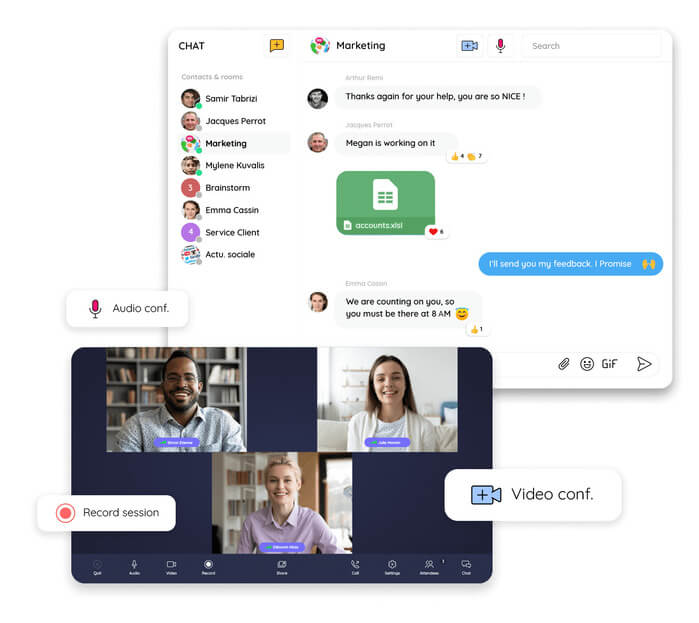
Talkspirit est un système d'exploitation organisationnel qui réunit ce qu'il faut pour développer l'intelligence collective :
- un tchat et de la visioconférence pour les échanges du quotidien,
- des sondages pour recueillir l'avis de tous, y compris de ceux qui ne prennent pas la parole en réunion,
- un module de réunions qui structure l'ordre du jour et garde la trace des décisions,
- un outil de gestion de projet pour organiser le travail,
- un fil d'actualité pour diffuser l'information utile à toute l'organisation.
Pour voir à quoi cela ressemble dans une organisation réelle, lisez le témoignage d'Anne Chabert, qui raconte comment travailler en intelligence collective chez idehō, au Canada.
Les quatre pratiques en un coup d'œil
| Pratique | Ce qu'elle change concrètement | Ce qui la bloque |
|---|---|---|
| PratiqueFavoriser le bon type de collaboration | Ce qu'elle change concrètementDes profils et des façons de raisonner différents se confrontent, au lieu de se répéter | Ce qui la bloqueDes équipes homogènes, recrutées sur le même parcours et le même profil |
| PratiqueLaisser du temps pour le travail individuel | Ce qu'elle change concrètementChacun arrive en réunion avec une idée déjà formée, et la parole se répartit plus également | Ce qui la bloqueUne organisation où tout se décide en réunion, et où seuls les plus à l'aise à l'oral s'expriment |
| PratiqueCréer un sentiment de sécurité psychologique | Ce qu'elle change concrètementLes désaccords et les erreurs se disent, donc se corrigent tôt | Ce qui la bloqueUn management qui sanctionne l'erreur ou ignore les retours qu'il a sollicités |
| PratiqueInvestir dans les bons outils | Ce qu'elle change concrètementLes idées, les décisions et les documents restent accessibles à tous, au même endroit | Ce qui la bloqueDes échanges dispersés entre messagerie, fils privés et fichiers stockés en local |
Avec Talkspirit, vous permettez à vos équipes de donner le meilleur d'elles-mêmes, et de le faire ensemble, en développant l'intelligence collective qui fera passer votre organisation au niveau supérieur.
Envie de voir comment Talkspirit peut vous aider à développer l'intelligence collective ? Planifiez une démo, ou parlez-en avec l'un de nos experts.
FAQ
C'est l'intelligence combinée d'une équipe. Elle apparaît quand chacun apporte ses réflexions, ses idées et son expérience au collectif, jusqu'à ce que la connaissance du groupe dépasse ce que n'importe lequel de ses membres aurait produit seul.
Une étude publiée dans Science en 2010 par des chercheurs du MIT, de Carnegie Mellon et d'Union College, sur deux expériences réunissant 699 personnes en groupes de deux à cinq, met en évidence un facteur général d'intelligence collective, le « facteur c ». Il n'est pas fortement corrélé à l'intelligence individuelle moyenne des membres, mais à leur sensibilité sociale, à l'égalité dans la distribution des tours de parole et à la proportion de femmes dans le groupe. (Voir l'étude.)
Une meilleure pensée critique et une meilleure résolution de problèmes, plus de créativité et d'innovation, et un engagement plus fort. Gallup chiffre l'écart médian entre équipes engagées et équipes désengagées à 14 % de productivité en plus, 23 % de rentabilité en plus et 78 % d'absentéisme en moins.
Parce que la puissance de l'intelligence collective vient de la rencontre de personnes qui pensent et résolvent les problèmes différemment. Des parcours, des expériences et des façons de travailler variés élargissent le champ des solutions envisagées, là où une équipe homogène tourne autour des mêmes réflexes.
Non. Les collaborateurs ont aussi besoin de temps pour réfléchir et traiter l'information seuls avant de partager avec le groupe. Certains peinent à s'exprimer sous pression : un tableau blanc anonyme, une collecte écrite avant la réunion ou une méthode de décision explicite permettent à chacun de contribuer sans passer par la prise de parole en réunion.
En demandant du feedback régulièrement, par des entretiens mensuels ou une enquête trimestrielle ; en écoutant vraiment puis en agissant sur ce qui a été dit ; en incarnant l'authenticité et l'empathie au niveau des dirigeants ; et en construisant une culture où l'erreur est admise et la prise de risque encouragée.


Découvrez des articles similaires

Travailler en intelligence collective avec Anne Chabert, idehō, Canada
Dans cet entretien, Anne Chabert, cofondatrice d’Ideho, partage sa vision d’une transformation fondée sur la clarté organisationnelle, la confiance et la responsabilité partagée. Elle explique comment la clarté, loin d’être une rigidité, permet aux équipes de se repérer, de collaborer avec sens et de renforcer leur intelligence collective.