Collective Intelligence at Work with Anne Chabert, idehō, Canada
.svg)
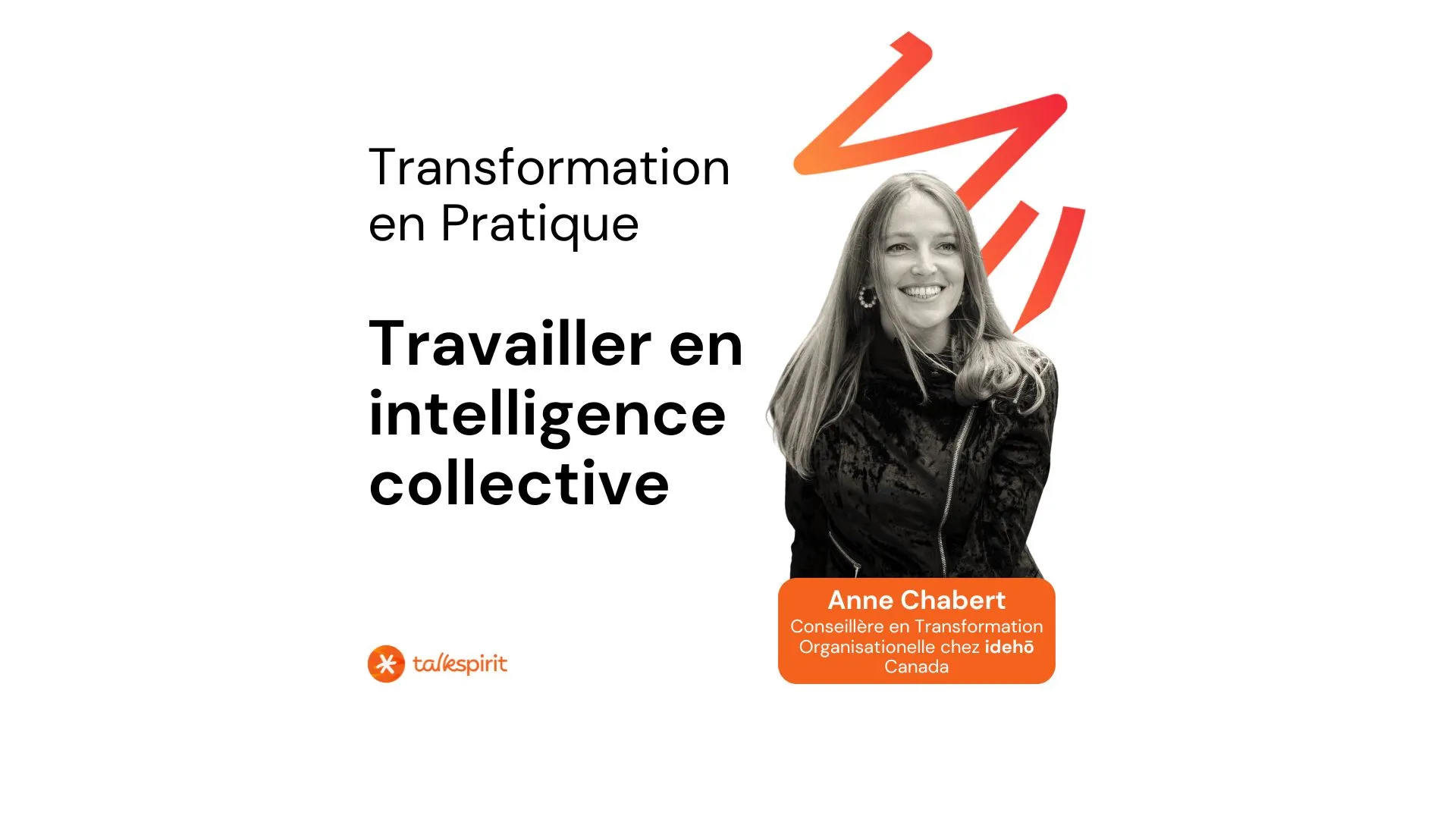
At Talkspirit, we love giving the floor to our partners who support organisations through their most profound transformations. In this new interview, we meet Anne Chabert, a transformation consultant at idehō, based in Montreal.
Anne shares with us the major challenges she observes in organisations today, how idehō supports the transition to alternative management models, and concrete experiences that illustrate the impact of these approaches.
1. Who is Anne Chabert and what is idehō?
Hello, my name is Anne and I am a consultant in organisational transformation at idehō. idehō is a creative collective offering advisory services in alternative management and technology.
Our purpose is to support organisations in implementing alternative practices and technologies to create healthier, more efficient and more engaging work environments. We are based in Montreal and I am very happy to be with you today.
2. What are the main challenges organisations face today?
I would say there are several major challenges. The first is linked to the current economic context, which is difficult and uncertain. Companies must do more with fewer resources. We see budget cuts and strong pressure to continuously adapt to new market demands.
Another more structural challenge concerns the role of managers. In recent years, their position has become increasingly uncomfortable. They are expected to be strategists, coaches, facilitators, guardians of both performance and well-being — all while embodying authority, but in an empathetic and inclusive way. These are sometimes contradictory expectations that create a great deal of tension. In fact, several studies show that people are less and less interested in management positions, especially middle management.
We also see a lot of decision-making bottlenecks at senior leadership level, or entrepreneurs and business owners who initially chose entrepreneurship for greater freedom and find themselves trapped in cumbersome decision-making processes.
Finally, a challenge common to almost every organisation, regardless of size or sector, is the question of organisational clarity. Who is responsible for what? What are the processes? What are the roles? This lack of clarity hinders day-to-day efficiency.
What drives us is knowing that management models and practices exist that can reduce these costly frictions — financially and humanly — and help organisations move beyond the status quo with concrete tools.
3. How do you help organisations transform?
We help them rethink their management models and practices in order to create healthier, more engaging and more efficient work environments.
We have been working with alternative management practices at idehō for more than ten years, and we have chosen to share this knowledge with the market.
We call this alternative management consulting, which characterises any management approach that moves away from the still-dominant standard pyramidal hierarchy.
In practice, this takes several forms:
- When there is a lack of clarity, we work on roles and responsibilities, process documentation and modelling the structure by roles rather than titles.
- On the collaboration side, we help review meeting mechanics, cooperation principles and team efficiency, by introducing practices from alternative models that quickly make a big difference.
- We also work on leadership postures — because leadership is not expressed in the same way in a traditional organisation and in an alternative one.
Finally, we recently launched an educational component: a training programme on alternative management models starting on 16 October in a virtual format. The goal is to help organisations begin their transformation and feed their curiosity.
4. What are the biggest mindset shifts required?
One first trap is believing in the magic solution. Transforming your management model does not make all problems disappear. But it allows you to approach them in a more equipped way.
Next, you need to develop a posture of curiosity, openness and boldness. Alternative models are still in the minority — you have to be willing to explore a path still less travelled.
The shift from a posture of control to a posture of trust is central. It means believing that everyone will do their best for the collective.
Added to this is the posture of humility: accepting that the solution is often found with the person closest to the problem, not the leader.
Finally, it takes courage — the courage to observe yourself as a leader and regularly ask: "Is my behaviour helping or hindering our transformation?"
5. What role does technology play in anchoring new behaviours?
Technology plays a central role, a bit like the nervous system of an organisation. In alternative models, it accelerates transformation, visualises concepts, streamlines exchanges and makes changes concrete and tangible.
We use Talkspirit ourselves and with our clients. It is, in our view, the most complete platform today for supporting the transition to alternative models. Its flexibility allows it to be adapted to each organisation's needs — whether it's clarifying roles, supporting cross-team collaboration, or aligning objectives.
6. A moment that made all of this concrete
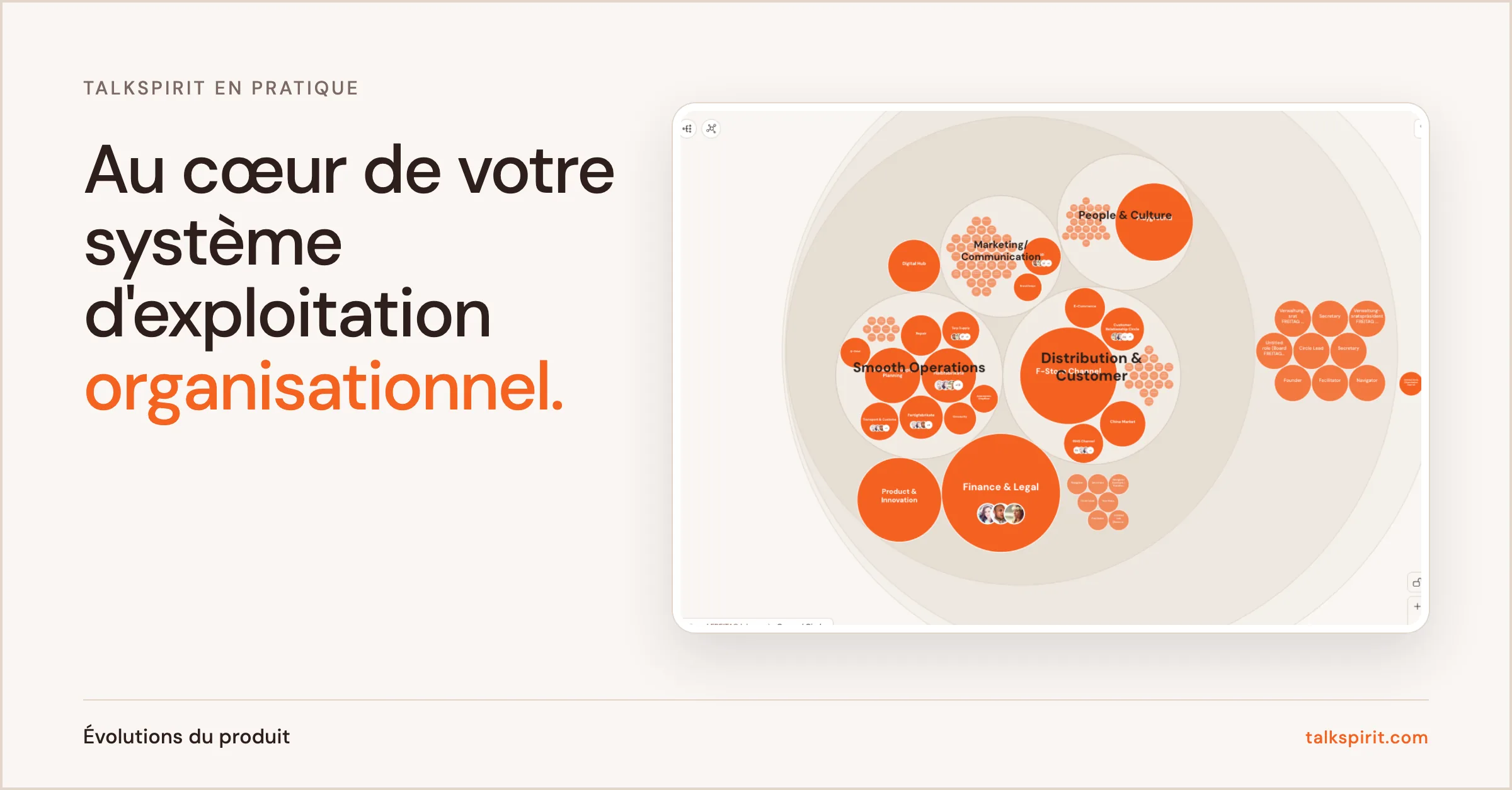
A client with 1,500 people spread across 23 sites in Quebec had a pressing need for clarity on roles and responsibilities. We mapped nearly 950 roles and modelled their structure in roles and circles via Talkspirit.
The effects were immediate:
- overloaded individuals were able to redistribute their roles,
- others discovered they were not in the right role and were able to reposition themselves,
- members of the executive committee gained in legitimacy by distinguishing their strategic and operational roles,
- and overall, everyone now knows who should be involved on a given topic, which eliminates unnecessary meetings and saves time and money.
This is just one example among many, but it shows the power of alternative models.
7. If you could share one piece of advice with leaders, what would it be?
Start with a first small step. It is often the hardest, but also the most decisive. Don't try to transform everything at once. Test it with a small team, or experiment with a simple tool. And don't hesitate to seek support.
8. What questions do you keep asking yourself?
We continue to ask ourselves many questions. One of them is: will these alternative models become the majority in the marketplace? We have a sense that they will, but only time will tell.
We also wonder about the strength of the community. Can it create a genuine movement? We believe so. That is why we organise training programmes and events — such as the one planned in Montreal on 11 November — to connect organisations and nurture this collective dynamic.
Closing thoughts
For Anne Chabert, transformation begins with a first small step. Clarifying roles, reviewing meetings, experimenting with a practice from alternative models — all are simple gestures that set a lasting dynamic in motion.
With idehō, she brings her experience of alternative practices to Quebec and Canadian organisations, convinced that clarity, trust and courage are the essential ingredients for building healthier, more efficient and more engaging work environments.